Food security, PDS and buffer stocks
- Syllabus
- PDS, buffer stocks and food security
- As of
- October 2026
- entitlement approach
- National Food Security Act 2013
- priority households
- Antyodaya Anna Yojana
- central issue price
- PMGKAY
- economic cost
- decentralised procurement
- buffer stock norms
- open market sale scheme
- One Nation One Ration Card
- leakage
- Shanta Kumar Committee
- fortified rice
The first principle
People go hungry not only when food is scarce but when they cannot command it. Amartya Sen's entitlement approach (1981) showed that the Bengal famine of 1943 happened while grain existed, because wages and prices moved against the poor. Food security therefore needs enough grain in the country, which procurement and buffer stocks secure, and the power of every household to obtain it, which the public distribution system (PDS) and a legal right to food secure. Every issue in this note is a cost or a leak in joining the two.
The core
What food security means
- The standard definition comes from the World Food Summit of 1996: food security exists when all people, at all times, have physical and economic access to sufficient, safe and nutritious food. Its four pillars are availability, access, utilisation (the body's use of food) and stability over time.
- India built availability first. The Food Corporation of India (FCI) was set up in 1965 under the Food Corporations Act 1964 to buy grain at a support price, hold stocks and supply the PDS.
From rationing to a legal right
- The PDS began as wartime rationing in the 1940s and stayed open to all until the Targeted PDS of 1997 split households by the poverty line; the Antyodaya Anna Yojana (AAY) was added in December 2000 for the poorest.
- The National Food Security Act (NFSA) 2013 turned a scheme into a right. It covers up to 75 per cent of the rural and 50 per cent of the urban population, giving a priority household 5 kg of grain per person per month and an AAY household 35 kg, at central issue prices (CIP) of Rs 3, Rs 2 and Rs 1 per kg for rice, wheat and coarse grains. It also gives a maternity benefit of at least Rs 6,000, meals for children through the Integrated Child Development Services (ICDS) and schools, and a food security allowance if grain is not supplied, and it makes the eldest woman of at least 18 years the head of the household for the ration card.
- The Pradhan Mantri Garib Kalyan Anna Yojana (PMGKAY) began in April 2020 as extra pandemic grain; from 1 January 2023 the NFSA grain itself became free under it, and in November 2023 the Cabinet extended free grain for five years from 1 January 2024 at an estimated cost of about Rs 11.8 lakh crore. The CIP is now zero.
Worked example: what one kilogram of free rice costs
- The economic cost is what FCI spends to bring a kilogram of grain to the point of issue. It is the acquisition cost, which is the pooled cost of grain (the minimum support price paid, converted to rice) plus procurement incidentals such as mandi charges, levies, gunny bags and labour, plus the distribution cost of freight, handling, storage and interest.
- The numbers. The economic cost of rice was about Rs 40.4 per kg in 2024-25 (revised estimate), against Rs 28.5 for wheat (PRS, 2026). Most of it is the acquisition cost, so every rise in the MSP raises the cost of the PDS.
- Subsidy per kg = economic cost − central issue price. With the CIP at zero, a priority household of five drawing 25 kg of rice a month receives 25 × Rs 40.4 = Rs 1,010 of subsidy every month. Under the old CIP of Rs 3 the family paid Rs 75 a month and the subsidy was 25 × (40.4 − 3) = Rs 935, so free grain added little to the subsidy per family.
Dimensions
- Economic. Open ended procurement of rice and wheat at the minimum support price (MSP) pulls land and water away from pulses and oilseeds, and the subsidy, budgeted at Rs 2,27,429 crore under PMGKAY in 2026-27, is about 0.6 per cent of gross domestic product (PRS, 2026).
- Nutritional. Calories are not nutrition. The National Family Health Survey (NFHS) 5 of 2019-21 found 35.5 per cent of children under five stunted, 19.3 per cent wasted and 32.1 per cent underweight, and 57 per cent of women anaemic, which is why the PDS now distributes rice fortified with iron, folic acid and vitamin B12, approved until December 2028 at about Rs 17,082 crore.
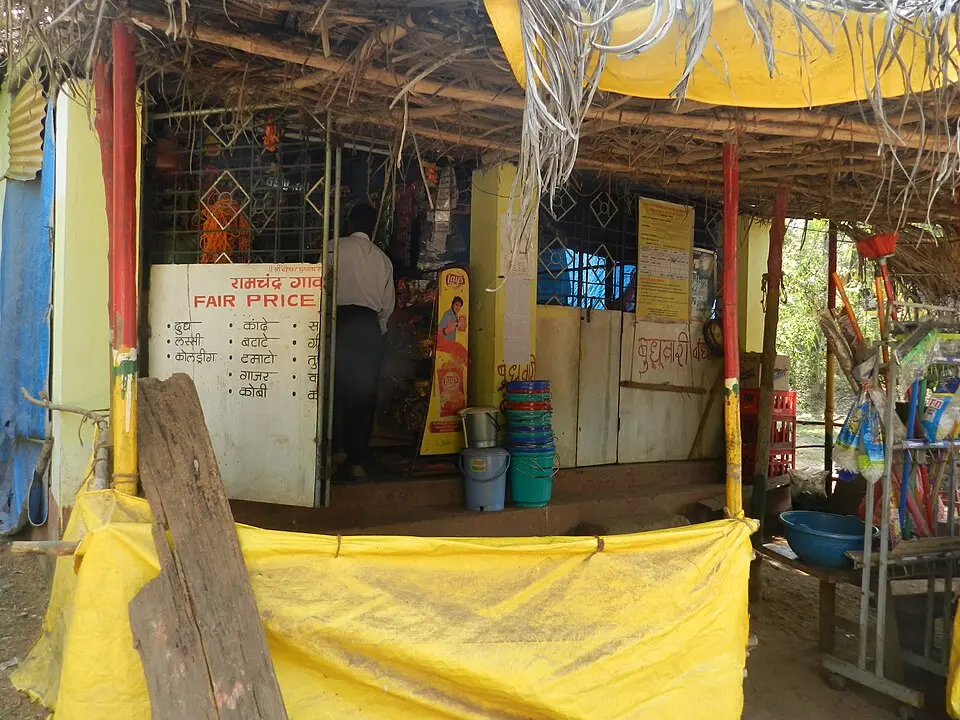
- Federal. The Centre sets entitlements, buys and moves grain, while States identify households and run fair price shops, sharing with the Centre the cost of delivery inside the State; decentralised procurement (DCP), begun in 1997-98, lets States buy and distribute grain themselves, and it covered about 65 per cent of wheat and rice procurement in 2024-25 (PRS, 2026).
- Legal. In People's Union for Civil Liberties (PUCL) v Union of India, from 2001, the Supreme Court read the right to food into the right to life under Article 21 and turned school meals and child nutrition schemes into entitlements; in 2021 it directed all States to implement One Nation One Ration Card for migrant workers.
- Environmental. Paddy procurement in Punjab and Haryana rewards a water hungry crop where water tables are falling, as the water resources note explains.
In practice
- Coverage. At 67 per cent of the Census 2011 population the NFSA ceiling is about 81.35 crore persons, and States had identified 80.6 crore by August 2025; in January 2026 there were 2.3 crore AAY and 18.3 crore priority households (PRS, 2026). Resting on the 2011 population, the ceiling is now under three fifths of a population estimated at over 140 crore.
- Reforms of delivery. Computerisation, ration cards seeded with Aadhaar (99 per cent by December 2025) and electronic point of sale (ePoS) machines that authenticate each sale led to the deletion of about 6.77 crore cards by December 2025. One Nation One Ration Card, piloted in August 2019 and enabled in all 36 States and Union Territories by February 2025, lets a card holder draw grain from any fair price shop, though in December 2025 only 0.5 per cent of ePoS sales were across States (PRS, 2026).
- Leakage has fallen but is disputed. A study by the Indian Council for Research on International Economic Relations (ICRIER) estimated that 47 per cent of grain lifted did not reach households in 2011-12, and a later ICRIER study put it at 28 per cent in 2022-23, a figure the Department of Food and Public Distribution disputes.
- Buffer stock norms are the minimum stocks the central pool must hold on four dates, fixed in January 2015 to cover the operational needs of the PDS and other welfare schemes plus a strategic reserve: 210.40 lakh tonnes on 1 April, 411.20 on 1 July, 307.70 on 1 October and 214.10 on 1 January (Department of Food and Public Distribution). They are highest on 1 July because the wheat harvest has just been bought.
- Stocks far above the norms. On 1 April 2025 the central pool held 382 lakh tonnes of rice and 118 lakh tonnes of wheat against norms of 135.8 and 74.6, which is 2.4 times the combined norm (PRS, 2026). Valued at the 2024-25 economic cost of Rs 40.4 per kg for rice and Rs 28.5 for wheat, the 289.6 lakh tonnes above the norm tied up about Rs 1.1 lakh crore, on which FCI pays storage, interest and losses. On 1 January 2026 wheat stocks were still about twice the norm and rice stocks about four times (PRS, 2026).
- Shanta Kumar Committee (2015). The High Level Committee on restructuring FCI found that only about 6 per cent of farmers sold to procurement agencies, and recommended handing procurement in surplus States to State agencies, moving FCI to the eastern States, cutting NFSA coverage to about 40 per cent and moving gradually to cash transfers.

Issues and way forward
- Excess stocks. Open ended procurement keeps stocks two to four times the norm, so grain ages in hired godowns; a rule that triggers sales under the open market sale scheme (OMSS) or exports once stocks cross the norm, as the Shanta Kumar Committee proposed, would cut the carrying cost.
- Storage gaps. FCI owns only 154 lakh tonnes of capacity and hires 327 lakh tonnes (PRS, December 2025), so modern silos built through public private partnership are the remedy.
- Exclusion with a frozen base. A ceiling fixed on Census 2011 leaves out families that need grain, while inclusion errors persist; fresh identification after the next Census and electronic know your customer (eKYC) checks (86 per cent done by October 2025) address both.
- A cereal bias. The basket is rice and wheat while malnutrition needs pulses, oils and vegetables; adding millets and pulses where they are grown would make the right to food a right to nutrition.
- Cash or kind. Cash transfers in lieu of grain, piloted in Chandigarh, Puducherry and Dadra and Nagar Haveli from 2015, save storage and movement but expose households to food inflation, so the choice should rest with States and households.
Common confusions
- Buffer stock and operational stock. The norm includes both the operational stock that runs the PDS and the strategic reserve for bad years; the two are held together and cannot be told apart physically.
- MSP and CIP. The MSP is what the government pays the farmer, while the CIP is what the ration card holder pays the State; the gap between economic cost and CIP is the food subsidy.
- NFSA and PMGKAY. The NFSA is a law that sets the entitlement, while PMGKAY is the scheme name under which that same entitlement is now given free.
- Food security and nutrition security. A full ration of cereals can meet calorie needs while a child remains stunted, because nutrition also needs protein, micronutrients, clean water and care.
For the exam
- Keyword bank: entitlement approach, four pillars of food security, National Food Security Act 2013, priority households, Antyodaya Anna Yojana, central issue price, economic cost, food subsidy, decentralised procurement, buffer stock norms, open market sale scheme, One Nation One Ration Card, ePoS and Aadhaar seeding, leakage, fortified rice.
- Previous year questions: Practise the previous year questions on this topic →
- Use in an answer:
- Introduction with data: India gives free grain to about 80.6 crore people under the National Food Security Act, yet on 1 April 2025 its central pool held 2.4 times the buffer norm while 35.5 per cent of children under five were stunted (PRS, 2026; NFHS-5).
- Introduction with a source: The Supreme Court read the right to food into Article 21 in PUCL v Union of India, and the National Food Security Act 2013 made it law for two thirds of the people.
- Conclusion: India has solved the availability half of food security; the next step is to hold leaner stocks, plug the remaining leaks and widen the basket from calories to nutrition.
- Conclusion: Technology, portability and decentralised procurement can deliver the right to food at lower cost, if procurement stops rewarding only rice and wheat.