Foreign trade and trade policy
- Syllabus
- Effects of liberalisation on the economy, changes in industrial policy and their effects on industrial growth
- As of
- October 2026
- comparative advantage
- trade deficit
- effective rate of protection
- inverted duty structure
- Foreign Trade Policy 2023
- RoDTEP
- export promotion
- free trade agreement
- CEPA
- rules of origin
- most favoured nation
- national treatment
- WTO dispute settlement
- reciprocal tariffs
- non tariff barriers
The first principle
A country gains from trade when it exports what it makes at a lower opportunity cost and imports the rest, even if it is not the cheapest producer of anything; this is comparative advantage. Trade policy decides how far a country lets that logic work, using tariffs, subsidies and agreements to protect some producers, help others export and secure markets abroad. Every tariff protects one group at the cost of another, usually the consumer or the downstream producer, and good trade policy keeps that cost visible.
The core
What a tariff really protects
- Nominal and effective protection. The tariff printed on a product is its nominal protection. What matters to a producer is protection of its value added, because it also pays duties on its inputs. The effective rate of protection is (value added at domestic prices − value added at world prices) ÷ value added at world prices.
- A worked example. A shirt sells for 100 on the world market and uses fabric worth 60, so value added at world prices is 40. With a 20 per cent duty on shirts and 5 per cent on fabric, the shirt sells at home for 120 and the fabric costs 63, so domestic value added is 57 and effective protection is (57 − 40) ÷ 40 = 42.5 per cent, more than double the nominal 20 per cent. If instead fabric carries 25 per cent and shirts 10 per cent, domestic value added is 110 − 75 = 35, and effective protection is −12.5 per cent: the tariff structure taxes the shirt maker.
- Why it matters for India. This inverted duty structure, with higher duties on inputs than on finished goods, has hurt Indian makers of electronics, textiles and machinery for years, and correcting it is a recurring theme of Union Budgets.
The instruments
- Tariffs and non tariff barriers. Customs duties are the visible tool, while standards, licences, quotas and quality control orders work as non tariff barriers, which now restrict more trade than tariffs do.
- Trade remedies. Anti dumping duties counter imports sold below normal value, countervailing duties offset foreign subsidies, and safeguard duties give temporary relief from a surge in imports; in India the Directorate General of Trade Remedies investigates and the Finance Ministry imposes them.
- Export promotion. Exports should carry no domestic taxes, because a country exports goods, not taxes. India refunds embedded taxes through Remission of Duties and Taxes on Export Products (RoDTEP, 2021), lets exporters import inputs duty free under Advance Authorisation and machinery at concessional duty under Export Promotion Capital Goods, and offers special economic zones and export oriented units.
- Agreements. Trade agreements cut tariffs between members while each keeps its own tariffs against others, so rules of origin decide which goods qualify and prevent third countries from routing goods through a partner.
World Trade Organization (WTO) rules that matter
- Most favoured nation and national treatment. A member must give all members the best tariff it gives any, and must treat imports like domestic goods once they cross the border. Free trade agreements are allowed as an exception under Article XXIV of the General Agreement on Tariffs and Trade, and developing countries may trade preferences under the Enabling Clause.
- Subsidies. The Agreement on Subsidies and Countervailing Measures prohibits subsidies tied to export performance. In 2019 a WTO panel ruled against India's Merchandise Exports from India Scheme and export incentives for special economic zones, which is why India replaced the scheme with RoDTEP, a tax refund rather than a reward. India's appeal lies unheard because the Appellate Body has not functioned since December 2019.
- Agriculture and intellectual property. The Agreement on Agriculture limits trade distorting farm support, and the Agreement on Trade Related Aspects of Intellectual Property Rights sets patent rules for medicines; both shape Indian food and drug policy and are covered in the farm subsidy and intellectual property notes.
Dimensions
- Growth. East Asian economies grew by exporting manufactures to the world, and India's export share in goods is still under 2 per cent of the world total while its share in services is above 4 per cent (WTO), so the gap is in goods.
- Employment. Labour intensive exports such as garments, leather, footwear and toys employ millions of low skilled workers, and they are the sectors most hurt by tariffs abroad and inverted duties at home.
- Strategic. Dependence on a single source for active pharmaceutical ingredients, solar modules or electronics components is a security risk, which is why trade policy now talks of resilient supply chains.
- Consumer welfare. High tariffs raise prices for consumers and for downstream firms, so protection that is not temporary becomes a tax on the rest of the economy.
- Regional. Exports are concentrated in a few coastal States, which district export hubs try to change.
In practice
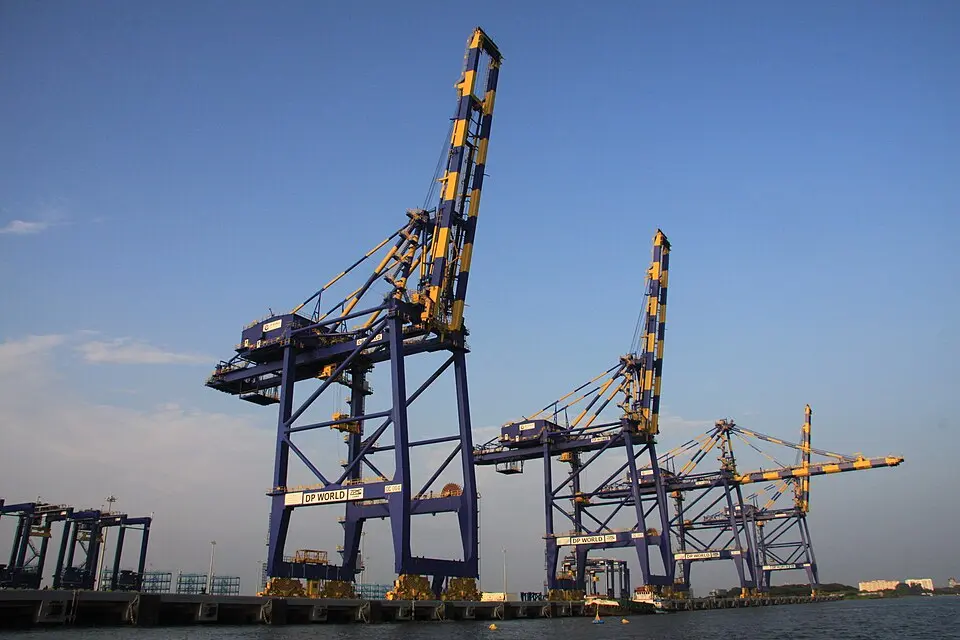
India's trade pattern
- The numbers. In 2025-26 India exported goods worth US$441.8 billion and imported goods worth US$775.0 billion, a goods deficit of US$333.2 billion. Services exports were an estimated US$418.3 billion against imports of US$204.4 billion, and total exports of goods and services reached about US$860 billion (Department of Commerce, 15 April 2026).
- What and where. India's main exports are engineering goods, petroleum products, electronics led by smartphones, pharmaceuticals, gems and jewellery, and software and business services. Its main imports are crude oil, electronics, gold, coal and machinery. The United States is the largest single export market, while China is the largest source of imports, with a deficit of about US$99 billion in 2024-25.

Policy and agreements
- Foreign Trade Policy 2023. In force from 1 April 2023 with no end date, it shifts from incentives to tax remission and facilitation, aims at exports of US$2 trillion by 2030, names towns of export excellence, promotes districts as export hubs and exports through online commerce, and allows trade settlement in rupees. The Export Promotion Mission approved in November 2025 brings export credit and market access support under one scheme.
- Agreements in force. The Comprehensive Economic Partnership Agreement (CEPA) with the United Arab Emirates took effect in May 2022 and the Economic Cooperation and Trade Agreement with Australia in December 2022. The Trade and Economic Partnership Agreement with the European Free Trade Association (EFTA), made up of Switzerland, Norway, Iceland and Liechtenstein, signed in March 2024 and in force from October 2025, carries a commitment by EFTA to aim for US$100 billion of investment in India over fifteen years. The Comprehensive Economic and Trade Agreement (CETA) with the United Kingdom (UK), signed on 24 July 2025, came into force on 15 July 2026.
- Agreements signed or concluded. India signed a CEPA with Oman on 18 December 2025, concluded negotiations with the European Union (EU) on 27 January 2026 and signed a free trade agreement with New Zealand on 27 April 2026. India left the Regional Comprehensive Economic Partnership negotiations in 2019, mainly over the fear of a surge of imports from China.
- United States tariffs. In August 2025 the United States imposed a 25 per cent reciprocal tariff on most Indian goods and then a further 25 per cent penalty linked to India's purchases of Russian oil, taking the total to 50 per cent, while sparing pharmaceuticals, smartphones and energy. In February 2026 the two countries announced a framework for an interim deal that would lower the rate to 18 per cent, and on 20 February 2026 the United States Supreme Court ruled that the emergency powers law used for the reciprocal tariffs does not authorise the President to impose tariffs. Duties under other United States trade laws, such as those on steel and aluminium, continue, and the interim agreement had not been signed when the RBI Annual Report appeared in May 2026.
Issues and way forward
- A persistent goods deficit. India imports energy, gold and electronics and exports too few manufactures. Correcting inverted duties, cheaper logistics and power, and scale through production linked incentives address the cause rather than the symptom.
- Low use of agreements. Indian exporters use a small share of the preferences in existing agreements because rules of origin are complex and awareness is low. Simple rules, digital certificates of origin and help desks in export councils raise use.
- Rising tariffs at home. Customs duties were raised on many goods from 2018, and quality control orders restrict imports of inputs; low, uniform duties on inputs would make Indian makers competitive.
- Exposure to one market. The 2025 tariffs showed how quickly access to the largest market can change. Diversifying through the UK, EFTA, Oman, New Zealand and EU agreements spreads that risk.
- A weakened WTO. Without a working Appellate Body disputes cannot be finally settled. India gains from a rules based system and should help restore it while defending food security and policy space.
Common confusions
- Balance of trade and balance of payments. The balance of trade is exports minus imports; the balance of payments records all transactions with the world, including capital flows and reserves.
- Free trade agreement and CEPA. A free trade agreement mainly cuts tariffs on goods, while a comprehensive agreement also covers services, investment, standards and rules; the names vary, but the content decides.
- Anti dumping and countervailing duty. Anti dumping duty targets a firm selling below normal value, while countervailing duty targets a foreign government's subsidy.
- Nominal and effective protection. Nominal protection is the duty on the product; effective protection is the protection of value added after duties on inputs.
For the exam
- Keyword bank: comparative advantage, effective rate of protection, inverted duty structure, export of goods not taxes, RoDTEP, rules of origin, most favoured nation, national treatment, Article XXIV, trade remedies, non tariff barriers, Foreign Trade Policy 2023, CEPA, supply chain resilience, Appellate Body impasse.
- Previous year questions: Practise the previous year questions on this topic →
- Use in an answer:
- Introduction with data: India exported goods and services worth about US$860 billion in 2025-26, but a goods deficit of US$333 billion shows that its strength lies in services (Department of Commerce, April 2026).
- Introduction with a law or ruling: The WTO panel ruling of 2019 against India's export subsidy schemes pushed India from rewarding exports to refunding taxes, the logic of the Foreign Trade Policy 2023.
- Conclusion: Trade agreements open doors, but Indian exporters will walk through them only if inputs are cheap, logistics are efficient and duties are not inverted.
- Conclusion: Spreading exports across many markets through new agreements is India's best insurance against sudden tariffs in any one of them.