Renewable energy technologies
- Syllabus
- Developments in science and technology and their applications and effects in everyday life
- As of
- October 2026
- photovoltaic effect
- band gap
- p–n junction
- capacity utilisation factor
- Betz limit
- swept area
- small hydro
- geothermal gradient
- non fossil capacity
- grid inertia
- variability
- Green Energy Corridor
- Shockley–Queisser limit
- Approved List of Models and Manufacturers
- International Solar Alliance
The first principle
Energy cannot be created, only converted, so every renewable technology is a converter: a solar cell turns the energy of light into electric current, a wind turbine turns the motion of air into the rotation of a generator, and a hydro or geothermal plant turns falling water or the earth's heat into the same rotation. The fuel is free and never runs out, but it arrives when the weather and the geography allow rather than when people switch on their lights. That single fact, a free but variable source, explains both why renewables are now the cheapest new power in India and why the grid has to be rebuilt around them.
The core
Solar photovoltaics
- The photovoltaic effect needs a junction. A solar cell is a thin wafer of silicon in which one layer is doped to carry extra electrons (n type) and the next to carry holes (p type); where they meet, a p–n junction forms with a built in electric field. Light arrives as photons, and a photon whose energy is above silicon's band gap of about 1.1 electron volts frees an electron and leaves a hole, which the field then pushes in opposite directions, so a direct current flows through an outside circuit.
- The band gap sets the limit. A photon with less energy than the gap passes through unused, and a photon with more energy wastes the excess as heat, so a single junction cell cannot convert more than about a third of sunlight, the Shockley–Queisser limit. Commercial modules convert a little over a fifth, and tandem cells that stack a perovskite layer over silicon catch more of the spectrum and have passed 33 per cent in the laboratory, though they are not yet durable outdoors.
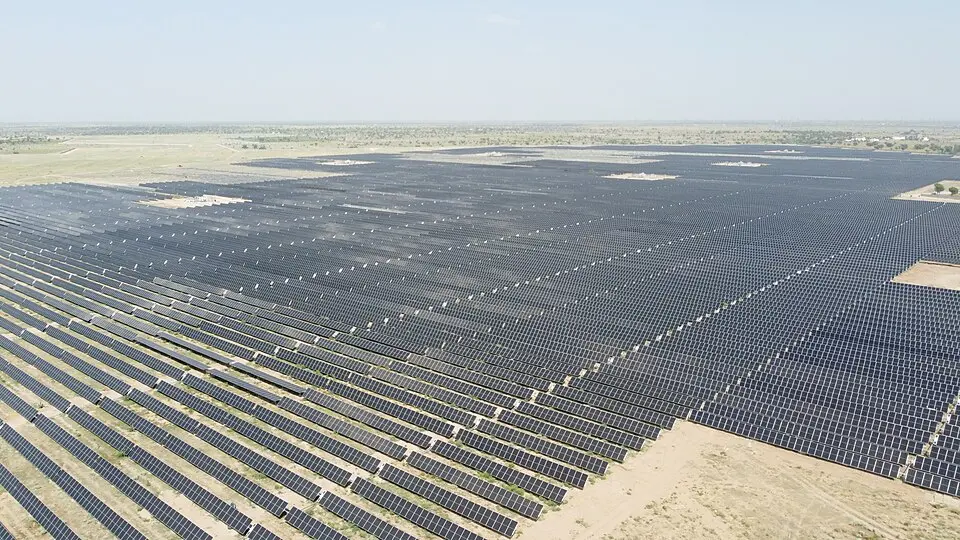
- From cell to grid. An inverter turns their direct current into the 50 hertz alternating current of the grid. Because the sun sets and clouds pass, a solar plant in India produces about a fifth of what its rating suggests over a year, which is why its capacity utilisation factor (CUF), actual output divided by output at full rating all year, is around 18 to 20 per cent.
Wind, small hydro and geothermal
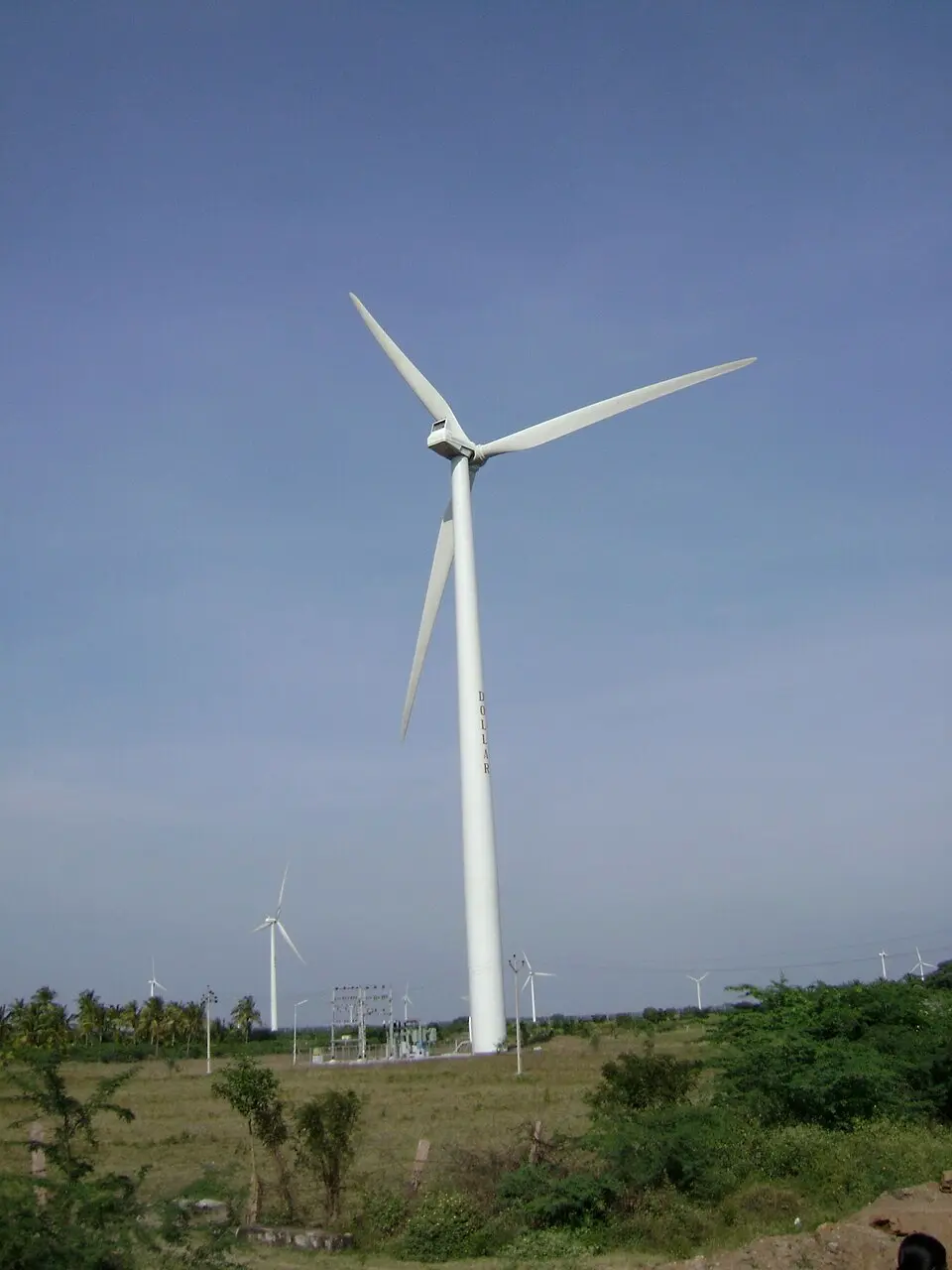
- Wind power rises with the cube of wind speed. The power in wind crossing a rotor is half the air density times the swept area times the cube of the speed, so doubling the wind speed gives eight times the power, and a longer blade, which sweeps a larger circle, gains with the square of its length. A turbine cannot take all of it, because the air must keep moving away, and the Betz limit caps the share at 16/27, about 59 per cent; good turbines reach a little under 50 per cent at their best speed.
- Blades work like wings. Air flowing over the curved blade produces lift that turns the rotor and the generator behind it. Taller towers reach steadier, faster wind, which is why the National Institute of Wind Energy assesses India's onshore potential at about 696 gigawatts (GW) at 120 metres and about 1,164 GW at 150 metres.
- Small hydro uses height and flow. The power of falling water is its density times gravity times the flow times the head, the height it falls, times the efficiency of the turbine, so a mountain stream with a high head can run a turbine with little water. In India a hydro project up to 25 megawatts (MW) is counted as small hydro and handled by the Ministry of New and Renewable Energy (MNRE), while larger projects belong to the Ministry of Power; its estimated potential is about 21 GW, mostly in the Himalayan States.
- Geothermal taps the earth's heat. Temperature rises with depth, and near plate boundaries or hot spots hot water and steam lie close enough to drill, so a well brings them up to spin a turbine or to heat buildings directly. Unlike solar and wind it runs day and night with a CUF above 80 per cent, but it works only where the heat is shallow; the Geological Survey of India has mapped 381 hot springs in 10 geothermal provinces with a theoretical potential of about 10.6 GW, and India generates no commercial geothermal power yet.
Dimensions
- Environmental. Solar and wind emit no carbon dioxide while running, and their lifetime emissions are a small fraction of coal's; land for large parks, bird deaths at turbines and the waste of old panels are the real costs, the last now covered by the E-Waste (Management) Rules, 2022.
- Economic. Auctions have pushed solar tariffs to among the lowest in the world, so new renewable power undercuts new coal; the power sector, distribution companies and energy security as economics are in the Economy note on the energy sector.
- Technical. A coal or hydro turbine is a heavy spinning mass whose inertia resists sudden changes in grid frequency, while solar and wind connect through inverters and give none, so a grid with much renewable power needs grid forming inverters, fast storage and good forecasting to stay near 50 hertz.
- Strategic. Sunlight cannot be blockaded, but the manufacturing chain can: polysilicon, wafers and most cells come from China, so a country that imports its modules has swapped dependence on fuel for dependence on equipment.
- International. The International Solar Alliance (ISA), launched by India and France at Paris in 2015 and based at Gurugram, is the first treaty based intergovernmental organisation headquartered in India.
In practice
- Capacity. India's installed non fossil capacity reached 300.5 GW on 31 July 2026: solar about 164.6 GW, wind about 58.1 GW, hydro (large and small) about 57.2 GW, bioenergy about 11.8 GW and nuclear about 8.8 GW. That is more than 54 per cent of the country's total installed capacity of about 552 GW, though coal still generates most of the electricity because its plants run far more hours.
- Targets. India's updated Nationally Determined Contribution of 2022 promised that half of installed electricity capacity would be non fossil by 2030, a share India crossed in 2025, and the national goal announced at Glasgow in 2021 is 500 GW of non fossil capacity by 2030.
- Solar schemes. The National Solar Mission of 2010 aimed at 20 GW by 2022 and was raised to 100 GW in 2015; the solar parks scheme of 2014 gives developers land and transmission ready made, and Bhadla in Rajasthan is among the largest parks; and PM Surya Ghar Muft Bijli Yojana, approved in February 2024 at about Rs 75,000 crore, aims at rooftop panels on one crore homes with up to 300 free units a month.
- Making it at home. The Approved List of Models and Manufacturers (ALMM) restricts government backed projects to listed modules, and from 2026 to listed cells; the production linked incentive (PLI) for high efficiency modules carries Rs 24,000 crore; and basic customs duty of 40 per cent on modules and 25 per cent on cells has applied since April 2022.
- Wind and geothermal. Gujarat and Tamil Nadu lead onshore wind, and a viability gap funding scheme of about Rs 7,453 crore, approved in June 2024, supports the first 1 GW offshore, off those two coasts. The National Policy on Geothermal Energy was notified in September 2025, and the Oil and Natural Gas Corporation (ONGC) Energy Centre drilled the first two wells at Puga in Ladakh in July 2026 for a 1 MW demonstration plant.
- Transmission. The Green Energy Corridor builds lines from the sunny and windy States to the rest of the grid.


Issues and way forward
- Variability and the evening peak. Solar peaks at noon while demand peaks after sunset, so cheap daytime power is wasted unless it is stored or shifted; battery storage, pumped hydro, wind solar hybrids and time of day tariffs are the answers, and storage technology is in the batteries note.
- Curtailment and lines. Plants in Rajasthan and Gujarat are built in two years while a transmission line takes four or five, so power is sometimes switched off for want of wires; planning lines ahead of plants, as the Central Electricity Authority's transmission plans now do, is the fix.
- Import dependence. Module making has grown fast, but cells, wafers and polysilicon lag, so the ALMM for cells and incentives further up the chain aim to move manufacturing backwards link by link.
- Land and local consent. Large parks need thousands of hectares and can clash with grazing and wildlife, as with the great Indian bustard in Rajasthan; agrivoltaics, floating solar on reservoirs, canal top panels and rooftops use land twice over.
Common confusions
- Capacity and generation. Capacity is the rating of a plant in gigawatts, while generation is the energy it actually delivers in a year in units (kilowatt hours), so a solar gigawatt yields far less energy than a coal gigawatt.
- Renewable and non fossil. Renewable capacity counts solar, wind, bioenergy and hydro, while non fossil capacity also adds nuclear, which is not renewable but emits no carbon dioxide while running.
- Small and large hydro. The line is 25 MW: small hydro sits with MNRE, large hydro with the Ministry of Power, and large hydro has been counted as renewable since 2019.
- Photovoltaic and solar thermal. A photovoltaic cell turns light directly into current with no moving parts, while solar thermal turns sunlight into heat that then drives a turbine or warms water.
For the exam
- Keyword bank: photovoltaic effect, band gap, p–n junction, Shockley–Queisser limit, capacity utilisation factor, cube law of wind power, Betz limit, head and flow, geothermal gradient, grid inertia, curtailment, Green Energy Corridor, Approved List of Models and Manufacturers, non fossil capacity, International Solar Alliance.
- Previous year questions: Practise the previous year questions on this topic →
- Use in an answer:
- Introduction with data: India's installed non fossil capacity crossed 300 GW in July 2026, more than half of its total installed capacity of about 552 GW, with solar alone at about 165 GW (MNRE, 2026).
- Introduction with a source: In its updated Nationally Determined Contribution of 2022, India committed to drawing half of its installed power capacity from non fossil sources by 2030, a goal it reached five years early.
- Conclusion: India has solved the problem of building cheap renewable capacity; the next decade's task is to store it, move it and make its equipment at home.
- Conclusion: Because sunlight and wind are free but variable, the measure of success is no longer gigawatts installed but clean power delivered at seven in the evening.