
First Principles IAS · Current affairs
The monthly magazine, October 2026 · Science and Technology › Launch vehicles, satellites and applications
Printed on · firstprinciplesias.com/current-affairs
NVS-03 reaches orbit on GSLV-F18 and gives NavIC its fourth satellite, the minimum for a position fix
LeadPrelims and Mains31 Oct 2026
Why in news
- In October 2026 the Geosynchronous Satellite Launch Vehicle, on flight GSLV-F18, carried the NVS-03 navigation satellite from Sriharikota into its intended geosynchronous transfer orbit.
- The launch takes NavIC back to its minimum operating configuration of four working satellites. Since July 2026 the system had only three, and three cannot give a position fix of their own.
Background
- NavIC, Navigation with Indian Constellation, is ISRO's regional satellite navigation system. NavIC gives a position over India and about 1,500 km beyond its borders, and a timing service.
- India felt the need after the Kargil conflict of 1999, when the country could not count on access to foreign navigation signals.
- The design has seven satellites: three in geostationary orbit over the equator and four in inclined geosynchronous orbits, which trace a figure of eight over the Indian Ocean region each day.
- ISRO named the first generation IRNSS, the Indian Regional Navigation Satellite System.
- Every navigation satellite carries atomic clocks. A receiver finds its position by timing the signals from several satellites at once, which is why the clocks must agree to a few billionths of a second.
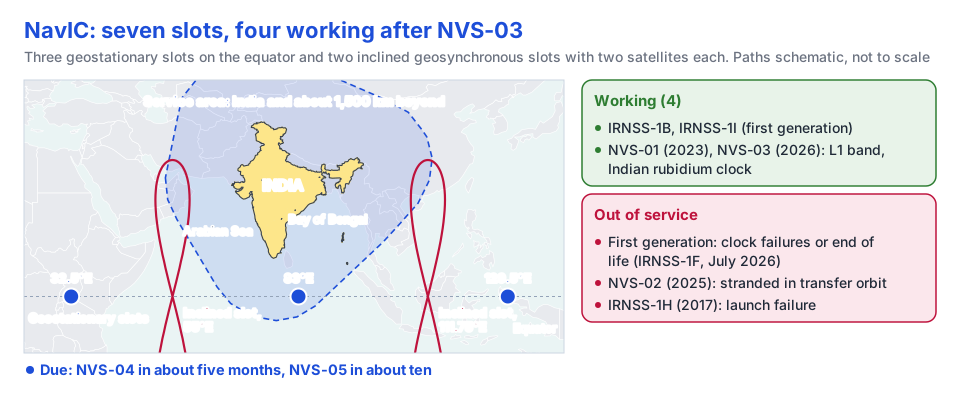
How the constellation thinned
The first generation carried imported rubidium atomic clocks, and they began to fail in 2016.
Why three satellites give no fix
- A cheap receiver clock is not exact, and the fourth satellite supplies the extra measurement that corrects the receiver's clock error.
- With three satellites NavIC could only supply timing and augment the Global Positioning System.
What is new in NVS-03
| First generation IRNSS | NVS series | |
|---|---|---|
| Atomic clock | Imported rubidium clocks, which failed early | At least one indigenous rubidium clock from ISRO's Space Applications Centre |
| Bands | L5 and S | L5, S and the L1 band that phone chips already receive |
| Launcher | PSLV | GSLV, with the indigenous cryogenic upper stage |
| Life and status | Ten years. Most are now out of service | NVS-01 and NVS-03 working, NVS-02 stranded |
- With L1, the band that GPS uses, NavIC can reach ordinary handsets and work alongside GPS.
- To avoid the fault that stranded NVS-02, ISRO flew NVS-03 with its three pyro valves already open. A national committee cleared the step after ground tests.
Analysis
Clocks were the weak link.
- The imported rubidium clocks failed early
- The indigenous clock on the NVS series is the fix that matters most for the long run
Four is a floor, not a target.
- With four satellites a receiver gets a fix only when all four are in view
- Full service needs all seven slots filled
- NVS-04 and NVS-05 matter as much as NVS-03
Navigation is critical infrastructure.
- Banks, grids and telecom networks take their time from satellite clocks
- The armed forces need a signal no other country can switch off
The way forward
Get phone makers to build NavIC L1 support into handsets sold in India, so that a civilian user base exists when full service returns.
Exam lens
- Prelims:
- NavIC: seven satellites, three geostationary and four inclined geosynchronous, covering India and about 1,500 km beyond
- Four satellites in view are the minimum for a position fix. Three can only give timing
- NVS series: indigenous rubidium atomic clock from the Space Applications Centre, and the L1 band
- NVS-03 launched on GSLV-F18 from Sriharikota in October 2026
- Mains: India's regional navigation system lost its ability to fix a position before its replacements flew. Explain how NavIC works, why the constellation thinned, and what the NVS series restores.
Asked before: Prelims 2023 · Prelims 2018 · Mains 2018 GS1
Show the questions
- Prelims 2023: Which one of the following countries has its own Satellite Navigation System?
- Prelims 2018: With reference to the Indian Regional Navigation Satellite System (IRNSS), consider the following statements : 1. IRNSS has three satellites in geostationary and four satellites in geosynchronous orbits. 2. IRNSS covers entire India and about 5500 sq. km beyond its borders. 3. India will have its own satellite navigation system with full global coverage by the middle of 2019. Which of the statements given above is/are correct ?
- Mains 2018 GS1: Why is Indian Regional Navigational Satellite System (IRNSS) needed? How does it help in navigation?
Connects to
- NavIC: three satellites, and no position fix of its own (Science and Technology, July): the position the October launch repairs.
- The first working nuclear clocks run on thorium-229 (Science and Technology, October): the next generation of the clocks that navigation depends on.
- India's first private thermal imaging payload flies, and TRISHNA is 12 to 16 months away (Science and Technology, October): the other satellites of the month.
Sources
- The Hindu, 30 October 2026
- The Hindu, 31 October 2026
Settled facts (dates of Acts, constitutional provisions, standing definitions) are from standard references.
Filed under: Launch vehicles, satellites and applications · The monthly magazine, October 2026