
First Principles IAS · Current affairs
The monthly magazine, October 2026 · Global Affairs and International Relations › West Asia
Printed on · firstprinciplesias.com/current-affairs
West Asia war: Hormuz shut on Iran's conditions, and Houthi missiles hit Riyadh and Dammam
LeadPrelims and Mains31 Oct 2026
Why in news
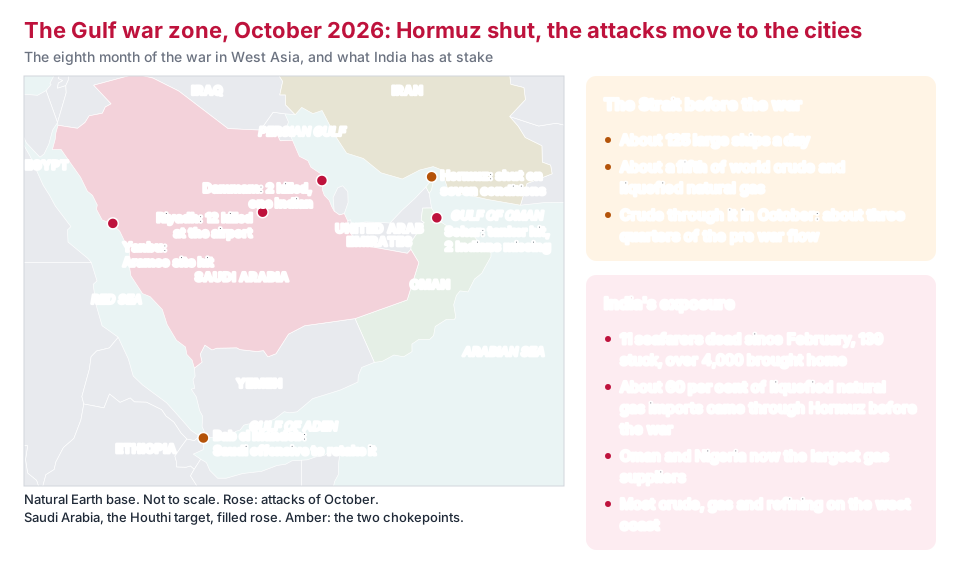
- In October 2026, the eighth month of the war, Iran said the Strait of Hormuz will not reopen until the United States meets seven conditions. The conditions come from the Islamabad Memorandum of Understanding, the interim agreement with the United States of June.
- A Houthi missile hit the domestic terminals of Riyadh's King Khalid airport, killing 12 and injuring over 300, the deadliest attack in a Gulf Arab country since the war began. An Indian injured in the attack later died. Later in the month a Houthi attack on Dammam's King Fahd airport killed two, one of them Indian.
- Ships with Indian crews were hit again. A projectile struck a Kuwaiti tanker in the Strait, and a drone hit a tanker at Sohar anchorage in Oman, where two Indian crew were missing.
Background
- The war began on 28 February 2026. Before it the Strait carried about 125 large ships a day and about a fifth of the world's crude oil and liquefied natural gas supply.
- The Saudi Houthi ceasefire of 2022 collapsed in July 2026. The Houthis took Yemen's whole Red Sea coast in September. Saudi led forces are fighting to retake the coast and the Bab el Mandeb strait, which carries about 12 per cent of world trade.
- The International Energy Agency says about 80 per cent of the oil passing Hormuz goes to Asia. India imports 85 to 90 per cent of its oil, and most of its oil and gas imports land on the west coast, with most of its refining and regasification (turning imported liquefied gas back into gas).
The Strait in October
Flows
- Crude through the Strait fell to about three quarters of its pre war flow. Exports from Oman's coast and the Red Sea, at more than twice their pre war levels, kept the region's total steady.
Attacks
- Maritime agencies reported at least one attack a day from early October. A shipping intelligence firm suggests Iran is firing into a "kill box", an area where it hits any ship that enters, rather than picking targets.
Going dark
- Tankers from Qatar and the United Arab Emirates have crossed the Strait "going dark", with their tracking transponders switched off. Qatar's deliveries to India recovered sharply in October from the near standstill of March to September.
What India has lost and what it has changed
Seafarers
- The Ports Secretary said 11 Indian seafarers have died since the war began. India has brought over 4,000 home. At the end of the month 139 were still stuck in the Strait. There have been four attacks on Indian flagged ships and 74 incidents on foreign ships with Indian crew.
Gas
Liquefied natural gas meets about half of India's gas needs.
- Before the war about 60 per cent of imports came through Hormuz, mainly from Qatar and the United Arab Emirates
- In September Oman and Nigeria overtook the United States as India's largest suppliers; Oman's exports do not depend on the Strait
- Imports stayed higher than a year earlier
Analysis
- The war has moved from the Strait to the cities. The Riyadh airport attack killed civilians in a capital. The American President spoke of joining Saudi strikes on the Houthis. The Houthi front and the Iranian front are now one war for India's purposes.
- A stated list of conditions is both a threat and an opening. Iran has named a price for reopening the Strait, tied to an agreement that already exists on paper. That gives the talks a text to work with, which the closure of June did not.
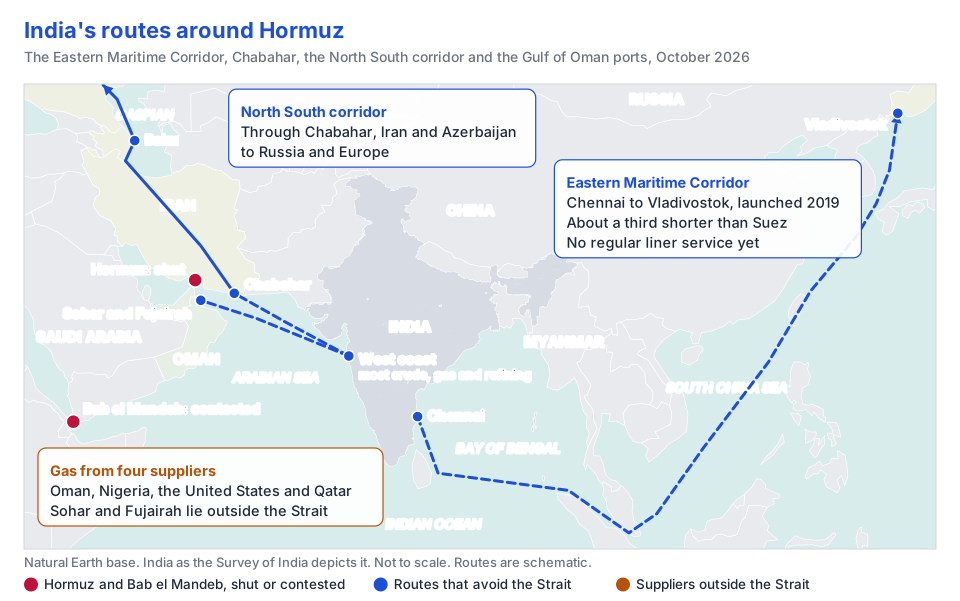
- The west coast is India's vulnerability. The map shows the routes that avoid the Strait: the Eastern Maritime Corridor from Chennai to Vladivostok, the North South corridor through Chabahar, and the Gulf of Oman ports.
- Derisking means more than new suppliers. India's trade with the Gulf Cooperation Council reached about $179 billion in 2025-26. Trade, fertilisers, investment and shipping all depend on the same sea routes. One disruption spreads to all.
The way forward
- Keep the lines to Tehran and Riyadh open at the same time, because India needs both the Strait reopened and the Houthi attacks stopped.
- Build the Eastern Maritime Corridor into a regular service, so that the east coast can take crude too.
- Protect seafarers through the consultative framework India proposed with Liberia in September.
Exam lens
- Prelims:
- The Strait of Hormuz joins the Persian Gulf to the Gulf of Oman and the Arabian Sea
- Bab el Mandeb joins the Red Sea to the Gulf of Aden
- The International Energy Agency coordinates stock releases; India is an associate member, not a full member
- Sohar and Fujairah lie on the Gulf of Oman outside the Strait
- The Eastern Maritime Corridor runs from Chennai to Vladivostok
- The Gulf Cooperation Council has six members
- Mains: "India's energy security is a west coast problem." Examine with reference to the closure of the Strait of Hormuz in 2026 and the options for derisking.
Asked before: Prelims 2026 · Mains 2017 GS2 · Mains 2025 GS3
Show the questions
- Prelims 2026: Ships from which of the following countries have to cross the Strait of Hormuz to reach out to the Indian Ocean? 1. Bahrain 2. Syria 3. Qatar 4. Egypt
- Mains 2017 GS2: The question of India's Energy Security constitutes the most important part of India's economic progress. Analyze India's energy policy cooperation with West Asian countries.
- Mains 2025 GS3: Why is maritime security vital to protect India's sea trade? Discuss maritime and coastal security challenges and the way forward.
Connects to
- The war in West Asia and the Strait of Hormuz: what India has at stake (Global Affairs, June): the Lead this one follows, with the Updates of July, August and September.
- The war in West Asia: tankers, the Houthis and a shipping initiative (Global Affairs, September): the India and Liberia initiative on the safety of seafarers.
- G7 releases 100 million barrels of oil through the International Energy Agency (Global Affairs, October): the world's answer to the closure.
- Green cards barred, oil courted and navigation contested: India and the United States in October (Global Affairs, October): the American and Venezuelan crude India is buying in the Strait's place.
Sources
- The Hindu, 4 October 2026
- The Hindu, 3 October 2026
- The Hindu, 5 October 2026
- The Hindu, 8 October 2026
- The Hindu, 11 October 2026
- The Hindu, 12 October 2026
- The Hindu, 22 October 2026
- The Indian Express, 8 October 2026
- The Indian Express, 14 October 2026
- The Indian Express, 28 October 2026
- Frontline, 13 October 2026
- The Hindu, 2 October 2026
Settled facts (dates of Acts, constitutional provisions, standing definitions) are from standard references.