History atlas · Theme 5
हिन्दी — Read in HindiPersian and Greek invasions, and the rise of Magadha
6th century BCE to 321 BCE
Two parallel developments that together explain why the subcontinent was ready for a much larger empire in the late fourth century BCE. The northwest opened to Persian power under the Achaemenids and then to Greek power under Alexander, while in the middle Gangetic plain Magadha rose under the Haryanka, Shishunaga and Nanda dynasties to become the strongest Indian power. The two do not belong to the same political stream, but by about 321 BCE the northwest was unstable and the Ganga heartland had a strong state.
Northwest, sixth century to 326 BCE: Under Darius I, Gandhara and the Indian borderlands became the Achaemenid province of Hindush; in 327 to 326 BCE Alexander crossed the Indus near Attock, entered Taxila and fought Porus on the Hydaspes.
- Kingdom around its capital, borders not fixed
- Most powerful
- Republic (gana sangha)
- Capital
- Site
- Battlefield
- UNESCO World Heritage Site
Literary sources
- Buddhist tradition records the councils held under Magadha's rulers, the first Buddhist council being held at Rajagriha under Ajatashatru.
- The second Buddhist council was held at Vaishali under Kalashoka.
- The sources of the previous theme apply to Magadha as well. (Janapadas, Mahajanapadas and the second urbanisation)
Foreign accounts
- The historians and geographers who came with Alexander described the conditions prevailing in India, praising for example the carpentry of its chariots, boats and ships.
- Greek accounts give an outside description of the Indian northwest at a crucial moment, which is their value as a historical source.
Inscriptions
- The word Hindu first appears, written as Hidus, in the Persian inscriptions of Darius I at Persepolis and Naqsh e Rustam.
- In the inscriptions at Persepolis and Naqsh e Rustam, Hidus was a geographical term for the region and people of the Indus valley.
The Achaemenid rulers
- The Achaemenid rulers who matter are Cyrus II, the founder of the empire, followed by Cambyses II, Darius I and Xerxes I.
- Among them Darius I matters most for India, because under him the northwest of the subcontinent was brought into the Persian empire.
Bimbisara's alliances
- Bimbisara of Magadha made a marriage alliance with Kosala Devi, daughter of the king of Kosala and sister of Prasenajit.
- Bimbisara also married Chellana, a Licchavi princess and the mother of Ajatashatru.
- He also made an alliance with the Madra clan of Punjab.
The Punjab and Alexander
- In the Punjab the northwest was politically fragmented when Alexander came.
- Ambhi of Taxila chose diplomacy with Alexander, while Porus chose resistance against him.
Cyrus II
king; also Cyrus the Great
Cyrus the Great, founder of the Achaemenid Empire of Persia.
Cambyses II
king
An Achaemenid ruler of Persia.
Darius I
king
Achaemenid ruler under whom Gandhara and the Indian borderlands entered the empire; defeated at Marathon in 490 BCE.
Xerxes I
king
An Achaemenid ruler of Persia.
Alexander III of Macedon
king; also Alexander the Great, Sikander
Alexander the Great, 336 to 323 BCE, Sikander in Persian accounts; he overturned the Persian Empire and entered the Indian northwest in 327 to 326 BCE.
Ambhi
king
Ruler of Taxila who did not fight Alexander but welcomed him with troops and elephants, hoping for support against Porus.
Porus
king
Ruler between the Hydaspes and the Acesines who fought Alexander in 326 BCE, was defeated and was reinstated as satrap.
Bimbisara
king
Haryanka ruler of Magadha, 544 to 492 BCE, contemporary of the Buddha and Mahavira; standing army and the first marriage alliances.
Ajatashatru
king
Haryanka ruler of Magadha, 492 to 460 BCE; killed his father, convened the first Buddhist council and won Kashi and Vaishali.
Udayin
king
Haryanka ruler of Magadha, 460 to 444 BCE, who moved the capital to Pataliputra.
Nagadasaka
king
The last Haryanka ruler, killed by his minister Shishunaga.
Shishunaga
king
Founder of the Shishunaga dynasty of Magadha, who destroyed the power of Avanti.
Kalashoka
king
Son of Shishunaga, who held the second Buddhist council at Vaishali.
Mahanandin
king
The last Shishunaga ruler, killed by Mahapadma Nanda.
Mahapadma Nanda
king
Founder of the Nanda dynasty, who called himself ekarat, the sole sovereign.
Dhana Nanda
king
Nanda ruler with a very large army and oppressive taxes, defeated by Chandragupta Maurya.
Chanakya
scholar; also Kautilya
A learned Brahmana whom Dhana Nanda is said to have insulted, and who took it as a challenge to overthrow him; tradition connects him with Chandragupta Maurya.
Chandragupta Maurya
king
Defeated Dhana Nanda and founded the Maurya dynasty; tradition connects him with Taxila and Kautilya.
Jivaka
physician
The physician Bimbisara sent to Pradyota of Avanti when he had jaundice.
Pradyota
king; also Chanda Pradyota Mahasena
Chanda Pradyota Mahasena, ruler of Avanti, who fought Bimbisara.
Kosala Devi
queen
Daughter of the king of Kosala, sister of Prasenajit and a wife of Bimbisara.
Chellana
queen
A Licchavi princess, wife of Bimbisara and mother of Ajatashatru.
The Achaemenid empire
- The Achaemenid Empire of Persia rose in the sixth century BCE.
- Its control never reached deep into the Gangetic heartland, remaining mainly a northwestern phenomenon.
- Under Darius I, Gandhara became a satrapy and the Indian borderlands became a province often called Hindush in Achaemenid usage.
The name and the languages
- In Old Persian usage the initial s often shifted, so Sindhu, the Indus, became Hindu or Hindush.
- Greek forms of the name later gave Indos and India.
- Persian contact brought Persian and Aramaic into political communication in the northwest.
- Later Greek and Aramaic were known in Afghanistan and likely understood at Taxila.
Alexander's march
- Greek and Persian rivalry was the background to Alexander's march.
- Darius I was defeated by the Greeks at Marathon in 490 BCE.
- Alexander III of Macedon ruled from 336 to 323 BCE, and is Sikander in Persian accounts.
- Alexander marched into the northwest as the final stage of the Macedonian conquest of Persia.
- In 327 to 326 BCE Alexander crossed the Indus near Attock.
- He then entered Taxila, whose ruler Ambhi welcomed him.
Porus and the turning back
- Porus ruled between the Hydaspes (Jhelum) and the Acesines (Chenab).
- Porus fought Alexander in 326 BCE, lost, and was given back his kingdom as satrap.
- After the battle with Porus, Alexander's tired soldiers turned back without attacking the Nanda ruler Dhana Nanda, and the march into India ended there.
What the campaign left
- Alexander's campaign was the first direct contact between India and Europe.
- It opened a direct India Hellenistic connection that mattered for later Indo Greek developments.
- The campaign also showed the role of cavalry, mobility and organised command in warfare.
- It widened the subcontinent's diplomatic and commercial horizon.
After Alexander
- After Alexander's death, Hellenistic zones stayed strongest in Afghanistan, Gandhara and northwest Pakistan.
- Greek possessions were later lost to the Mauryan empire.
The northwest
Sixth century BCE
The Achaemenid Empire rises under Cyrus II
Under Darius I
Gandhara a satrapy; the Indian borderlands the province of Hindush
490 BCE
Darius I defeated at Marathon
336 to 323 BCE
Alexander III of Macedon rules, and overturns the Persian Empire
327 to 326 BCE
Alexander in the northwest: the Indus crossed near Attock, Taxila, Porus on the Hydaspes
About 305 BCE
Chandragupta Maurya fights Seleucus Nikator, taken up with the Mauryan empire
What Persian and Greek contact left behind
| Contact | Impact | What it meant |
|---|---|---|
| Persian | Cultural and linguistic contact | Persian and Aramaic entered political communication in the northwest; later Greek and Aramaic were known in Afghanistan and likely understood at Taxila |
| Persian | Opening of routes | Imperial roads, tribute and long distance exchange tied the northwest more firmly to West Asia |
| Greek | A direct India Hellenistic connection | It mattered greatly for later Indo Greek developments |
| Greek | Military lessons | The role of cavalry, mobility and organised command in warfare |
| Greek | Diplomatic and commercial links | The western horizon of the subcontinent widened |
| Greek | Historical source value | An outside description of the Indian northwest at a crucial moment |
Why Magadha rose: the land
- The middle Gangetic plain gave Magadha fertile alluvial land, which supported strong agriculture and a surplus of production.
- A river advantage placed Magadha well to control the communication and trade that moved along the Ganga system.
- The wider region lay near forest resources, elephants and the iron rich zones of eastern India, giving Magadha access to them.
Why Magadha rose: rulers, conquest and capitals
- Magadha's success is closely tied to ambitious and strong rulers such as Bimbisara and Ajatashatru of the Haryanka dynasty.
- Through aggressive expansion Magadha conquered Anga, fought the Vrijjis, and outlasted rival powers such as Kosala and Avanti.
- Rajagriha was a defensible capital, and later Pataliputra was even better placed for imperial expansion because of its riverine location.
Bimbisara (Haryanka, 544 to 492 BCE)
- Bimbisara is considered the founder of the Haryanka dynasty.
- Bimbisara was a contemporary of the Buddha and Mahavira.
- He kept a standing army, and he was the first ruler to make marriage alliances to strengthen his kingdom.
- He fought Chanda Pradyota Mahasena of Avanti, but later sent Pradyota the physician Jivaka when Pradyota had jaundice.
Ajatashatru (Haryanka, 492 to 460 BCE)
- Ajatashatru took the throne by killing his father Bimbisara, a rare case of patricide in ancient India.
- Ajatashatru was a contemporary of the Buddha and Mahavira.
- He convened the first Buddhist council at Rajagriha soon after the Buddha's death.
- He is the presumed inventor of two war weapons, the rathamusala, a scythed chariot, and the mahashilakantaka, an engine to eject big stones.
- He won Kashi from Kosala and Vaishali from the Licchavis, extending the kingdom of Magadha.
Udayin (Haryanka, 460 to 444 BCE)
- Udayin moved the capital of Magadha to Pataliputra.
- Pataliputra's riverine location made it better placed for imperial expansion.
The Shishunagas: Shishunaga (412 to 344 BCE) and Kalashoka
- Shishunaga was a minister under Nagadasaka, the last Haryanka ruler.
- Shishunaga killed Nagadasaka and founded his own dynasty in Magadha.
- He destroyed the power of Avanti, ending a century old rivalry between Magadha and the Avanti kingdom.
- Kalashoka, the son of Shishunaga, is known for holding the second Buddhist council at Vaishali.
The Nandas: Mahapadma Nanda (344 to 321 BCE) and Dhana Nanda (to 321 BCE)
- Mahapadma Nanda began the Nanda dynasty by killing Mahanandin, the last Shishunaga ruler.
- Mahapadma Nanda called himself ekarat, the sole sovereign.
- Dhana Nanda, a son of Mahapadma Nanda, kept a very large army, and it is said even Alexander did not dare move east.
- Oppressive taxation made Dhana Nanda unpopular with his subjects.
- Some texts say he insulted Chanakya, a learned Brahmana.
- Chandragupta Maurya defeated Dhana Nanda and founded the Maurya dynasty, ending Nanda rule in Magadha.
Magadha's dynastiesTap to enlarge
Bimbisara's marriages
| Queen | Who she was |
|---|---|
| Kosala Devi | Daughter of the king of Kosala and sister of Prasenajit |
| Chellana | A Licchavi princess, the mother of Ajatashatru |
| A princess of the Madra clan | Of the Madra clan of Punjab |
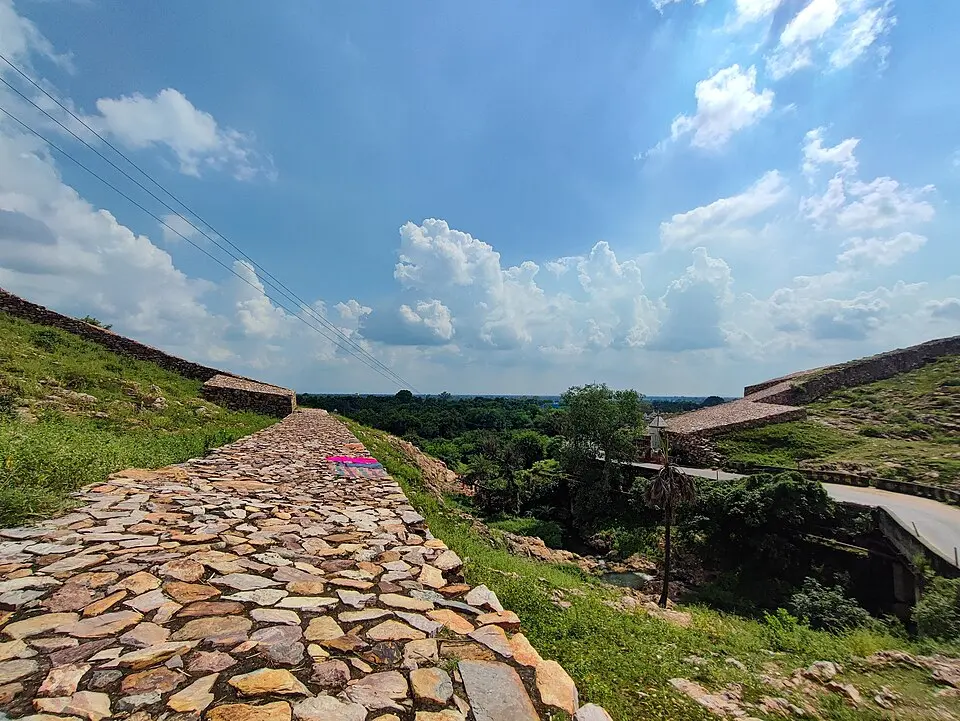
The cyclopean wall at Rajgir
Rajagriha, Magadha's first capital, was defensible, before Pataliputra's riverine location proved better for expansion.
Sumitsurai, CC BY-SA 4.0, via Wikimedia Commons
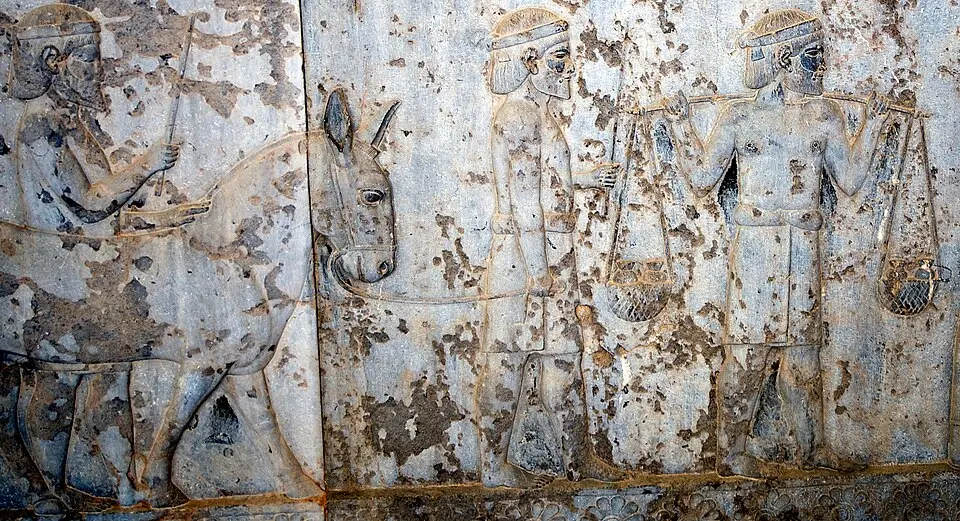
Indian tribute bearers at Persepolis
Imperial roads, tribute and long distance exchange tied the northwest more firmly to West Asia.
A. Davey, CC BY 2.0, via Wikimedia Commons
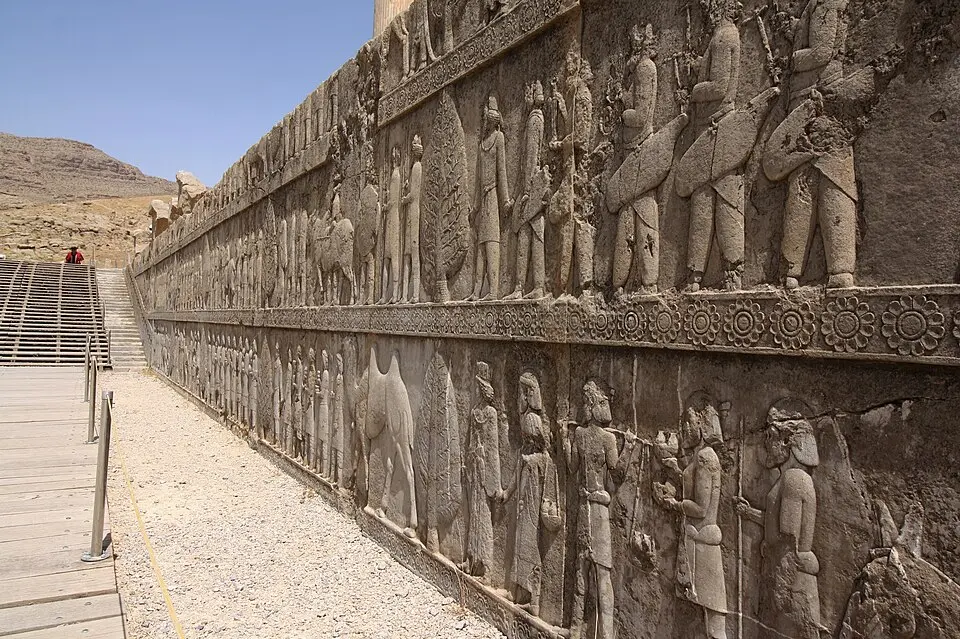
Persepolis
The word Hindu first appears in Darius I's inscriptions at Persepolis and Naqsh e Rustam, as Hidus.
Blondinrikard Fröberg, CC BY 2.0, via Wikimedia Commons
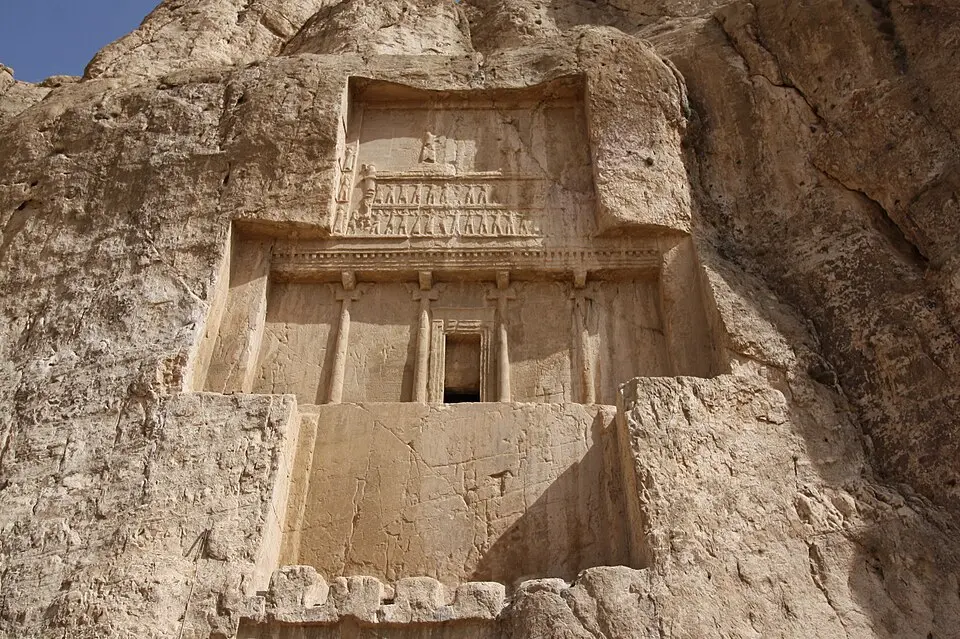
The tomb of Darius I at Naqsh e Rustam
Darius I brought Gandhara and the Indian borderlands into the Achaemenid empire as the province of Hindush.
Blondinrikard Fröberg, CC BY 2.0, via Wikimedia Commons
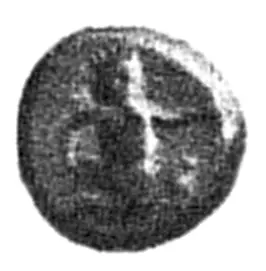
An Achaemenid coin from the Bhir Mound, Taxila
Persian contact connected the northwest more firmly to West Asia; Greek and Aramaic were later understood at Taxila.
Ministry of Culture, Public domain, via Wikimedia Commons
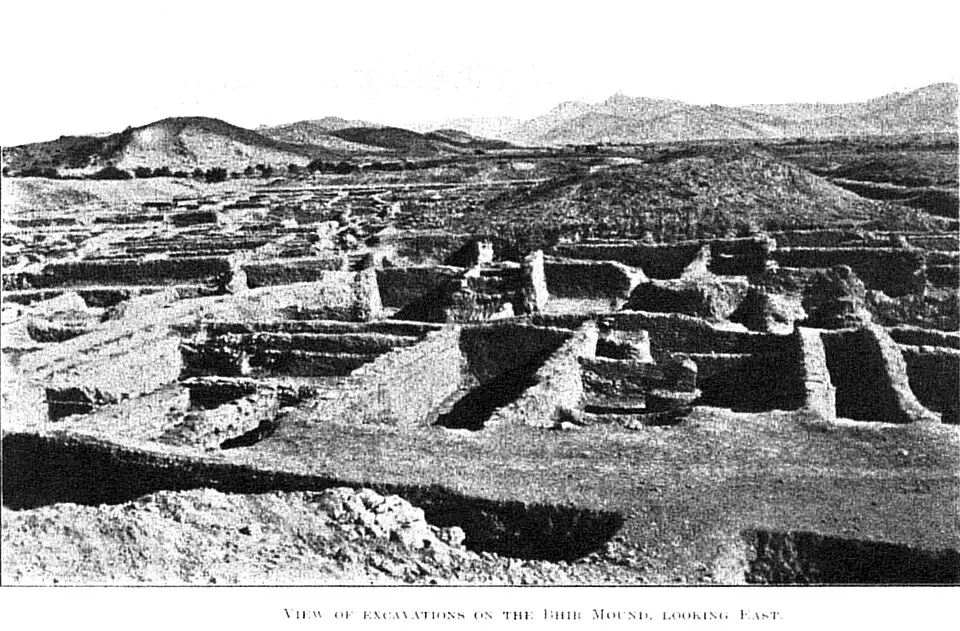
Excavations at the Bhir Mound, Taxila
Ambhi of Taxila did not fight Alexander, but welcomed him with troops and elephants.
Ministry of Culture, Public domain, via Wikimedia Commons
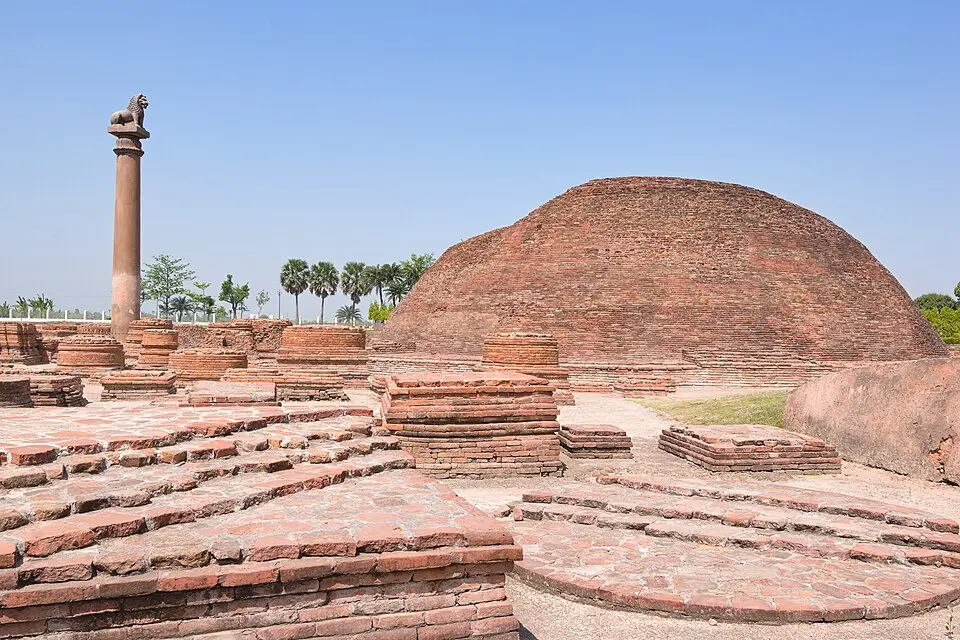
Vaishali
Ajatashatru won Vaishali from the Licchavis; the second Buddhist council met here under Kalashoka.
Rohit Sharma, CC BY-SA 4.0, via Wikimedia Commons


- Achaemenid Empire
- The Persian Empire relevant to Indian history, which rose in the sixth century BCE and became one of the largest of the ancient world.
- Satrap
- A governor of a province of the Persian Empire; Alexander also reinstated Porus as satrap.
- Satrapy
- A province of the Persian Empire governed by a satrap; Gandhara became one under Darius I.
- Hindush
- The province connected with India in Achaemenid usage, from Sindhu, the Indus.
- Hellenistic
- Of Greek history, art and culture, as in the Hellenistic zones left in Afghanistan, Gandhara and northwest Pakistan.
- Hydaspes
- The Greek name of the Jhelum, where Porus fought Alexander in 326 BCE.
- Acesines
- The Greek name of the Chenab.
- Ekarat
- The sole sovereign, the title Mahapadma Nanda took.
- Rathamusala
- A scythed or maced chariot, of which Ajatashatru is the presumed inventor.
- Mahashilakantaka
- An engine to throw big stones, of which Ajatashatru is the presumed inventor.
- Patricide
- The killing of one's father, as Ajatashatru killed Bimbisara, a rare case in ancient India.
The northwest
- In the northwest, Persian rule had connected the frontier to West Asia, but Alexander had then destroyed Persian power there.
- After Alexander's death Macedonian authority in the region was unstable.
- The Greek ruled satrapies and frontier garrisons were vulnerable.
The Gangetic heartland
- In the Gangetic heartland, Magadha was already the strongest Indian power by the late fourth century BCE.
- The Haryankas, Shishunagas and Nandas had built a strong state, with resources, taxation, river control and military organisation already in place.
Chandragupta Maurya
- This is the landscape into which Chandragupta Maurya emerged.
- Tradition connects him with Taxila and Kautilya, and his empire is the next theme. (Mauryan empire)