

First Principles IAS · Current affairs
The monthly magazine, July 2026 · Polity and Governance › Union Territories, special provisions and the Fifth and Sixth Schedules
Printed on · firstprinciplesias.com/current-affairs
Ladakh: an Article 371 model in place of the Sixth Schedule
LeadPrelims and Mains3 Jul 2026
Why in news
- On 3 July 2026 the Ministry of Home Affairs and Ladakh's two civil society alliances, the Leh Apex Body and the Kargil Democratic Alliance, signed at Leh the agreed minutes of their High Powered Committee meeting of 22 May.
- The minutes record a consensus on an elected body for the whole Union Territory with executive, legislative and financial powers and control over the bureaucracy, protected by a customised provision under Article 371, with statehood kept as the long term aspiration.
- The signing followed a June of protests and shutdowns in Leh and Kargil over changes to the draft, and it sets Ladakh on a path that is neither the Sixth Schedule it asked for nor the Union Territory without a legislature it has been since 2019.
Background
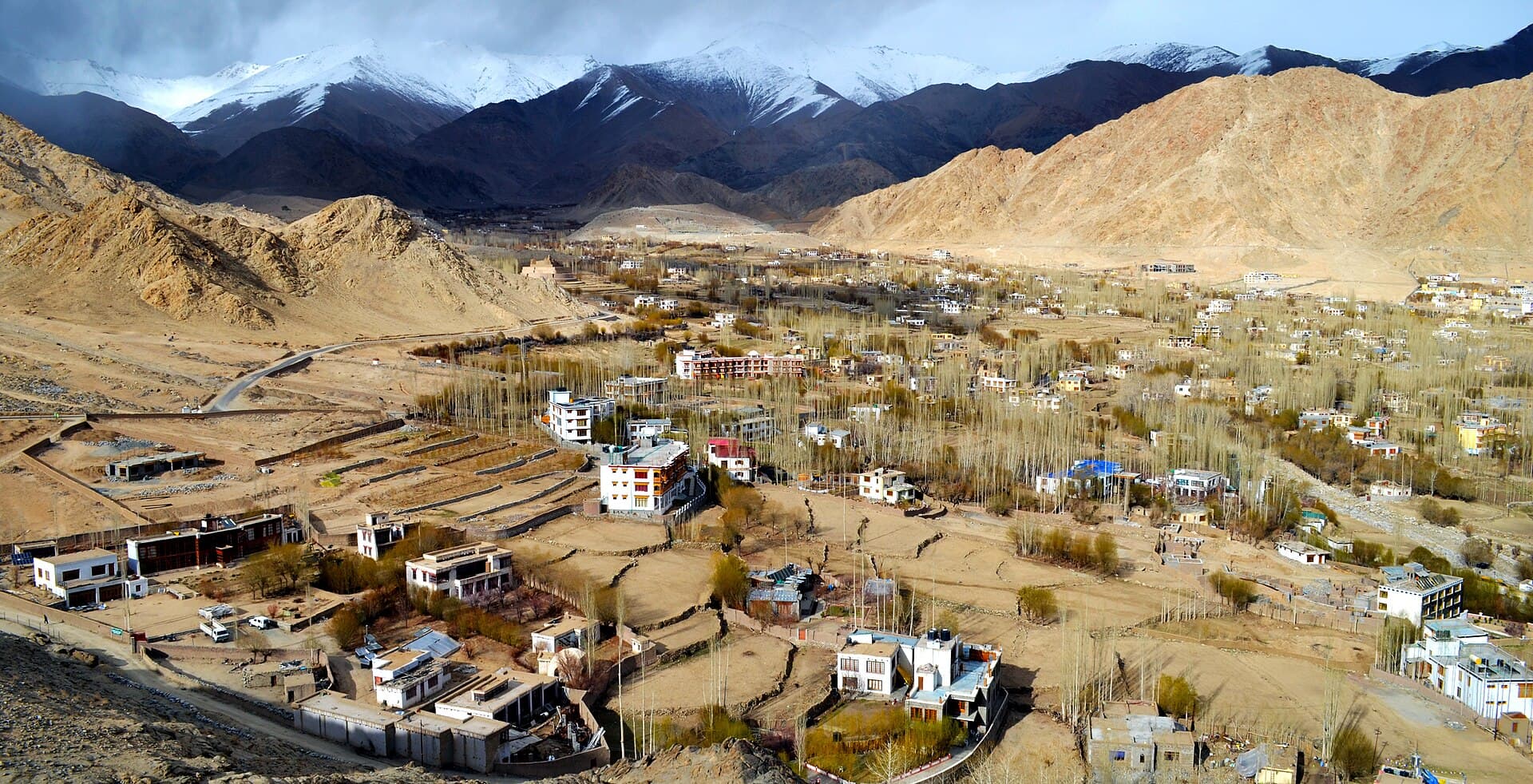
- Ladakh became a Union Territory without a legislature on 31 October 2019 under the Jammu and Kashmir Reorganisation Act, 2019. A Lieutenant Governor administers it, and the President may make regulations for it under Article 240.
- Local self government runs through the Ladakh Autonomous Hill Development Councils of Leh (1995) and Kargil (2003); on 13 July the administration said hill councils would be extended to all seven districts.
- The Leh Apex Body and the Kargil Democratic Alliance, which represent Buddhist majority Leh and Muslim majority Kargil, have asked since 2020 for four things: statehood, inclusion in the Sixth Schedule, a public service commission, and two Lok Sabha seats.
- Most of Ladakh's people belong to Scheduled Tribes, which is the basis of the Sixth Schedule demand; the National Commission for Scheduled Tribes recommended the Schedule for Ladakh in 2019.
The Sixth Schedule and Article 371 compared
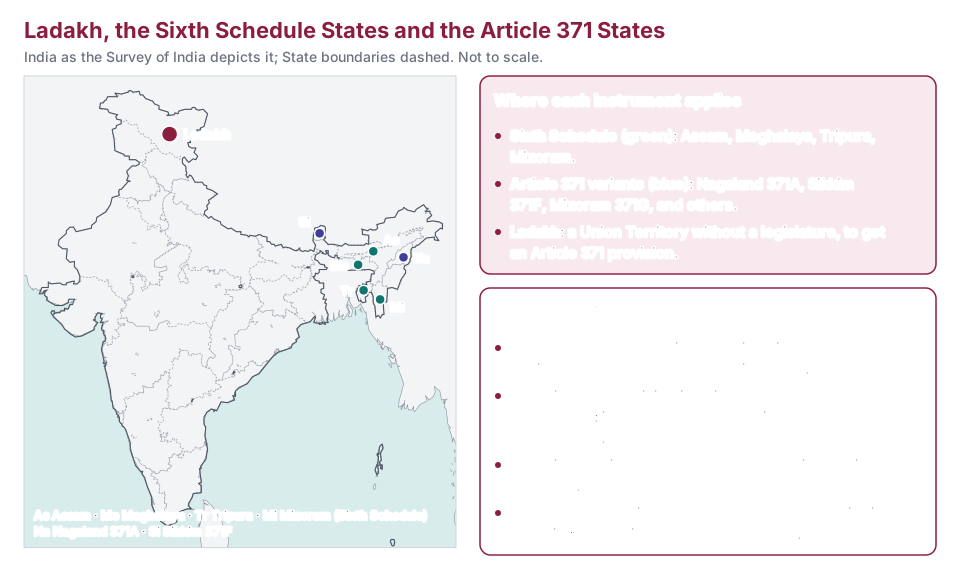
- The Sixth Schedule is a ready framework: elected councils with legislative, executive and judicial powers over listed subjects, whose laws need the Governor's assent. It was designed for districts within a State, not for a whole territory administered by the Centre.
- Article 371 and its lettered variants, 371A to 371J, give particular States safeguards written for them. Article 371A for Nagaland and 371G for Mizoram bar any Act of Parliament on religious or social practice, customary law, and the ownership and transfer of land from applying unless the State Assembly so decides.
- An Article 371 provision is drafted afresh for each case, by a constitutional amendment, so its strength depends on its wording; the Sixth Schedule's strength is fixed.
What the minutes provide
- An elected body at the level of the Union Territory, with executive, financial and legislative powers.
- Control and supervision by the elected executive over the bureaucracy that handles its subjects, the point on which the June protests turned.
- Constitutional safeguards for the body under Article 371; statehood recorded as the long term aspiration, and the elected body as a first step towards a customised model.
- The Ministry will prepare the final draft framework, the two alliances will submit theirs, and the details of business rules will be settled in further meetings.
The Sixth Schedule and Article 371 side by side
| The Sixth Schedule | Article 371 (371 to 371J) | |
|---|---|---|
| Basis | Articles 244(2) and 275(1): autonomous district and regional councils in Assam, Meghalaya, Tripura and Mizoram | Special provisions written for particular States by constitutional amendment |
| What it gives | Elected councils with legislative, executive and judicial powers over land, forests, custom and inheritance; laws need the Governor's assent | 371A Nagaland and 371G Mizoram: Acts of Parliament on custom, land and religious practice apply only if the Assembly decides; 371F Sikkim; 371 Maharashtra and Gujarat development boards |
| Form | A fixed text, designed for districts within a State; never applied to a Union Territory | Drafted afresh each time: its strength is its wording |
| Ladakh today | Union Territory without a legislature since 31 October 2019; a Lieutenant Governor; regulations under Article 240; Hill Development Councils of Leh (1995) and Kargil (2003) | The minutes of 3 July 2026: an elected body for the whole territory with executive, legislative and financial powers, safeguards under a customised Article 371 provision, statehood the long term aspiration |
Analysis
- A compromise in which each side gives up its first choice. Ladakh wanted the Sixth Schedule, which fixes protections in a text Parliament cannot easily change; the Centre, which has never placed a Union Territory in the Schedule, offered an Article 371 provision it can write.
- What each gets. Ladakh gets an elected body, more than the Schedule's district councils; the Centre keeps the territory, on a border with China and Pakistan.
- The open points are the ones that matter. Whether the body's laws need the Centre's assent, how land and jobs will be protected from outsiders, and what the elected executive's control over civil servants means while the Lieutenant Governor heads the administration, the dispute Delhi has lived with since 1991.
- Asymmetric federalism as a toolkit. The Fifth and Sixth Schedules, Article 371 and the Delhi model each answer a different question; Ladakh is being given a new instrument drawn from all three.
- For Mains: set the Sixth Schedule and Article 371 side by side, and judge the model by whether its protections are written into the Constitution or left to an executive arrangement.
The way forward
- Put the model into the Constitution, since an executive arrangement can be withdrawn.
- Protect land, jobs and culture in clear words, as Article 371A does for Nagaland, with a domicile rule the elected body administers.
- Settle the relationship between the elected executive and the Lieutenant Governor in the amendment itself, with Delhi's experience in mind.
- Keep statehood on the table, with a timeline, and involve both Leh and Kargil, whose interests differ.
Exam lens
- Prelims: the Sixth Schedule applies to Assam, Meghalaya, Tripura and Mizoram under Article 244(2); the Fifth Schedule to Scheduled Areas in other States; Article 371A Nagaland, 371G Mizoram, 371F Sikkim; Ladakh has had no legislature since 2019 and is governed through Article 240 regulations; the Hill Development Councils of Leh (1995) and Kargil (2003).
- Mains: "Asymmetric federalism in India is a toolkit, not a rule." Discuss with reference to the Ladakh settlement of 2026 and the choice between the Sixth Schedule and Article 371.
Asked before: Prelims 2015 · Mains 2025 GS2 · Mains 2026 GS3
Show the questions
- Prelims 2015: The provisions in Fifth Schedule and Sixth Schedule in the Constitution of India are made in order to
- Mains 2025 GS2: Discuss the nature of Jammu and Kashmir Legislative Assembly after the Jammu and Kashmir Reorganization Act, 2019. Briefly describe the powers and functions of the Assembly of the Union Territory of Jammu and Kashmir.
- Mains 2026 GS3: Ladakh is strategically located between China and Pakistan. As a measure to win hearts and minds of locals, discuss the Border Area Development Programmes (BADP) by the Central Government and civic actions by the Army. Also discuss demand of promulgation of provision of the Sixth Schedule of constitution for Ladakh.
Cases to cite
- Samatha v. State of Andhra Pradesh (1997): land in a Scheduled Area cannot be transferred to non tribals, even by the State.
- Pu Myllai Hlychho v. State of Mizoram (2005): the Sixth Schedule is a "Constitution within the Constitution".
- Government of NCT of Delhi v. Union of India (2023): the elected government of a Union Territory with a legislature controls the services on the subjects it legislates on.
- In re Article 370 of the Constitution (2023): upheld the creation of the Union Territory of Ladakh under Article 3.
Connects to
- Ladakh: the High Court bench Regulation (Polity, August): the first Article 240 regulation after the settlement.
- Kerala becomes Keralam (Polity, August): the Article 3 power under which Ladakh was created.
- Citizenship and due process: the Foreigners Tribunals ruling (Polity, July): the other border region whose politics turns on who belongs.
Sources
- The Statesman, 3 July 2026, “Centre, Ladakh groups seal deal on elected UT body, Article 371 safeguards”
- The Hindu, 1 July 2026
- The Hindu, 3 July 2026
- The Hindu, 13 July 2026
Settled facts (dates of Acts, constitutional provisions, standing definitions) are from standard references.
Updated, 27 Aug 2026: Ladakh: the High Court bench Regulation
Filed under: Union Territories, special provisions and the Fifth and Sixth Schedules · The monthly magazine, July 2026