

First Principles IAS · Current affairs
The monthly magazine, August 2026 · Environment and Disaster Management › Elephants and other land mammals
Printed on · firstprinciplesias.com/current-affairs
The elephant in India: numbers, corridors and conflict
LeadPrelims and Mains17 Aug 2026
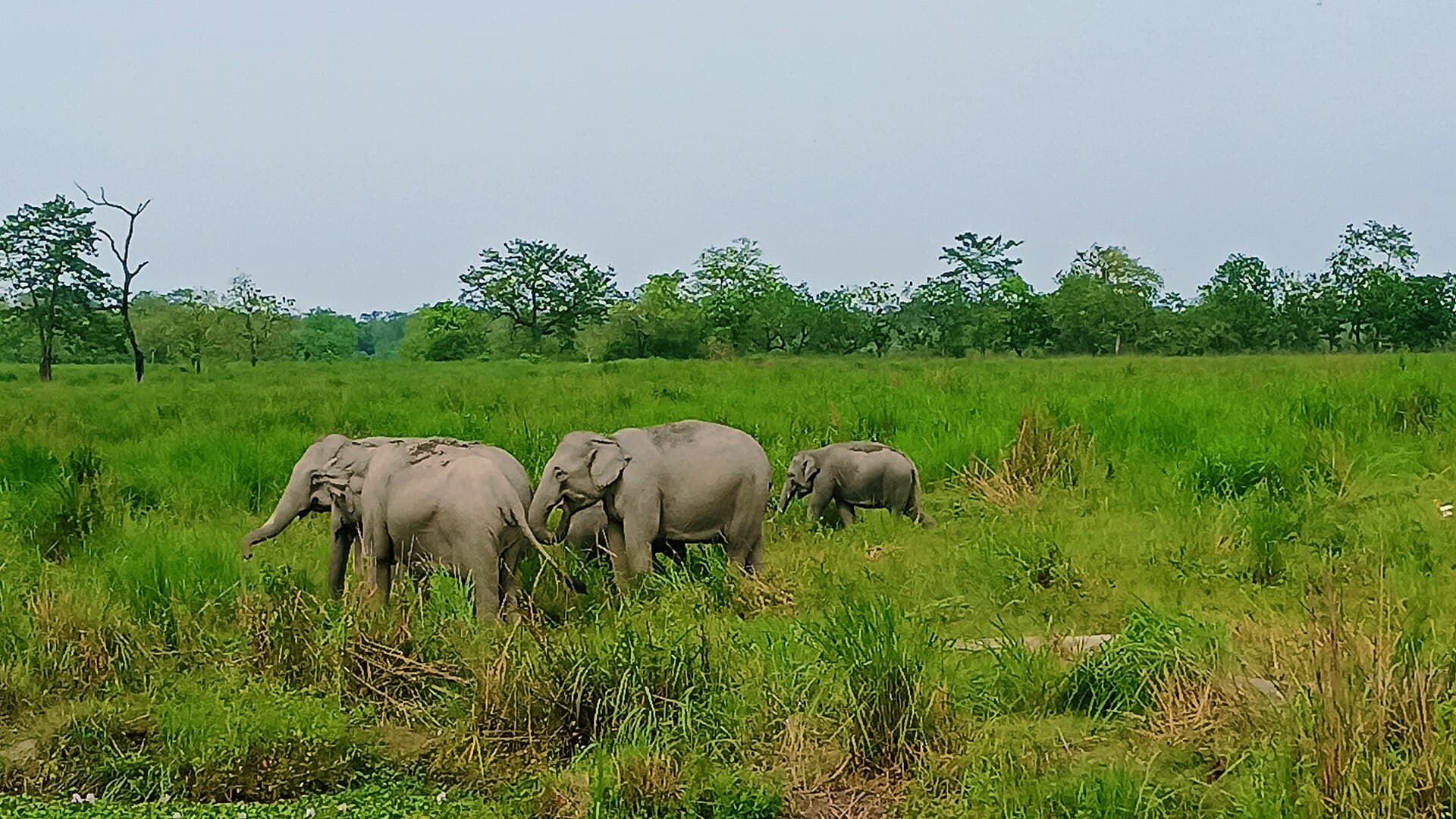
Species card
Asian elephant
- Scientific name: Elephas maximus; India's largest land mammal and its National Heritage Animal since 2010; a keystone species that disperses seeds and opens paths other animals use.
- IUCN Red List: Endangered. Indian law: Schedule I, Wild Life (Protection) Act, 1972. CITES: Appendix I, which bars commercial trade in the animal and its ivory. (Endangered)
- Habitat: dry and moist forest and grassland; a herd, led by the oldest female, ranges over 100 to 3,000 sq km, so no single reserve holds one.
- Distribution: 13 countries of South and Southeast Asia; India holds about 60 per cent of the world's wild Asian elephants, in four regions: the North East (the Himalayan foothills from northern West Bengal through Assam to Arunachal Pradesh, Meghalaya and the Karbi plateau), Central India (Odisha, Jharkhand, southern West Bengal, with herds wandering into Chhattisgarh), the North West (the Uttarakhand and Uttar Pradesh foothills) and the South (eight separate populations from northern Karnataka to Agasthyamalai).
- Threats: loss and breaking up of habitat, with most elephants ranging outside protected areas; human elephant conflict and retaliatory killing; electrocution, train hits and poisoning; poaching for ivory.
Why in news
- On 17 August 2026 a three judge bench of the Supreme Court led by the Chief Justice of India ordered the Union Environment Ministry to survey every elephant corridor afresh and to report by 14 October on why corridors are obstructed and what has been done to clear them.
- The Court said that no State may block a traditional elephant route, and asked for a ban on the hulla parties that drive elephants with fire.
- Five days earlier, on World Elephant Day, the Ministry had released the result of India's first DNA based count: 22,446 wild elephants, nearly 60 per cent of the world's wild Asian elephants.
- 22,446wild elephants in India, by the Synchronous All India Estimation of Elephants, 2021 to 2025, the first count made from DNA in dung samples
- Nearly 60 per centIndia's share of the world's wild Asian elephants
- 33Elephant Reserves, covering 80,777 sq km in 14 States
- 150validated elephant corridors, 19 of them across State lines and six into Nepal
- 12elephants killed by trains in 2024, down from 26 in 2013
Background
- The Asian elephant (Elephas maximus) is Endangered on the International Union for Conservation of Nature's Red List, in Schedule I of the Wild Life (Protection) Act, 1972 and in Appendix I of the Convention on International Trade in Endangered Species, which bars commercial trade in the animal and its ivory.
- It was declared India's National Heritage Animal in 2010.
- Elephants live in herds led by the oldest female, and a herd's home range runs from 100 to 3,000 sq km, which is why a herd cannot be kept inside one reserve.
- The elephant is a keystone species: it disperses seeds over long distances and opens paths and clearings that other animals use.
How India counts and protects elephants
- Project Elephant, launched in 1992 as a centrally sponsored scheme, supports the States with habitat, corridors, conflict and captive elephants. Since 2023 it has run with Project Tiger under one division of the Environment Ministry, and a Management Effectiveness Evaluation framework for Elephant Reserves was launched the same year.
- An Elephant Reserve is an administrative unit under Project Elephant, not a category under the Wild Life (Protection) Act, so it carries no legal protection of its own; the 33 reserves have grown by 8,610 sq km since 2014.
- The new count identified individual animals from the genetic fingerprint in dung, which removes the double counting of a sighting based census, and combined it with block counts and line transects.
- Captive elephants are registered through the Gajah Suchana app in a national genetic database, and their transfer is governed by the Captive Elephant (Transfer or Transport) Rules, 2024 and a High Powered Committee set up on the Supreme Court's order of March 2023.
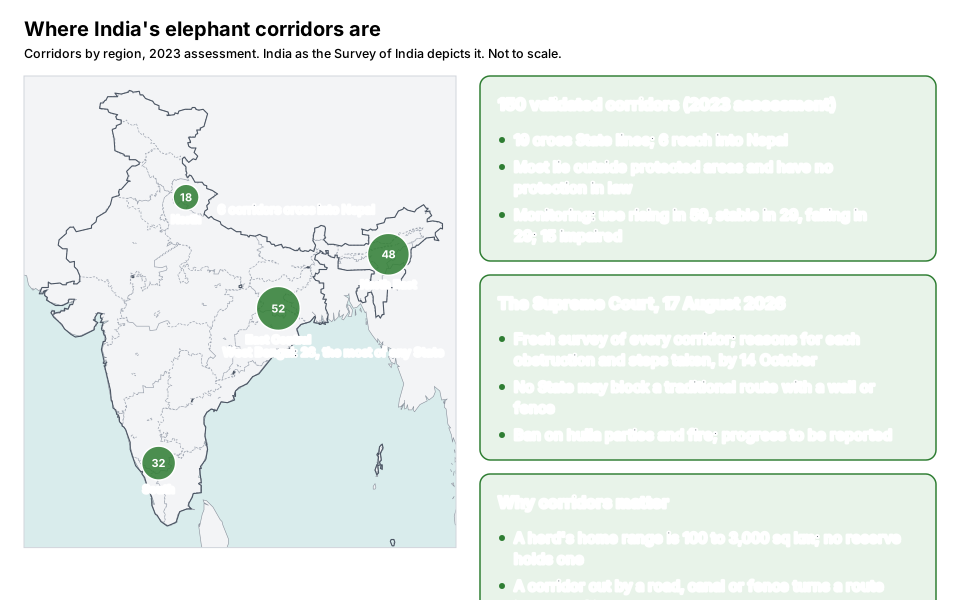
Corridors
- An elephant corridor is a strip of habitat that connects two larger elephant habitats, so that herds can move between them for food and water.
- Elephant Corridors of India, 2023, prepared with the Wildlife Institute of India, validated 150, most of them in the East Central region. West Bengal has the most, 26, more than 17 per cent of the total.
- Monitoring found 15 corridors impaired.
- Most corridors lie outside protected areas and have no protection in law, which is why they are lost to settlements, farms, fences, roads, railways and canals.
What the Supreme Court ordered
- A fresh survey of the corridors, with the reasons for each obstruction and the steps taken to remove it, by 14 October 2026.
- No State may put up a wall, a fence or any other obstacle in a corridor to deal with crop damage, because elephants move across States and a herd pushed out of one State enters the next.
- A report on progress in banning fireballs, torches and spiked rods, and a specific ban on hulla parties, the squads that drive elephants with fire; the Court had banned these methods in 2018, and West Bengal, which recruits such squads, faced a contempt plea in 2024 after a pregnant elephant died of a fire spiked rod.
Human elephant conflict
- Conflict rises where habitat is broken up and herds are pushed into farms, and it kills both people and elephants. Elephants die mainly from electrocution, train hits, poisoning and poaching.
- Joint surveys with the Railways covered 127 sensitive stretches, and 77 of them were recommended for underpasses, overpasses, ramps and sensors; train deaths have halved since 2013.
- On World Elephant Day the Ministry released a Regional Action Plan on conflict for the southern States, Karnataka, Keralam, Andhra Pradesh and Tamil Nadu, backed by ₹500 crore.
- Ex gratia under the scheme is ₹10 lakh for a death, ₹2 lakh for grievous injury and up to ₹25,000 for treatment of a minor injury; crop and property losses follow State norms.
Analysis
- Two questions, and the second matters more. The count says India has more elephants than anyone thought and the largest share of the species by far; the Court's order says the problem is not the number but the space.
- A corridor outside a protected area is a line on a map. A herd with a home range of a thousand square kilometres needs corridors, and a validated corridor has no standing until a road or a fence crosses it, which the Court can report but cannot prevent.
- Legal status is the Ministry's work, not the Court's. A corridor notified as an ecologically sensitive area under the Environment (Protection) Act, or as a conservation reserve, has a standing that a validated line does not.
- The lesson is federal. Nineteen corridors cross State lines and six cross into Nepal, so a State that walls its border against elephants exports its conflict, which is why the Court spoke to the States and not to the Ministry alone.
- Conflict is a land use problem before it is a wildlife problem. Compensation paid quickly is the cheapest form of corridor protection, since a farmer who is paid does not electrify his fence.
The way forward
- Give corridors legal protection, by notifying them as ecologically sensitive areas or conservation reserves, starting with the 15 impaired ones.
- Build crossings on roads, railways and canals that cut corridors, and route new lines around them, as the Railways' joint surveys already recommend.
- Settle conflict across States through joint plans for shared herds, which the Regional Action Plans are meant to do.
- Pay compensation within weeks, so that farmers do not turn to electric fences and poison.
Exam lens
- Prelims: Asian elephant, Endangered, Schedule I, CITES Appendix I, National Heritage Animal since 2010; Project Elephant began in 1992; 33 Elephant Reserves in 14 States; 150 corridors, most in the East Central region, West Bengal the most among States; the count of 22,446 is the first from DNA in dung; an Elephant Reserve has no legal status under the Wild Life (Protection) Act; World Elephant Day is 12 August; MIKE, Monitoring the Illegal Killing of Elephants, is a CITES programme.
- Mains: "Elephant conservation in India is a question of corridors, not of numbers." Discuss in the light of the first DNA based count and the Supreme Court's order of August 2026.
Asked before: Prelims 2020 · Prelims 2017
Show the questions
- Prelims 2020: With reference to Indian elephants, consider the following statements : 1. The leader of an elephant group is a female. 2. The maximum gestation period can be 22 months. 3. An elephant can normally go on calving till the age of 40 years only. 4. Among the States in India, the highest elephant population is in Kerala. Which of the statements given above is/are correct?
- Prelims 2017: In India, if a species of tortoise is declared protected under Schedule I of the Wildlife (Protection) Act, 1972, what does it imply?
Connects to
- Kaziranga: a smaller eco sensitive zone and mining in the hills (Environment, August): the Karbi Anglong Elephant Reserve where mines were sanctioned.
- India's first Conservation Action Plan for the clouded leopard (Environment, August): the same landscape and corridor logic for a cat.
- International Big Cat Alliance (Environment, September): the other flagship species programme.
Sources
- PIB, 12 August 2026
- PIB, 13 August 2026
- Mongabay India, August 2026, “Court orders survey of elephant corridors, seeks ban on fireball use”
- The Hindu, 18 August 2026
- WWF, “Asian elephant”
- Ministry of Environment, Forest and Climate Change, “Project Elephant (PE)”
Settled facts (dates of Acts, constitutional provisions, standing definitions) are from standard references.
Filed under: Elephants and other land mammals · The monthly magazine, August 2026