

First Principles IAS · Current affairs
The monthly magazine, October 2026 · Environment and Disaster Management › Big cats
Printed on · firstprinciplesias.com/current-affairs
A tigress from Valmiki starts West Bengal's first tiger reintroduction at Buxa
LeadPrelims and Mains2 Oct 2026
Species card
Bengal tiger
- Scientific name: Panthera tigris tigris, the tiger subspecies of the Indian subcontinent.
- IUCN Red List: Endangered. Indian law: Schedule I, Wild Life (Protection) Act, 1972. CITES: Appendix I. (Endangered)
- Habitat: dry and moist deciduous forest, Terai grassland and swamp, and the Sundarbans mangroves, the only mangrove forest with tigers.
- Distribution: India holds about three quarters of the world's wild tigers. The global count rose from about 3,200 in 2010 to about 5,700 in 2025, by the Living Planet Report 2026.
- Threats: loss of prey and grassland, poaching, fragmented corridors, and conflict where tigers meet livestock and people.
Why in news
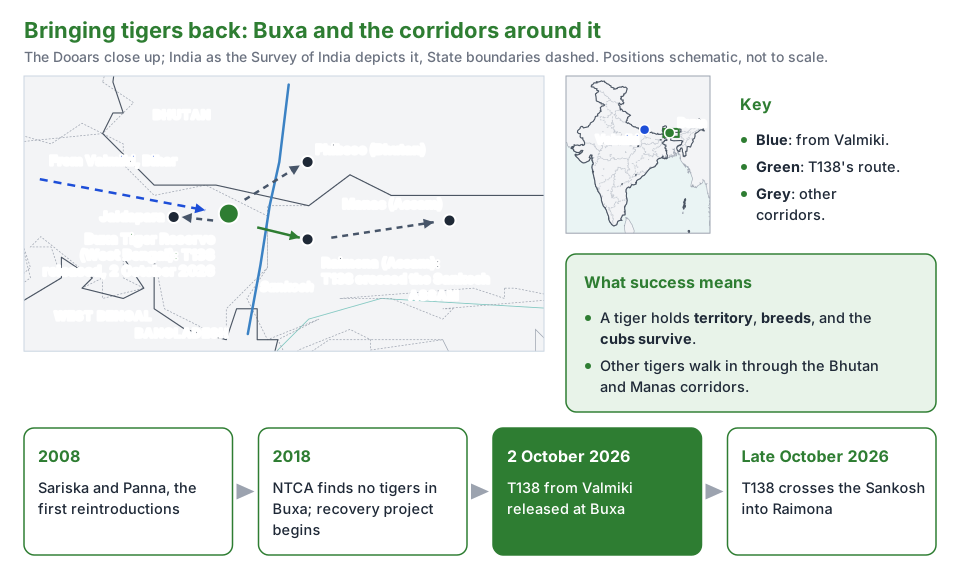
- On 2 October 2026 West Bengal released a three year old tigress, T138, into Buxa Tiger Reserve in Alipurduar. She came from Valmiki Tiger Reserve in Bihar.
- The release is West Bengal's first tiger reintroduction, the opening step of a phased plan to build a breeding population.
- More tigers are to follow in the coming months. By late October T138 had crossed the Sankosh river into Assam's Raimona National Park, apparently looking for territory. The National Tiger Conservation Authority is tracking her by radio collar and has not brought her back.
Background
- Reintroduction means returning a species to part of its historical range where it has died out locally. India began with tigers in 2008, at Sariska and Panna, and has since tried it in twelve tiger reserves, with uneven results. The timeline gives the earlier cases and Buxa's own road to the release.
- By 2018 the Authority's count had found no tigers left in three reserves: Buxa, Dampa in Mizoram and Palamau in Jharkhand. Since then the Tiger Augmentation and Recovery Project, run by West Bengal with the Authority and the Wildlife Institute of India, has rebuilt the prey base and the grassland.
Why Valmiki, and why the corridors matter
- West Bengal chose Valmiki because its Terai terrain, tall grass and sal forest resemble Buxa's. A tiger from the Sundarbans mangroves would not know how to hunt in it.
- Buxa is a junction. The reserve links to Phibsoo Wildlife Sanctuary in Bhutan to the north, to Manas in Assam to the east through Raimona, and to Jaldapara in West Bengal to the west.
What success will look like
Success is not the release. Success is a tiger holding territory, breeding and raising cubs that survive, with other tigers walking in on their own through the Bhutan and Manas corridors.
Analysis
A triumph of bureaucracy, not ecology.
- The Hindu gives that verdict. Buxa is reactive conservation, as Sariska and Panna were: the State acted only after the tigers had gone.
- The real failure was the two decades in which prey and grassland declined and no one moved.
The habitat is still the problem.
- A closed canopy choked Buxa's grasslands, and prey grew so scarce that goats, macaques and cattle appeared in tiger diets.
- Settlements, tea estates, a railway line through elephant habitat and traffic on the Bhutan road remain.
Moving people out can override rights.
- The State has shifted villages out of the core.
- Relocation under the Wild Life (Protection) Act, 1972 must be voluntary and consistent with the Forest Rights Act, 2006. Satkosia's experience shows what happens when it is not.
The corridor is the real reserve.
- T138 did not stay in Buxa. She used the whole landscape.
- Phibsoo, Raimona, Manas and Jaldapara together are the unit that will decide whether Buxa's tigers breed.
The way forward
- Keep the grassland open and the prey base growing before each release. A tiger without prey walks out or kills cattle.
- Secure the corridors across the Sankosh and towards Phibsoo with Bhutan and Assam, including the railway and road crossings.
- Monitor habitat decline in every reserve as a warning. Forest departments should prevent the next Buxa rather than repair it.
Exam lens
- Prelims:
- Buxa Tiger Reserve, West Bengal, 1983, borders Bhutan
- Valmiki Tiger Reserve, Bihar, is the eastern end of the Terai Arc Landscape
- First reintroductions: Sariska and Panna, 2008
- The Sundarbans is the only mangrove forest with tigers
- The National Tiger Conservation Authority is a statutory body under the Wild Life (Protection) Act, 1972
- The tiger is Endangered, Schedule I and CITES Appendix I
- Raimona National Park and Manas are in Assam; Phibsoo is in Bhutan
- Mains: "Tiger reintroduction shows technical skill but often reflects a failure of prevention." Critically examine with reference to Buxa.
Asked before: Prelims 2020 · Prelims 2014 · Prelims 2026
Show the questions
- Prelims 2020: Among the following Tiger Reserves, which one has the largest area under "Critical Tiger Habitat" ?
- Prelims 2014: Consider the following statements: 1. Animal Welfare Board of India is established under the Environment (Protection) Act, 1986. 2. National Tiger Conservation Authority is a statutory body. 3. National Ganga River Basin Authority is chaired by the Prime Minister. Which of the statements given above is/are correct?
- Prelims 2026: With reference to Madhav National Park, which of the following statements is/are correct? 1. It was declared a Tiger Reserve in India in 2025. 2. Sakhya Sagar, which is designated as a Ramsar Site, is situated within this National Park. 3. Its area is shared between Madhya Pradesh and Rajasthan.
Connects to
- Satkosia relocation inquiry (Environment, August): the reintroduction that failed, and why.
- A Kuno cub is the first cheetah shot dead in India, as a third site opens at Nauradehi (Environment, October): the other reintroduction, with the same question of range.
- Living Planet Report 2026: monitored wildlife populations down 73 per cent since 1970 (Environment, October): the source of the global tiger count.
Sources
- The Hindu, 3 October 2026
- PIB, 2 October 2026
- The Hindu, 29 October 2026
- The Indian Express, 8 October 2026
Settled facts (dates of Acts, constitutional provisions, standing definitions) are from standard references.