
First Principles IAS · Current affairs
The monthly magazine, October 2026 · Environment and Disaster Management › UNFCCC negotiations and the Paris framework
Printed on · firstprinciplesias.com/current-affairs
Emissions Gap Report 2026 plans for overshoot and a return to 1.5°C by 2100
LeadPrelims and Mains31 Oct 2026
Why in news
- The United Nations Environment Programme released its Emissions Gap Report 2026, titled "The Point of Return", in October 2026, a few weeks before COP31 at Antalya.
- The report accepts that warming will pass 1.5°C above pre industrial levels. For the first time the report sets out how deep the cuts must be to bring warming back to 1.5°C by 2100.
Background
- The Paris Agreement, 2015 holds warming well below 2°C above pre industrial levels and pursues 1.5°C. Each country files a Nationally Determined Contribution, its pledge, every five years, and each pledge must go further than the last.
- The emissions gap is the difference between where emissions are heading under the pledges and where they must be for the temperature goals. The Programme has measured it every year since 2010.
The four pathways
The four pathways, and the cuts the lowest overshoot path needs, are in the figure.
What the pledges add up to
- The UNFCCC's NDC Synthesis Report, covering 127 new pledges, finds a cut of only 6 per cent below 2019 by 2035.
- With the net zero targets, mostly for 2050, the pledges would hold warming to 1.7 to 2.3°C.
- India's own 2035 pledge, filed in July 2026, sets a 47 per cent cut in emissions intensity (emissions per unit of GDP), 60 per cent non fossil capacity and a carbon sink of 3.5 to 4.0 billion tonnes.
India's carbon removal bet
The money
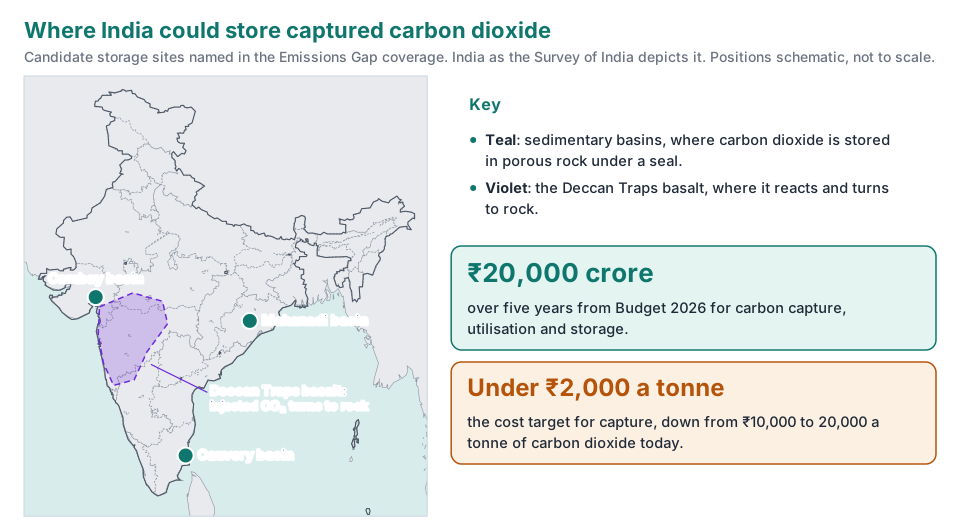
- Budget 2026 set aside ₹20,000 crore over five years for carbon capture, utilisation and storage, and the Department of Science and Technology has set a cost target for capture. The map gives the target and the candidate storage sites.
The case
- The case for the spending is the arithmetic of overshoot. If the world returns to 1.5°C only by removal, countries that can store carbon cheaply will sell that service.
Analysis
- Overshoot is now the plan, not the failure. The report's title says the question has moved from how to avoid 1.5°C to how to get back. The UN Secretary General's line, "overshoot is not surrender", is honest about the first part and hopeful about the second.
- The numbers do not meet. The lowest overshoot path needs an 18 per cent cut by 2030 from 2025. Pledges deliver 6 per cent by 2035 from 2019. A pathway built on cuts that no pledge contains is a model, not a forecast.
- Removal shifts the burden to the future. Every tenth of a degree of overshoot adds 220 billion tonnes to the removal bill. Machines and forests that do not yet exist at that scale must pay it.
For India the report cuts both ways.
- The report strengthens India's case for finance and technology before deeper cuts, since the richest emitters made the gap.
- The report turns India's ₹20,000 crore carbon capture spending into a strategic bet: in an overshoot world, removal is a service that can be sold.
The way forward
- Raise the pledges before the 2028 Global Stocktake, with the 2030 cut, not the 2050 target, as the test.
- Fund the cuts in developing countries. The overshoot path fails without them, and the finance goal agreed at Baku remains unmet.
- Count carbon removal separately from cuts, with its own accounting, so that a promise to remove later cannot stand in for a cut today.
Exam lens
- Prelims:
- The Emissions Gap Report is published every year by the United Nations Environment Programme
- Four pathways: 2.8°C on current policies; 2.6°C with all pledges; 2.1°C with net zero targets; 1.7 to 1.8°C peak on the lowest overshoot path
- Lowest overshoot path: cuts of 18, 45 and 69 per cent by 2030, 2035 and 2040, from 2025
- Every 0.1°C of overshoot adds 220 billion tonnes to the removal bill
- The NDC Synthesis Report is the UNFCCC's: 6 per cent below 2019 by 2035
- The Global Stocktake comes every five years, next in 2028
- Mains: "The world is now planning to overshoot 1.5°C rather than avoid it." Critically examine in the light of the Emissions Gap Report 2026, and discuss what it means for India's carbon removal plans.
Asked before: Prelims 2016 · Mains 2025 GS3 · Mains 2025 GS3
Show the questions
- Prelims 2016: With reference to the Agreement at the UNFCCC Meeting in Paris in 2015, which of the following statements is/are correct? 1. The Agreement was signed by all the member countries of the UN and it will go into effect in 2017. 2. The Agreement aims to limit the greenhouse gas emissions so that the rise in average global temperature by the end of this century does not exceed 2 °C or even 1.5 °C above pre-industrial levels. 3. Developed countries acknowledged their historical responsibility in global warming and committed to donate $ 1000 billion a year from 2020 to help developing countries to cope with climate change. Select the correct answer using the code given below.
- Mains 2025 GS3: Write a review on India's climate commitments under the Paris Agreement (2015) and mention how these have been further strengthened in COP26 (2021). In this direction, how has the first Nationally Determined Contribution intended by India been updated in 2022?
- Mains 2025 GS3: What is Carbon Capture, Utilization and Storage (CCUS)? What is the potential role of CCUS in tackling climate change?
Connects to
- The 1.5°C goal and overshoot: the UN's first pathway back down (Environment, September): the Limiting Overshoot report that this one puts numbers on.
- COP31 at Antalya: a split presidency and a missing agenda item (Environment, September): where the finance for these cuts will be fought over.
- IPCC members cannot agree when to publish the seventh assessment (Environment, October): the science that the 2028 stocktake may have to do without.
Sources
- The Hindu, 21 October 2026
- The Indian Express, 23 October 2026
- The Hindu, 27 October 2026
Settled facts (dates of Acts, constitutional provisions, standing definitions) are from standard references.
Filed under: UNFCCC negotiations and the Paris framework · The monthly magazine, October 2026