First Principles IAS · Current affairs
The monthly magazine, October 2026 · Global Affairs and International Relations › Russia and Ukraine
Printed on · firstprinciplesias.com/current-affairs
India's four point ceasefire plan, and the American waiver of the Russia sanctions law
LeadPrelims and Mains31 Oct 2026
Why in news
- In October 2026 Ukraine's Foreign Minister called India's ceasefire proposal the "broadest" of the four Kyiv has received. The other three came from Türkiye, Egypt and the United States. The External Affairs Minister said India had gone "beyond advocacy" and was carrying messages between Moscow and Kyiv.
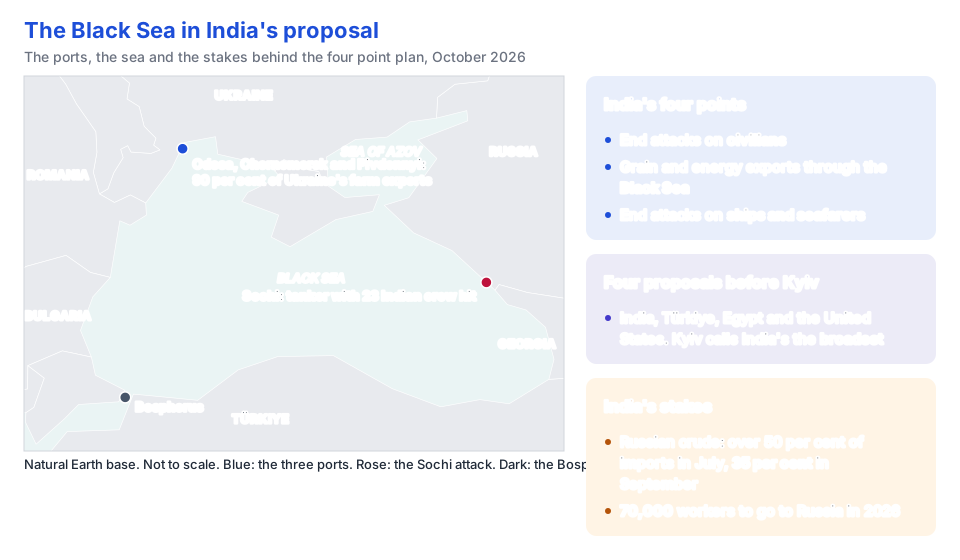
- India's four point proposal covers an end to attacks on civilians, grain and energy exports through the Black Sea, and an end to attacks on ships and seafarers. Indian officials deny that India is "mediating".
- In the same month the American President waived the sanctions and tariffs under the Sanctioning Russia and Iran Act of 2026, a day before its enforcement deadline. The Secretary of State later called the waiver a 60 day pause. The September Lead dealt with the threat that law carried for India.
- The energy ceasefire the American President announced in October collapsed within a week. Russia, Ukraine and the United States plan three way technical talks for November.
Background
- India is the largest buyer of Russian seaborne crude, at about 1.8 million barrels a day in 2026, ahead of China.
- India has carried messages between warring sides before. In the Korean War it chaired the Neutral Nations Repatriation Commission in 1953, with Indian troops guarding about 23,000 prisoners. It kept strictly to what both sides had agreed and handed the prisoners back in 1954.
What India is carrying
The ceasefire terms
- Ukraine is ready for a ceasefire covering energy infrastructure and the Black Sea, on condition that the two come together. Russia would stop attacking Ukraine's energy infrastructure and Ukraine would not attack Russian positions along the line of contact (the front line).
Grain
The Black Sea matters for food.
- Odesa, Chornomorsk and Pivdennyi handle about 90 per cent of Ukraine's farm exports
- Russia ships most of its grain through the Azov and Black Sea region
- Fighting there puts at least 400 million people in Africa, West Asia and Asia at risk of food shortages
Ships
- The sea is a war zone for shipping. In October Ukrainian drone boats hit a tanker off Sochi with 23 Indian crew, all rescued. India said attacks on international waterways are "severely undermining global commerce".
The waiver and India's exposure
Two steps in a week. Diesel sanctions lifted first, then the law itself waived. The figure traces the law to the 60 day pause, with India's falling share of Russian crude beside it.
- An Indian official called the waiver "helpful"
- Lawmakers of both parties said the deal undermined the law they had passed a month earlier
- India's other stakes remain. Russia agreed to take about 70,000 Indian skilled workers in 2026, mainly in construction and logistics. The Russian army has discharged about 140 Indians, and India is tracing more. The two countries still aim at $100 billion in trade by 2030.
Analysis
- India is a messenger because it talks to both sides. It is not a formal mediator, and its officials say so. What makes India acceptable to Kyiv and Moscow is the same policy that Washington punishes: India kept its lines open to Russia.
- The proposal follows the Korean method. India has chosen the issues on which both sides share an interest: ships, grain and energy. India leaves territory and security guarantees to the parties. That is multi alignment practised issue by issue, as in 1953.
- The waiver answers the law, not the dispute. The law stands, the pause is 60 days, and the President can reconsider. India's exposure has fallen from over half of its crude to about a third, but it is still the largest buyer.
- The costs are counted in people, not only barrels. Indian crews in the Black Sea, Indians recruited into the Russian army, and 70,000 workers about to go to Russia tie India to the war in ways a tariff cannot capture.
The way forward
- Build on narrow deals first, in the Black Sea and on energy infrastructure, as steps towards a wider ceasefire.
- Diversify crude supply steadily, so that the end of the waiver does not become a shock.
Exam lens
- Prelims:
- The Black Sea ports Odesa, Chornomorsk and Pivdennyi; the Bosphorus and the Sea of Azov
- The Sanctioning Russia and Iran Act of 2026: tariffs of up to 100 per cent on large buyers of Russian oil and gas
- India is the largest buyer of Russian seaborne crude
- India chaired the Neutral Nations Repatriation Commission in 1953
- Mains: "Strategic autonomy lets India speak to both Russia and Ukraine, but it carries costs." Discuss with reference to India's four point proposal and the American waiver of October 2026.
Asked before: Mains 2022 GS4 · Mains 2019 GS2
Show the questions
- Mains 2022 GS4: Russia and Ukraine war has been going on for the last seven months. Different countries have taken independent stands and actions keeping in view their own national interests. We are all aware that war has its own impact on the different aspects of society, including human tragedy. What are those ethical issues that are crucial to be considered while launching the war and its continuation so far? Illustrate with justification the ethical issues involved in the given state of affair.
- Mains 2019 GS2: 'What introduces friction into the ties between India and the United States is that Washington is still unable to find for India a position in its global strategy, which would satisfy India's national self-esteem and ambitions.' Explain with suitable examples.
Connects to
- India between Russia and Ukraine: outreach, oil and the American sanctions law (Global Affairs, September): the law, the Kyiv visit and the stakes this Lead builds on.
- Green cards barred, oil courted and navigation contested: India and the United States in October (Global Affairs, October): the same Secretary of State in Mumbai days after calling the waiver a pause.
- American tariffs: the Russia sanctions tariff is waived, and the first tranche of the trade deal is finalised but unsigned (Economy, October): the trade side of the same waiver.
- Poland's Prime Minister visits India, the first since 2010, with a target to double trade by 2030 (Global Affairs, October): the visit at which the four point proposal was discussed.
Sources
- The Hindu, 3 October 2026
- The Hindu, 4 October 2026
- The Indian Express, 11 October 2026
- Frontline, 20 October 2026
- The Hindu, 7 October 2026
- The Hindu, 10 October 2026
- The Hindu, 16 October 2026
- The Hindu, 17 October 2026
- The Hindu, 18 October 2026
- The Hindu, 21 October 2026
- The Hindu, 24 October 2026
Settled facts (dates of Acts, constitutional provisions, standing definitions) are from standard references.
Filed under: Russia and Ukraine · The monthly magazine, October 2026