Fires, stampedes and biological disasters
- Syllabus
- Disaster and disaster management
- As of
- October 2026
- fire and emergency services
- National Building Code Part 4
- fire no objection certificate
- forest fire alert system
- fire prone forest
- crowd management
- carrying capacity
- Incident Response System
- biological disaster
- Epidemic Diseases Act 1897
- Epidemic Diseases (Amendment) Act 2020
- Integrated Disease Surveillance Programme
- notified disaster
- ex gratia
The first principle
Fires, stampedes and epidemics look unrelated, but each is a hazard that people build for themselves before nature or chance sets it off. A cinema with locked exits, a pilgrimage route with one narrow bridge and a district with no laboratory are all disasters waiting for a trigger, so in all three the deaths are decided long before the event by rules on buildings, crowds and public health. That is why they are managed mainly by regulation and surveillance rather than by forecasting.
The core
Urban fires
- Fire is a State subject. Fire services appear in the Twelfth Schedule among municipal functions, so each State runs its own fire and emergency service under its own fire Act, while the Directorate General of Fire Services, Civil Defence and Home Guards in the Ministry of Home Affairs (MHA) only advises. Fire is one of the twelve calamities notified for relief from the State Disaster Response Fund (SDRF).
- The building is the first line of defence. Part 4 of the National Building Code (NBC) 2016, "Fire and Life Safety", groups buildings by occupancy, such as assembly, educational and institutional, and for each sets the means of escape, fire resistant construction, alarms and sprinklers. The Code, a model document of the Bureau of Indian Standards, binds only when written into building bye laws.
- The fire no objection certificate (NOC) is where the fire service checks a building against these rules before it opens and at each renewal; most deadly fires happen where this check was skipped or never renewed.
- Response capacity is funded from disaster money. In 2023 the MHA launched the Scheme for Expansion and Modernisation of Fire Services in the States with an outlay of Rs 5,000 crore, drawn from the preparedness and capacity building window of the National Disaster Response Fund (NDRF). The National Disaster Management Authority (NDMA) set norms for equipment and training of fire services in its guidelines of 2012.
Forest fires
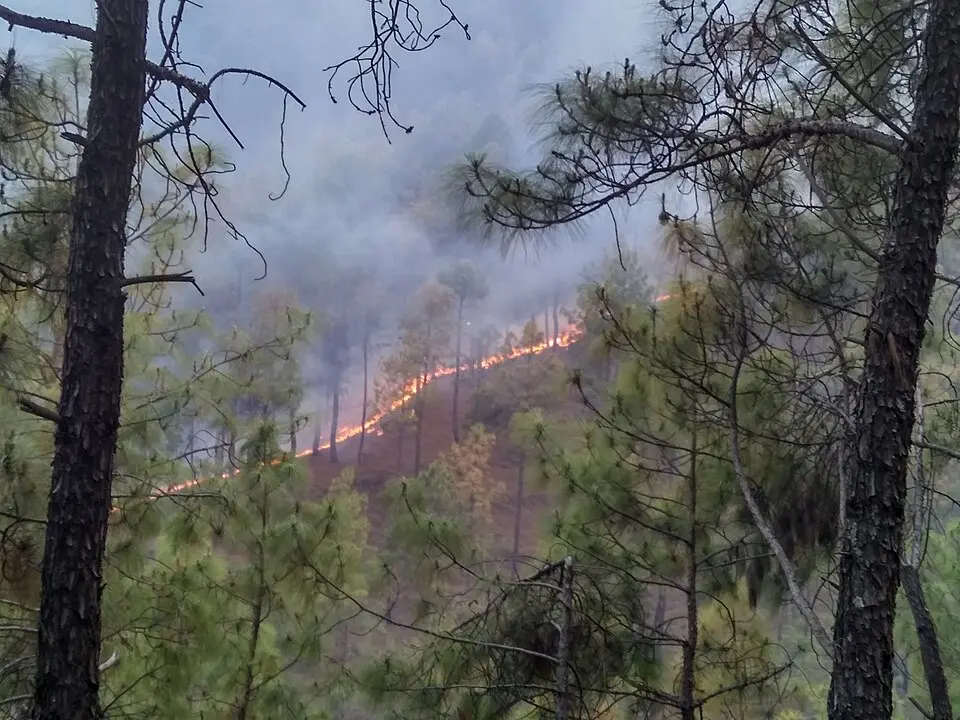
- Most forest fires in India are surface fires lit by people, through clearing land, burning litter or carelessness, in the dry season from about November to June; chir pine forests of the western Himalaya and dry deciduous forests burn most often.
- The scale is measured. The India State of Forest Report (ISFR) 2021 of the Forest Survey of India (FSI) estimated that about 35.46 per cent of the country's forest cover is prone to fire.
- The FSI fire alert system turns satellite hot spots from the Moderate Resolution Imaging Spectroradiometer (MODIS) and Visible Infrared Imaging Radiometer Suite (VIIRS) sensors into alerts for the forest guard several times a day, and runs the Van Agni geoportal, which also gives a weekly fire danger rating. The National Action Plan on Forest Fires (2018) of the environment ministry aims to cut fires by informing, enabling and rewarding forest fringe communities. Remote sensing itself is explained in the note on geospatial technology.

Stampedes and crowd management
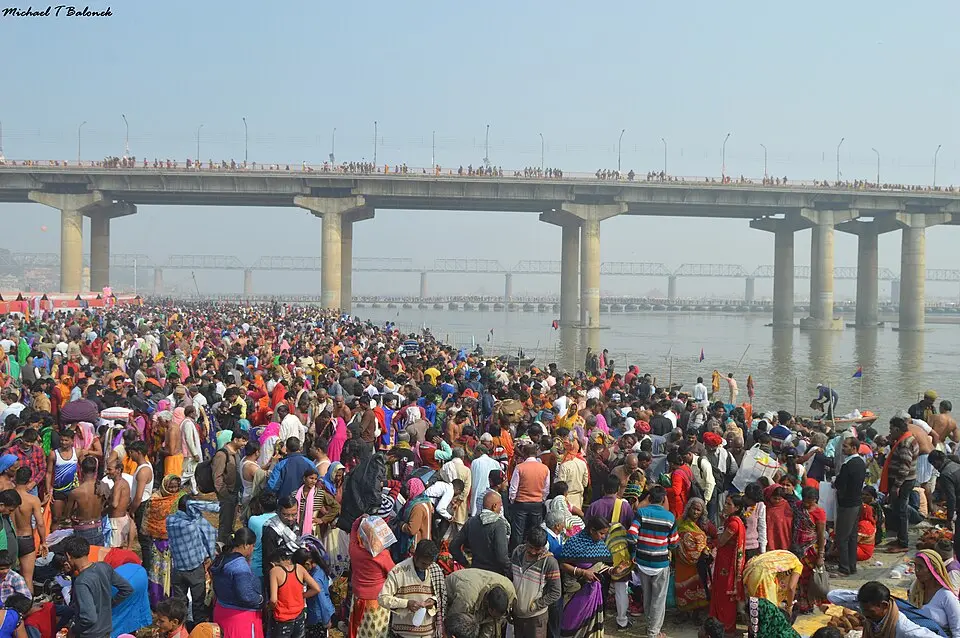
- A stampede is a failure of capacity, not of crowd character. When more people enter a space than it can hold, a small trigger starts a surge, and most victims die standing, of compressive asphyxia, because the pressure stops them breathing.
- NDMA's guide of 2014, Managing Crowd at Events and Venues of Mass Gathering, written for States, local authorities and organisers, observes that most crowd disasters in India have occurred at religious places. It groups causes into six kinds (structural, fire or electricity, crowd control, crowd behaviour, security and poor coordination among agencies) and asks organisers to plan for capacity, control entry, movement and exit, and run large events under the Incident Response System (IRS) with one incident commander.
Biological disasters
- An epidemic becomes a disaster when cases outrun the capacity of the health system and a health problem becomes a crisis of hospitals, livelihoods and order. NDMA's Guidelines on Management of Biological Disasters (2008) cover natural epidemics, animal diseases that cross to humans and bioterrorism within one framework. How such diseases emerge is covered in the note on antimicrobial resistance and emerging diseases.
- The Epidemic Diseases Act 1897, passed during the Bombay plague, lets governments take special measures and make regulations when an outbreak threatens. The Epidemic Diseases (Amendment) Act 2020, which replaced an ordinance of April 2020, made violence against health workers cognisable and non bailable, with imprisonment of three months to five years and a fine of Rs 50,000 to Rs 2 lakh, rising to six months to seven years and a fine of up to Rs 5 lakh for grievous hurt; it also let the Centre inspect and detain any ship, aircraft, train or vehicle entering or leaving the country.
- The Integrated Disease Surveillance Programme (IDSP), launched in 2004 and run by the National Centre for Disease Control (NCDC), collects weekly reports of syndromes, probable cases and laboratory confirmed cases from every district so that outbreaks are spotted early.
Dimensions
- Legal and federal. These hazards are governed by a patchwork of State fire Acts, bye laws, forest laws, police rules and an epidemic law of 1897, and because health, police and fire are State subjects, the Centre directed States during Covid through the Disaster Management Act 2005 rather than any health law.
- Economic and social. Fire NOCs and crowd limits cost owners and organisers money, which is why they are evaded, while the victims are often children in village schools, pilgrims from distant districts and workers in unregistered premises.
- Ecological. Forest fires destroy regeneration, release carbon and drive soil erosion, but some fire is natural in dry forests, so the aim is control rather than total suppression.
- Ethical. The official who signed the NOC or approved the event is rarely the one who pays.
In practice
- Uphaar cinema, Delhi, 13 June 1997. A fire that began in a transformer in the basement filled the hall with smoke during a screening, and 59 people died, mostly of suffocation, because gangways had been narrowed and exits were blocked.
- Kumbakonam, Tamil Nadu, 16 July 2004. Fire from a school kitchen spread to a thatched roof and killed 94 children. In Avinash Mehrotra v Union of India (2009) the Supreme Court held that safe schools are part of the right to education and directed fire safety norms for all schools.
- TRP game zone, Rajkot, 25 May 2024. A fire in a temporary metal structure used as a gaming zone killed 27 people, including children. The facility had no fire NOC, and the Gujarat High Court took notice of it on its own and called it a man made disaster, exposing temporary structures as a gap in fire rules.
- Hathras, Uttar Pradesh, 2 July 2024. A crush at the close of a religious congregation killed 121 people, mostly women, when the crowd rushed towards the preacher's departing vehicle; the judicial commission blamed mainly the organisers, which shows how a dignitary's movement can act as the trigger.
- Maha Kumbh, Prayagraj, 29 January 2025. On Mauni Amavasya, the busiest bathing day, a surge near the Sangam killed 30 people by the police count, because the crowd converged on the Sangam bathing area in the small hours.
- Covid as a notified disaster, 2020. The MHA declared Covid a notified disaster for SDRF relief on 14 March 2020, and on 24 March NDMA ordered a national lockdown under section 6 of the Disaster Management Act, with the National Executive Committee issuing the detailed guidelines. In Reepak Kansal v Union of India (2021), decided together with Gaurav Kumar Bansal's petition, the Supreme Court held that NDMA must lay down ex gratia relief for Covid deaths under section 12 of the Act, and NDMA fixed Rs 50,000 per death.

Issues and way forward
- Codes exist but are not enforced. The NBC is adopted unevenly into bye laws and NOCs are issued without inspection, so States should adopt Part 4 in full, publish NOC status online and hold the signing officer accountable.
- Temporary and informal spaces escape the rules. Game zones, coaching centres and small hospitals often run in sheds or converted buildings, so the rules must cover temporary structures and changes of use.
- Fire services are thin. The 2023 scheme pays for equipment, but stations and trained staff in fast growing towns lag, and NDMA's 2012 norms should guide where new stations go.
- Forest fire alerts arrive faster than crews. Too few fire watchers and fire lines exist, so communities and joint forest management committees should be paid to clear litter, especially pine needles.
- Crowd plans ignore capacity. Events are approved by expected attendance rather than the safe capacity of routes, so organisers should file a crowd plan based on NDMA's guide, with entry slots, separate exits and no movement of dignitaries at peak hours.
- Epidemic law is old and thin. The 1897 Act gives broad powers but no framework for surveillance, rights or coordination, and a draft public health bill of 2017 lapsed; a modern public health law, a public health cadre and district laboratories would turn surveillance into response.
Common confusions
- Epidemic Diseases Act and Disaster Management Act. The 1897 Act gives health powers during an outbreak, such as inspection and isolation, while the 2005 Act gives the executive power to direct every department and every State, which is why the Covid lockdown was ordered under the second.
- Stampede and crowd crush. A stampede suggests people running and trampling, while most crowd deaths are crushes in which people die standing, from pressure; the remedy is managing density, not controlling panic.
- Fire NOC and building plan approval. Plan approval checks the design before construction, while the fire NOC checks the finished building and its use before it opens and must be renewed.
- Notified disaster and local disaster. A notified calamity is on the national list and is funded from the SDRF and NDRF, while a local disaster is declared by a State for a hazard outside the list and can draw only a small share of the SDRF.
For the exam
- Keyword bank: fire and emergency services as a State subject, National Building Code Part 4, fire no objection certificate, temporary structures, fire prone forest, forest fire alert system, crowd carrying capacity, compressive asphyxia, Incident Response System, biological disaster, Epidemic Diseases (Amendment) Act 2020, Integrated Disease Surveillance Programme, notified disaster, ex gratia under section 12, One Health.
- Previous year questions: Practise the previous year questions on this topic →
- Use in an answer:
- Introduction with data: The India State of Forest Report 2021 estimates that about 35 per cent of India's forest cover is prone to fire, and most of these fires are lit by people in the dry season.
- Introduction with a source: NDMA's crowd management guide of 2014 observes that most crowd disasters in India have occurred at religious places, and the Hathras crush of 2024, which killed 121 people, fits that pattern.
- Conclusion: Fires, stampedes and epidemics are disasters that rules can prevent, so India's task is less to build new institutions than to enforce the codes, crowd plans and surveillance systems it already has.
- Conclusion: Each major case, from Uphaar to Rajkot, has produced a new rule after the deaths; a resilient system would audit buildings, venues and laboratories before the trigger rather than after it.