Industrial, chemical and nuclear disasters
- Syllabus
- Disaster and disaster management
- As of
- October 2026
- Bhopal gas tragedy
- methyl isocyanate
- absolute liability
- Public Liability Insurance Act
- major accident hazard unit
- on site and off site emergency plan
- crisis groups
- LG Polymers styrene leak
- Crisis Management Group
- Atomic Energy Regulatory Board
- emergency planning zone
- radiological emergency
- Mayapuri incident
- SHANTI Act 2025
The first principle
A natural hazard comes from outside society, but an industrial disaster is made by people: someone chose to store a dangerous substance in a certain quantity, at a certain place, near certain neighbours. Every such disaster can therefore be traced to a decision that could have been different, and management rests on three questions that law must answer in advance: how to prevent the release, how to protect people if it happens, and who pays. India's law on all three was written in the shadow of Bhopal.
The core
What makes an industrial hazard
- The substance. Chemicals are dangerous because they are toxic (methyl isocyanate, chlorine, ammonia), flammable (liquefied petroleum gas, solvents), explosive (ammonium nitrate) or reactive, meaning they can heat up and react on their own, as styrene does when it polymerises without an inhibitor.
- The quantity and the site. Units that store chemicals above threshold quantities are classed as major accident hazard (MAH) units and carry extra duties, because the size of the inventory sets the size of the possible disaster.
- The neighbours. Exposure depends on who lives near the plant; slums and villages grow up around factories because workers need housing, so the people most exposed are often the poorest.
The layers of defence
- On site. The occupier of the factory must prevent accidents through design, maintenance, alarms and trained staff, and must keep an on site emergency plan for incidents within the boundary.
- Off site. When a release can cross the boundary, the district administration must have an off site emergency plan: who sounds the alarm, which roads are closed, where people shelter and which hospitals are ready.
- Compensation. Victims need money quickly, and the law decides whether they must first prove negligence, which can take years, or are paid regardless of fault.
Dimensions
- Legal. Indian law moved from fault based liability towards absolute liability and no fault insurance, so that the burden of proof does not fall on the injured.
- Economic. Clusters of small chemical and pharmaceutical units with weak safety systems are as much a risk as large plants.
- Social. Workers on contract and families in informal settlements bear most of the harm, and they have the least power to demand inspections or compensation.
- Environmental. A release can poison soil and groundwater for decades, as the waste left at the Bhopal site showed.
- Federal and administrative. Factory inspectorates and pollution control boards belong to the States and are short of staff, while the rules are made by the Centre, so enforcement varies widely.
In practice
Bhopal, December 1984, and what followed
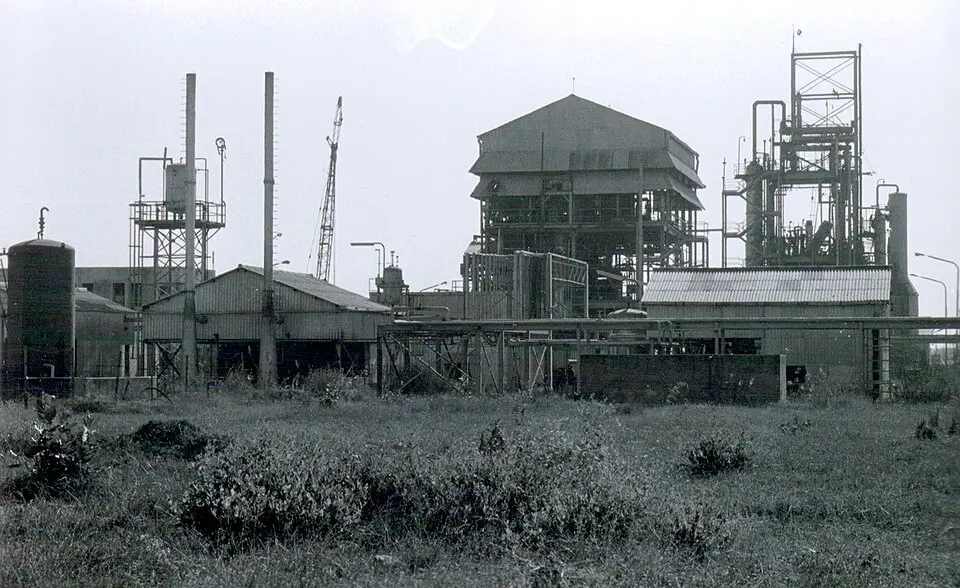
- The event. On the night of 2 to 3 December 1984, about 40 tonnes of methyl isocyanate escaped from a storage tank at the Union Carbide India Limited pesticide plant in Bhopal after water entered the tank and set off a runaway reaction. The refrigeration, scrubber and flare that should have contained it were not working. The Madhya Pradesh government confirmed 3,787 deaths, later estimates are far higher, and hundreds of thousands were exposed.
- Justice and its limits. The Bhopal Gas Leak Disaster (Processing of Claims) Act 1985 made the Union government the sole representative of the victims, and in 1989 the Supreme Court recorded a settlement of 470 million dollars with Union Carbide. In 2010 a Bhopal court convicted seven former officials of the Indian company of causing death by negligence, and in 2023 the Supreme Court rejected the Centre's curative petition for more compensation.
- The Environment (Protection) Act (EPA) 1986 was passed as an umbrella law that lets the Centre make rules for hazardous substances; most of what follows was made under it.
- M C Mehta v Union of India (1986). Deciding on an oleum gas leak from a Delhi fertiliser plant in December 1985, the Supreme Court held that an enterprise engaged in hazardous activity is absolutely liable for harm caused by an accident, with none of the exceptions of the English rule of strict liability, and that compensation must match the size and capacity of the enterprise.
- The Factories Act 1948 was amended in 1987 to add a chapter on hazardous processes, covering siting, disclosure to workers and medical checks. Since 21 November 2025 these provisions sit in the Occupational Safety, Health and Working Conditions Code 2020.
- The Manufacture, Storage and Import of Hazardous Chemical (MSIHC) Rules 1989 require MAH units to notify their sites, prepare safety reports and on site plans, and inform the public nearby, and they make the District Collector responsible for the off site plan.
- The Public Liability Insurance Act (PLIA) 1991 obliges every owner handling hazardous substances to take insurance, so that victims receive fixed immediate relief without proving fault; a 1992 amendment added an Environment Relief Fund.
- The Chemical Accidents (Emergency Planning, Preparedness and Response) Rules 1996 created crisis groups at four levels, central, State, district and local, to plan for and respond to chemical accidents.

LG Polymers, Visakhapatnam, May 2020
- In the early hours of 7 May 2020, styrene vapour escaped from a storage tank at the LG Polymers plant in Visakhapatnam as the plant prepared to restart after the Covid lockdown; the stored styrene had heated and begun to polymerise. About a dozen people died and hundreds fell ill in nearby villages. The State's High Power Committee found negligence, poor safety practice and a siren system that did not work, and the National Green Tribunal ordered an interim payment of Rs 50 crore. The lesson was that a long shutdown is itself a hazard, so restart needs as much care as normal operation.
NDMA guidelines
- The National Disaster Management Authority (NDMA) issued guidelines on chemical disasters (industrial) in 2007, covering siting, safety audits, off site plans, medical preparedness and community awareness, and separate guidelines on chemical terrorism in 2009.
Nuclear and radiological emergencies
- Who is responsible. The Department of Atomic Energy (DAE) is the nodal agency for nuclear and radiological emergencies, and its Crisis Management Group is activated for any such emergency in the public domain and mobilises technical help. NDMA's guidelines on the management of nuclear and radiological emergencies (2009) set out the roles of the Centre, States and districts.
- The regulator. The Atomic Energy Regulatory Board (AERB), set up in 1983, licenses plants and radiation sources and reviews emergency plans, and it became a statutory body under the SHANTI Act 2025, which also replaced the Civil Liability for Nuclear Damage Act 2010. Reactor safety, liability caps and the Act's details are in the S&T note on nuclear power safety and the future.
- Emergency planning around plants. Around each nuclear power plant there is an exclusion zone of 1.6 km with no public habitation, a sterilised zone up to 5 km where growth of population is restricted, and an emergency planning zone up to 16 km. The off site emergency plan for that zone, led by the district authority, covers sheltering, distribution of potassium iodide tablets that stop the thyroid taking up radioactive iodine, and evacuation, and an off site exercise is held at each plant once every two years.
- Mayapuri, April 2010. A gamma irradiator containing cobalt 60, auctioned as scrap by a Delhi university, was broken open in a scrap market in west Delhi; one worker died and several were injured. The lesson was that the likeliest radiological emergency is not a reactor accident but a lost or discarded source, so tracking every source from purchase to disposal matters.
Issues and way forward
- Plans on paper. Many districts with MAH units have off site plans that are outdated or never rehearsed, and the Comptroller and Auditor General (CAG) found in 2012 that AERB had no power to make States fix gaps found in nuclear off site exercises. Annual drills with the public, published results and penalties for neglect would make plans real.
- Too few inspectors. State factory inspectorates are thinly staffed and inspect rarely, so compliance rests on self certification. Risk based inspection that targets MAH units and small chemical clusters, backed by digital records, would spread scarce inspectors where risk is highest.
- Land use around plants. Towns grow up to factory fences, so even a small leak harms many. Buffer zones must be enforced in master plans, and new hazardous units should be kept out of dense areas.
- Slow and small compensation. PLIA relief amounts are small and victims still wait years for full damages. Updating the relief schedule and fast tracking claims before the National Green Tribunal would give absolute liability real force.
- Radiation sources and nuclear expansion. Industrial and medical sources are scattered across hospitals and workshops, and the opening of nuclear power to private operators raises the stakes. AERB's independence, source tracking and drilled off site plans at every new site must keep pace.
Common confusions
- Strict and absolute liability. Strict liability, from the English case of Rylands v Fletcher (1868), removes the need to prove fault but allows defences such as an act of God, while absolute liability, from M C Mehta (1986), allows no such exceptions.
- On site and off site plans. The on site plan is the occupier's duty and covers the factory premises, while the off site plan is the district administration's duty and covers the people outside.
- PLIA relief and full compensation. PLIA gives fixed immediate relief without proof of fault, while full damages are claimed separately through courts or the National Green Tribunal.
- Nuclear and radiological emergency. A nuclear emergency involves a reactor or fuel facility, while a radiological emergency involves a radiation source outside such a facility, as at Mayapuri.
For the exam
- Keyword bank: man made disaster, methyl isocyanate, runaway reaction, absolute liability, no fault liability, major accident hazard unit, safety report, on site and off site emergency plan, crisis groups, Environment Relief Fund, Crisis Management Group, emergency planning zone, potassium iodide, orphan radiation source, statutory regulator.
- Previous year questions: Practise the previous year questions on this topic →
- Use in an answer:
- Introduction with data: About 40 tonnes of methyl isocyanate leaked at Bhopal on the night of 2 to 3 December 1984, and the State government alone confirmed 3,787 deaths, making it the worst industrial disaster in India.
- Introduction with a judgement: In M C Mehta v Union of India (1986) the Supreme Court held that an enterprise carrying on hazardous activity is absolutely liable for any harm it causes, with no exceptions.
- Conclusion: India wrote strong laws after Bhopal, but Visakhapatnam in 2020 showed that the gap lies in inspection, drills and land use, not in the statute book.
- Conclusion: As nuclear power opens to private operators under the SHANTI Act 2025, an independent regulator and rehearsed off site plans must grow with it, so that the lessons of Bhopal are not learnt again.