Irrigation and water for agriculture
- Syllabus
- Different types of irrigation and irrigation systems
- As of
- October 2026
- irrigation potential
- gross and net irrigated area
- canal irrigation
- tube wells
- stage of groundwater extraction
- micro irrigation
- Per Drop More Crop
- Pradhan Mantri Krishi Sinchayee Yojana
- Accelerated Irrigation Benefit Programme
- command area development
- water use efficiency
- volumetric pricing
- participatory irrigation management
- PM-KUSUM
The first principle
Irrigation turns farming from a bet on the monsoon into a decision the farmer controls: it lets a second crop grow in the dry season, lets seed and fertiliser pay off, and steadies income in a bad year. But water given to a field has a cost, either in the dam and canal that store and carry it or in the aquifer that it is pumped from, and when that cost is not charged to the user, water is overused where it is cheapest to pump rather than where it is most valuable. Irrigation policy in India is the story of building access first and only later learning to manage what was built.
The core
Sources and how much land they water
- Coverage. India's gross irrigated area, which counts land irrigated twice in a year twice, was about 102.7 million hectares in 2018-19 (Land Use Statistics, Ministry of Agriculture and Farmers Welfare), and a little over half of the net sown area of about 140 million hectares is irrigated. The ultimate irrigation potential, the most that could be irrigated from all sources, is put at about 140 million hectares, so a large gap remains in rainfed regions.
- Groundwater is now the main source. Tube wells and other wells water more than 60 per cent of the irrigated area, and close to nine tenths of the groundwater India pumps goes to irrigation (Central Ground Water Board, CGWB). The reason is control: a tube well delivers water when the farmer wants it, a canal on a fixed rotation.
- Canals from major and medium dams water about a quarter of the irrigated area, mainly in Punjab, Haryana, Uttar Pradesh, Andhra Pradesh and the deltas, and tanks, once the backbone of the south, now water only a small share because many have silted up or been encroached.
- Major, medium and minor projects. Projects with a culturable command area above 10,000 hectares are major, those of 2,000 to 10,000 hectares medium and those below 2,000 hectares minor; minor irrigation includes all groundwater schemes and small surface schemes.
Methods and water use efficiency
- Surface or flood irrigation fills furrows, basins or whole fields, and much of the water seeps below the roots, evaporates or runs off, so only about a third to two fifths of the water reaches the crop in a typical canal system.
- Sprinkler irrigation sprays water like rain and suits uneven land and crops such as wheat, pulses and vegetables, while drip irrigation delivers water through pipes and emitters at the root, reaching efficiencies of about 90 per cent and allowing fertiliser to be applied with water (fertigation).
- Water use efficiency is the useful output, such as crop yield, per unit of water used. Figure 1 shows why the method matters: the same crop that needs 5,000 cubic metres of water at the root requires about 12,500 cubic metres by flood but about 5,600 by drip.
Dimensions
- Productivity and income. Irrigated land carries a second crop and responds to seed and fertiliser, which is why the green revolution spread first where canals and tube wells existed.
- Groundwater depletion. The CGWB's 2025 assessment put the national stage of extraction at 60.63 per cent, but 730 of 6,762 assessment units (10.8 per cent) were over exploited, drawing more than recharge, clustered in Punjab, Haryana, Rajasthan, western Uttar Pradesh and parts of Tamil Nadu and Karnataka. Figure 2 sets out the grades; the water resources note covers the assessment in full.
- Energy. Groundwater irrigation runs on electricity, and free or flat rate power for farms, given in Punjab since 1997 and in several other States, means that pumping more costs the farmer nothing, so power subsidies and the losses of distribution companies are tied to the water table.
- Equity. As water tables fall, deeper bores and bigger pumps are affordable only to larger farmers, so small farmers lose access to a shared aquifer, and in canal systems tail end farmers get less water than head reach farmers.
- Federal and legal. Water is in the State List (Entry 17), so States set canal water rates and groundwater laws, while under the Indian Easements Act 1882 the right to groundwater goes with ownership of the land, which makes a well private even though the aquifer is shared.
- Environmental. Over irrigation in canal commands causes waterlogging and salinity, as in parts of Punjab, Haryana and the Indira Gandhi canal area of Rajasthan, while over pumping dries springs and the lean season flow of rivers.
In practice
Pradhan Mantri Krishi Sinchayee Yojana
- The scheme. The Pradhan Mantri Krishi Sinchayee Yojana (PMKSY), launched in July 2015 with the slogans "Har Khet Ko Pani" (water to every field) and "More crop per drop", brought existing irrigation programmes under one umbrella. Its phase for 2021-26 was approved in December 2021 with an outlay of Rs 93,068 crore.
- Its components. The Accelerated Irrigation Benefit Programme (AIBP), running since 1996-97, funds the completion of unfinished major and medium projects; Har Khet Ko Pani funds command area development, surface minor irrigation, the repair, renovation and restoration of water bodies and groundwater development in suitable areas; and watershed development, under the Department of Land Resources, conserves soil and water in rainfed areas.
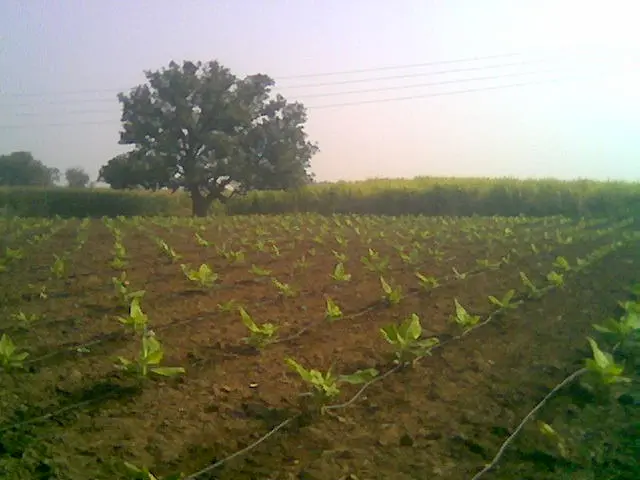
- Per Drop More Crop (PDMC), the micro irrigation component, has been run under the Rashtriya Krishi Vikas Yojana since 2022-23. It pays 55 per cent of the cost of drip or sprinkler systems for small and marginal farmers and 45 per cent for others, up to five hectares, and since 2015-16 it has brought roughly one crore hectares under micro irrigation, still less than a tenth of the net sown area. Impact studies cited by the Ministry of Agriculture and Farmers Welfare found water savings of 20 to 48 per cent and yield gains of 20 to 38 per cent.

Power and water
- Separate feeders. Gujarat's Jyotigram Yojana, begun in 2003, separated farm feeders from village feeders, so homes got power round the clock while farm power was rationed to fixed hours, which cut both power losses and over pumping.
- Solar pumps. The Pradhan Mantri Kisan Urja Suraksha evam Utthan Mahabhiyan (PM-KUSUM), launched in 2019, funds solar power plants on farm land, standalone solar pumps and the solarisation of grid connected pumps, so that a farmer can sell surplus power instead of pumping it into the ground.
- Groundwater regulation and community management. The Central Ground Water Authority regulates industrial and infrastructure use but exempts farmers, so the Atal Bhujal Yojana (from 2020) tried community water budgets in water stressed gram panchayats, as the water resources note explains.
Issues and way forward
- Water priced near zero. Canal water rates set by States are low, often unrevised for years and poorly collected, so they cover only a small part of operation and maintenance and canals decay; the National Water Policy 2012 asked for water to be priced to cover at least those costs and for charges to be set by volume, so that users pay for what they take.
- Unfinished projects and the gap between potential and use. Dams are built but field channels lag, so irrigation potential created exceeds the area actually irrigated; completing command area development, as AIBP and Har Khet Ko Pani try to do, gives more water per rupee than new dams.
- Users left out of management. Canals run by distant departments serve the head reach first, so participatory irrigation management, in which water user associations of farmers take over distribution and fee collection, as State laws in Andhra Pradesh (1997) and Maharashtra (2005) allow, is the standard reform.
- Fragmented institutions. Surface water and groundwater are managed by separate bodies, so the committee under Mihir Shah (2016) recommended merging the Central Water Commission and the CGWB into a National Water Commission that manages each basin as one system.
- Crop choice. Paddy and sugarcane in dry regions use water that a pulse or millet would not need, so diversification payments, procurement of less thirsty crops and pricing of power are needed alongside micro irrigation; otherwise water saved by drip is simply used to irrigate more land.
Common confusions
- Gross and net irrigated area. Net irrigated area counts each irrigated field once, while gross irrigated area counts it once for each crop irrigated in the year, so gross divided by net gives irrigation intensity.
- Irrigation potential created and utilised. Potential created is what the dams and canals could water, while potential utilised is what they actually water, and the gap usually lies in missing field channels.
- Water use efficiency and water productivity. Efficiency is the share of water applied that the crop actually uses, while productivity is the crop or value produced per cubic metre of water, so a drip system raises the first and a better crop choice raises the second.
- Micro irrigation and minor irrigation. Micro irrigation is a method, drip or sprinkler, while minor irrigation is a class of project, any scheme with a command area below 2,000 hectares, including tube wells.
For the exam
- Keyword bank: ultimate irrigation potential, gross and net irrigated area, command area development, potential created and utilised, stage of groundwater extraction, over exploited unit, micro irrigation, fertigation, water use efficiency, Per Drop More Crop, Accelerated Irrigation Benefit Programme, volumetric pricing, participatory irrigation management, separate feeders, PM-KUSUM.
- Previous year questions: Practise the previous year questions on this topic →
- Use in an answer:
- Introduction with data: Groundwater waters more than 60 per cent of India's irrigated land, and 730 of the country's 6,762 groundwater units are over exploited (CGWB, 2025).
- Introduction with a report: The National Water Policy 2012 asked that water for irrigation be priced at least to cover the cost of operation and maintenance, and charged by volume.
- Conclusion: India has built the dams and wells it needs, so the gains of the next decade will come from delivering water to every field, pricing power and water sensibly and growing more crop per drop.
- Conclusion: Irrigation that ignores the aquifer only borrows from the future, so supply schemes and demand management must move together.