Water resources and conservation
- Syllabus
- Conservation, environmental pollution and degradation, environmental impact assessment
- As of
- October 2026
- water budget
- per capita water availability
- stage of groundwater extraction
- over exploited unit
- Dynamic Ground Water Resources assessment
- Central Ground Water Authority
- Atal Bhujal Yojana
- Jal Shakti Abhiyan
- Catch the Rain
- rainwater harvesting
- water footprint
- virtual water
- interlinking of rivers
- Ken–Betwa link
The first principle
Fresh water is a renewable resource only up to the rate at which rain renews it. A river or an aquifer can supply, year after year, roughly what flows into it, and any draw beyond that is taken from storage that took decades or centuries to fill. India's water problem therefore is less a shortage of rain than a mismatch: rain falls in about four months, in a few places, while use is spread over the whole year and concentrated where water is scarce. Conservation means bringing the draw back within the renewal, by storing more of the monsoon and wasting less of it.
The core
India's water budget
- Most rain never becomes usable water. India receives about 4,000 billion cubic metres (bcm) of precipitation a year, but much of it evaporates or runs off in floods, so the Central Water Commission (CWC) puts the average annual water resource of the country's river basins at about 1,999 bcm. Because of the terrain and the timing of the monsoon, only about 1,122 bcm can be put to use, roughly 690 bcm from surface water and 432 bcm from replenishable groundwater.
- Availability per person is falling with population. The CWC's 2019 reassessment puts per capita availability at 1,486 cubic metres a year in 2021 and 1,367 in 2031. Below 1,700 cubic metres a country is called water stressed, and below 1,000 it is water scarce, so India is already stressed and some basins in the west and south, such as the Sabarmati, are scarce.
- India has 18 per cent of the world's people but about 4 per cent of its fresh water. NITI Aayog's Composite Water Management Index of 2018 estimated that about 600 million Indians faced high to extreme water stress.
Groundwater and its assessment
- India is the largest user of groundwater in the world. Groundwater irrigates more than 60 per cent of the irrigated area and supplies most rural drinking water, and close to nine tenths of what is pumped goes to irrigation.
- The assessment. The Central Ground Water Board (CGWB) and the States assess every block, taluk or mandal, and since 2022 they do it every year. The 2025 assessment put annual recharge at 448.52 bcm, the extractable resource at 407.75 bcm and actual extraction at 247.22 bcm, so the national stage of extraction was 60.63 per cent.
- The stage of extraction is the annual draw divided by the annual extractable resource, and it sorts every unit into four grades: safe below 70 per cent, semi critical from 70 to 90 per cent, critical from 90 to 100 per cent, and over exploited above 100 per cent, where more is pumped than the rain puts back. Units with brackish groundwater are listed separately as saline.
- The national average hides the hotspots. In 2025, 730 of 6,762 units (10.8 per cent) were over exploited, against 17.2 per cent in 2017, but they are clustered in Punjab, Haryana, Rajasthan, western Uttar Pradesh and parts of Tamil Nadu and Karnataka, where the water table falls every year.
Dimensions
- Economic. Tube wells made the Green Revolution possible because the farmer controls when water reaches the crop, but free or flat rate farm power removes any cost of pumping more.
- Food and crop choice. Paddy and sugarcane, procured at assured prices, are grown in dry regions such as Punjab and Maharashtra, so India in effect exports large volumes of its scarce water inside rice and sugar.
- Social. Falling water tables push wells beyond the reach of small farmers, women spend hours fetching water where taps run dry, and arsenic, fluoride and uranium in deep aquifers harm health, as the water pollution note explains.
- Federal and legal. Water is in the State List (Entry 17, subject to Entry 56 of the Union List on inter State rivers), so the Centre can guide but not directly govern most water use, and disputes over shared rivers go to tribunals under Article 262 and the Inter State River Water Disputes Act 1956.
- Ecological. Over pumping dries springs and the base flow of rivers in the lean season, lets sea water intrude into coastal aquifers, and can make the land subside.
In practice
Who regulates groundwater
- The landowner owns the water under the land. Under the Indian Easements Act 1882 the right to groundwater goes with the land, so a well is private property even though the aquifer is shared by all.
- The Central Ground Water Authority (CGWA) was constituted in 1997 under Section 3(3) of the Environment (Protection) Act 1986, on the direction of the Supreme Court in M C Mehta v Union of India. Under its guidelines of 24 September 2020 it issues no objection certificates for groundwater use by industry, infrastructure and mining projects, charges for abstraction and sets stricter conditions in over exploited units, while farmers and individual households are exempt.
- States act through their own laws, built on a model groundwater bill that the Centre has circulated since 1970, and through compulsory rainwater harvesting in buildings, which Tamil Nadu made mandatory in 2003.
- The public trust doctrine, applied by the Supreme Court in M C Mehta v Kamal Nath (1997), holds that the state is the trustee of natural resources such as water for the public.
Programmes
- Atal Bhujal Yojana (Ministry of Jal Shakti) began in 2020 as a five year scheme, part funded by the World Bank, in 8,203 water stressed gram panchayats of 80 districts in seven States: Gujarat, Haryana, Karnataka, Madhya Pradesh, Maharashtra, Rajasthan and Uttar Pradesh. Its idea was demand management by the community, since villages measured their own water and wrote water security plans.
- Jal Shakti Abhiyan, begun in 2019 in 1,592 water stressed blocks of 256 districts, became the yearly campaign "Catch the Rain" in 2021, with the slogan "catch the rain, where it falls, when it falls". Jal Sanchay Jan Bhagidari (September 2024) mobilises communities and industry to build recharge structures, and Mission Amrit Sarovar (2022) has built or revived nearly 69,000 ponds.
- The National Water Mission under the National Action Plan on Climate Change aims to raise water use efficiency by 20 per cent, and the CGWB's aquifer mapping programme gives each area a management plan.
Rainwater harvesting and traditional systems
- Rooftop harvesting sends rain from roofs into tanks or recharge pits, and check dams slow runoff so that it soaks in.
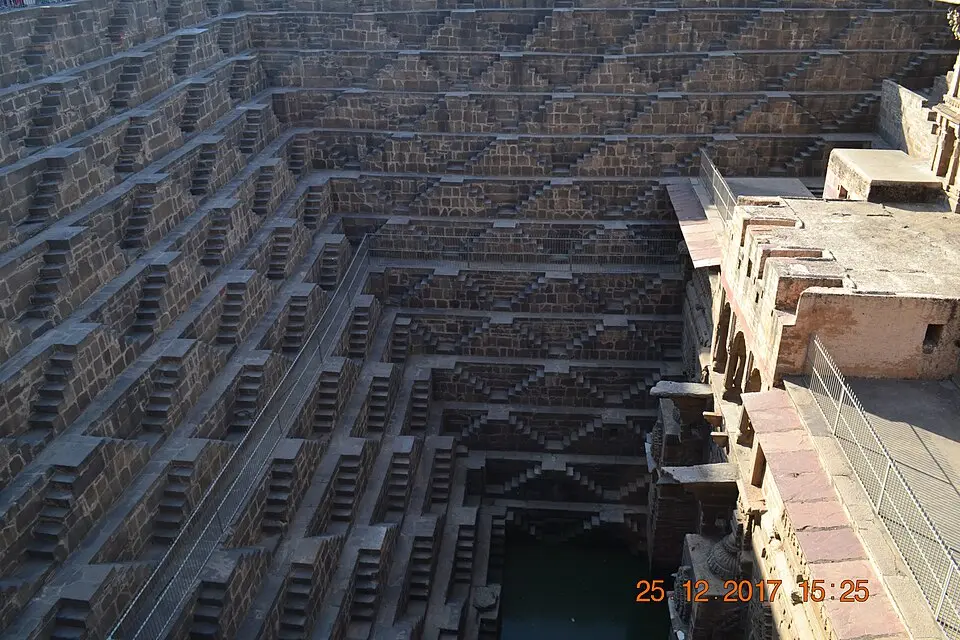
- Traditional systems did the same: johads and taankas in Rajasthan, stepwells (baolis) in western India, eris (tanks) in Tamil Nadu, ahar pynes in south Bihar, kuhls in Himachal Pradesh, zings in Ladakh and bamboo drip irrigation in Meghalaya.

Water footprint and river interlinking
- Water footprint is the total fresh water used to make a product, counted in three parts: green water (rain held in the soil), blue water (drawn from rivers and aquifers) and grey water (the water needed to dilute the pollution it causes). Virtual water is the same idea applied to trade, since exporting a crop exports the water used to grow it.
- The National Perspective Plan of 1980 identified 30 river links, 16 in the peninsula and 14 in the Himalaya, to move water from surplus to deficit basins.
- The Ken–Betwa link is the first to be built. A dam at Daudhan on the Ken, inside the Panna Tiger Reserve, will send water to the Betwa basin to irrigate about 10.62 lakh hectares in Bundelkhand and supply drinking water to about 62 lakh people, at a cost of Rs 44,605 crore (2020-21 prices). The Prime Minister laid its foundation stone on 25 December 2024, and completion is planned for March 2030.
Issues and way forward
- Ownership tied to land. As long as the well is private and the aquifer common, each farmer pumps before the neighbour does, so the recommendation of water experts, reflected in the draft National Water Policy prepared by a committee under Mihir Shah, is to manage groundwater as a shared resource at the level of the aquifer, with users taking part.
- Free power and the crop mix. Flat rate electricity and assured procurement of paddy reward pumping, so separate feeders for farm power, solar pumps that let farmers sell surplus power, and support for millets and pulses in dry regions are the levers.
- Weak data and enforcement. Few wells are metered and the CGWA regulates only industry, so metering, a public water account for every panchayat on the Atal Bhujal model, and local water budgets are needed.
- Supply bias. Large dams and river links promise water but take decades and carry ecological costs, such as the loss of tiger habitat in Panna, while demand side steps such as micro irrigation, reuse of treated urban waste water and fixing leaking city pipes are cheaper per litre saved.
- Recharge without upkeep. Many structures silt up within a few seasons, so maintenance and siting by aquifer maps matter as much as new building.
Common confusions
- Water stress and water scarcity. Stress means per capita availability below 1,700 cubic metres a year and scarcity below 1,000; India as a whole is stressed, while some basins are scarce.
- Recharge and extractable resource. Recharge is what enters the aquifer each year, and the extractable resource is recharge minus the natural outflow that must be left to sustain rivers and springs, so the stage of extraction is measured against the smaller number.
- CGWB and CGWA. The CGWB is the scientific body that monitors and assesses groundwater, while the CGWA is the regulator created under the Environment (Protection) Act that issues permissions.
For the exam
- Keyword bank: water budget, per capita availability, water stress, stage of extraction, over exploited unit, Dynamic Ground Water Resources assessment, Central Ground Water Authority, public trust doctrine, Atal Bhujal Yojana, Catch the Rain, Jal Sanchay Jan Bhagidari, rainwater harvesting, water footprint, virtual water, Ken–Betwa link.
- Previous year questions: Practise the previous year questions on this topic →
- Use in an answer:
- Introduction with data: India's per capita water availability has fallen to about 1,486 cubic metres a year, below the stress line of 1,700, and 730 of its 6,762 groundwater assessment units are over exploited (CWC, 2019; CGWB, 2025).
- Introduction with a judgement: In M C Mehta v Kamal Nath (1997) the Supreme Court held that the state holds natural resources such as water in trust for the public, and the Central Ground Water Authority itself was created on the Court's direction.
- Conclusion: India's water problem is one of management more than of rain, so storing the monsoon, pricing power sensibly and letting villages budget their own aquifers will do more than any single dam or canal.
- Conclusion: Groundwater is a commons drawn as private property, and until law and incentives treat the aquifer as shared, recharge structures will only slow a decline that pumping drives.