Sustainable agriculture
- Syllabus
- Conservation, environmental pollution and degradation, environmental impact assessment
- As of
- October 2026
- sustainable agriculture
- regenerative agriculture
- NPK ratio
- soil organic carbon
- integrated nutrient management
- integrated pest management
- natural farming
- conservation agriculture
- Happy Seeder
- alternate wetting and drying
- direct seeded rice
- millets
- agroforestry
- climate smart agriculture
- National Mission on Natural Farming
The first principle
A farm is an ecosystem that we harvest, and every harvest carries nutrients, water and carbon out of the field. Farming is sustainable only when what is taken out is put back at the rate it is removed, through nitrogen fixation, decomposition and recharge, or through inputs that do not damage the soil, water and air the next crop depends on. The green revolution raised yields by bringing nutrients and water in from outside the field, which worked for a generation, but it drew down stocks such as groundwater and soil carbon that cannot be rebuilt quickly.
The core
Why green revolution farming became unsustainable
- A narrow package. From the mid 1960s dwarf wheat and rice were bred to respond to heavy fertiliser and assured water, and assured procurement, cheap urea and free or flat rate farm power made the rice wheat rotation the safest choice in Punjab and Haryana.
- Groundwater mined. Paddy grown on tube wells in the dry north west lowers the water table every year; the water resources note covers the assessment.
- Soil carbon run down. Intensive tillage, burnt residue and little manure have left organic carbon low: on the Soil Health Card dashboard for 2023 to 2025, about 48.5 per cent of some 1.3 crore samples were low in organic carbon and 64 per cent low in nitrogen (Centre for Science and Environment, 2025). Organic carbon holds water, feeds soil microbes and binds nutrients.
- A skewed NPK ratio. The agronomic benchmark for nitrogen, phosphorus and potassium (N:P:K) is about 4:2:1. The Economic Survey 2025-26 put India's ratio at about 7:2.8:1 in 2019-20 and 10.9:4.1:1 in 2023-24, after it had been close to the benchmark around 2009-10, because urea is priced far below other fertilisers; surplus nitrogen leaks as nitrate and nitrous oxide while potassium, sulphur and zinc run short.
- A pesticide treadmill. Calendar spraying kills natural predators and selects for resistance, as when pink bollworm overcame Bt cotton, so farmers spray more and leave residues.
- Residue burning. Paddy stubble is burnt to clear fields for wheat in a short window; the air pollution note covers the smoke.
- Emissions. In India's Fourth Biennial Update Report (2024), agriculture made 13.72 per cent of national greenhouse gas emissions in 2020; within it, enteric fermentation in cattle and buffalo gave about 55 per cent, soils about 23 per cent and rice about 17 per cent. Cattle guts and flooded paddy both emit methane, made by methanogenic archaea that break down organic matter where there is no oxygen.
Principles
- Sustainable agriculture meets today's food needs without degrading the soil, water and biodiversity that tomorrow's depend on, while regenerative agriculture aims to rebuild soil through four practices that recur below: keep the soil covered, disturb it little, keep living roots in it most of the year, and diversify crops and animals so that the system, not the bag, manages nutrients and pests.
The approaches and their science
- Organic farming replaces synthetic fertilisers and pesticides with compost, manure, green manure, rotation and biological control, and is certified, for the home market mainly through the Participatory Guarantee System (PGS) India, in which farmers inspect one another.
- Natural farming buys almost nothing from outside the farm. Its best known form, Subhash Palekar's zero budget natural farming, rests on jeevamrutha, a fermented culture of dung, urine, jaggery, pulse flour and soil that stimulates soil microbes; beejamrutha, a seed treatment; acchadana, mulching; and whapasa, keeping soil moist and aerated.
- The yield debate. A harvest removes nitrogen that a microbial culture cannot supply, so yields depend on legumes and biological fixation making up the balance. A 2019 policy brief of the National Academy of Agricultural Sciences called the method an unproven technology for want of data, and the Indian Council of Agricultural Research (ICAR) has run field trials since 2017; Sri Lanka's sudden ban on chemical fertilisers in April 2021, partly reversed by November amid crop losses, shows the risk of an abrupt switch.
- Integrated nutrient management (INM) combines chemical fertiliser with manure, green manure such as Sesbania and biofertilisers such as Rhizobium and Azotobacter, in doses set by a soil test.
- Integrated pest management (IPM) scouts and traps pests, sprays only when damage would cost more than control (the economic threshold level), and relies first on resistant varieties, rotation, pheromone traps and natural enemies such as Trichogramma.
- Crop diversification and millets. Pearl millet, sorghum and finger millet use the C₄ pathway, which fixes carbon efficiently in heat and loses less water, so they yield on poor rainfed soils, and they are richer than polished rice in fibre, iron and calcium; pulses in rotation fix their own nitrogen.
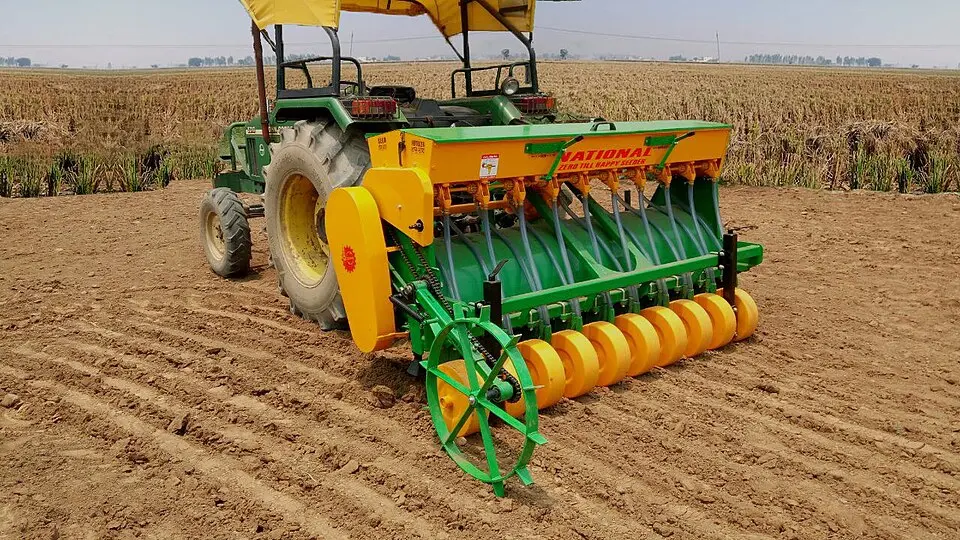
- Conservation agriculture rests on three principles of the Food and Agriculture Organization (FAO): minimum soil disturbance, permanent soil cover and crop rotation. In zero tillage wheat is drilled into an unploughed field, and the Happy Seeder, developed at Punjab Agricultural University with Australian support, cuts the paddy straw and sows through it, leaving a mulch that saves moisture and adds carbon.
- Agroforestry grows trees with crops or livestock, so deep roots recycle nutrients and timber, fruit and fodder spread risk.
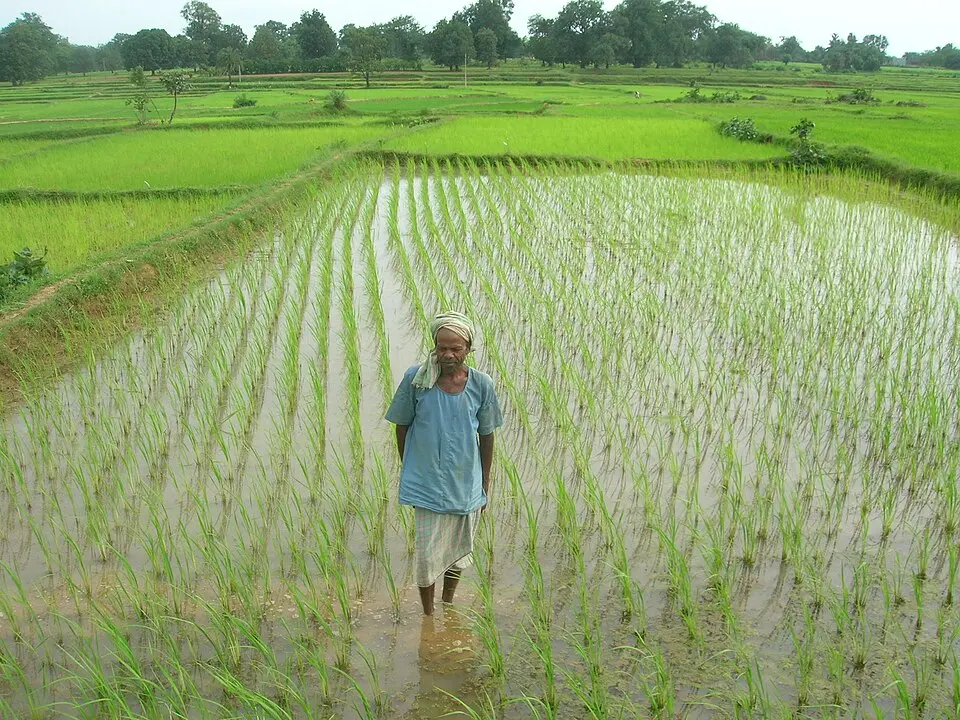
- Rice without standing water. The system of rice intensification (SRI), developed in Madagascar in the 1980s, transplants single young seedlings at wide spacing into moist rather than flooded soil, while direct seeded rice (DSR) is drilled as seed and skips puddling and transplanting.
- Alternate wetting and drying (AWD) lets field water fall to 15 centimetres below the surface before flooding again, saving about 15 to 30 per cent of irrigation water and 30 to 70 per cent of methane without loss of yield (International Water Management Institute).
- Micro irrigation by drip and sprinkler is covered in the irrigation note, and climate smart agriculture, an FAO framework, asks every practice to raise productivity, aid adaptation and cut emissions together.
Dimensions
- Ecological. Practices that add soil carbon also raise water holding, nutrient cycling and the diversity of soil life, pollinators and natural enemies of pests.
- Economic and fiscal. Fewer bought inputs lower costs and debt, and urea saved trims one of the largest subsidies in the Union budget, but lower yields during conversion can erase the gain.
- Health and climate. Nitrate in wells, pesticide residues and smoke are costs borne by people who do not farm, while AWD, zero tillage and agroforestry serve both adaptation and mitigation.
- Food security. Lower national staple yields would raise imports and prices, so the change must go region by region.
In practice
- National Mission for Sustainable Agriculture (NMSA), Ministry of Agriculture and Farmers Welfare, from 2014-15: one of the eight missions of the National Action Plan on Climate Change (2008), it funds rainfed area development, soil health and adaptation, and houses the Sub Mission on Agroforestry; India's National Agroforestry Policy of 2014 was the first in the world.
- Paramparagat Krishi Vikas Yojana (PKVY), from 2015 under the NMSA, groups farmers in 20 hectare clusters and gives Rs 31,500 per hectare over three years, Rs 15,000 of it directly for organic inputs; by February 2025 it covered about 15 lakh hectares in 52,289 clusters. Its sub scheme Bharatiya Prakritik Krishi Paddhati (2020-21) supported natural farming.
- Soil Health Card scheme, launched on 19 February 2015 at Suratgarh, Rajasthan, tests each holding for twelve parameters, from nutrients to pH and organic carbon, and recommends doses; since 2022-23 it is part of the Rashtriya Krishi Vikas Yojana.
- National Mission on Natural Farming (NMNF), approved by the Cabinet in November 2024 as a standalone centrally sponsored scheme of the Ministry of Agriculture and Farmers Welfare: Rs 2,481 crore up to 2025-26 (Centre Rs 1,584 crore, States Rs 897 crore) to reach 1 crore farmers and 7.5 lakh hectares through 15,000 clusters, 10,000 Bio Input Resource Centres and about 30,000 Krishi Sakhis and community resource persons.
- PM-PRANAM (Programme for Restoration, Awareness, Generation, Nourishment and Amelioration of Mother Earth), approved in June 2023 in a fertiliser package of the Ministry of Chemicals and Fertilizers, gives a State that cuts chemical fertiliser use 50 per cent of the subsidy saved as a grant.
- National Innovations in Climate Resilient Agriculture (NICRA), an ICAR project from February 2011, researches tolerant crops and demonstrates resilient practices in villages through Krishi Vigyan Kendras.
- Sikkim, declared India's first fully organic State in January 2016, phased out chemical inputs over more than a decade and won the FAO's Future Policy Award in 2018.
- Millets. At India's proposal the United Nations General Assembly declared 2023 the International Year of Millets, and India renamed millets Shree Anna.


Issues and way forward
- Prices point the wrong way. Cheap urea, free power and assured procurement of paddy reward the practices that degrade soil and water, so the Economic Survey 2025-26 suggested a higher urea price returned to farmers as a direct transfer; the subsidy note carries the detail.
- The transition gap. Yields often dip during conversion, so support must outlast three years, and payment for ecosystem services, such as a reward per hectare left unburnt, can bridge the gap.
- Thin evidence. Claims on natural farming rest on short trials, so long term ICAR trials with open yield, cost and soil data should guide its expansion.
- Trust in labels. A premium needs a trusted label, so cheaper group certification and residue testing are needed.
- Region by region. Rainfed, hill and tribal areas that already use few chemicals can turn organic at little cost to national output, while the irrigated north west first needs diversification out of paddy, conservation agriculture and AWD.
Common confusions
- Organic and natural farming. Organic farming allows bought organic inputs and is certified, while natural farming buys almost nothing.
- INM and organic farming. INM still uses chemical fertiliser in balanced, soil tested doses, while organic farming excludes it.
- Zero tillage and conservation agriculture. Zero tillage is one practice, while conservation agriculture needs all three principles together.
- SRI and DSR. SRI transplants young seedlings at wide spacing, while DSR does away with transplanting altogether.
For the exam
- Keyword bank: sustainable agriculture, regenerative agriculture, NPK ratio of 4:2:1, soil organic carbon, integrated nutrient management, integrated pest management, economic threshold level, natural farming, conservation agriculture, Happy Seeder, alternate wetting and drying, direct seeded rice, Shree Anna, climate smart agriculture.
- Previous year questions: Practise the previous year questions on this topic →
- Use in an answer:
- Introduction with data: India's fertiliser NPK ratio widened from about 7:2.8:1 in 2019-20 to 10.9:4.1:1 in 2023-24, against a benchmark of 4:2:1 (Economic Survey 2025-26).
- Introduction with a report: Nearly half of 1.3 crore soil samples on the Soil Health Card dashboard for 2023 to 2025 were low in organic carbon (Centre for Science and Environment, 2025).
- Conclusion: Sustainable farming is a return of carbon, nutrients and water to the soil, and India's missions will succeed only if prices, procurement and advice reward that return.
- Conclusion: A shift crop by crop and region by region, from rainfed areas to the irrigated north west, can protect both the soil and the food security the green revolution won.