Orbits and launch vehicles
- Syllabus
- Awareness in the fields of IT, space, computers, robotics, nano-technology, bio-technology; indigenisation of technology and developing new technology
- As of
- October 2026
- low earth orbit
- geostationary orbit
- geostationary transfer orbit
- Sun synchronous orbit
- Lagrange point
- orbital velocity
- escape velocity
- rocket equation
- specific impulse
- staging
- cryogenic engine
- semi cryogenic engine
- PSLV
- LVM3
- reusable launch vehicle
The first principle
A satellite in orbit is falling all the time, but it moves sideways so fast that the curved Earth drops away beneath it as quickly as it falls, so it never comes down. Orbits follow from this balance between gravity and sideways speed, and rockets follow from the cost of reaching that speed. A rocket gains speed only by throwing mass backwards, so most of it is propellant, and the higher the orbit, the larger the rocket a satellite needs.
The core
The physics of an orbit
- Orbital speed falls with height. In a circular orbit gravity supplies exactly the inward pull needed, giving a speed of √(GM/r), where G is the gravitational constant, M the Earth's mass and r the distance from the Earth's centre. This is about 7.9 km/s at the surface, 7.7 km/s at 400 km (a period of about 92 minutes) and only 3.1 km/s at geostationary height.
- Escape velocity is a different number. Orbital speed keeps a body circling, but to leave the Earth it needs √2 times that speed at the same height, about 11.2 km/s from the surface, so Chandrayaan and Mangalyaan raised their orbits step by step with engine burns instead of riding a bigger rocket.
- Low earth orbit (LEO) runs from about 160 km to 2,000 km. It is cheap to reach and close enough for sharp images and short signal delay, so the International Space Station, imaging satellites and internet constellations fly there, though each satellite sees only a small patch of Earth.
- Sun synchronous orbit (SSO) is a near polar LEO, inclined at about 98 degrees, whose plane turns about one degree a day because the Earth bulges at the equator. That turn keeps pace with the Earth's yearly journey round the Sun, so the satellite crosses each place at the same local time and its images can be compared pass to pass.
- Medium earth orbit (MEO) lies between the two and holds navigation constellations such as the Global Positioning System (GPS), at about 20,200 km.
- Geostationary orbit (GEO) is a circular orbit over the equator at 35,786 km above the surface, where the period equals one sidereal day (about 23 hours 56 minutes), so the satellite appears fixed. A fixed dish can point at it, which suits television, communication and weather watching, at the cost of about a quarter second of signal delay.
- Geostationary transfer orbit (GTO) is an ellipse with its low point a few hundred kilometres up and its high point at geostationary height. The launcher leaves the satellite there, and the satellite's own motor fires at the high point to make the orbit circular and remove its tilt.
- Lagrange points are five places in the Sun and Earth system where a spacecraft keeps its position relative to both bodies. L1, about 1.5 million km towards the Sun, gives Aditya-L1 an unbroken view of the Sun, while L2 on the far side hosts the James Webb Space Telescope.
How a rocket works
- The rocket equation sets the limit. The gain in speed equals the exhaust speed multiplied by the natural logarithm of the ratio of starting mass to final mass, so doubling the speed needed squares the mass ratio. A launch vehicle is therefore roughly 85 to 90 per cent propellant at lift off, and small gains in engine efficiency matter a great deal.
- Specific impulse measures that efficiency as the thrust produced per unit weight of propellant burnt each second, in seconds. In vacuum, solid motors give roughly 250 to 300 seconds, kerosene and liquid oxygen engines roughly 300 to 350, and liquid hydrogen with liquid oxygen about 440 to 460, which is why cryogenic upper stages carry far more to GTO.
- Staging throws away empty tanks and engines on the way up, so later stages push a lighter vehicle. Solid stages are simple and give large thrust for lift off but, once lit, generally cannot be throttled or stopped, while liquid stages can be throttled, shut down and sometimes restarted, which suits upper stages.
- Cryogenic propellants are liquid hydrogen kept below about 20 K and liquid oxygen below about 90 K. They give the highest efficiency of any chemical pair in use, but the cold, light hydrogen makes tanks bulky and engines hard to build; this is the technology India was denied in the 1990s and then built itself.
- Launching east from near the equator adds the Earth's spin, about 0.46 km/s at the equator, which is why Sriharikota sits low on India's east coast with the sea below the flight path.
Dimensions
- Economic. The price per kilogram decides how many satellites a country can afford and whether it can sell launches abroad, so reuse and launch rate matter as much as payload.
- Strategic. A country that cannot launch its own military, navigation and surveillance satellites depends on another's schedule and goodwill, and the same motors and guidance skills underpin missiles.
- Commercial. Since the reforms of 2020 and the Indian Space Policy 2023, private firms build rockets and parts while the Indian Space Research Organisation (ISRO) moves towards research.
- International. Launches for other countries through ISRO's company NewSpace India Limited (NSIL) earn foreign exchange and build ties, while spent stages add to orbital debris.
In practice
India's launch vehicles
- The Small Satellite Launch Vehicle (SSLV) has three solid stages and a small liquid velocity trimming module, and carries about 500 kg to a 500 km orbit. Its third developmental flight put the Earth observation satellite EOS-08 in orbit in August 2024. In June 2025 its technology was transferred to Hindustan Aeronautics Limited (HAL) for about Rs 511 crore, the first complete transfer of a launch vehicle's technology from ISRO to a company.
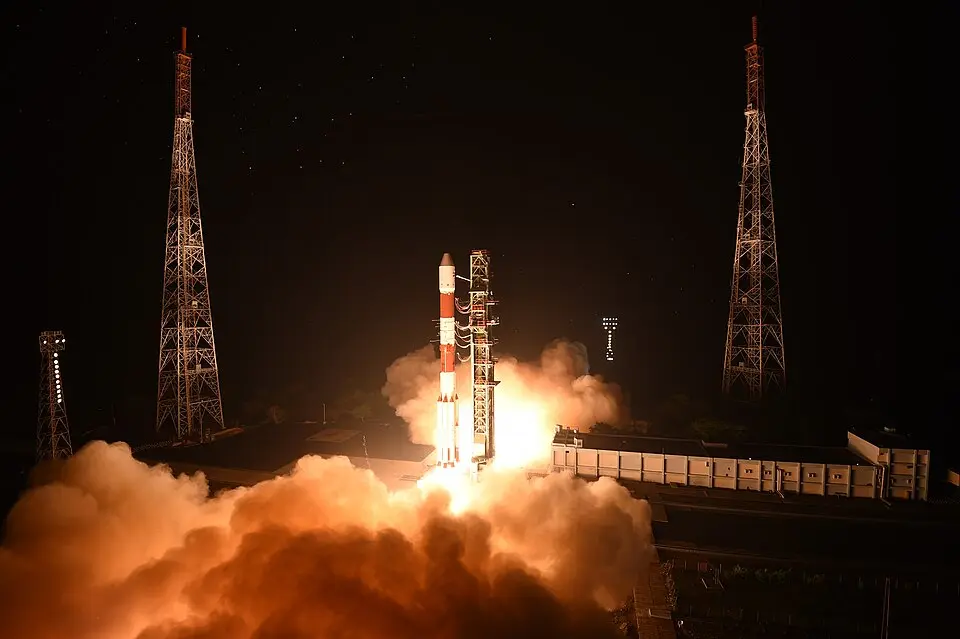
- The Polar Satellite Launch Vehicle (PSLV) has four stages that alternate solid, liquid, solid and liquid, with strap on boosters in most versions, and carries about 1,750 kg to a 600 km SSO. It launched Chandrayaan-1 (2008), the Mars Orbiter Mission (2013) and 104 satellites on one flight (2017). Trouble in the third stage cost PSLV-C61 its satellite EOS-09 in May 2025, and PSLV-C62 failed in the same stage in January 2026.
- The Geosynchronous Satellite Launch Vehicle (GSLV) Mk II has a solid core with four liquid strap on boosters, a liquid second stage and the indigenous CE-7.5 cryogenic upper stage, and carries about 2,250 kg to GTO. It launched the NASA–ISRO Synthetic Aperture Radar (NISAR), built with the United States National Aeronautics and Space Administration (NASA), on 30 July 2025.
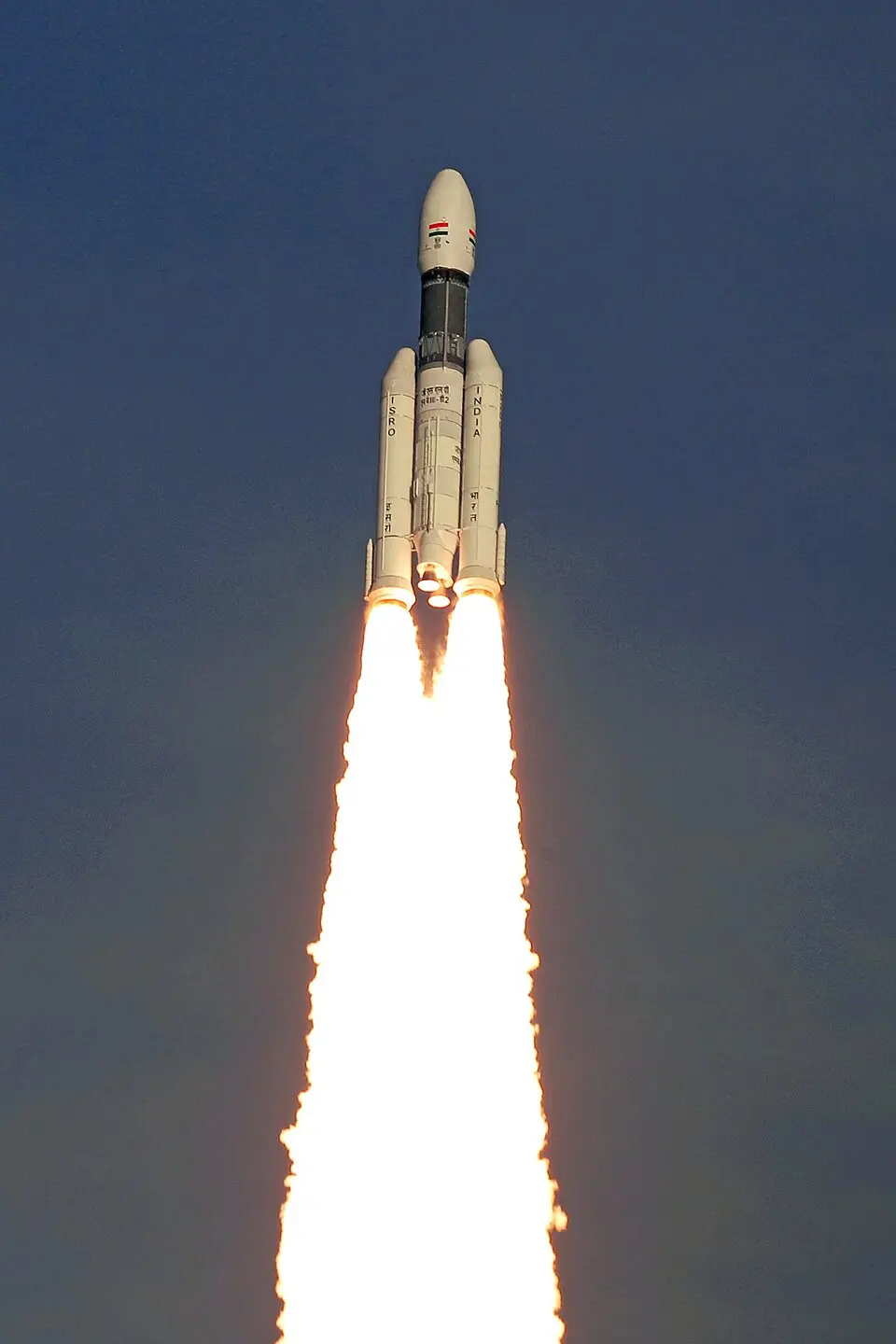
- LVM3, earlier called GSLV Mk III, has two S200 solid boosters, the L110 liquid core and the C25 cryogenic stage with the CE-20 engine, and carries about 4,000 kg to GTO and about 8,000 kg to LEO. It flew Chandrayaan-3 (2023) and the roughly 4,400 kg naval satellite CMS-03 to GTO (November 2025), and a human rated version will carry Gaganyaan.
- The Next Generation Launch Vehicle (NGLV), approved in September 2024 at Rs 8,240 crore, is designed to carry up to 30 tonnes to LEO with a reusable first stage, about three times LVM3's payload at about 1.5 times its cost, over 96 months of development.


Reuse, engines and launch sites
- Reusable launch vehicle (RLV) tests began with a hypersonic flight in 2016, and in the landing experiments of 2023 and 2024 a winged vehicle, Pushpak, was dropped from a helicopter and landed itself on a runway at Chitradurga. A semi cryogenic stage is being developed to replace the L110 and raise LVM3's payload.
- Sriharikota in Andhra Pradesh, home of the Satish Dhawan Space Centre, has two launch pads, and a Third Launch Pad for NGLV was approved in January 2025 at about Rs 3,985 crore, to be built in four years. A second spaceport for SSLV and private small rockets is being built at Kulasekarapattinam in Thoothukudi district of Tamil Nadu (foundation stone February 2024); from there rockets can fly due south to polar orbit without the payload sapping dogleg turn that Sriharikota launches make to avoid Sri Lanka.
- Private launchers have arrived. After suborbital flights by Skyroot Aerospace (Vikram-S, 2022) and Agnikul Cosmos (Agnibaan, 2024, with a single piece 3D printed engine), Skyroot's Vikram-1 reached orbit in July 2026, the first privately built Indian rocket to do so.
Issues and way forward
- Reliability of the workhorse. Two PSLV failures in eight months, both during the third stage burn, cost two Earth observation satellites, and the 2025 failure report was not made public. Open failure reports, independent audits and stricter supplier checks would rebuild trust.
- Cost per kilogram. Expendable rockets throw away their costliest parts every flight, while reusable boosters abroad have cut prices sharply; the NGLV and the semi cryogenic engine are India's answer, but are years from flight.
- Launch rate. ISRO flies only a handful of orbital missions a year from one site, so the third pad, new spaceport and private launchers all add capacity.
- Industry maturity. Handing PSLV and SSLV production to industry works only if firms get assured orders and time to learn.
Common confusions
- Geosynchronous and geostationary. Any orbit with a period of one sidereal day is geosynchronous and may be tilted, tracing a figure of eight on the ground as NavIC's inclined satellites do; geostationary is the untilted case over the equator, where the satellite appears fixed.
- Polar and Sun synchronous orbits. A polar orbit passes over or near both poles, while a Sun synchronous orbit is a near polar orbit whose plane turns to keep the same local crossing time; every SSO is near polar, but not every polar orbit is Sun synchronous.
- GTO and GEO. GTO is the ellipse a launcher reaches, while GEO is the circle the satellite reaches later on its own fuel, so much of a communication satellite's quoted mass is propellant.
- Cryogenic and semi cryogenic. A cryogenic engine burns liquid hydrogen with liquid oxygen, while a semi cryogenic engine burns kerosene with liquid oxygen, which is less efficient but denser and cheaper, suiting a core stage.
For the exam
- Keyword bank: orbital velocity, escape velocity, low earth orbit, Sun synchronous orbit, geostationary transfer orbit, Lagrange point L1, rocket equation, specific impulse, staging, cryogenic upper stage, semi cryogenic engine, reusable first stage, cost per kilogram, launch cadence, technology denial.
- Previous year questions: Practise the previous year questions on this topic →
- Use in an answer:
- Introduction with data: LVM3 carries about 4,000 kg to geostationary transfer orbit but about 8,000 kg to low earth orbit, which shows that the orbit, not only the satellite, decides the rocket a mission needs (ISRO).
- Introduction with a source: In September 2024 the Union Cabinet approved the Next Generation Launch Vehicle at Rs 8,240 crore, a rocket with a reusable first stage meant to carry up to 30 tonnes to low earth orbit (PIB, 2024).
- Conclusion: India solved the cryogenic engine problem that held it back for two decades; the task now is reliability, reuse and a higher launch rate, so that cost per kilogram falls.
- Conclusion: A space station, crewed lunar flights and a large commercial market all depend on heavy, reusable rockets, so the NGLV and the new launch pads are the foundation of India's space plans.