Human spaceflight and space stations
- Syllabus
- Awareness in the fields of IT, space, computers, robotics, nano-technology, bio-technology; indigenisation of technology and developing new technology
- As of
- October 2026
- Gaganyaan
- human rating
- crew escape system
- crew module
- service module
- environmental control and life support system
- microgravity
- re entry heat shield
- Vyommitra
- Bharatiya Antariksh Station
- International Space Station
- Tiangong
- Artemis
- Artemis Accords
The first principle
An astronaut in orbit is not beyond gravity: at 400 km gravity is still about 89 per cent of its strength on the ground, and the crew float only because they and their spacecraft are falling round the Earth together. Human spaceflight is therefore the art of keeping a fragile body alive inside a falling box, with air, temperature and pressure held steady for days or months, and then bringing that box back through the atmosphere without burning it. Everything that makes a human mission costlier and slower than a satellite follows from that single demand, that the payload must come home alive.
The core
What human rating adds to a rocket and a capsule
- Human rating means redesigning a launcher and spacecraft so that the chance of losing the crew is far below the chance of losing a satellite. In practice it means redundancy in every critical system, wider safety margins on structures and engines, health monitoring that can detect a fault in time, and an escape route at every stage of flight.
- The crew escape system is a tower of quick acting solid rocket motors above the capsule; if the rocket fails on the pad or in the lower atmosphere, it pulls the crew module clear in a few seconds and parachutes bring it down. India tested it from the pad in 2018 and in flight in the Test Vehicle Demonstration 1 (TV-D1) of October 2023.
- The orbital module has two parts. The crew module is the pressurised capsule the astronauts live in and the only part that returns, while the service module carries the engines, propellant, solar panels and radiators, and is discarded before re entry.
Keeping people alive in orbit
- The environmental control and life support system (ECLSS) keeps cabin pressure near sea level, supplies oxygen, removes the carbon dioxide each person breathes out, controls temperature and humidity, and detects fire. On a short flight oxygen comes from stored tanks and carbon dioxide is absorbed chemically, while a station must recycle, splitting water by electrolysis for oxygen and recovering water from cabin humidity and urine.
- Microgravity changes the body. Without weight on them, bones in the legs and spine lose mass at roughly 1 to 1.5 per cent a month, muscles weaken, fluids shift towards the head and balance is disturbed; daily exercise and careful diet reduce but do not prevent these effects, which is why long missions need medical study first.
- Radiation is the long term limit. Low Earth orbit sits inside the Earth's magnetic field, which deflects most charged particles from the Sun and from deep space, so a three day mission is safe; longer stays, and especially journeys to the Moon beyond the field's protection, need shielding, dose limits and storm shelters.
Coming back
- Re entry is the hardest phase. A capsule in low orbit moves at about 7.8 km per second, so each kilogram carries kinetic energy of about half of 7,800 squared, roughly 30 million joules, about seven times the energy released by a kilogram of the explosive trinitrotoluene (TNT). The atmosphere must take all of that away as heat.
- A blunt shape and an ablative shield do it. The broad base pushes a strong shock wave ahead of the capsule, so most of the heat stays in the hot gas and does not reach the surface, and the heat shield material chars and wears away, carrying heat with it. Parachutes then slow the capsule for a splashdown, and the Indian Navy recovers it.
Dimensions
- Technological. Life support, re entry, docking and long duration systems are skills that satellites never demand, and they are the foundation for a station and a Moon landing.
- Strategic. Only the Soviet Union and Russia, the United States and China have launched people on their own rockets; a nation that can do so has a voice when rules for stations, the Moon and space resources are written.
- Economic. Indian orders for capsules, suits, parachutes and life support build a supplier base, and a station later offers commercial research and tourism, as the International Space Station now does.
- Scientific. Microgravity research helps medicine, materials and biology, from protein crystals to how bone is lost, which links to osteoporosis on Earth.
- Social. A visible human mission draws students to science and engineering, as Rakesh Sharma's flight did in 1984.
- Ethical. Every rupee and every risk is public, so the case rests on what the programme yields beyond prestige, and safety must never bend to a deadline.
In practice
- India's first step. Rakesh Sharma, an Indian Air Force pilot, flew to the Soviet Salyut 7 station on Soyuz T-11 in April 1984.
- Gaganyaan. Approved in December 2018, Gaganyaan is to carry a crew of up to three to a 400 km orbit for up to three days on a human rated LVM3 rocket of the Indian Space Research Organisation (ISRO), and splash down in Indian waters. In September 2024 the Cabinet widened its scope and raised its funding to Rs 20,193 crore, adding Rs 11,170 crore, to cover eight missions by December 2028 and the first module of the Bharatiya Antariksh Station.
- The test ladder. Each uncrewed flight qualifies one more system before people fly. After the pad abort test (2018) and TV-D1 (2023), the Integrated Air Drop Tests from August 2025 proved the parachute sequence, and the first uncrewed orbital flight, G1, carrying the half humanoid robot Vyommitra, was targeted for the last quarter of 2026, with two more uncrewed flights before the first crewed mission.
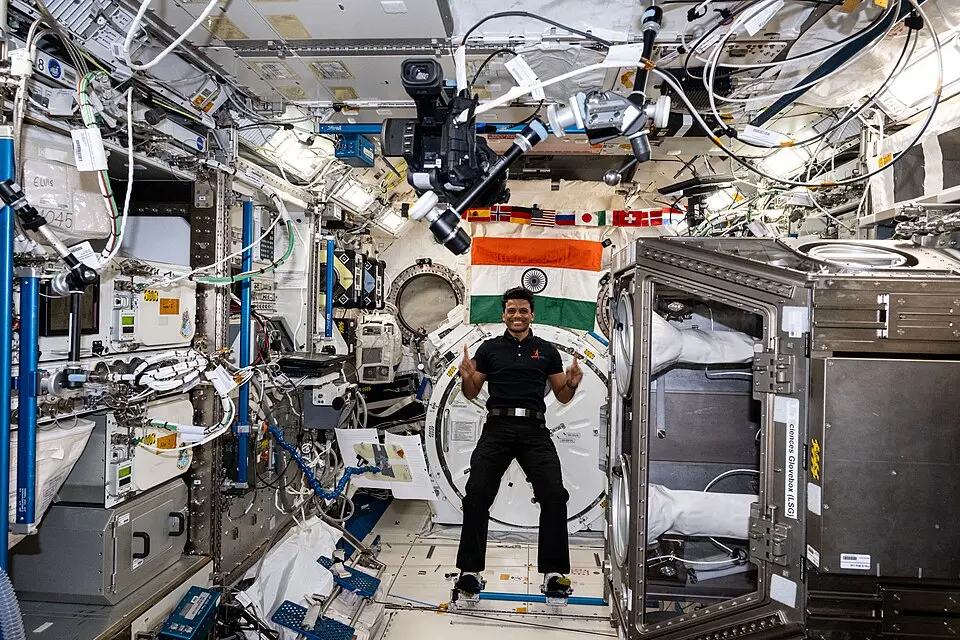
- The crew. Four Indian Air Force test pilots, Prasanth Balakrishnan Nair, Ajit Krishnan, Angad Pratap and Shubhanshu Shukla, were named in February 2024. Shukla flew to the International Space Station on the commercial Axiom-4 mission from 25 June to 15 July 2025, the first Indian aboard it, and carried out seven Indian microgravity experiments.
- The Bharatiya Antariksh Station (BAS). The plan is a five module station in low Earth orbit, with the first module, BAS-1, of about 10 tonnes, by 2028 and a working station by 2035, followed by an Indian crewed Moon landing by 2040. A model shown in August 2025 displayed planned features such as an Indian docking system, life support and viewports. The launcher it needs is in the orbits and launch vehicles note.
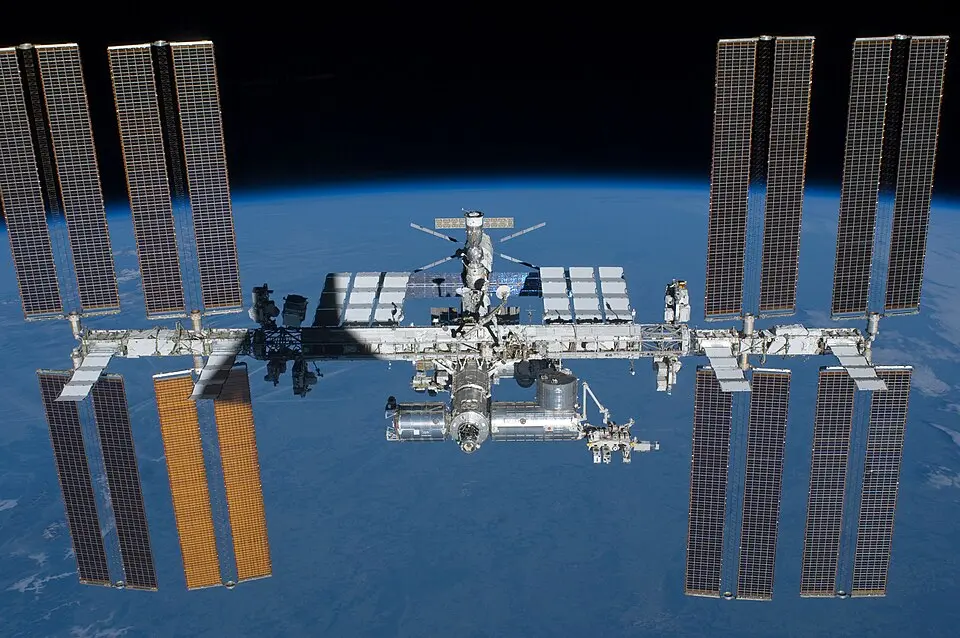
- The world. The International Space Station, built from 1998 by the United States, Russia, Europe, Japan and Canada, has been crewed without a break since November 2000 and is planned to be retired around 2030. China completed its Tiangong station in 2022. Artemis II of the National Aeronautics and Space Administration (NASA) carried four astronauts round the Moon in April 2026, the first crewed lunar flight since 1972, and under a plan announced in February 2026 Artemis III becomes a docking test in Earth orbit in 2027, with the landing moved to Artemis IV in 2028. India signed the Artemis Accords, a set of principles for civil exploration, in June 2023.


Issues and way forward
- Delay. The first crewed flight was once aimed at 2022 and is now expected after 2026, because the pandemic stalled testing and every system must be qualified twice over; publishing a realistic schedule and holding to safety over dates is better than a date missed in public.
- Cost and justification. At over Rs 20,000 crore the programme competes with satellites that serve farmers and fishermen directly; the answer is to tie it to spin offs, to science on the station and to Indian industry building its parts.
- Single points of failure. One launcher, one launch site for crew and a young recovery system leave little margin; a second crew capable vehicle and drills with the Navy reduce that risk.
- Medicine and training. India has little space medicine research, so the Institute of Aerospace Medicine and partner agencies need long term studies, and the Axiom-4 experience shows the value of flying with partners first.
- The station's economics. A station costs every year it flies, so it needs a stream of users; commercial modules, research slots for universities and partnerships, as the International Space Station transition to private stations shows, are the way forward.
Common confusions
- Weightlessness and zero gravity. Astronauts float because they are in continuous free fall with their craft, not because gravity is absent; at 400 km it is still about 89 per cent of its surface value.
- Crew module and service module. The crew module carries people and returns, while the service module powers and propels the craft and burns up after separation.
- Gaganyaan and the Bharatiya Antariksh Station. Gaganyaan is the capability to send people to orbit and bring them back, while the station is a permanent laboratory in orbit that Gaganyaan class vehicles will later serve.
- The Artemis programme and the Artemis Accords. The programme is NASA's set of missions to return people to the Moon, while the Accords are non binding principles on transparency, safety zones and resources that countries, including India, can sign without taking part in any mission.
- First Indian in space and first Indian on the station. Rakesh Sharma flew in 1984 on a Soviet craft to Salyut 7, while Shubhanshu Shukla in 2025 was the first Indian aboard the International Space Station.
For the exam
- Keyword bank: human rating, crew escape system, crew module, service module, environmental control and life support system, microgravity, bone loss, radiation dose, re entry heating, ablative heat shield, Vyommitra, Bharatiya Antariksh Station, Artemis Accords, space medicine.
- Previous year questions: Practise the previous year questions on this topic →
- Use in an answer:
- Introduction with data: The Cabinet in September 2024 raised Gaganyaan's funding to Rs 20,193 crore to cover eight missions and the first module of a Bharatiya Antariksh Station, setting a path to a station by 2035 and a crewed Moon landing by 2040.
- Introduction with a source: Only three countries, the Soviet Union, the United States and China, have so far launched people on their own rockets, and Gaganyaan is India's attempt to be the fourth (ISRO).
- Conclusion: Human spaceflight is less about a single flight than about mastering life support, re entry and docking, the skills on which a station and a Moon landing depend.
- Conclusion: India's programme will be judged by whether it is safe, affordable and useful to science and industry, not by how quickly it reaches orbit.