Roads and railways
- Syllabus
- Infrastructure: Energy, Ports, Roads, Airports, Railways etc.
- As of
- October 2026
- national highways
- Bharatmala Pariyojana
- PMGSY
- hybrid annuity model
- FASTag
- operating ratio
- cross subsidy
- modal share
- National Rail Plan
- dedicated freight corridor
- DFCCIL
- Mumbai–Ahmedabad high speed rail
- gross budgetary support
- Kavach
The first principle
Transport is a derived demand: nobody wants a tonne kilometre for itself, but every factory, farm and port pays for it, so the cost and speed of moving goods and people set how far a market can reach. Roads and railways are natural monopolies with large fixed costs and low costs of using them once built, so the state either builds them or tightly regulates whoever does, and the economic questions are always the same two: who pays for the track, and how the user is charged. Roads win on door to door flexibility and railways on cost per tonne over long distances.
The core
Roads
- The network and its tiers. National highways measured 1,46,560 km in 2025, up from 91,287 km in 2014, and the length of access controlled high speed corridors and expressways rose from 93 km to 3,052 km over the same years (Ministry of Road Transport and Highways, MoRTH). National highways are about 2 per cent of road length but carry about 40 per cent of road traffic, while State highways, district roads and rural roads carry the rest.
- Who builds and how it is paid for. The National Highways Authority of India (NHAI), set up under an Act of 1988, builds and runs most national highways; the money comes from the budget, a cess on petrol and diesel, tolls under the National Highways Fee Rules, 2008, and private capital. Since February 2021 tolls are collected electronically through FASTag.
- Contract models. A highway can be built under engineering, procurement and construction (EPC), where the government pays and bears all traffic risk; build operate transfer (BOT), where the builder collects tolls and bears traffic risk; or the hybrid annuity model (HAM) of 2016, where the government pays 40 per cent during construction and the rest as annuities with interest, so the builder bears construction risk but not traffic risk. How these contracts pay out is worked through in the note on infrastructure investment models.
- Bharatmala Pariyojana. Approved in 2017, its Phase I planned 34,800 km of economic corridors, inter corridor and feeder roads, border and coastal roads and expressways at an estimated Rs 5.35 lakh crore. By 31 March 2026, 22,590 km had been completed (Press Information Bureau, PIB, June 2026), and the ministry expects Phase I to finish by 2027-28 at a higher cost than first estimated.
- Rural roads. The Pradhan Mantri Gram Sadak Yojana (PMGSY), launched in December 2000, builds all weather roads to unconnected habitations, with the Centre and States sharing cost 60:40 (90:10 in the north eastern and Himalayan States). Its fourth phase, approved in September 2024 for 2024-25 to 2028-29, will build 62,500 km to connect 25,000 habitations at Rs 70,125 crore.
Railways
- A commercial department of the government. Indian Railways is run by the Ministry of Railways and its budget has been part of the Union Budget since 2017-18. It earns mostly from freight, which is estimated at 62 per cent of internal revenue in 2026-27, and loses money on passengers, whose fares covered only about 55 per cent of cost in 2023-24, a subsidy of Rs 60,466 crore (PRS Legislative Research, 2026). Freight therefore subsidises passengers, which raises freight rates and pushes cargo onto roads.
- The operating ratio. Operating ratio = working expenses ÷ traffic receipts × 100. It was 98.22 in 2024-25 and is budgeted at 98.40 for 2026-27, so the railways keep less than Rs 2 of every Rs 100 they earn; salaries took 41 per cent and pensions 25 per cent of internal revenue in 2026-27 (PRS, 2026).
- Investment comes from the budget. Capital expenditure is budgeted at Rs 2,93,030 crore in 2026-27, up from Rs 2,65,200 crore in 2025-26, and about 95 per cent of it is gross budgetary support from the Centre (PRS, 2026).
- Worked example. If receipts were Rs 2,000 crore and working expenses Rs 1,964 crore, the operating ratio would be 1,964 ÷ 2,000 × 100 = 98.2, leaving Rs 36 crore for investment. A train that covers 1,500 km at the conventional network's average of about 19 km per hour takes 1,500 ÷ 19 = 79 hours; on a freight corridor at about 57.5 km per hour it takes 1,500 ÷ 57.5 = 26 hours, so the corridor saves about two days on every trip.
Dimensions
- Economic. Freight cost decides whether an Indian factory can compete, and the National Rail Plan of 2020 set a target of raising rail's share of freight to 45 per cent by 2030 from about 27 per cent, because rail moves a tonne over a long distance at a fraction of road's energy and cost.
- Fiscal. Highways and railways now take a large share of the Union's capital expenditure, which raises growth through the multiplier but also builds liabilities, as when NHAI borrowed heavily before 2022 and the Centre had to restrict new borrowing by it.
- Environmental. Rail emits far less carbon dioxide per tonne kilometre than road, and with nearly all of its broad gauge network electrified, moving cargo from lorries to trains is one of the cheapest ways to cut transport emissions.
- Social and regional. Rural roads raise farm prices, school attendance and access to health care, while railways remain the only affordable long distance travel for most people, which is why passenger fares are kept low.
- Safety. India records among the highest road deaths in the world, and the railways' indigenous automatic train protection system, Kavach, aims to stop collisions caused by signals passed at danger.
- Strategic. Border roads and lines to the north east, Ladakh and Jammu and Kashmir serve defence as much as trade.
In practice
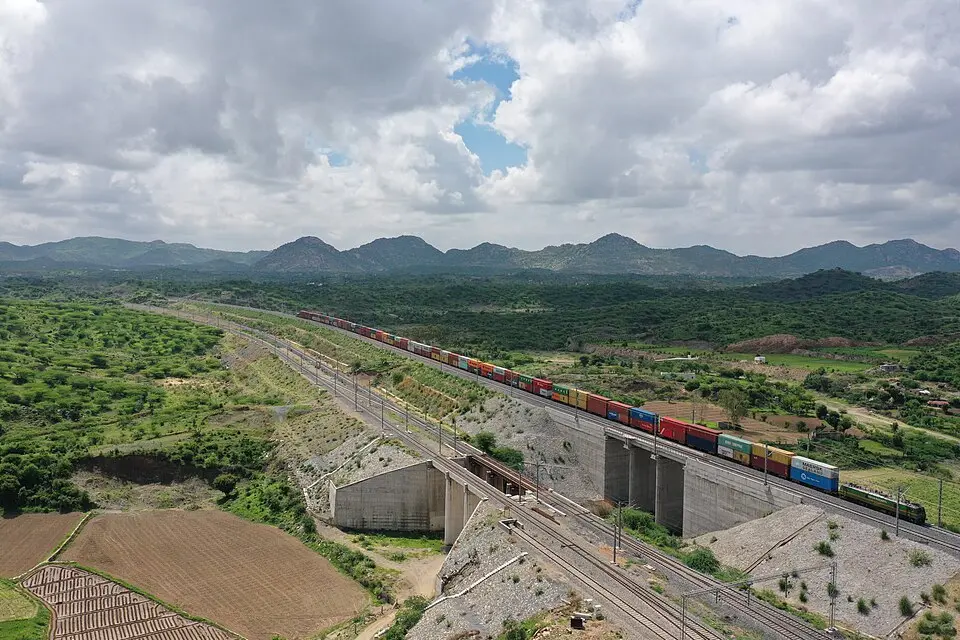
- Dedicated freight corridors. The Dedicated Freight Corridor Corporation of India (DFCCIL), set up in 2006, built two corridors on which only freight trains run, faster, longer and heavier than on the shared network. The Eastern corridor runs 1,337 km from Sahnewal near Ludhiana to Sonnagar in Bihar, through Khurja, with a spur to Dadri, and was funded largely by the World Bank. The Western corridor runs 1,506 km from Dadri through Rewari, Palanpur and Vadodara to the Jawaharlal Nehru Port Authority (JNPA) near Mumbai, funded largely by Japan and built to carry containers stacked two high, and its last stretch, Vaitarna to JNPA, was completed with a trial run on 31 March 2026. The corridors are about 4 per cent of the rail network but carry about 13 to 14 per cent of its freight (DFCCIL, January 2026).
- New corridors. The Union Budget 2026-27 proposed a new freight corridor from Dankuni in West Bengal to Surat in Gujarat and seven high speed rail corridors of about 4,000 km in all.
- Mumbai–Ahmedabad high speed rail. The 508 km line, with 12 stations, uses Japanese Shinkansen technology for speeds of up to 320 km per hour and is financed mostly by a soft loan from the Japan International Cooperation Agency. Its foundation stone was laid in September 2017; the Railway Minister said in July 2026 that the Surat–Bilimora section should open in 2027 and the whole line by the end of 2029.
- Modernisation. Vande Bharat trains, first run in 2019, the redevelopment of more than 1,300 stations under the Amrit Bharat Station Scheme, near complete electrification and the spread of Kavach are the main upgrades of the shared network.

Issues and way forward
- Rail loses freight to road. Freight subsidises passengers, so rail rates are high, and the shared network is slow; letting the corridors carry fast, time tabled freight, linking them to ports and industrial clusters, and moving towards fares closer to cost for upper classes would help rail regain share.
- Railway finances. An operating ratio near 98 leaves almost nothing for investment, and pensions and salaries take two thirds of internal revenue; the Bibek Debroy committee of 2015 recommended commercial accounting, separating the railways' social obligations from their business and paying for those obligations openly from the budget.
- Highway costs and delays. Land acquisition, forest and wildlife clearances and the rising cost of land have delayed Bharatmala and raised its cost, while some HAM and BOT projects stalled when builders could not raise money; better project preparation, land acquired before award and recycling of capital through toll operate transfer and investment trusts are the answers.
- Road safety. Poor design, speeding and weak enforcement cause most deaths; safer road engineering, the stricter penalties of the Motor Vehicles (Amendment) Act, 2019, and quick trauma care are the standard remedies.
- High speed rail's economics. The line is costly and its fares will need heavy traffic to cover the loan, so its value lies as much in the technology and manufacturing it brings and in the land development around stations as in fares.
Common confusions
- Bharatmala and the National Highways Development Project. The project of 1998 built the Golden Quadrilateral and corridors stage by stage, while Bharatmala plans economic corridors around freight flows and absorbed the project's unfinished work.
- Dedicated freight corridor and high speed rail. A freight corridor carries only goods trains on heavy tracks, while high speed rail carries only passengers at over 300 km per hour on a separate standard gauge line.
- Operating ratio and profitability. An operating ratio below 100 means working expenses are less than receipts, but it says nothing about the return on the capital that the budget has invested.
- HAM and BOT. In BOT the builder collects tolls and bears traffic risk; in HAM the government collects tolls and pays the builder annuities, so traffic risk stays with the government.
For the exam
- Keyword bank: national highways, Bharatmala Pariyojana, PMGSY, hybrid annuity model, FASTag, operating ratio, cross subsidy, gross budgetary support, modal share, National Rail Plan, dedicated freight corridor, double stack containers, high speed rail, Kavach, derived demand.
- Previous year questions: Practise the previous year questions on this topic →
- Use in an answer:
- Introduction with data: India's national highway network grew from 91,287 km in 2014 to 1,46,560 km in 2025 (MoRTH), and railway capital spending is budgeted at Rs 2,93,030 crore for 2026-27.
- Introduction with a report: The National Rail Plan of 2020 aims to raise rail's share of freight from about 27 per cent to 45 per cent by 2030, because rail moves goods over long distances at a fraction of the cost of road.
- Conclusion: Roads give reach and railways give scale, and India's task is to let each carry the traffic it does best, with freight corridors, ports and highways planned as one network.
- Conclusion: Building track is no longer India's main constraint; pricing it right, keeping railway finances sound and moving freight back to rail now decide what the investment returns.