Ports, shipping and airports
- Syllabus
- Infrastructure: Energy, Ports, Roads, Airports, Railways etc.
- As of
- October 2026
- major and non major ports
- Major Port Authorities Act 2021
- Indian Ports Act 2025
- Sagarmala
- port led development
- transshipment
- Vadhavan port
- landlord port model
- shipbuilding
- Maritime Development Fund
- UDAN
- viability gap funding
- airport privatisation
- AERA
The first principle
About 95 per cent of India's trade by volume and about 70 per cent by value moves by sea, so the cost of passing a container through a port is a tax on every export and import. Ports and airports are gateways with huge fixed costs and strong economies of scale: a deeper berth takes a bigger ship, and a bigger ship carries each container more cheaply, so traffic gathers at a few hubs. A country that lacks a hub sends its cargo to a foreign one and pays twice, which is the thread that runs through India's port and aviation policy.
The core
Ports
- Two kinds of ports. India has 12 major ports, owned by the Union and run by port authorities, and more than 200 non major ports under State maritime boards, of which fewer than 70 handle cargo (Ministry of Ports, Shipping and Waterways, March 2025). The Major Port Authorities Act, 2021 replaced the port trusts with authorities whose boards can set their own tariffs, and the Indian Ports Act, 2025, notified in August 2025, replaced the Act of 1908, gave the Maritime State Development Council a statutory base and required every coastal State to have a maritime board.
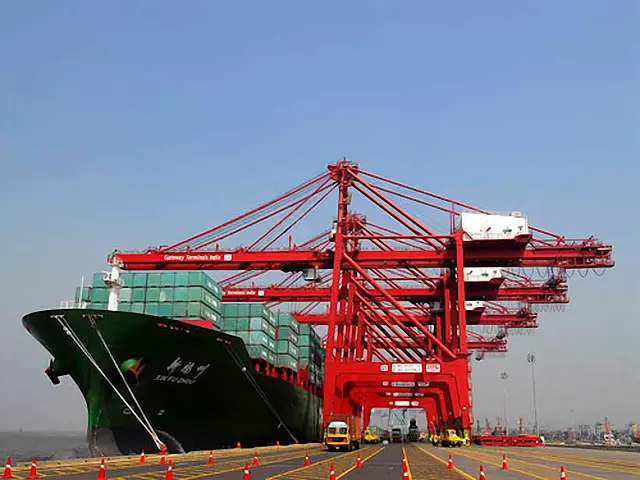
- The landlord model. Major ports increasingly own the land and water and lease berths and terminals to private operators for thirty years or so, who bring cranes and capital and share revenue with the port; this public private partnership is how most new capacity at major ports has been built.
- Cargo and its pattern. In 2025-26 major ports handled a record 915.17 million tonnes and non major ports 753.07 million tonnes, of which Gujarat's ports alone handled 485.25 million tonnes. Deendayal Port at Kandla was the busiest major port with 160.11 million tonnes, followed by Paradip with 156.45 million tonnes. Coal, crude oil and petroleum products, iron ore and containers make up most of the cargo.
- Worked example. Total cargo was 915.17 + 753.07 = 1,668.24 million tonnes, so the major ports' share was 915.17 ÷ 1,668.24 × 100 = 54.9 per cent and the non major ports' share 45.1 per cent. Twenty years ago major ports handled more than two thirds, so the rise of private ports in Gujarat, Andhra Pradesh and elsewhere is the main change in the pattern.
Shipping and shipbuilding
- Few ships, little shipbuilding. Ships flying the Indian flag carry only a small share of India's own trade, so Indian traders pay freight to foreign shipping lines, and India builds well under 1 per cent of the world's ships, far behind China, South Korea and Japan, which together build most of them.
- The package of September 2025. The Union Cabinet approved Rs 69,725 crore for shipbuilding and the maritime sector: the Shipbuilding Financial Assistance Scheme extended to March 2036 with Rs 24,736 crore, a Maritime Development Fund of Rs 25,000 crore for long term finance, and a Shipbuilding Development Scheme of Rs 19,989 crore for shipbuilding clusters, with an aim of building capacity of 4.5 million gross tonnes a year.
Airports and aviation
- Owners and regulators. The Airports Authority of India (AAI) owns and runs most airports; Delhi and Mumbai were leased to private operators in 2006, and six more, Ahmedabad, Lucknow, Mangaluru, Jaipur, Guwahati and Thiruvananthapuram, followed in 2020 and 2021. The Airports Economic Regulatory Authority (AERA), set up under an Act of 2008, fixes charges at major airports, and the Directorate General of Civil Aviation (DGCA) regulates safety. The Bharatiya Vayuyan Adhiniyam, 2024 replaced the Aircraft Act of 1934.
- Growth. India is the third largest domestic aviation market in the world; domestic airlines carried about 16.69 crore passengers in 2025 (DGCA), and operational airports rose from 74 in 2014 to 165 by 15 July 2026 (Press Information Bureau, PIB).
- UDAN. The Regional Connectivity Scheme, Ude Desh ka Aam Nagrik (UDAN), launched in 2016, asks airlines to bid for regional routes; on each route a share of seats, up to half, is sold at a capped fare, and the gap between cost and fare is paid as viability gap funding, 80 per cent by the Centre and 20 per cent by the State (90:10 in the north east), from a levy on flights on busy routes. By 15 July 2026 it had run 679 routes through 95 airports, heliports and water aerodromes and carried over 1.68 crore passengers. A modified UDAN for 2026-27 to 2035-36, with an outlay of Rs 28,840 crore, aims at 100 new airports built from unused airstrips and 200 helipads.
Dimensions
- Trade competitiveness. Port dwell time, turnaround of ships and the cost of moving a container inland add to the price of every export, so port efficiency matters as much as tariffs for exporters.
- Transshipment. Large container ships call at deep hubs and smaller feeder ships carry boxes onward, and because India long had no deep water hub, most Indian transshipment cargo has gone through Colombo, Singapore and other foreign ports, costing time, money and port revenue.
- Strategic. India's coastline, officially revised in 2025 to 11,098.81 km, and its position beside the sea lanes of the Indian Ocean make ports and a national fleet part of security and of influence abroad; coastal security is covered in its own note.
- Regional. Port led industrial clusters, coastal shipping and inland waterways can lower freight costs for coastal States, and regional airports open tourism and trade in the hills and the north east.
- Environmental. Dredging and reclamation harm mangroves, fisheries and coasts, and aviation is a growing source of emissions, which sustainable aviation fuel and green port rules try to reduce.
In practice
- Sagarmala. Approved in 2015, the programme has four pillars: modernising ports, connecting them to the hinterland by road, rail and waterway, port led industrialisation, and development of coastal communities, with coastal shipping and inland waterways added later. Maritime India Vision 2030 (2021) and the Maritime Amrit Kaal Vision 2047 (2023) set the longer targets.
- Vadhavan. Approved by the Union Cabinet in June 2024 at about Rs 76,200 crore, the port at Vadhavan in Palghar district of Maharashtra is being built by a company in which the Jawaharlal Nehru Port Authority (JNPA) holds 74 per cent and the Maharashtra Maritime Board 26 per cent. Its natural depth of about 20 metres will let it take the largest container ships, and it is planned to be among the ten largest ports in the world.
- Vizhinjam. India's first deep water container transshipment port, built at Vizhinjam in Kerala by a private operator with the State, was dedicated to the nation in May 2025, and a transshipment port at Galathea Bay in Great Nicobar is planned.
- Airports in public private partnership. The leased airports are run on revenue sharing concessions, and new greenfield airports such as Navi Mumbai, inaugurated in October 2025, are built under the Greenfield Airports Policy of 2008; the economics of these contracts is in the note on infrastructure investment models.

Issues and way forward
- The last mile on land. Ships wait less than before, but containers still lose days on congested roads and rail links to the port; dedicated freight corridors reaching JNPA and Mundra, rail sidings inside ports and coastal shipping for bulk cargo cut that cost.
- Shipbuilding needs patient finance. Shipyards need cheap long term loans, steady orders and a supply chain for steel, engines and equipment; the Maritime Development Fund, clusters and orders from Indian public sector shippers are meant to provide these, but yards in East Asia have decades of scale.
- Uneven competition between ports. Major ports carry legacy labour and land costs while private ports set their own tariffs, and the Indian Ports Act, 2025 now gives States a common framework and dispute resolution committees for non major ports.
- Aviation is fragile. Airlines have failed one after another because fuel, taxed heavily and left outside the goods and services tax, is their largest cost, fares are volatile and two groups carry most passengers; bringing aviation turbine fuel into the goods and services tax, building maintenance and leasing capacity at home and keeping UDAN routes alive after their subsidy ends are the main reforms.
- Coasts and communities. Large ports displace fishing villages and harm mangroves, so environmental clearance, fair compensation and Sagarmala's community pillar have to be taken seriously.
Common confusions
- Major and non major ports. The difference is who controls the port, the Union or the State, not its size: several non major ports, such as Mundra, handle more cargo than most major ports.
- Transshipment and transit trade. A transshipment port moves containers from one ship to another without the cargo entering the country, while transit trade passes through a country's territory to a third country.
- Viability gap funding and a subsidy to passengers. UDAN's viability gap funding is paid to the airline for capped seats on a route, not to the passenger.
- Sagarmala and Bharatmala. Sagarmala is about ports and the coast, while Bharatmala is a highway programme.
For the exam
- Keyword bank: major and non major ports, landlord port model, Major Port Authorities Act 2021, Indian Ports Act 2025, Sagarmala, port led development, transshipment hub, Vadhavan, turnaround time, shipbuilding financial assistance, Maritime Development Fund, UDAN, viability gap funding, AERA, aviation turbine fuel.
- Previous year questions: Practise the previous year questions on this topic →
- Use in an answer:
- Introduction with data: Indian ports handled 1,668 million tonnes of cargo in 2025-26, and the major ports' share has fallen to about 55 per cent as private ports in Gujarat and elsewhere have grown (Ministry of Ports, Shipping and Waterways).
- Introduction with a law: The Major Port Authorities Act, 2021 and the Indian Ports Act, 2025 replaced laws of 1963 and 1908, giving major ports commercial freedom and the States a common framework for their own ports.
- Conclusion: India's ports have caught up on capacity; the next gains lie in deep water hubs such as Vadhavan and Vizhinjam, in the land links behind them and in a shipbuilding base that India still lacks.
- Conclusion: UDAN shows that a small, well designed subsidy can open new markets, but aviation will stay fragile until fuel is taxed sensibly and competition among airlines deepens.