Technology in agriculture
- Syllabus
- E-technology in the aid of farmers; technology missions
- As of
- October 2026
- yield led growth
- green revolution package
- high yielding varieties
- scale neutrality
- technology missions
- Technology Mission on Oilseeds
- Digital Agriculture Mission 2024
- AgriStack
- farmer ID
- digital crop survey
- Krishi Decision Support System
- precision farming
- variable rate application
- Kisan drones
- Namo Drone Didi
The first principle
Farm output is area multiplied by yield, and India's area under foodgrains has stayed around 120 to 130 million hectares since about 1970. Almost all the growth since then has therefore come from yield, which means from technology: better seeds, water, nutrients and knowledge applied to the same land. A technology spreads only when it pays the farmer who must adopt it, so the economics of agricultural technology is about who bears its cost, who captures its gain, and whether a small farmer can use it as easily as a large one.
The core
The green revolution as a package
- Seeds were the trigger. Semi dwarf wheat bred by Norman Borlaug in Mexico responded to fertiliser without falling over, and India imported about 18,000 tonnes of its seed in 1966, with M S Swaminathan adapting the varieties and C Subramaniam as Food Minister driving policy. The High Yielding Varieties Programme began in 1966-67, building on the Intensive Agricultural District Programme of 1960-61, and rice followed with varieties from the International Rice Research Institute.
- The seed worked only as part of a package. It needed assured irrigation, mostly from tube wells, chemical fertiliser, credit, and a guaranteed price, which came through the Agricultural Prices Commission and the Food Corporation of India, both set up in 1965. Wheat output roughly doubled, from about 12 million tonnes in 1964-65 to about 26 million tonnes in 1971-72.
- It was scale neutral in seed but not in water. A kilogram of seed is equally useful on one acre or a hundred, but a tube well is lumpy, so early gains went to irrigated districts of Punjab, Haryana and western Uttar Pradesh and to larger farmers. Its environmental costs are traced in the sustainable agriculture note.
Technology missions
- The mission model sets a production target for one crop and joins research, seed, extension, credit and procurement under one head. The Technology Mission on Oilseeds of 1986 roughly doubled oilseed output within a decade (the yellow revolution), and later missions covered cotton (2000), horticulture (the National Horticulture Mission of 2005-06, now the Mission for Integrated Development of Horticulture) and food crops (the National Food Security Mission of 2007-08).
- The current missions aim at import dependence. The National Mission on Edible Oils covers oil palm (2021, Rs 11,040 crore) and oilseeds (October 2024, Rs 10,103 crore for 2024-25 to 2030-31), and the Mission for Aatmanirbharta in Pulses was approved in October 2025 with Rs 11,440 crore for 2025-26 to 2030-31. Genetically modified crops as a technology are covered in the note on GM crops and agricultural biotechnology.
Worked example: precision nitrogen and who gains
- Variable rate application uses a soil test, sensor or satellite map to give each part of a field only what it needs. Suppose a 4 hectare field has 2 hectares needing 100 kg of nitrogen per hectare and 2 hectares needing 140 kg. A uniform dose of 140 kg uses 4 × 140 = 560 kg, while variable rate uses 2 × 100 + 2 × 140 = 480 kg, saving 80 kg of nitrogen.
- In fertiliser terms, urea is 46 per cent nitrogen, so the saving is 80 ÷ 0.46 = about 174 kg of urea, or nearly four 45 kg bags.
- The farmer's gain is small because urea's price is controlled at Rs 242 per 45 kg bag (excluding neem coating charges and taxes), so four bags save him less than Rs 1,000. Most of the real cost of each bag is paid by the fertiliser subsidy, and the excess nitrogen escapes to air and water, so the public gain is much larger than the private one. That gap is the economic case for public soil testing, advisory services and support for precision equipment.
Dimensions
- Economic. Public spending on agricultural research is well under one per cent of agricultural output, yet studies by the International Food Policy Research Institute have found that research gives among the highest returns of any rural public spending, both for growth and for poverty reduction.
- Scale and equity. With an average holding of 1.08 hectares (Agriculture Census 2015-16), lumpy machines such as tractors, harvesters and drones reach small farmers only through custom hiring centres and service providers, while divisible inputs and phone based advice reach them directly.
- Digital divide. Smartphones, literacy and network coverage decide who can use apps, and women farmers, tenants and older farmers are most often left out, which is why assisted channels such as Krishi Vigyan Kendras and common service centres matter.
- Data rights. Registries of farmers, land and crops can speed credit and insurance but can also expose farmers to misuse; AgriStack keeps State ownership of data with consent based sharing under the Digital Personal Data Protection Act 2023.
- Environmental. Precision application, micro irrigation and resilient varieties raise output per unit of water and nutrient, while the old package of free power and cheap urea did the opposite.
In practice
- Digital services for farmers. Kisan Call Centres (2004) answer queries on a toll free line; the Soil Health Card (2015) gives a test based nutrient dose; the National Agriculture Market (eNAM, 2016) links mandis online, as the marketing note explains; the Pradhan Mantri Kisan Samman Nidhi (PM-KISAN, 2019) pays Rs 6,000 a year by direct benefit transfer; and the India Meteorological Department sends agromet advisories. Under the crop insurance scheme, the Yield Estimation System based on Technology (YES-TECH) uses remote sensing to estimate yields.
- The Digital Agriculture Mission, approved in September 2024 with an outlay of Rs 2,817 crore, builds digital public infrastructure for farming. Its core, AgriStack, has three State owned registries: a farmers registry that gives each farmer an ID linked to land records, geo referenced village maps, and a crop sown registry filled by a digital crop survey each season. Alongside sit the Krishi Decision Support System, which joins weather, soil and crop data, and a soil profile map. By 1 February 2026 more than 8.43 crore farmer IDs had been generated against a target of 11 crore by March 2027, and the digital crop survey of kharif 2025 covered 604 districts and more than 28.5 crore plots (Lok Sabha, February 2026).
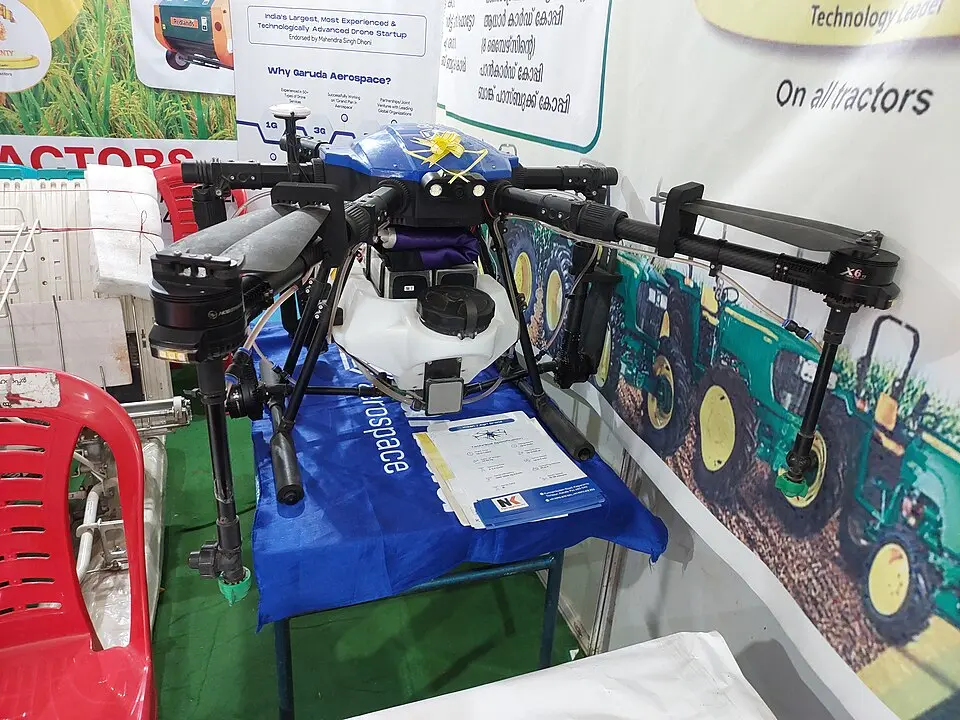
- Drones. The Drone Rules 2021 eased permissions, the Prime Minister flagged off 100 Kisan drones in February 2022, and spraying of approved pesticides by drone is now allowed. Under Namo Drone Didi, approved in November 2023 with Rs 1,261 crore, 15,000 drones are given to women's self help groups for 2024-25 and 2025-26, with central assistance of 80 per cent of the cost up to Rs 8 lakh, so the groups earn by renting spraying services.
- Precision farming combines satellite positioning, remote sensing, soil sensors and variable rate machines; in India it spreads mainly through drip fertigation in horticulture and through service providers rather than through individual purchase.

Issues and way forward
- Records decide reach. A farmer ID depends on land records, so tenants and sharecroppers without recorded rights are left out; recording tenancy, as the land reforms note explains, and onboarding tenants under State rules would extend digital services to those who need them most.
- Weak extension. Public extension workers are few for India's millions of holdings, and advice is often generic; Krishi Vigyan Kendras, farmer producer organisations and tested artificial intelligence advisory in local languages can make advice field specific.
- Subsidies blunt the incentive. As the worked example shows, cheap urea and free power make saving inputs pay little to the farmer; shifting support from price subsidy to per hectare payments, or rewarding measured savings, would align private and public gains.
- Lumpy technology. Drones, harvesters and sensors are costly for one small farm; custom hiring centres, drone service enterprises and pooling through producer organisations spread their fixed cost.
- Research and seed. Low public research spending and slow release of varieties limit the pipeline; raising research funding, faster regulatory review and public private seed partnerships are the standard recommendations.
- Data trust. Farmers will share data only if they see benefit and control its use; consent, audit and clear rules on commercial use must be built in from the start.
Common confusions
- Green revolution and technology mission. The green revolution was a package that transformed wheat and rice in irrigated regions, while a technology mission is a targeted programme for one crop, such as oilseeds in 1986 or pulses in 2025.
- AgriStack and eNAM. AgriStack is a set of registries of farmers, land and crops on which services are built, while eNAM is a trading platform linking mandis.
- Digital crop survey and crop cutting experiments. The digital crop survey records which crop is sown on each plot, while crop cutting experiments, now aided by YES-TECH, estimate yield.
- Precision farming and mechanisation. Mechanisation replaces labour with machines, while precision farming uses information to vary inputs within a field; a tractor can be mechanised without being precise.
- Kisan drones and Namo Drone Didi. Kisan drones is a general push for drone use in farming, while Namo Drone Didi is a specific scheme giving subsidised drones to women's self help groups.
For the exam
- Keyword bank: yield led growth, green revolution package, scale neutrality, technology mission, Technology Mission on Oilseeds, Digital Agriculture Mission, AgriStack, farmer ID, digital crop survey, Krishi Decision Support System, precision farming, variable rate application, custom hiring centres, Namo Drone Didi, consent based data sharing.
- Previous year questions: Practise the previous year questions on this topic →
- Use in an answer:
- Introduction with data: India's foodgrain output rose from about 51 million tonnes in 1950-51 to a record 376.56 million tonnes in 2025-26, with little change in area since 1970, so growth has been driven by technology (Department of Agriculture and Farmers Welfare, 2026).
- Introduction with a scheme: The Digital Agriculture Mission of 2024 is building AgriStack, under which more than 8.43 crore farmers had a digital ID by February 2026, so that credit, insurance and advice can reach each farmer directly.
- Conclusion: The green revolution showed that technology spreads when it comes as a package and pays the farmer; the digital and precision revolution will succeed only if it reaches tenants and small farmers on the same terms.
- Conclusion: Aligning subsidies with input saving, building trust in farm data and reviving public research are the three conditions for the next round of yield led growth.