Drones and emerging warfare technology
- Syllabus
- Developments in science and technology and their applications and effects in everyday life; indigenisation of technology and developing new technology; awareness in the fields of IT, space, computers, robotics
- As of
- October 2026
- unmanned aerial vehicle
- MALE and HALE drones
- loitering munition
- drone swarm
- counter drone system
- soft kill and hard kill
- directed energy weapon
- high power microwave
- electronic warfare
- jamming and spoofing
- anti satellite weapon
- Defence Space Agency
- autonomous weapons
- iDEX
- Drone Rules 2021
The first principle
War has always rewarded the side that sees first and strikes from farthest away at the lowest cost. Cheap sensors, satellite links and small computers have now made it possible to put an eye and a weapon in the air without risking a pilot, so a drone worth a few lakh rupees can threaten a tank or a radar worth crores. Every technology in this note is either a way of exploiting that cost gap or a way of closing it, which is why drones and counter drone systems, jamming and anti jamming, and lasers that cost little per shot all grow together.
The core
Drones and how they are classified
- A drone, or unmanned aerial vehicle (UAV), is an aircraft with no one on board, flown by a remote pilot over a radio or satellite link or by an onboard computer following a programmed route.
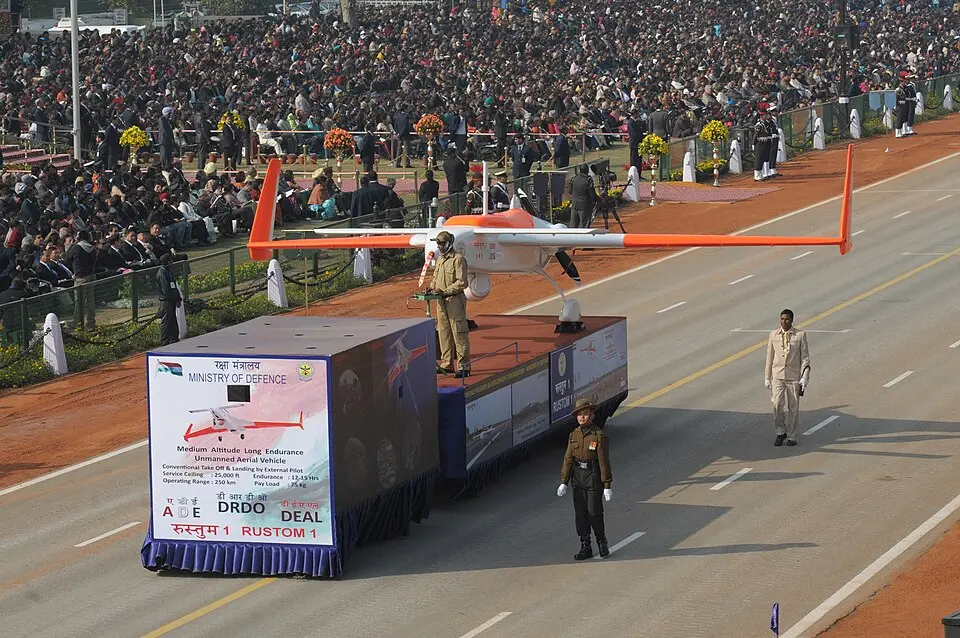
- Military drones are sorted by altitude and endurance. Small tactical drones fly a few kilometres for an hour or so; medium altitude long endurance (MALE) drones such as the MQ-9B and the Heron fly at medium altitudes, roughly 10,000 to 30,000 feet, for a day or more; and high altitude long endurance (HALE) drones fly higher still for strategic watch. The longer a drone stays up, the more it is a sensor rather than a weapon.
- A loitering munition is a drone that is also the warhead: it circles over an area, its operator or its own sensor picks a target, and it dives into it. It sits between a drone, which returns, and a missile, which is fired at a known target.
- A swarm is a large group of drones that coordinate among themselves through simple shared rules, so that losing some does not stop the rest. Swarms overwhelm defences built to stop a few expensive targets, and they depend on artificial intelligence for coordination.
Counter drone systems
- Detection is the hard part. Small drones are slow, low and made of plastic, so ordinary radar often mistakes them for birds, and a counter drone system therefore combines radar, radio frequency detectors that pick up the control link, and electro optical and infrared cameras.
- Soft kill disables without destroying. Jamming floods the drone's control or navigation frequency with noise, and spoofing feeds it false satellite signals so that it lands or flies away.
- Hard kill destroys the drone, by guns, missiles, interceptor drones or directed energy. The Defence Research and Development Organisation (DRDO) Drone Detect, Deter and Destroy (D4) system combines radar, jamming and a laser in one package and has been inducted by the services.
Directed energy weapons
- A directed energy weapon sends energy itself, rather than a projectile, at the target. A high energy laser focuses tens of kilowatts of light on one spot until the drone's structure or sensor burns through, and a high power microwave weapon sends a broad pulse that burns out the electronics of everything in its beam, which makes it useful against swarms.
- Its advantages follow from the physics. Light travels at about 3 lakh kilometres a second, so there is no need to lead the target, and each shot costs only the electricity, compared with lakhs or crores for a missile.
- Its limits follow from the physics too. Dust, rain and fog scatter and absorb the beam, the air near the beam heats and bends it, and the laser must hold on one spot for seconds, so range today is a few kilometres. In April 2025 DRDO demonstrated a 30 kilowatt laser weapon, the Mk-II(A), destroying drones at Kurnool in Andhra Pradesh.
Space and electronic warfare
- Electronic warfare is the contest for the electromagnetic spectrum: listening to the enemy's signals, jamming or deceiving them, and protecting one's own by frequency hopping and encryption. Because drones, satellites and missiles all depend on radio links, the side that controls the spectrum controls them.
- Space is now a war fighting domain. Satellites give navigation, communication and imagery, so they are targets: an anti satellite (ASAT) missile destroys a satellite by direct collision, and jamming, lasers and cyber attacks can blind one without debris. India tested a direct ascent ASAT missile under Mission Shakti in March 2019, destroying its own satellite in low earth orbit.
Dimensions
- Military. Drones have made the battlefield transparent, so troops and vehicles are seen almost anywhere, and the conflicts in Ukraine and Armenia–Azerbaijan showed cheap drones destroying armour and artillery at scale.
- Economic. The cost exchange favours the attacker when a lakh rupee drone draws a crore rupee missile, and only cheap defences such as guns, jammers and lasers restore the balance; this is why directed energy attracts money.
- Security. The same drones carry arms, drugs and explosives across borders and threaten airports and crowds; this use is covered in the internal security notes on border management and cybersecurity.
- Legal and ethical. Lethal autonomous weapons, which select and engage a target without a human decision, raise the question of who is accountable for a mistake, and states have discussed limits under the Convention on Certain Conventional Weapons without agreeing a treaty.
- Civilian. The same technology maps land under the SVAMITVA scheme, sprays crops, delivers medicines to hill districts and inspects power lines, which is why civilian rules and military needs share one industry.
In practice
- Rules and the market. The Drone Rules 2021 of the Ministry of Civil Aviation replaced a permit heavy regime with self certification, a digital sky platform and an airspace map of green, yellow and red zones. A production linked incentive (PLI) scheme of Rs 120 crore for drones and components followed in September 2021, and the import of foreign drones was banned in February 2022, with exemptions for research and defence.
- Imports and indigenous platforms. India operates Israeli Heron and Searcher drones and signed a contract with the United States in October 2024 for 31 MQ-9B drones for the three services. DRDO's TAPAS medium altitude drone and the Ghatak unmanned combat aircraft project are the indigenous lines, and Indian firms now make loitering munitions and tactical drones.
- Air defence against drones. In Operation Sindoor in May 2025 Indian air defences, including the Akashteer network that links sensors and guns into one air picture, countered large numbers of drones, which made layered counter drone defence a priority. In August 2025 the Prime Minister announced Mission Sudarshan Chakra, a plan for an indigenous multi layered air defence shield by 2035.
- Institutions. The Defence Space Agency and the Defence Cyber Agency were set up in 2019 to handle the two new domains, and Innovations for Defence Excellence (iDEX), launched in 2018, funds start ups that solve problems set by the services, many of them in drones and counter drone technology.

Issues and way forward
- Component dependence. Motors, batteries, flight controllers and image sensors are largely imported, so a ban on finished drones does not make the industry self reliant; extending incentives to components and setting standards for trusted suppliers are the answers.
- Engines and endurance. India still lacks a proven indigenous engine for MALE drones, which is why the large platforms are imported; long term funding for aero engines links this note to the defence platforms note.
- The cost exchange. Defending against swarms with missiles is unaffordable, so the way forward is layered defence in which jammers, guns and lasers take the cheap targets and missiles are kept for the expensive ones.
- Speed of change. Drone designs change in months, while defence procurement takes years, so smaller, faster buys through iDEX and emergency procurement, and doctrine written for drone rich battlefields, are needed.
- Autonomy and law. As machines take more decisions, India needs a clear national position on meaningful human control over lethal force, consistent with international humanitarian law.
Common confusions
- Drone and loitering munition. A drone is meant to come back after its mission, while a loitering munition is expended, because the aircraft itself is the warhead.
- Drone and cruise missile. Both fly with wings and engines, but a cruise missile is fired at a chosen target and cannot wait, while a drone or loitering munition can stay over an area and choose its target late.
- Jamming and spoofing. Jamming drowns a signal in noise so the receiver hears nothing, while spoofing sends a convincing false signal so the receiver believes a lie, such as a wrong position.
- Laser and high power microwave. A laser burns one target at a time with a narrow beam, while a microwave weapon disables electronics across a wide cone, which suits swarms but has a shorter range.
- Automated and autonomous. An automated system follows fixed rules set by a human, while an autonomous system decides for itself within a goal, and only the second raises the accountability question.
For the exam
- Keyword bank: unmanned aerial vehicle, MALE and HALE, loitering munition, swarm, counter drone kill chain, soft kill and hard kill, directed energy weapon, cost exchange ratio, electronic warfare, spoofing, anti satellite weapon, Mission Shakti, Mission Sudarshan Chakra, lethal autonomous weapons, iDEX.
- Previous year questions: Practise the previous year questions on this topic →
- Use in an answer:
- Introduction with data: In April 2025 DRDO's 30 kilowatt Mk-II(A) laser destroyed drones at Kurnool, placing India among the few countries to have demonstrated a laser weapon against drones, where each shot costs only electricity.
- Introduction with a source: The Drone Rules 2021 of the Ministry of Civil Aviation moved India from a permit regime to self certification and green, yellow and red airspace zones, opening the way for a domestic drone industry.
- Conclusion: Drones have turned air power from an expensive few into a cheap many, so India's defence must be layered and cheap per shot, and its drone industry must own its components as well as its airframes.
- Conclusion: Mission Sudarshan Chakra will succeed only if sensors, jammers, guns, lasers and missiles are joined into one network, because against drones the side that sees and decides faster wins.