History atlas · Theme 8b
हिन्दी — Read in HindiPart of: India from 200 BCE to 300 CE · Post Mauryan north India: Shungas, Kanvas and Kharavela · The northwestern invasions: Indo Greeks, Shakas, Pahlavas, Kushanas and the Western Satraps · The Satavahanas · The Sangam age
The northwestern invasions: Indo Greeks, Shakas, Pahlavas, Kushanas and the Western Satraps
200 BCE to 300 CE; the Western Satraps to 415
After the Mauryas the northwest, the region of modern Afghanistan and Pakistan, saw not one invasion but a series of overlapping waves: Indo Greeks, Shakas, Parthians and Kushanas, each bringing new peoples, political forms, religions, art and economic connections. Alongside them the Western Satraps, a branch of the Shakas, ruled Gujarat and western India for centuries. The Khyber and Bolan passes were the ways in, and at its peak the Kushana empire reached from Bactria to the Gangetic plain, with Mathura as a major centre in India.
Indo Greeks, about 200 to 70 BCE: From their base in Bactria the Greeks crossed the Hindu Kush; Menander's kingdom covered much of the Punjab and possibly reached Mathura.
- Settlement
- Capital
- Site
- Sacred site
- Major Rock Edict
- Port
- UNESCO World Heritage Site
Literary sources
- The Pali Milindapanha records a dialogue between the Indo Greek king Menander and the monk Nagasena, confirming Menander's existence and his knowledge of Buddhism.
- Patanjali's Mahabhashya mentions the Yavana presence in the northwest.
- The Yuga Purana of the Gargi Samhita also mentions the Yavana presence in the northwest.
Foreign accounts
- Chinese sources, especially the Hou Hanshu, record the Kushana rulers and their contacts with China along the Silk Route.
- The Periplus of the Erythraean Sea of the first century CE records the trade between India and Rome in detail.
Inscriptions
- Rudradaman's Junagadh inscription of about 150 CE, in classical Sanskrit prose, is the most important Western Satrap inscription.
- The Heliodorus pillar at Besnagar dates to about 110 BCE.
- The Bactrian language Rabatak inscription of Kanishka I was found in Afghanistan.
- The Mathura lion capital inscription, a Shaka record in Kharoshthi from the time of the Northern Satrap Rajuvula, records his chief queen's gift.
Coins
- Coins are the single most important source for this period.
- For the Indo Greeks and Shakas coins are often the only evidence that a ruler existed.
The Kushana rulers, thinkers and scholars
- The Kushana rulers began with Kujula Kadphises, the founder, followed by Vima Takto and Vima Kadphises.
- After them came Kanishka I, then Huvishka and Vasudeva I.
- Nagarjuna and Ashvaghosha were the great Buddhist thinkers of the age, and Yavaneshvara translated the Yavanajataka under Rudradaman.
Diodotus
king
Seleucid governor of Bactria who declared independence about 250 BCE, founding the Bactrian Greek kingdom.
Demetrius I
king
Led the first major Greek push into northwestern India, about 200 to 180 BCE.
Menander
king; also Milinda
Milinda, about 165 to 130 BCE, the most famous Indo Greek; ruled much of the Punjab; the philosopher king of the Milindapanha.
Nagasena
monk
The Buddhist monk who debates Menander in the Milindapanha.
Maues
king; also Moga
Moga, one of the earliest Shaka rulers in India, who controlled Taxila.
Azes I
king
A Shaka ruler whom some historians connect with the Vikrama Samvat of 58 BCE.
Gondophares
king
The most notable Pahlava ruler, linked in later Christian tradition with the legend of St Thomas.
Kujula Kadphises
king
Founder of the Kushana empire, about 30 to 80 CE, who unified the Yuezhi clans.
Vima Takto
king
Kushana ruler, about 80 to 95 CE, who extended control deep into the subcontinent.
Vima Kadphises
king
Kushana ruler, about 95 to 127 CE, who introduced gold coinage and showed strong Shaiva devotion.
Kanishka I
king
The greatest Kushana, about 127 to 150 CE; the fourth Buddhist council; capital at Purushapura.
Huvishka
king
Kushana ruler, about 150 to 190 CE, whose coins show a great variety of deities.
Vasudeva I
king
The last great Kushana, about 190 to 230 CE.
Bhumaka
king
Founder of the Kshaharata dynasty of the Western Satraps.
Nahapana
king
Kshaharata ruler, about 119 to 124 CE, defeated by Gautamiputra Satakarni, who counterstruck his coins.
Rudradaman I
king
The most important Western Satrap, about 130 to 150 CE, of the Junagadh inscription and the Sudarshana lake.
Nagarjuna
philosopher
The greatest Mahayana philosopher, about 150 to 250 CE; founder of Madhyamaka.
Ashvaghosha
poet
Sanskrit poet and Buddhist philosopher of Kanishka's court; the Buddhacharita and Saundarananda.
Yavaneshvara
scholar
A Greek writer in India under Rudradaman who translated the Yavanajataka from Greek into Sanskrit.
Overlapping waves
- This was not a single invasion but overlapping waves: Indo Greeks, then Shakas, then Parthians, then Kushanas, with the Western Satraps beside them.
- The ways in were the Khyber Pass, from the Kabul region to the Peshawar valley, and the Bolan Pass, from Baluchistan to Sindh.
Indo Greeks, about 200 to 70 BCE
- After Alexander, Diodotus, the Seleucid governor of Bactria, declared independence about 250 BCE, founding the Bactrian Greek kingdom.
- Demetrius I led the first major Greek push across the Hindu Kush about 200 to 180 BCE.
- Menander, or Milinda, about 165 to 130 BCE, ruled much of the Punjab and possibly reached Mathura.
- Their coins carried Greek on one side and Kharosthi or Brahmi on the other, a deliberate act of cultural accommodation.
- Always politically fragmented, they were displaced by Shaka pressure, and by about 70 BCE the Shakas held most of their territory.
Shakas, about 110 BCE to 400 CE
- The Shakas, the Scythians of Greek and Roman sources, were Central Asian nomads displaced by the Yuezhi confederation.
- Maues, or Moga, one of the earliest Shaka rulers in India, controlled Taxila.
- The Shakas split into a northern branch, later absorbed by the Kushanas, and a western branch, the Western Satraps.
Pahlavas, about 50 BCE to 75 CE
- The Pahlavas, the Parthians of western sources, were an Iranian people who briefly held Sindh and parts of Punjab.
- Gondophares, the most notable, is linked in later Christian tradition with the legend of St Thomas's mission to India.
Kushanas, about 50 to 230 CE
- The Kushanas, Guishuang in Chinese sources, were one of the five clans of the Yuezhi, displaced from northwest China by the Xiongnu.
- Under Kanishka the empire ran from Bactria through the Punjab, Sindh and Kashmir down the Gangetic plain to Varanasi.
- Purushapura, modern Peshawar, was the primary capital, and Mathura an extremely important secondary centre in India.
- Straddling the Silk Route between China, Central Asia and Rome gave them enormous commercial wealth and political leverage.
Western Satraps, about 35 to 415 CE
- The Kshatrapas and Mahakshatrapas, a Shaka branch, ruled Gujarat, Saurashtra, Malwa and parts of Rajasthan.
- The earliest dynasty, the Kshaharatas, was founded by Bhumaka.
- Nahapana was defeated by the Satavahana Gautamiputra Satakarni.
- Rudradaman I of the Kardamakas repaired the Sudarshana lake.
- Rudradaman I twice defeated the Satavahanas, sparing their king as a close relative.
- Western Satrap rule lasted until about 415 CE, when the Gupta emperor Chandragupta II ended it.
The four waves
About 250 BCE
Diodotus founds the Bactrian Greek kingdom
About 200 to 70 BCE
The Indo Greeks in the northwest; Menander about 165 to 130 BCE
About 110 BCE onward
The Shakas displace the Indo Greeks
About 50 BCE to 75 CE
The Pahlavas in Sindh and parts of Punjab
About 50 to 230 CE
The Kushanas; Kanishka about 127 to 150 CE
About 35 to 415 CE
The Western Satraps in western India, until Chandragupta II
Royal patronage
- Indo Greek, Shaka and Kushana rulers all patronised Buddhism, Vaishnavism and Shaivism.
- That patronage was both genuine and strategic, a path to political legitimacy.
Vrata kshatriyas
- Brahmanical texts classed the Shakas, Yavanas and Kushanas as vrata kshatriyas.
- Vrata kshatriyas were fallen Kshatriyas who had lost ritual purity.
Indianisation
- Rudradaman, of Shaka origin, is presented as a patron of Sanskrit, Brahmanical culture and classical learning.
- Rudradaman is an example of the Indianisation of foreign rulers.
The Silk Route
- The Silk Route, connecting China with Central Asia, Iran and the Roman Empire, passed directly through Kushana territory.
- Silk, spices and luxury goods moved westward through Kushana lands.
- The Roman writer Pliny complained that Rome was losing gold to India for luxuries, a sign of the trade imbalance in India's favour.
The western ports
- The Periplus names western ports such as Barygaza, modern Bharuch, and Kalliena, modern Kalyan, as major nodes of this trade.
- The Western Satraps controlled Gujarat's ports, which brought them great revenue.
- Barygaza, the most important of these ports, gave the Western Satraps contact with Roman and Persian Gulf trade.
Coins and crafts
- The Greeks introduced gold coins, but Vima Kadphises began large scale gold coinage.
- Roman gold was likely recoined as Kushana dinars.
- Textiles, ivory and metal crafts served both internal demand and export.
What it left
- The Kushana period is said to have been a forerunner of the Gupta golden age.
- Garments such as overcoats and sherwanis are of Kushana origin.
The Silk Route through Kushana landsTap to enlarge
Mahayana and the fourth council
- Mahayana, the Great Vehicle, took clear shape, stressing universal salvation for all beings.
- Mahayana also stressed the Bodhisattva, who delays nirvana to help all sentient beings.
- Kanishka convened the fourth Buddhist council at Kundalavana, possibly in Kashmir.
- The fourth council is associated with the systematisation of Sarvastivada.
Nagarjuna and Ashvaghosha
- Nagarjuna, the greatest Mahayana philosopher, founded the Madhyamaka school and composed the Mulamadhyamakakarika.
- He argued that all phenomena are empty, shunyata, of inherent existence, one of the most profound arguments in Indian thought.
- Ashvaghosha, associated with Kanishka's court, composed the Buddhacharita and the Saundarananda in Sanskrit.
The first Buddha images
- The first depiction of the Buddha in human form came in this period in the northwest, one of the great developments in the world's art.
- The Gandhara school worked in grey blue schist in a strongly Hellenistic style.
- The Mathura school used red Sikri sandstone in an indigenous style.
Bhagavata, Shaiva and Puranic traditions
- The Heliodorus pillar of about 110 BCE is the earliest epigraphic evidence of the Bhagavata tradition.
- Vima Kadphises's coins show Shiva's trident and Nandi.
- The Puranas, the great compilations of mythological and genealogical tradition, were taking shape in this period.
Gandhara and MathuraTap to enlarge
Kharosthi
- Kharosthi was used in the northwest beside Brahmi, in Gandhara.
- Kharosthi also appears on the bilingual Indo Greek and Kushana coins.
The two eras
- The Vikrama Samvat of 58 BCE, widely used in northern India, is traditionally linked with Vikramaditya of Ujjain.
- The Shaka era of 78 CE is likely associated with the Shaka rulers.
- The Shaka era is the basis of the Indian national calendar adopted in 1957.
Sanskrit as an imperial language
- Rudradaman's Junagadh inscription of about 150 CE is the first major royal inscription in classical Sanskrit prose.
- That inscription marks Sanskrit as an imperial language.
- Ashvaghosha's Buddhacharita is among the earliest examples of the Sanskrit mahakavya, the great poem.
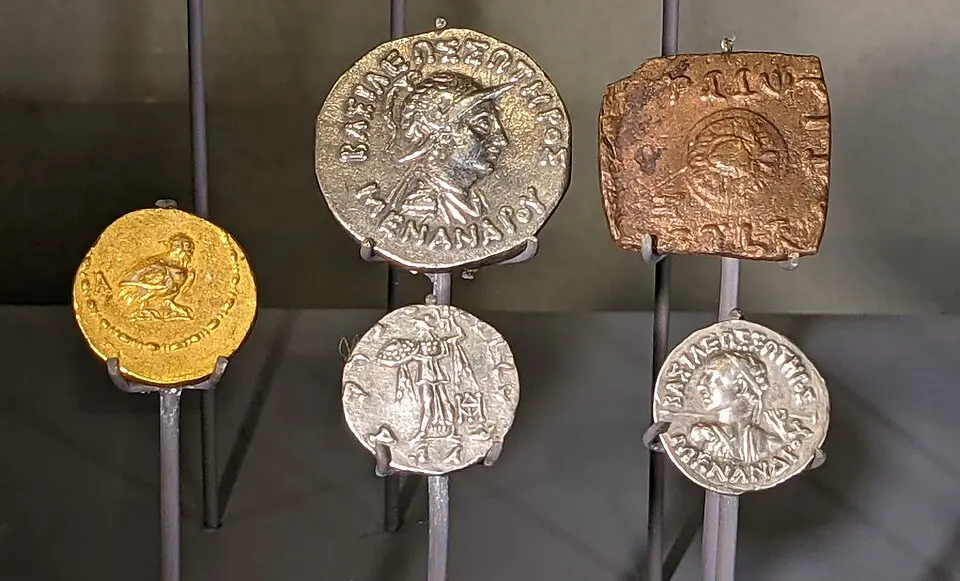
Coins of Menander
Indo Greek coins carry Greek on one side and Kharosthi or Brahmi on the other, a deliberate act of cultural accommodation.
SpeakingArch, CC BY-SA 4.0, via Wikimedia Commons
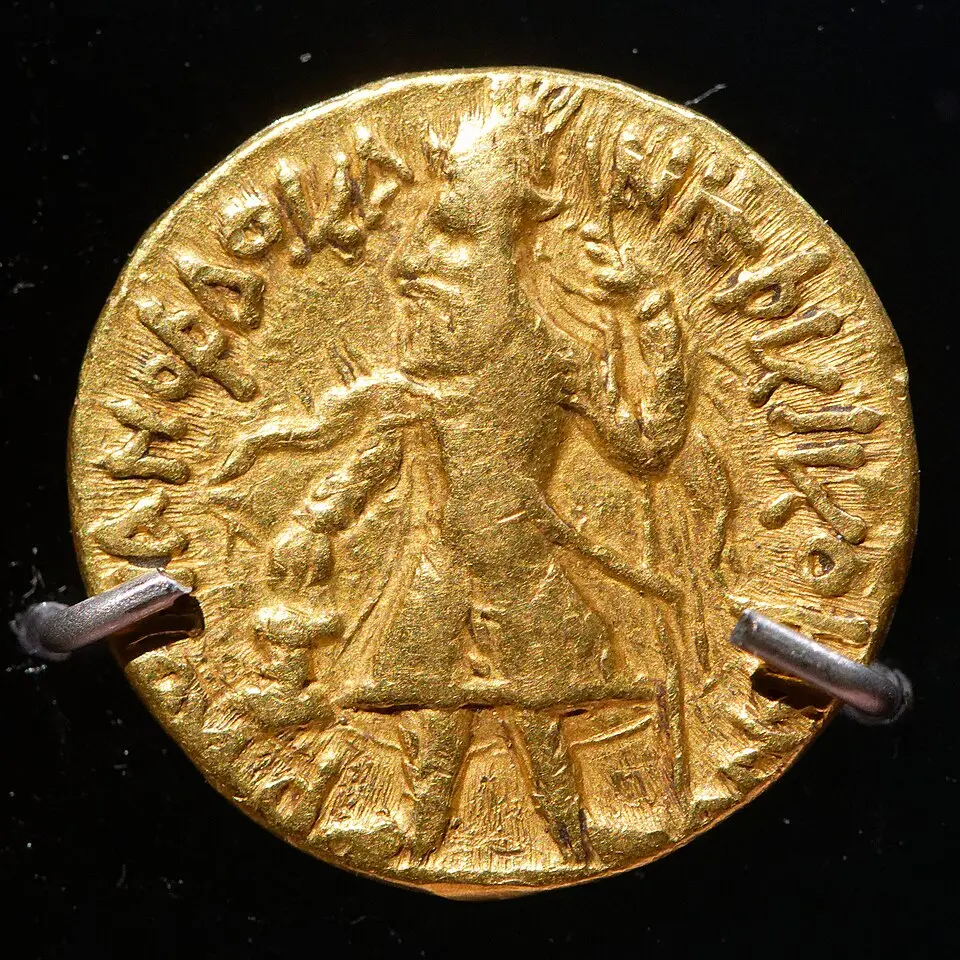
A gold stater of Kanishka I
Kushana coins are a masterclass in religious pluralism.
Marie-Lan Nguyen, Public domain, via Wikimedia Commons
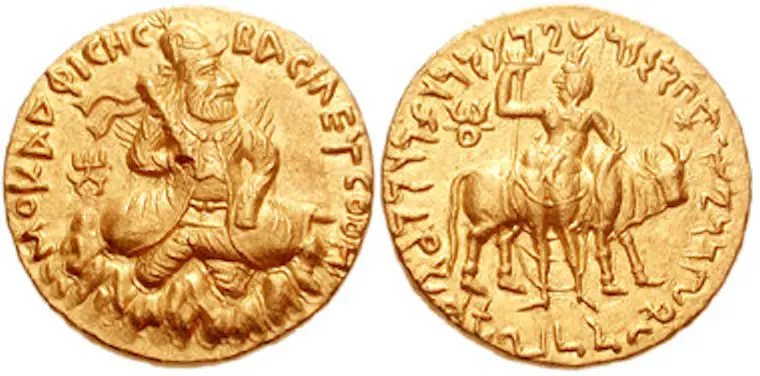
A coin of Vima Kadphises with Shiva
Vima Kadphises's coins show Shiva's trident and the bull Nandi, indicating Kushana royal patronage of Shaivism.
Ancient Art, CC BY 2.0, via Wikimedia Commons
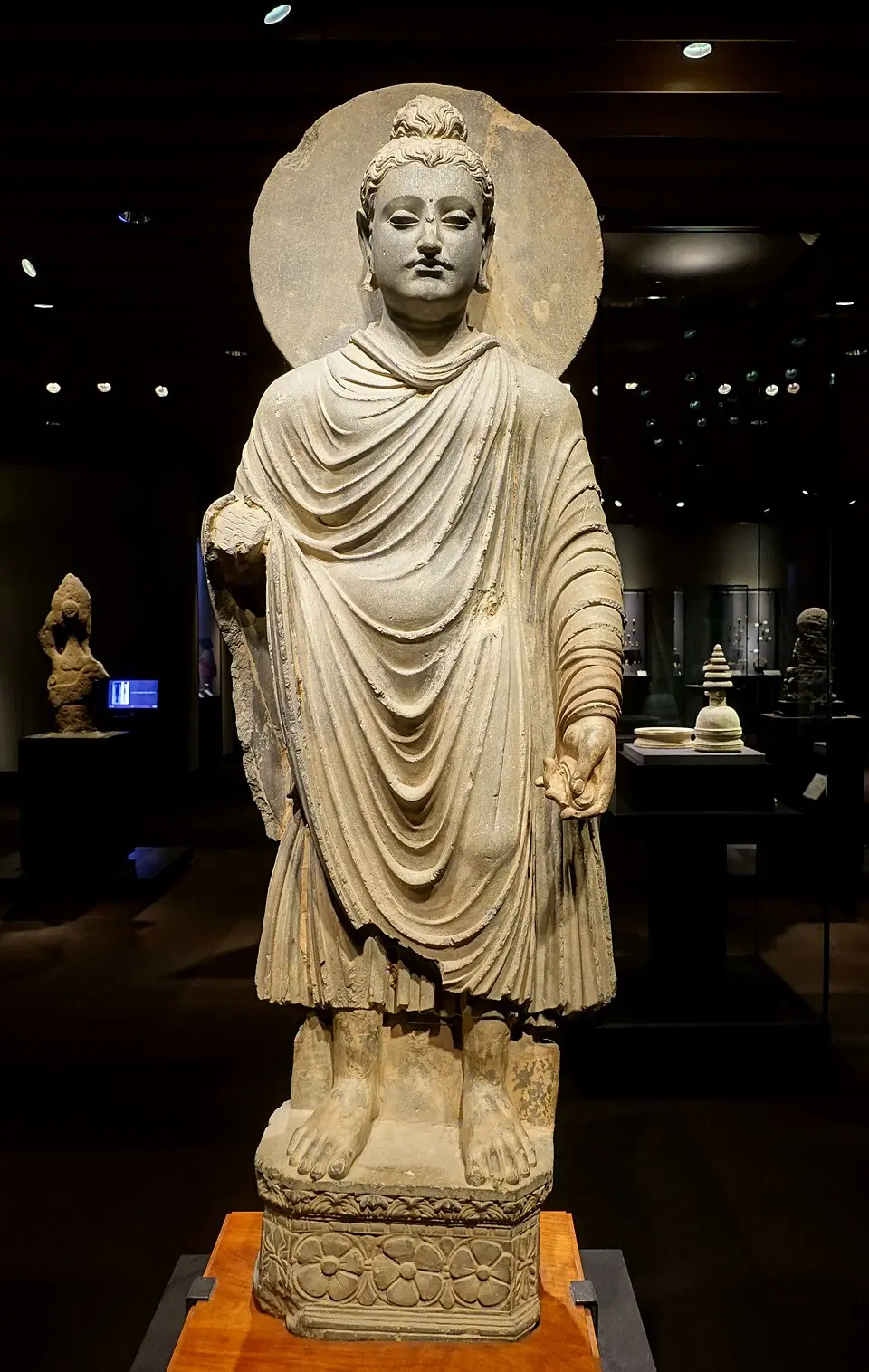
A Gandhara Buddha
The Gandhara school worked in grey blue schist in a strongly Hellenistic style, the Buddha with wavy hair and a toga like robe.
Daderot, Public domain, via Wikimedia Commons
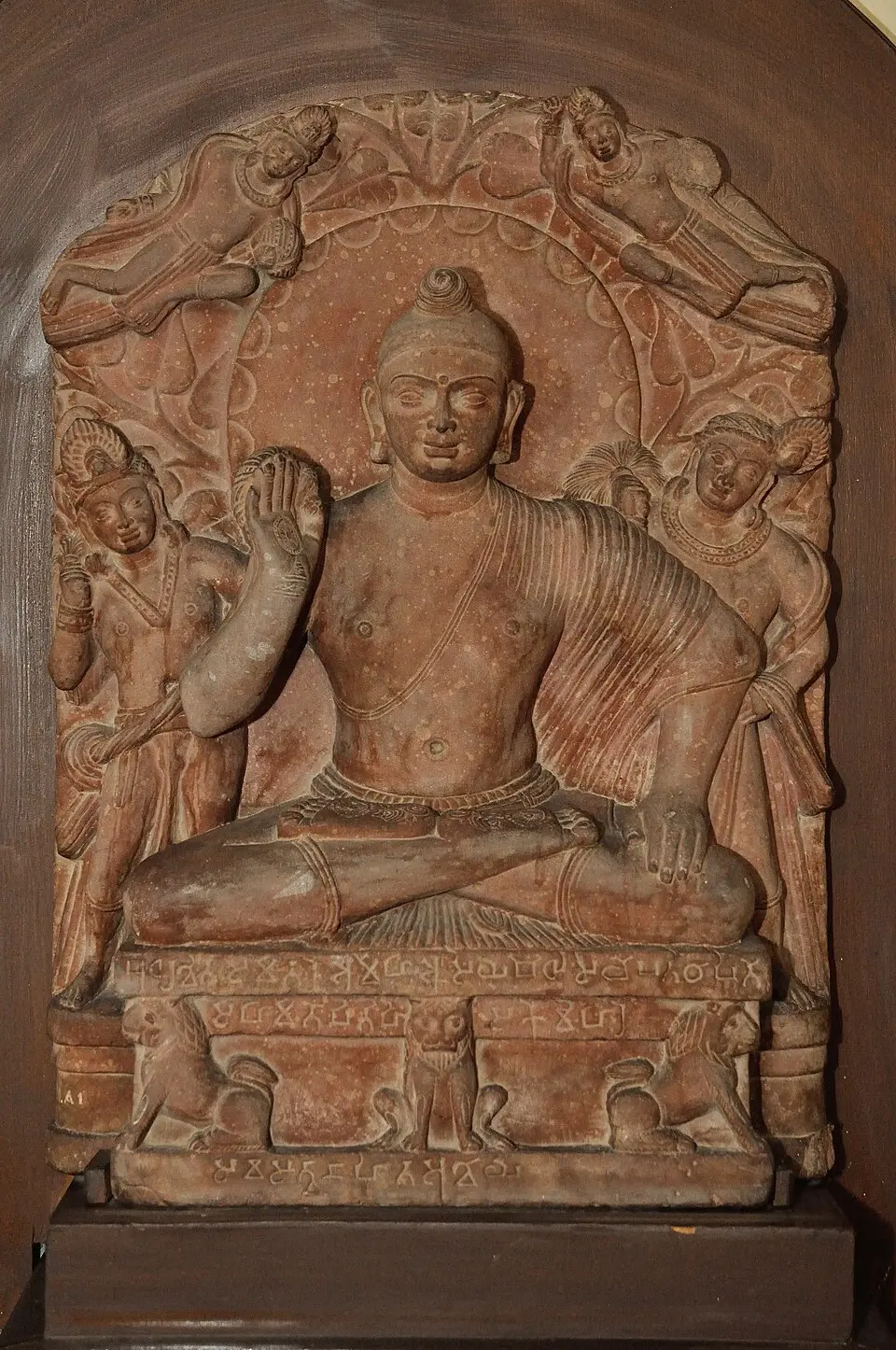
A Mathura Buddha from Katra
The Mathura school used red Sikri sandstone in an indigenous style, with broad shoulders and a powerful physique.
Biswarup Ganguly, CC BY 3.0, via Wikimedia Commons
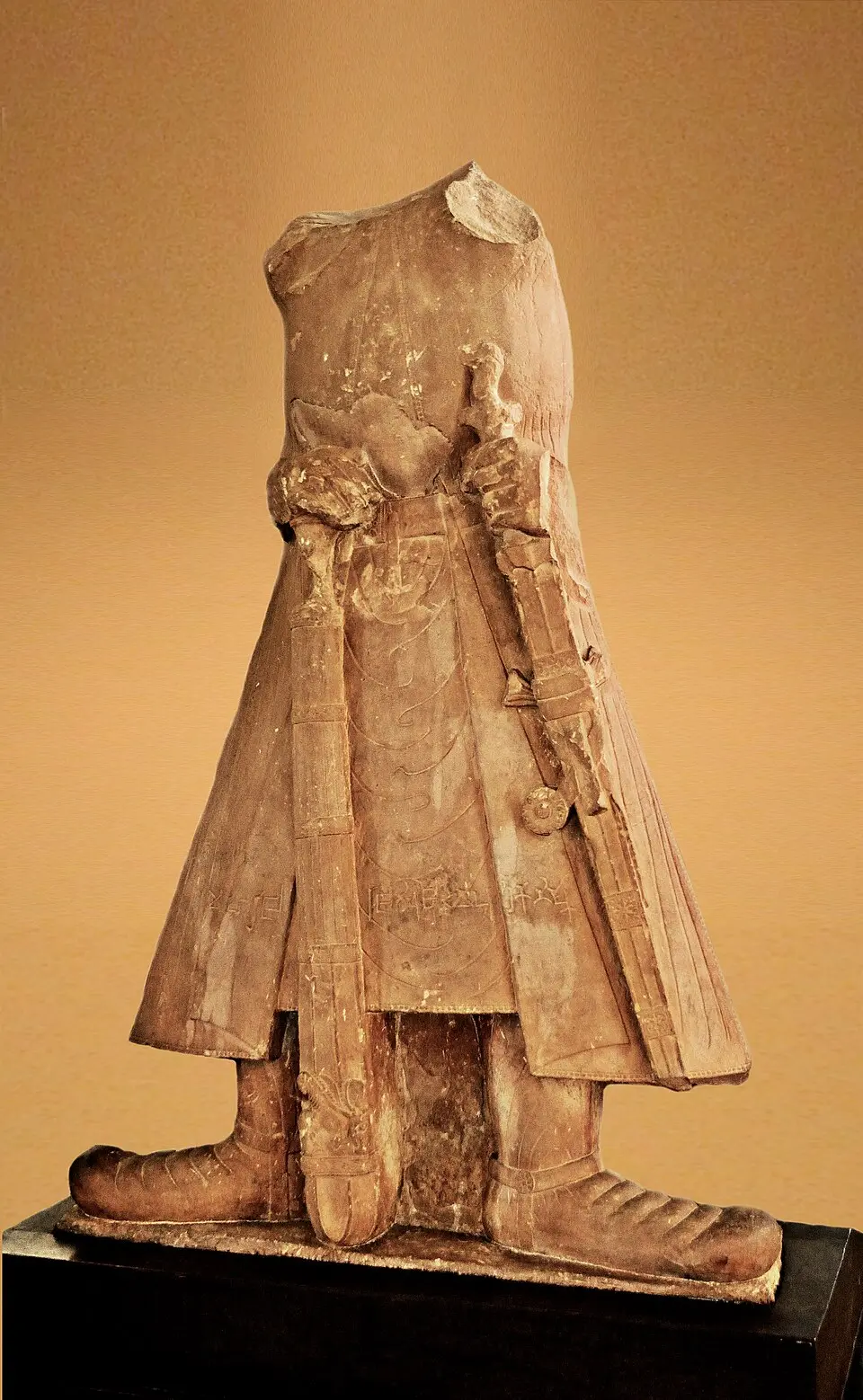
The statue of Kanishka, Mathura
Kanishka I, the greatest Kushana ruler, with Mathura an extremely important secondary centre in India.
Biswarup Ganguly, CC BY-SA 3.0, via Wikimedia Commons
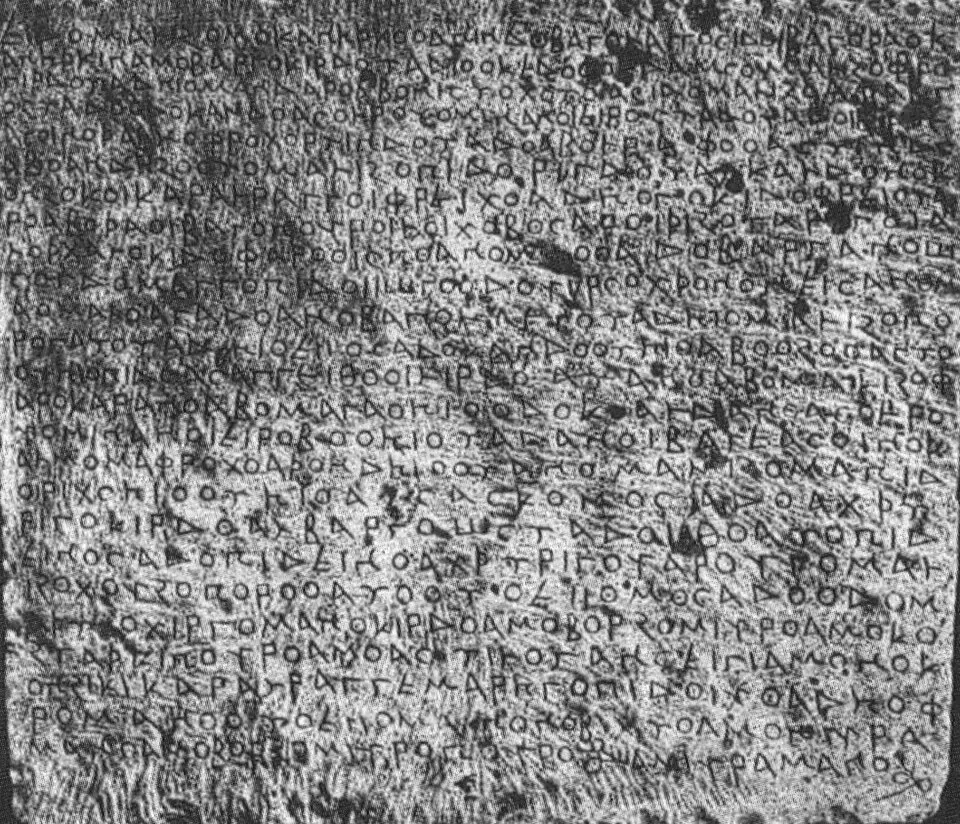
The Rabatak inscription
A Bactrian language inscription of the Kushana king Kanishka I, found in Afghanistan.
Kushan Emperor Kanishka (2nd century CE), Public domain, via Wikimedia Commons
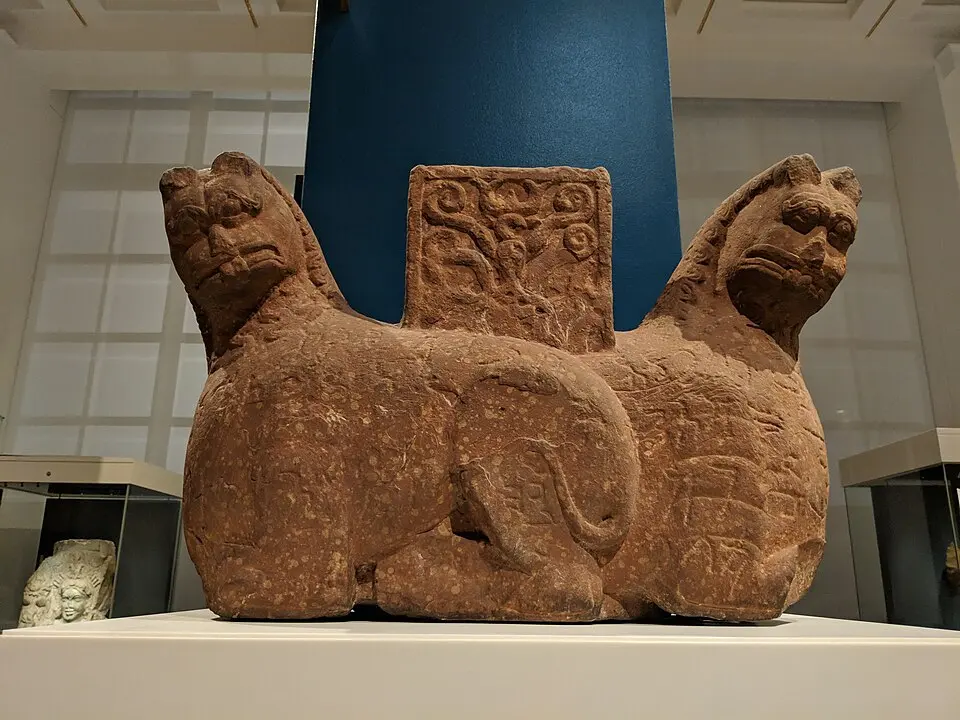
The Mathura lion capital
Its Kharoshthi inscription, a Shaka record from the time of the Northern Satrap Rajuvula, records his chief queen's gift.
Sushma Jansari, CC BY-SA 4.0, via Wikimedia Commons
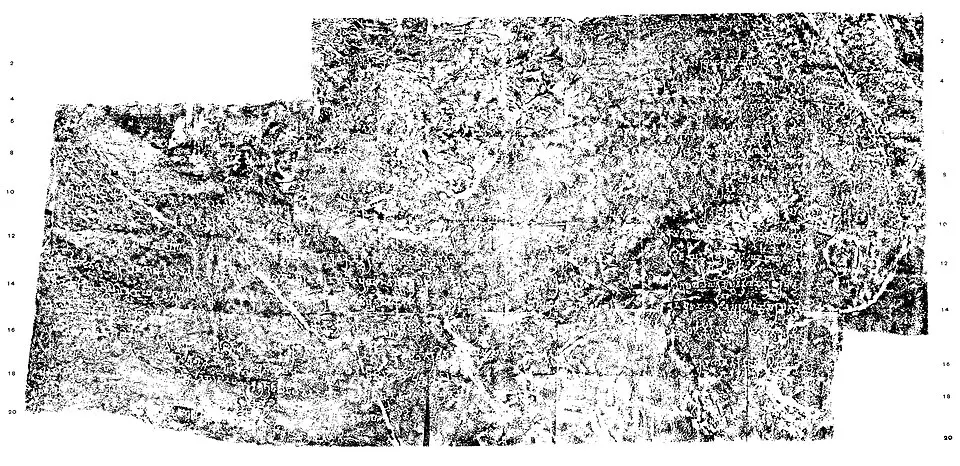
Rudradaman's Junagadh inscription
The most important Western Satrap inscription, the earliest major prose inscription in Sanskrit.
JF. Fleet, Public domain, via Wikimedia Commons


- Yavana
- The word for the Greeks, later used for other foreigners too.
- Kshatrapa and Mahakshatrapa
- The satrap and the great satrap: the titles of the Western Satraps.
- Yuezhi
- A Central Asian people of five clans, one of them the Kushanas, displaced from northwest China by the Xiongnu.
- Guishuang
- The Kushanas' name in Chinese sources.
- Dinar
- The Kushana gold coin, into which Roman gold was likely recoined.
- Bodhisattva
- A being who delays personal nirvana to help all sentient beings.
- Mahayana
- The Great Vehicle, a Buddhism of universal salvation for all beings, not just monks.
- Sarvastivada
- An important early Buddhist school, systematised at the fourth council.
- Shunyata
- Emptiness: Nagarjuna's argument that all phenomena are empty of inherent existence.
- Madhyamaka
- The Middle Way school of philosophy founded by Nagarjuna.
- Kharosthi
- A script used in the northwest beside Brahmi, and on bilingual coins.
- Shaka era
- The era beginning in 78 CE, the basis of the Indian national calendar.
- Vikrama Samvat
- The era beginning in 58 BCE, widely used in northern India.
- Periplus of the Erythraean Sea
- A first century CE account of India's trade with Rome and its western ports.
- Yavanajataka
- Astrological charts, or horoscopes, from the time and place of one's birth, translated from Greek into Sanskrit by Yavaneshvara.
When did Kanishka come to the throne?
- Dates for Kanishka's accession from 78 CE to 144 CE have been proposed.
About 127 CE
- The widely used date for his accession is about 127 CE, but it must be stated with caution.
78 CE
- The Shaka era of 78 CE is firmly established, but it is not firmly tied to Kanishka's accession.
The Kushana era remains debated, and 127 CE is used with caution.
Who founded the Vikrama Samvat?
Vikramaditya
- Tradition links the Vikrama Samvat of 58 BCE with the legendary king Vikramaditya of Ujjain.
Azes I
- Some historians connect the era with the Shaka ruler Azes I, though this is debated.
The 58 BCE era is certain, but its founder is debated.
Mains
General Studies Paper 1; every question is also on the Mains PYQs pages.
2019 · Q110 marks150 words
Highlight the Central Asian and Greco-Bactrian elements in the Gandhara art.