

3 Nov 2026GS1Topic
Art and culture with ancient and medieval history
Original questions
5 for today1 · First Principles IAS original10 marks150 words
Examine the salient features of Mauryan art, and distinguish between its court art and its popular art.
Show the model answerHide the model answer
Mauryan art, of the fourth to second centuries BCE, marks the first large scale use of stone in Indian art. It grew along two streams: art made for the state and art made by the people.
Court art
Ashokan pillars: Monolithic pillars of Chunar sandstone carry a high Mauryan polish. The Sarnath lion capital, now India's national emblem, crowns one of them.
Rock cut caves: The Barabar caves, such as Lomas Rishi, were cut for the Ajivika sect, with polished interiors.
Popular art
Yaksha and Yakshi figures: Large free standing images, such as the Didarganj Yakshi, were worshipped as local deities.
Terracotta and pottery: Clay figurines and Northern Black Polished Ware served everyday use and belief.
Key differences
Court art was state sponsored, refined and used to spread Ashoka's dhamma. Popular art came from local patrons and guilds, was sturdy in form and reflected folk beliefs.
Mauryan art shows an empire speaking through polished stone while its people spoke through their own gods.
Show how the answer was builtHide how the answer was built
Decode
Two tasks: the salient features, and the contrast between court and popular art.
Implicit demand
The examiner wants examples of both streams and clear points of difference.
Architecture
An introduction, court art, popular art, differences, then a verdict.
Articulation
The Sarnath capital and the Didarganj Yakshi stand for the two streams. Money line: polished stone and the people's own gods.
Show value added materialHide value added material
Facts
Sarnath lion capital, adopted as the national emblem in 1950.
Didarganj Yakshi, found near Patna in 1917.
Debate on Achaemenid Persian influence on Mauryan pillars.
2 · First Principles IAS original15 marks250 words
Distinguish between the Nagara and Dravida styles of temple architecture, and explain how regional schools elaborated each.
Show the model answerHide the model answer
The Shilpa Shastras describe two main styles of Hindu temples: Nagara in the north and Dravida in the south. Regional dynasties then developed each style in their own ways.
Nagara and Dravida distinguished
Tower: Nagara temples have a curved shikhara topped by an amalaka and kalasha. Dravida temples have a pyramid shaped vimana rising in storeys.
Enclosure and gateways: Nagara temples rarely have boundary walls. Dravida temples sit within walled enclosures entered through gopurams.
Platform and tank: Nagara temples often stand on a raised platform. Dravida complexes often include a temple tank.
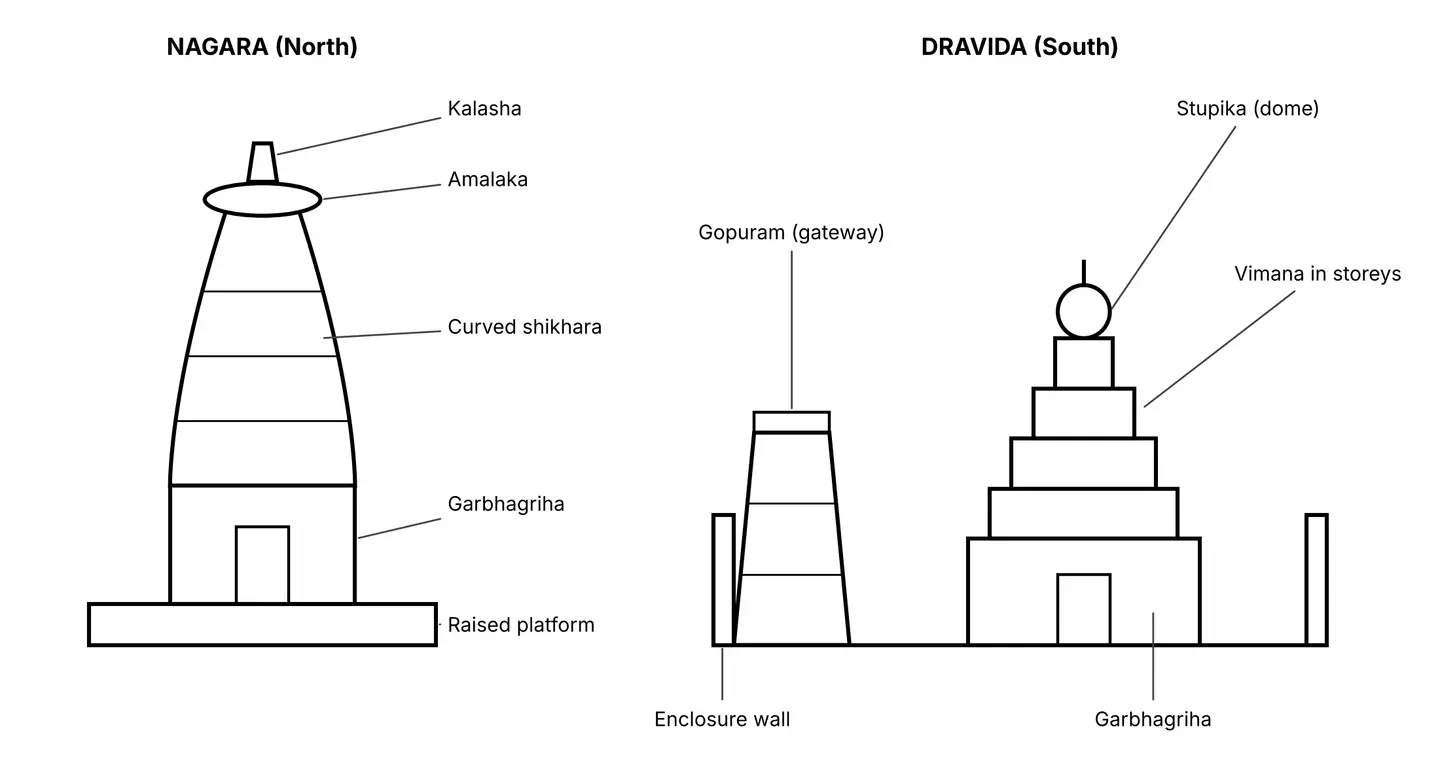
A simple sketch students can draw in two minutes: Nagara (left) and Dravida (right) Regional elaboration of Nagara
Odisha: The rekha deul tower and a front hall called the jagamohana appear in the Lingaraja temple and the Konark Sun Temple of the thirteenth century.
Khajuraho: The Chandelas built clusters of rising shikharas, as in the Kandariya Mahadeva temple.
Gujarat and Rajasthan: The Solankis built the Modhera Sun Temple, and marble Jain temples rose at Dilwara.
Regional elaboration of Dravida
Pallavas: Rock cut rathas and the Shore Temple at Mahabalipuram, and the Kailasanatha temple at Kanchipuram.
Cholas: The Brihadeeswara temple at Thanjavur, completed around 1010, has a towering vimana.
Nayakas: Huge gopurams and pillared halls, as at the Meenakshi temple in Madurai, came to dominate.
In the Deccan, the Chalukyas and Hoysalas blended both into the Vesara style, with star shaped plans at Belur and Halebidu.
Nagara and Dravida gave India two grammars of sacred space, and every region wrote its own poetry in them.
Show how the answer was builtHide how the answer was built
Decode
Two tasks: distinguish the styles, and show regional elaboration of each.
Implicit demand
The examiner wants consistent points of difference and named temples from several regions.
Architecture
An introduction, three differences, Nagara schools, Dravida schools, a line on Vesara, then a verdict.
Articulation
Every school names a temple a student can recall. Money line: two grammars of sacred space.
Show value added materialHide value added material
Temples
Lingaraja temple, Bhubaneswar.
Kandariya Mahadeva temple, Khajuraho.
Brihadeeswara temple, Thanjavur.
Hoysaleswara temple, Halebidu, in the Vesara style.
3 · First Principles IAS original10 marks150 words
Do you agree that coins are among the most reliable sources for reconstructing India’s political and economic history? Examine with reference to the ancient period.
Show the model answerHide the model answer
Coins are dated, durable and often carry rulers' names, which makes them valuable sources for ancient India. I largely agree, with clear limits.
Why coins are reliable
Rulers and dynasties: Most Indo Greek kings are known only from their coins.
Economy and trade: Hoards of Roman coins in south India show trade with Rome. Kushana gold coins reflect prosperity, and debased later Gupta coins show decline.
Achievements and beliefs: Samudragupta's Ashvamedha coins record his conquests. Kanishka's coins show Indian, Greek and Iranian deities, including the Buddha.
Commerce: Punch marked coins show early money economy, and Satavahana coins with ships show sea trade.
Limits
Coins found in a place may have arrived through trade, not conquest. Many lack dates, and they say little about society or ordinary life. In the early medieval period, coins become scarce.
Coins are among the most reliable witnesses to ancient India, but they speak best alongside inscriptions and literature.
Show how the answer was builtHide how the answer was built
Decode
Agree or disagree that coins are among the most reliable sources.
Implicit demand
The examiner wants strengths shown with examples and honest limits.
Architecture
A position, four strengths, limits, then a verdict.
Articulation
Indo Greek kings known only from coins make the strongest case. Money line: coins speak best alongside inscriptions and literature.
Show value added materialHide value added material
Facts
Punch marked coins from about the sixth century BCE.
Bilingual Indo Greek coins in Greek and Kharoshthi.
Roman coin hoards in Tamil Nadu and Karnataka.
4 · First Principles IAS original15 marks250 words
The classical dance forms of India are regional in body but share a common grammar. Discuss with reference to the Natyashastra and the major traditions.
Show the model answerHide the model answer
India's classical dances differ in costume, music and movement, yet all trace their roots to Bharata's Natyashastra. The Sangeet Natak Akademi recognises eight classical forms.
The common grammar from the Natyashastra
Rasa and bhava: Dance aims to evoke rasa, an aesthetic emotion, through bhava, expressed feeling.
Three elements: Nritta is pure movement, nritya is expressive dance, and natya is drama.
Four kinds of abhinaya: Expression through the body, speech, costume and inner emotion.
Hand gestures: A shared vocabulary of mudras, later codified in the Abhinaya Darpana.
Two moods: Tandava, vigorous and masculine, and lasya, graceful and feminine.
The regional body
Bharatanatyam: From Tamil Nadu, with a half seated stance and Carnatic music.
Kathak: From north India, shaped by temple storytellers and Mughal courts, with fast footwork and spins.
Kathakali: From Kerala, with elaborate make up and dance drama.
Odissi: From Odisha, with the tribhanga posture seen in temple sculpture.
Sattriya and Manipuri: Rooted in Vaishnava devotion in Assam and Manipur.
Kuchipudi from Andhra Pradesh and Mohiniyattam from Kerala complete the eight.
India's classical dances speak in many regional accents, but they share one grammar written in the Natyashastra.
Show how the answer was builtHide how the answer was built
Decode
Discuss the common grammar and regional variety of classical dance.
Implicit demand
The examiner wants Natyashastra concepts and named traditions with distinct features.
Architecture
An introduction, five shared elements, five regional forms, the remaining two, then a verdict.
Articulation
Rasa, nritta and abhinaya form the shared grammar. Money line: many regional accents, one grammar.
Show value added materialHide value added material
Sources and forms
Natyashastra attributed to Bharata.
Abhinaya Darpana by Nandikeshvara.
Eight classical dances recognised by the Sangeet Natak Akademi.
5 · First Principles IAS original15 marks250 words
Evaluate the achievements of ancient India in mathematics, astronomy and medicine, and examine the factors that enabled them.
Show the model answerHide the model answer
Ancient India produced ideas in mathematics, astronomy and medicine that later shaped the world through Arab and European scholars.
Achievements
Mathematics: Indians developed the decimal place value system with zero. Brahmagupta set rules for zero in 628 CE. The Sulbasutras used geometry for altar building, and Bhaskara II wrote the Lilavati in the twelfth century.
Astronomy: Aryabhata, in 499 CE, proposed that the earth rotates on its axis, explained eclipses by shadows and gave an accurate value of pi. Varahamihira compiled astronomical systems.
Medicine: The Charaka Samhita covered internal medicine, and the Sushruta Samhita described surgery, including plastic surgery of the nose and cataract operations.
Metallurgy: The rust resistant iron pillar at Delhi, of the Gupta age, shows advanced skill.
Factors that enabled them
Practical needs: Rituals needed precise altars and calendars, and farming and trade needed time keeping.
Patronage: Rulers such as the Guptas supported scholars.
Centres of learning: Takshashila and Nalanda drew students from across Asia.
Exchange of ideas: Contact with Greek and Babylonian astronomy enriched Indian work.
Limits
Knowledge often stayed within elite groups. Contempt for manual work limited experiment, and progress slowed in later centuries.
Ancient India's science shows what curiosity, patronage and exchange can achieve, and its decline shows what happens when knowledge is closed to many.
Show how the answer was builtHide how the answer was built
Decode
Two tasks: evaluate achievements, and examine the enabling factors.
Implicit demand
The examiner wants specific achievements, causes and an honest note on limits.
Architecture
An introduction, four fields, four factors, limits, then a verdict.
Articulation
Aryabhata and Sushruta are the anchor names. Money line: what happens when knowledge is closed to many.
Show value added materialHide value added material
Texts
Aryabhatiya, 499 CE.
Brahmasphutasiddhanta by Brahmagupta, 628 CE.
Charaka Samhita and Sushruta Samhita.
Lilavati by Bhaskara II.