

17 Nov 2026GS1Topic
Geography: resources, industry and location
Previous year questions
5 as set1 · GS1 201710 marks150 words
“In spite of adverse environmental impact, coal mining is still inevitable for development.” Discuss.
Show the model answerHide the model answer
India produced over a billion tonnes of coal in 2024 to 2025, and coal still generates about three fourths of its electricity.
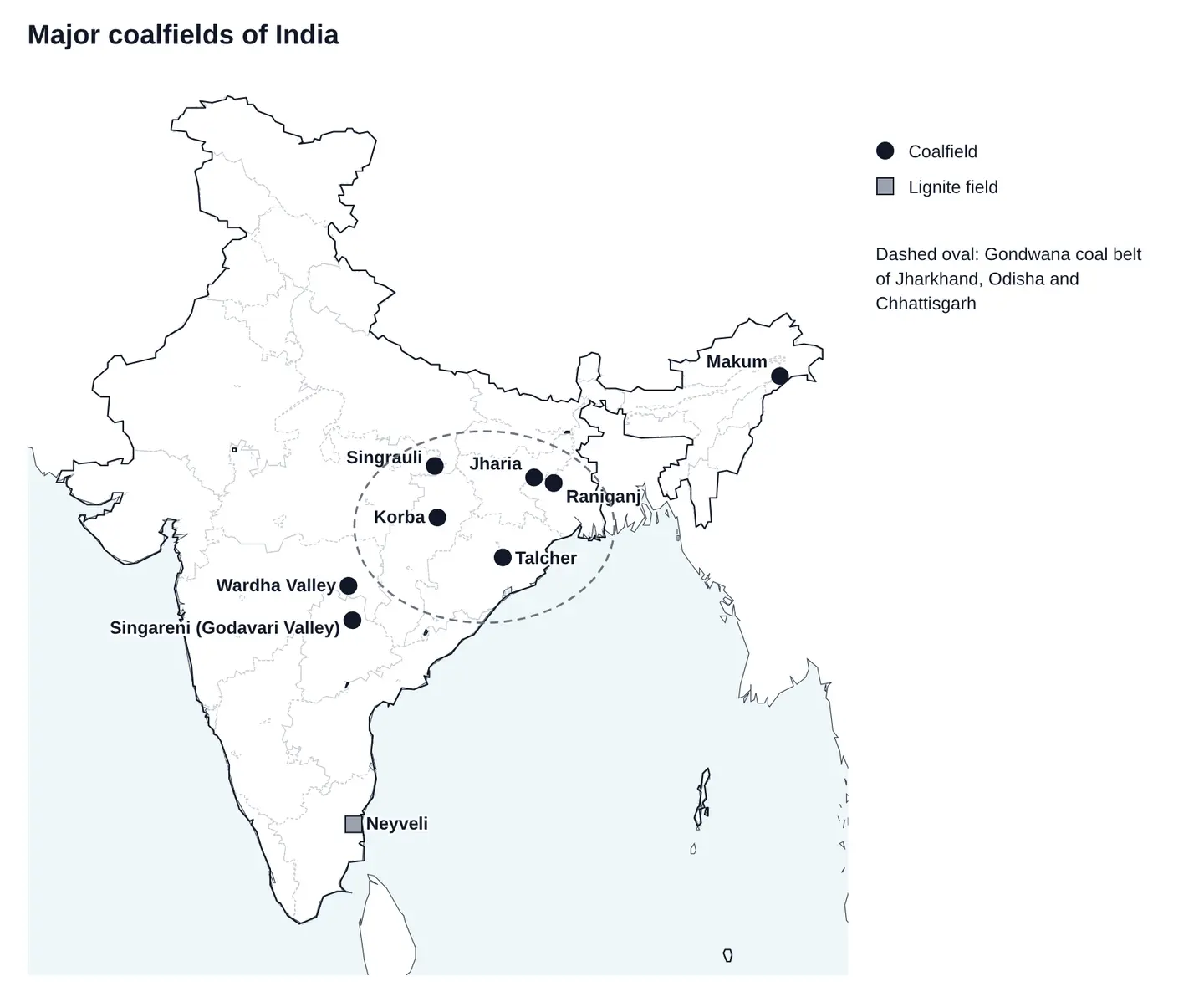
Why coal remains inevitable
Energy security: Coal is a domestic, cheap source of round the clock power, while solar and wind still need costly storage.
Core industries: Steel, cement and fertiliser depend on coal for heat and as raw material.
Livelihoods: Mining supports jobs and state revenue in Jharkhand, Odisha and Chhattisgarh.
Environmental costs
Mining clears forests, as in Hasdeo Arand, and displaces tribal families. Jharia's underground fires and fly ash pollute air and water.
Reducing the harm
Coal washing, supercritical plants, gasification and land reclamation cut damage. A just transition must protect coal workers as India moves towards net zero by 2070.
Coal remains India's bridge to development, but it must be crossed cleanly and left behind gradually.
Show how the answer was builtHide how the answer was built
Decode
Discuss why coal remains necessary despite its damage.
Implicit demand
The examiner wants the case for coal, its costs, and a clean way forward.
Architecture
An introduction with data, a coalfield map, three reasons, the costs, mitigation, then a verdict.
Articulation
The map shows where the trade off happens. Money line: crossed cleanly and left behind gradually.
Show value added materialHide value added material
Facts
Coal Gasification Mission targets 100 million tonnes by 2030.
District Mineral Foundations fund mining areas.
India targets 500 gigawatts of non fossil capacity by 2030.
2 · GS1 201815 marks250 words
“The ideal solution of depleting ground water resources in India is water harvesting system.” How can it be made effective in urban areas?
Show the model answerHide the model answer
The Central Ground Water Board finds about one in nine assessment units over exploited. Chennai ran short of water in 2019 and Bengaluru in 2024. Water harvesting is vital, and cities must make it work.
Making it effective in cities
Enforce the law: Tamil Nadu made rooftop harvesting compulsory in 2003, and Chennai's water table rose. Building bylaws elsewhere must be enforced, not just written.
Recharge, not just storage: Recharge wells and pits send rooftop water into aquifers. Bengaluru's citizen groups have dug thousands of such wells.
Revive lakes and tanks: Urban lakes once stored monsoon water. Restoring lakes, tanks and wetlands, as with Jakkur lake in Bengaluru, recharges groundwater naturally.
Sponge city design: Permeable pavements, parks and bioswales let rain soak in instead of flooding streets.
Floodplain recharge: Delhi's Yamuna floodplain at Palla stores monsoon flows underground for later use.
Science and upkeep: Aquifer mapping shows where recharge works best. Filters and regular cleaning keep structures working.
Incentives and people: Property tax rebates and resident welfare associations make harvesting a community habit. The Catch the Rain campaign (2021) builds awareness.
Harvesting alone is not enough
Cities must also reuse treated wastewater, fix leaking pipes and price water sensibly. AMRUT 2.0 (2021) supports such reforms.
Rainwater harvesting can refill urban aquifers only when law, design and citizens work together.
Show how the answer was builtHide how the answer was built
Decode
Explain how to make urban water harvesting work.
Implicit demand
The examiner wants practical measures with city examples and an honest limit.
Architecture
An introduction with data, seven measures, a limit, then a verdict.
Articulation
Chennai's 2003 rule gives proof of results. Money line: law, design and citizens together.
Show value added materialHide value added material
Facts
Model Building Bye Laws, 2016.
National Aquifer Mapping and Management Programme.
Atal Bhujal Yojana, 2019, for community groundwater management.
3 · GS1 201915 marks250 words
What is water stress? How and why does it differ regionally in India?
Show the model answerHide the model answer
Water stress arises when demand for water approaches or exceeds the usable supply. A region with less than 1,700 cubic metres per person a year is considered stressed. India's average has already fallen below this mark.
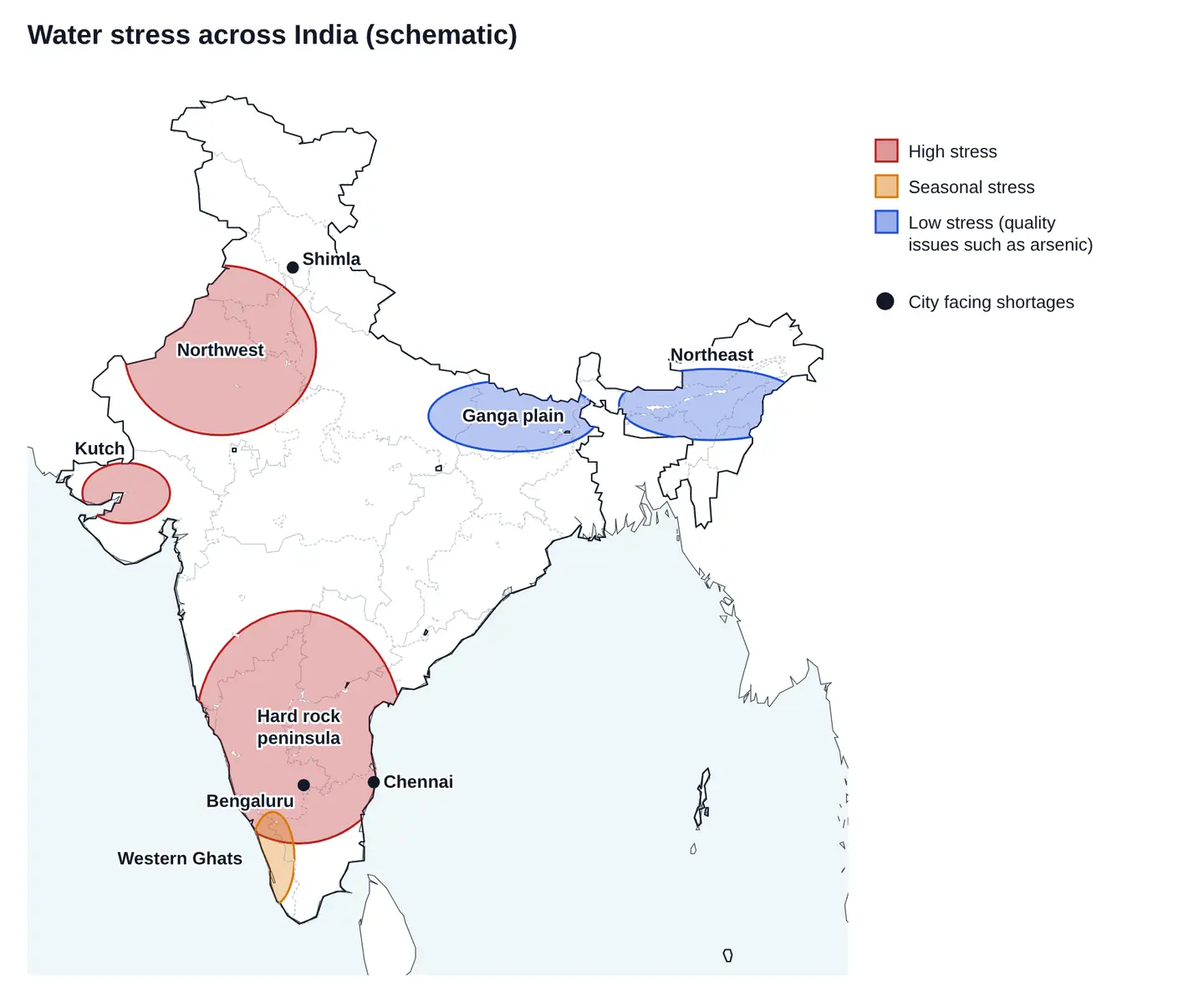
How it differs regionally
Northwest: Punjab, Haryana and Rajasthan extract more groundwater than rain replaces, mainly for paddy and wheat.
Hard rock peninsula: Karnataka, Telangana and Tamil Nadu sit on rocks that hold little water. Chennai and Bengaluru have faced acute shortages.
Rain shadow plateau: Marathwada and Bundelkhand get low and erratic rain, so droughts recur and wells run dry.
Arid west: Kutch and western Rajasthan receive scant rain, and much groundwater is saline.
Western Ghats: Kerala gets heavy rain, yet steep slopes drain it quickly, causing summer shortages.
Ganga plain and Northeast: Deep alluvial aquifers and heavy rain keep stress low. Arsenic in Bihar and West Bengal, however, creates a quality problem.
Himalaya: Drying springs have left towns such as Shimla short of water.
Why it differs
Rainfall, rock type and terrain set the natural limits. Water hungry crops, free farm power, rapid urban growth and pollution then deepen the stress.
Water stress is regional in cause, so its solutions must be regional too.
Show how the answer was builtHide how the answer was built
Decode
Define water stress and explain its regional pattern and causes.
Implicit demand
The examiner wants a precise definition, a region wise picture and the reasons behind it.
Architecture
A definition, a map, six regions, the causes, then a verdict.
Articulation
The map does half the work of the regional comparison. Money line: regional in cause and in solution.
Show value added materialHide value added material
Facts
NITI Aayog's Composite Water Management Index, 2018.
Jal Jeevan Mission, 2019.
Falkenmark indicator: below 1,000 cubic metres per person is scarcity.
4 · GS1 202010 marks150 words
Account for the present location of iron and steel industries away from the source of raw material, by giving examples.
Show the model answerHide the model answer
Early steel plants such as Jamshedpur, Bhilai and Rourkela grew in the Chota Nagpur belt, close to coal and iron ore. Newer plants increasingly locate away from these sources.
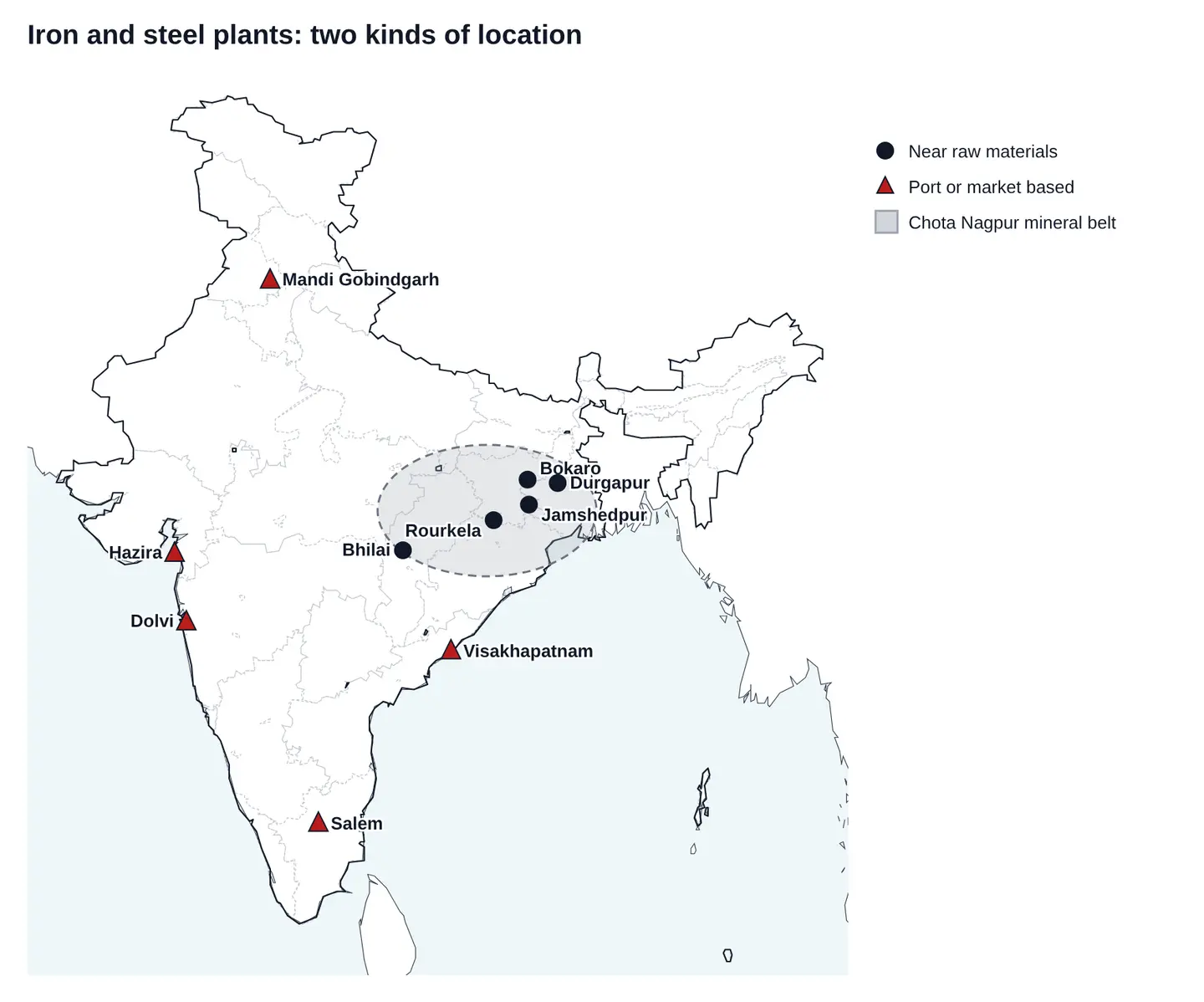
Imported coking coal: India imports most of its coking coal, so coastal plants such as Visakhapatnam, Hazira and Dolvi save on transport.
Nearness to markets: Plants near consumers in the west and south cut the cost of moving finished steel.
New technology: Electric arc furnaces use scrap and sponge iron, so mini mills such as Mandi Gobindgarh work far from mines.
Better transport: Slurry pipelines carry iron ore from Bailadila to Visakhapatnam.
Policy support: The National Steel Policy (2017) targets 300 million tonnes of capacity, encouraging port based plants.
Steel has moved from the mine to the port and the market, following cost rather than ore.
Show how the answer was builtHide how the answer was built
Decode
Explain why newer steel plants locate away from raw materials.
Implicit demand
The examiner wants clear reasons, each with a named plant.
Architecture
An introduction, a map, five reasons, then a verdict.
Articulation
The map contrasts the two kinds of location at a glance. Money line: following cost rather than ore.
Show value added materialHide value added material
Facts
Tata Steel at Jamshedpur, 1907.
Durgapur, Bhilai and Rourkela built in the 1950s and 1960s with foreign help.
JSW Vijayanagar in Karnataka lies near Bellary iron ore.
5 · GS1 202110 marks150 words
Why is India considered as a subcontinent? Elaborate your answer.
Show the model answerHide the model answer
A subcontinent is a large landmass that stands apart from the rest of a continent. The Indian subcontinent includes India, Pakistan, Nepal, Bhutan, Bangladesh and Sri Lanka.
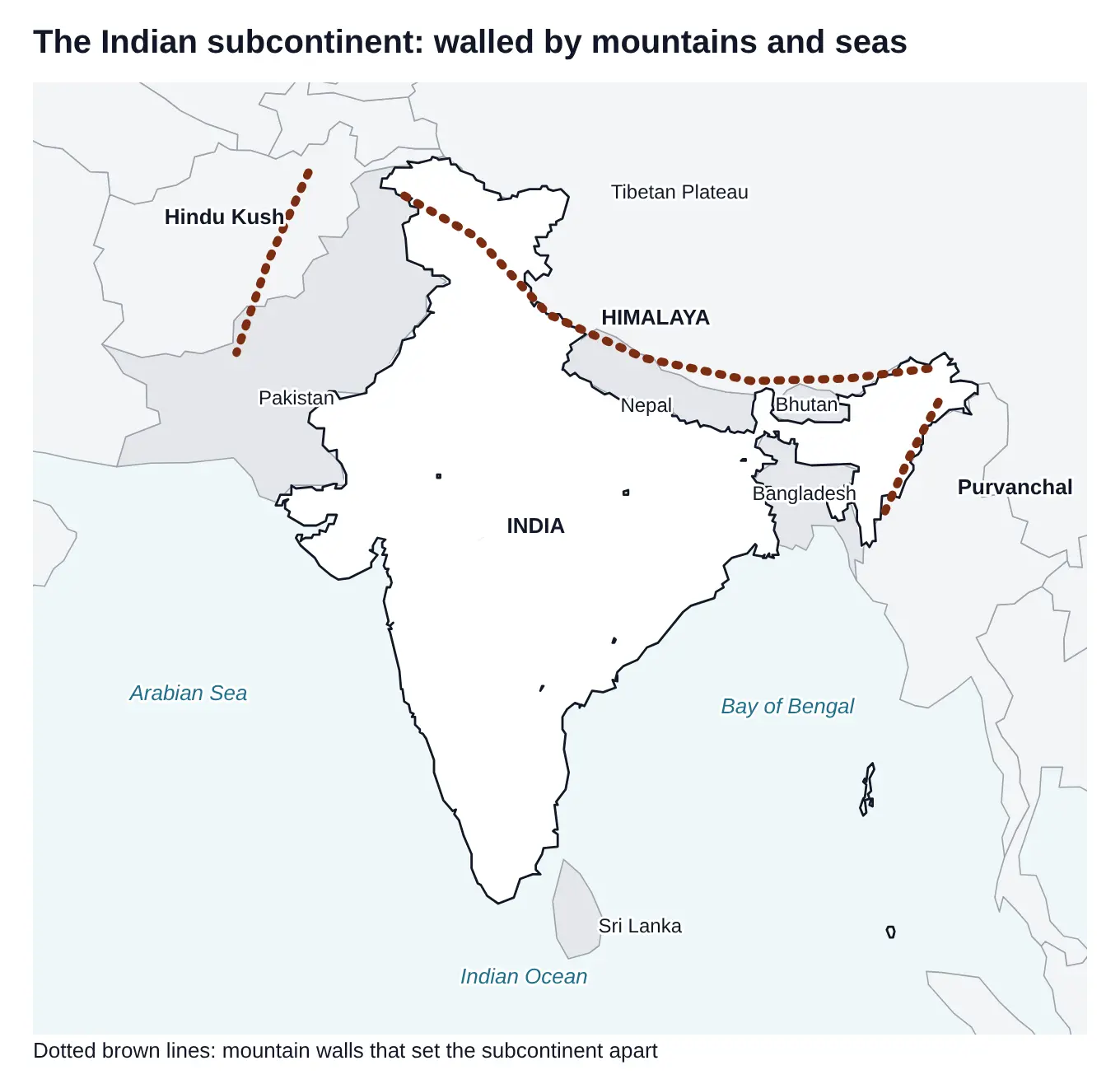
Natural walls: The Himalaya, the Hindu Kush and the Purvanchal hills separate it from the rest of Asia. Seas surround it on three sides.
Separate plate: It rests on the Indian Plate, which collided with Asia and raised the Himalaya.
Vast size and variety: It covers a huge area with every major landform: mountains, plains, plateaus, deserts and islands.
Own river systems: The Indus, Ganga and Brahmaputra rise in the Himalaya and build the great plains, a drainage pattern distinct from the rest of Asia.
Own climate: The Himalaya blocks cold Central Asian winds, and the monsoon gives the whole region one climate rhythm.
Shared culture: Common history, languages and faiths set it apart from Central and East Asia.
Geology, geography and culture together make the region a world within a continent.
Show how the answer was builtHide how the answer was built
Decode
Explain why India is called a subcontinent.
Implicit demand
The examiner wants physical, geological and cultural reasons.
Architecture
A definition, a map, five reasons, then a verdict.
Articulation
The map shows the mountain walls and seas. Money line: a world within a continent.
Show value added materialHide value added material
Facts
Indian Plate collided with the Eurasian Plate about 50 million years ago.
India alone covers about 2.4 percent of the world's land area.