

18 Nov 2026GS1Topic
Geography: resources, industry and location
Original questions
5 for today1 · First Principles IAS original10 marks150 words
Discuss the geographical logic underlying the location of India's proposed rare earth corridors.
Show the model answerHide the model answer
The Union Budget for 2026 to 2027 proposed rare earth corridors in Odisha, Kerala, Andhra Pradesh and Tamil Nadu. Their location follows the geography of India's rare earth deposits.
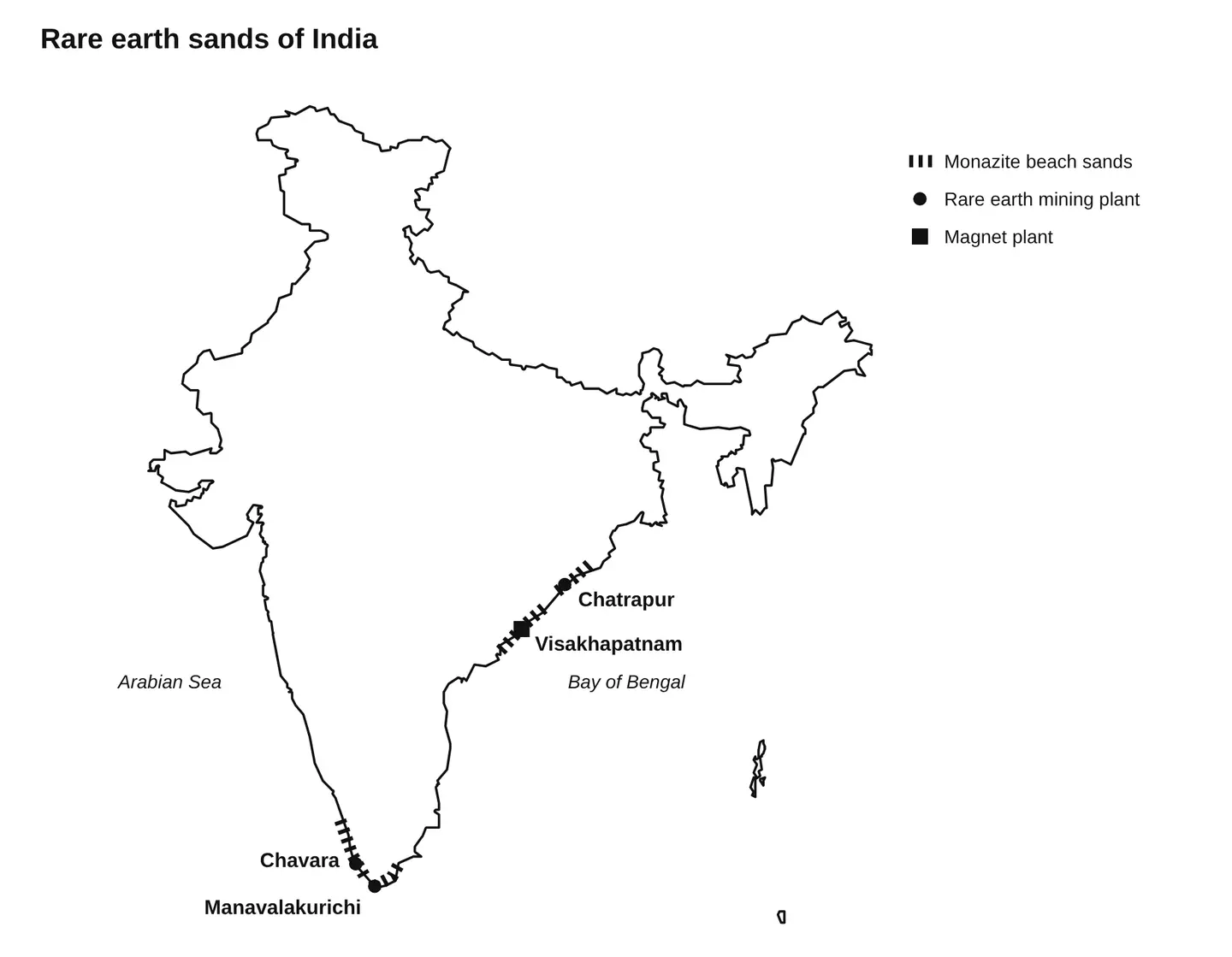
Placer deposits on the coast: India's rare earths occur mainly in monazite beach sands. Rivers and waves concentrated these heavy minerals along the coasts of Kerala, Tamil Nadu, Andhra Pradesh and Odisha.
Existing base: Indian Rare Earths Limited already runs plants at Chavara, Manavalakurichi and Chatrapur, and a magnet facility at Visakhapatnam.
Ports and corridors: Coastal sites link to ports and to the Visakhapatnam Chennai Industrial Corridor.
Demand nearby: Electronics and electric vehicle makers in Tamil Nadu and Andhra Pradesh need permanent magnets.
Constraints
Monazite contains radioactive thorium, so mining stays under atomic energy rules. Coastal regulation and fishing communities also limit expansion.
The corridors follow the sand, the port and the market together.
Show how the answer was builtHide how the answer was built
Decode
Discuss why the rare earth corridors sit where they do.
Implicit demand
The examiner wants the geology first, then infrastructure, markets and limits.
Architecture
An introduction, a sketch, four factors, constraints, then a verdict.
Articulation
Placer sands explain the coastal pattern. Money line: the sand, the port and the market together.
Show value added materialHide value added material
Facts
Scheme for sintered rare earth permanent magnets, 2025.
Beach sand minerals reserved for government companies.
Rare earth elements are vital for electric motors, wind turbines and defence electronics.
2 · First Principles IAS original10 marks150 words
Examine the locational factors governing green hydrogen production in India.
Show the model answerHide the model answer
The National Green Hydrogen Mission (2023) targets five million tonnes a year by 2030. Where this hydrogen is made depends on a few clear factors.
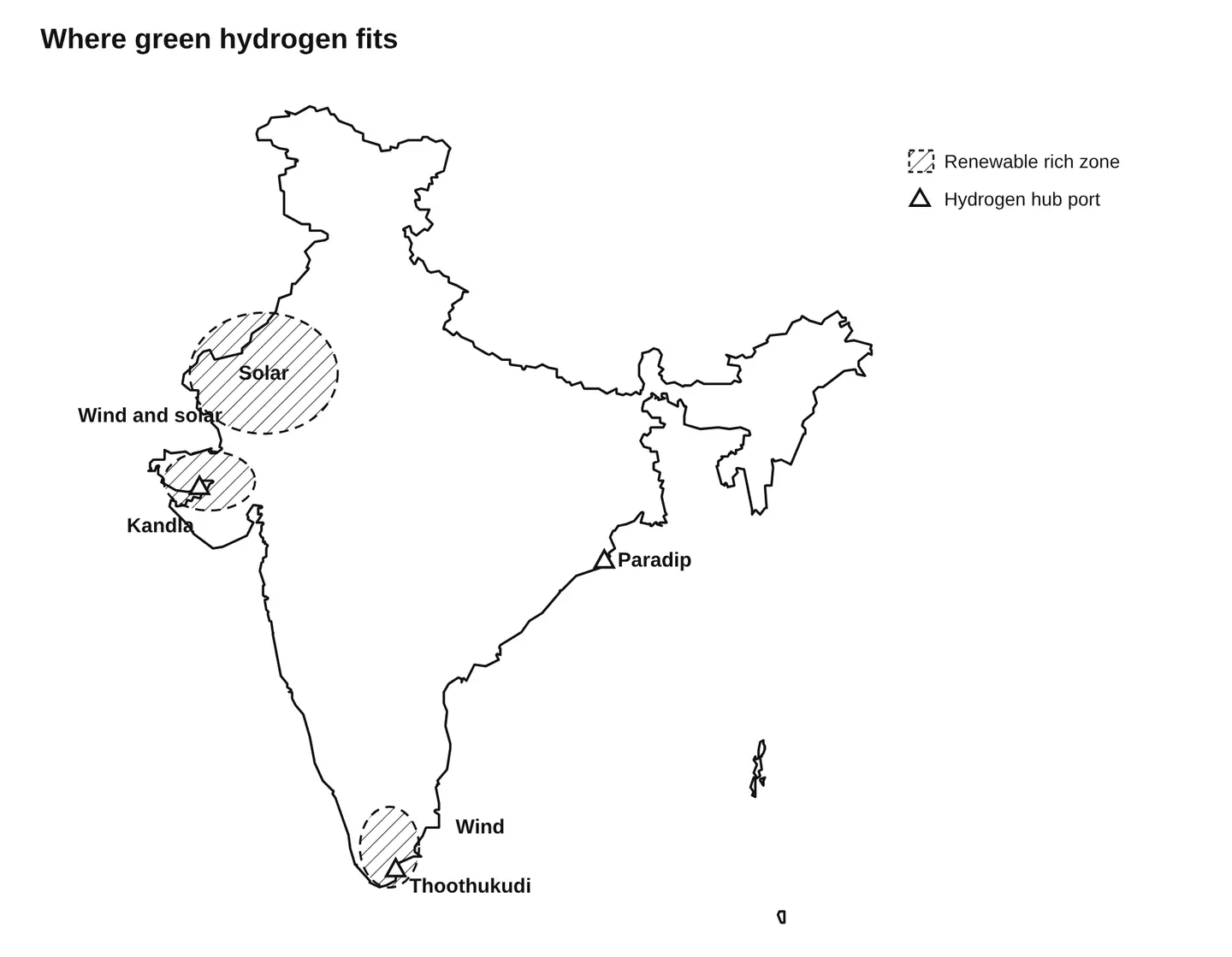
Cheap renewable power: Electricity is the largest cost, so plants favour solar and wind rich Rajasthan, Gujarat and Tamil Nadu.
Water: Electrolysis needs clean water, and dry regions must desalinate seawater. This pulls plants to the coast.
Ports: Green ammonia is exported by sea. Kandla, Paradip and Thoothukudi have been named hydrogen hubs.
Demand centres: Refineries, fertiliser plants and steel mills are the first users of hydrogen.
Round the clock supply: Electrolysers work best on steady power. Sites where wind and solar complement each other, as in Gujarat and Tamil Nadu, keep plants running longer.
Grid and land: Transmission waivers let plants draw renewable power from distant parks, and cheap land helps.
Green hydrogen settles where sun, wind, water and ports meet, which is why India's coasts lead.
Show how the answer was builtHide how the answer was built
Decode
Examine what decides where green hydrogen is produced.
Implicit demand
The examiner wants each factor with Indian places, and the coastal pull explained.
Architecture
An introduction, a sketch, five factors, then a verdict.
Articulation
The three port hubs anchor the answer. Money line: where sun, wind, water and ports meet.
Show value added materialHide value added material
Facts
Strategic Interventions for Green Hydrogen Transition programme under the mission.
Green ammonia can carry hydrogen for export.
Leh hosts an early green hydrogen mobility project.
3 · First Principles IAS original15 marks250 words
Explain the global distribution of rare earth elements. Why is geological abundance not the same as strategic availability?
Show the model answerHide the model answer
China's export controls on rare earths in 2025 disrupted factories worldwide. The episode showed that reserves and real supply are very different things.
Global distribution
Reserves: China holds the largest reserves, followed by Brazil, India and Australia. Russia, Vietnam and the United States also hold significant deposits.
Production: China mines about two thirds of the world's output. The United States, Myanmar and Australia follow.
Processing: China refines nearly nine tenths of rare earths and makes most of the world's permanent magnets.
Deposit types: Major sources are carbonatite deposits such as Bayan Obo in China, ionic clays in southern China and Myanmar, and monazite beach sands in India and Brazil.
Why abundance is not availability
Rarely concentrated: Elements such as cerium are as common as copper in the crust, but economic deposits are few.
Hard to separate: The seventeen elements occur together and need complex chemical separation.
Toxic waste: Processing leaves radioactive and acidic waste, which raises costs in countries with strict rules.
Long lead times: A new mine and refinery can take over a decade to start.
Market control: China's low prices kept rivals out, and its export controls now turn supply into a weapon.
India's response
India holds large reserves but produces little. The National Critical Mineral Mission (2025) and the Minerals Security Partnership aim to build supply chains.
Rare earths are not rare in the ground. They are rare in refined, reliable supply.
Show how the answer was builtHide how the answer was built
Decode
Explain where rare earths occur and why supply is limited.
Implicit demand
The examiner wants reserves, production and processing kept separate, then the reasons for scarcity.
Architecture
A current affairs introduction, four points on distribution, five on availability, India's response, then a verdict.
Articulation
Separating reserves from refining makes the core point. Money line: rare in refined, reliable supply.
Show value added materialHide value added material
Facts
Seventeen rare earth elements: fifteen lanthanides, scandium and yttrium.
Quad Critical Minerals Initiative, 2025.
Mountain Pass in California is the main United States mine.
4 · First Principles IAS original15 marks250 words
Petroleum refineries and iron and steel plants have both migrated away from their raw material sources. Compare the locational logic operating in each case.
Show the model answerHide the model answer
India's first refinery at Digboi sat on an oilfield, and its first steel plant at Jamshedpur sat on the coal and ore belt. Both industries have since moved, but for different reasons.
Refineries
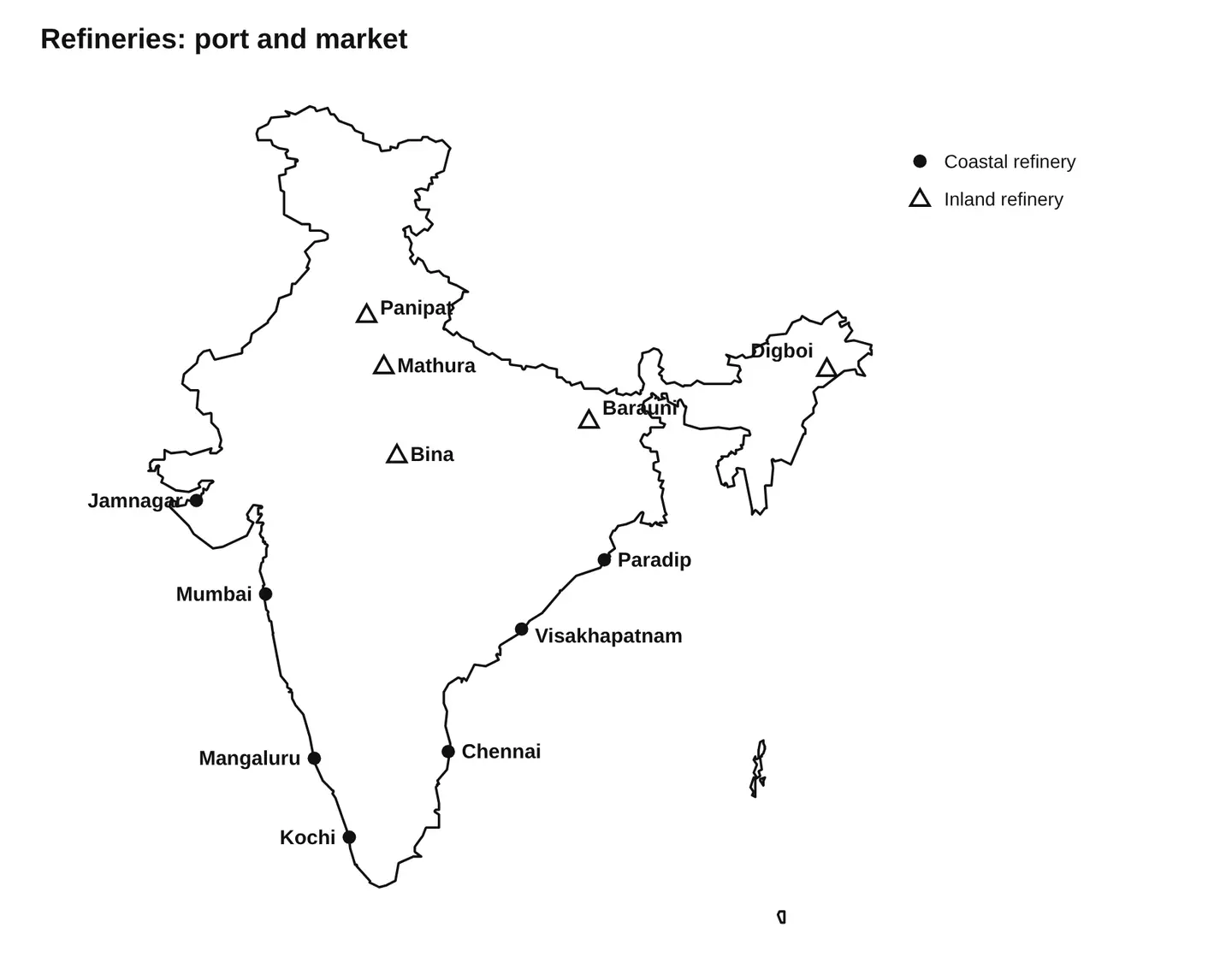
Imported crude: India imports nearly nine tenths of its crude, so large refineries sit at ports such as Jamnagar, Mangaluru and Paradip.
Little weight loss: Refining loses little weight, while products are many and costly to move. Plants such as Panipat and Mathura therefore sit near markets, fed by crude pipelines.
Pipelines: Cheap pipeline transport frees refineries from both oilfield and port.
Iron and steel
Weight losing inputs: Coal and ore lose much weight in smelting, which first tied plants to the Chota Nagpur belt.
Imported coking coal: Imports pulled new plants to Visakhapatnam, Hazira and Dolvi.
Ore still matters: Iron ore remains bulky, so many new plants still choose Odisha, near both ore and port.
Comparison
Both moved towards the coast because of imports. Refineries are market oriented since pipelines make crude mobile. Steel is pulled between ore, port and market, since its inputs remain heavy.
Refineries follow the market, while steel still weighs the cost of its raw materials.
Show how the answer was builtHide how the answer was built
Decode
Compare why refineries and steel plants left their raw material sites.
Implicit demand
The examiner wants the different logic of each industry and a direct comparison.
Architecture
An introduction, a sketch, three points on refineries, three on steel, a comparison, then a verdict.
Articulation
Weight loss and pipelines explain the difference. Money line: refineries follow the market.
Show value added materialHide value added material
Facts
Digboi refinery, 1901, is among the oldest working refineries.
Jamnagar is the world's largest refining complex.
Barmer refinery in Rajasthan is sited near local oilfields.
5 · First Principles IAS original15 marks250 words
Discuss the geographical distribution of polymetallic nodules in the ocean basins. Assess their significance for India's resource security.
Show the model answerHide the model answer
Polymetallic nodules are potato sized lumps on the deep sea floor, rich in manganese, nickel, copper and cobalt. They grow only a few millimetres in a million years.
Distribution
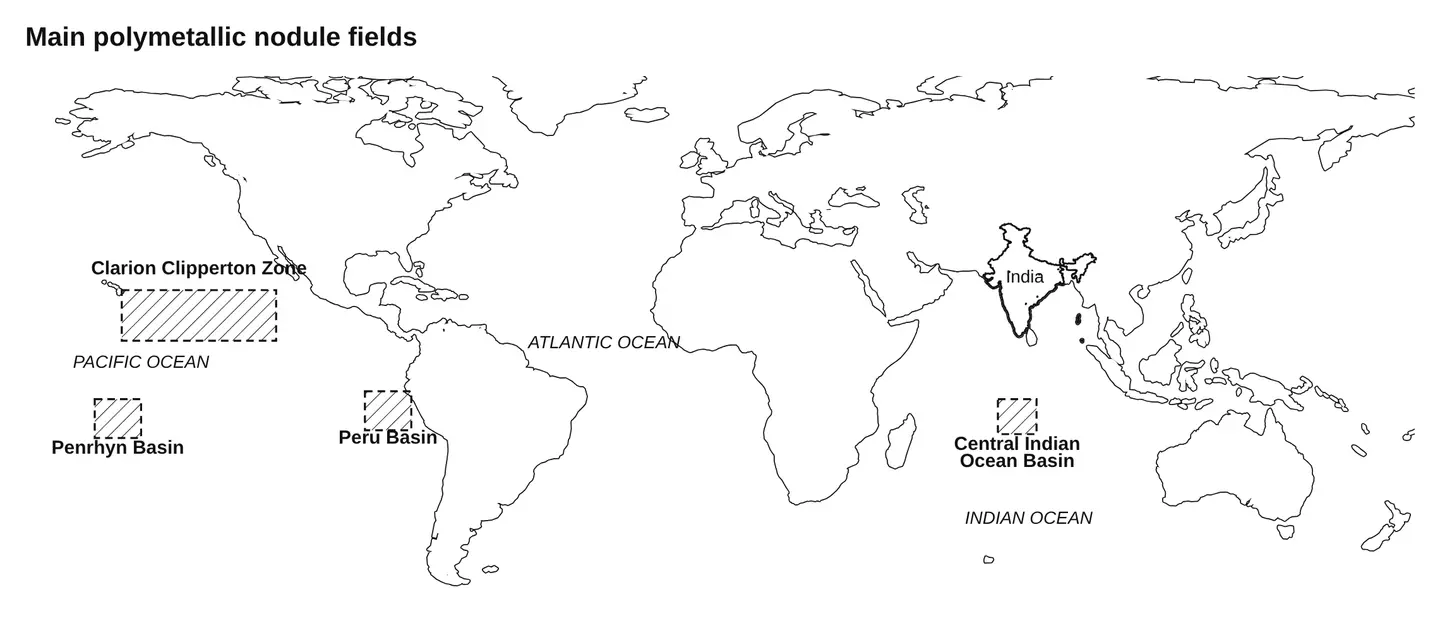
Pacific Ocean: The Clarion Clipperton Zone between Hawaii and Mexico holds the richest fields. The Peru and Penrhyn basins also hold large deposits.
Indian Ocean: The Central Indian Ocean Basin holds major fields.
Where they form: Nodules form on abyssal plains 4,000 to 6,000 metres deep, where sediment builds slowly.
Significance for India
Battery metals: Nickel, cobalt and copper are vital for electric vehicles and renewables, and India imports most of them.
India's claim: India was a pioneer investor and holds an International Seabed Authority contract over 75,000 square kilometres of the basin.
Deep Ocean Mission (2021): It funds mining technology and Samudrayaan, India's crewed submersible programme.
Strategic presence: Seabed research strengthens India's role in the Indian Ocean amid Chinese activity.
Limits
Mining could destroy fragile deep sea life, and the International Seabed Authority has yet to finalise mining rules. The technology also remains costly.
Nodules offer India a long term mineral reserve, but only careful and lawful mining can make it secure.
Show how the answer was builtHide how the answer was built
Decode
Discuss where nodules occur and what they mean for India.
Implicit demand
The examiner wants distribution with named basins, India's stake and the limits.
Architecture
A definition, a sketch, distribution, four points on significance, limits, then a verdict.
Articulation
The sketch shows India's basin beside the Pacific fields. Money line: careful and lawful mining.
Show value added materialHide value added material
Facts
India became a registered pioneer investor in 1987.
Matsya 6000 is designed to reach 6,000 metres.
Polymetallic sulphides contracts cover the Central and Southwest Indian Ridges.