

27 Nov 2026GS1Full length test
Full length test: GS1
Questions you have written before will appear here. That is by design. Writing an answer a second time, after reading the model answer, is the point of the day.
The paper
20 questions1 · GS1 202310 marks150 words
Explain the role of geographical factors towards the development of Ancient India.
Show the model answerHide the model answer
Geography shaped where Indian civilisation arose, how it grew and how it connected with the world.
Rivers and plains: The Indus and later the Ganga plains gave fertile soil and water, supporting the Harappan cities and the Mahajanapadas.
Monsoon: Reliable monsoon rain allowed two crops a year and a food surplus for towns and states.
Mountain barriers: The Himalaya protected the north, while passes such as the Khyber brought migrants, traders and ideas.
Minerals and forests: Iron ore and forests of the Chota Nagpur region helped Magadha clear land and build its power.
Peninsula and coasts: The Deccan's separate geography created distinct southern kingdoms. Long coasts linked India with Rome and Southeast Asia through trade.
Diversity: Varied regions produced varied cultures, laying the base of unity in diversity.
Ancient India's history was written on its rivers, mountains and coasts.
Show how the answer was builtHide how the answer was built
Decode
Explain how geography shaped ancient India.
Implicit demand
The examiner wants specific geographical factors linked to historical outcomes.
Architecture
An introduction, six factors, then a verdict.
Articulation
Magadha's iron links geography to power. Money line: written on rivers, mountains and coasts.
Show value added materialHide value added material
Facts
Uttarapatha and Dakshinapatha trade routes.
Monsoon winds explained by Hippalus aided Roman trade.
Doab lands of the Ganga Yamuna.
2 · GS1 201910 marks150 words
Examine the linkages between the nineteenth century's 'Indian Renaissance' and the emergence of national identity.
Show the model answerHide the model answer
The nineteenth century Indian Renaissance was a movement of social and religious reform. It also gave Indians a shared sense of nationhood.
Pride in the past: Reformers and Orientalist scholars revived interest in India's ancient heritage, building cultural confidence.
Reason and reform: Raja Ram Mohan Roy and others used reason to attack sati and caste rigidity, preparing a modern, united society.
Arya Samaj and revival: Dayanand Saraswati's call to return to the Vedas stressed self reliance and pride.
Press and language: Newspapers and vernacular literature spread ideas across regions, creating a public sphere.
Critique of colonial rule: Reformers exposed the economic drain and racial discrimination, turning reform into politics.
Organisation: Associations of the educated paved the way for the Indian National Congress (1885).
The Renaissance had limits. It was largely upper caste and urban, and some revivalist strands sharpened religious identity.
The Renaissance turned social awakening into national awakening.
Show how the answer was builtHide how the answer was built
Decode
Link the Indian Renaissance to national identity.
Implicit demand
The examiner wants specific links and a note on limits.
Architecture
An introduction, six links, a limit, then a verdict.
Articulation
Press and pride connect reform to politics. Money line: social awakening into national awakening.
Show value added materialHide value added material
Facts
Asiatic Society of Bengal, 1784.
Bankim Chandra's Vande Mataram, 1882.
Prarthana Samaj, 1867.
3 · GS1 202510 marks150 words
The ethos of civil service in India stand for the combination of professionalism with nationalistic consciousness – Elucidate.
Show the model answerHide the model answer
Sardar Patel called the civil services the steel frame of India. Their ethos joins professional skill with a commitment to the nation.
Professionalism
Merit and neutrality: Recruitment through the Union Public Service Commission rests on merit. Officers serve every government impartially.
Expertise and rule of law: Civil servants bring administrative skill and apply laws fairly.
Nationalistic consciousness
Unity and integration: All India Services bind the Union and states, as Patel intended.
Constitutional values: Officers serve the Constitution, not parties, and work for national development.
Service in crisis: In disasters, elections and the pandemic, civil servants worked as the nation's front line.
Balancing the two
Nationalism here means loyalty to constitutional values, not to a party. Reforms such as Mission Karmayogi (2020) build competence and citizen focus.
The civil service is professional in method and national in purpose.
Show how the answer was builtHide how the answer was built
Decode
Elucidate how civil service ethos joins professionalism and national commitment.
Implicit demand
The examiner wants both elements and how they balance.
Architecture
An introduction, two points on each element, a balance, then a verdict.
Articulation
Patel's steel frame anchors the answer. Money line: professional in method, national in purpose.
Show value added materialHide value added material
Facts
All India Services under the Constitution.
Second Administrative Reforms Commission on civil service ethics.
Lateral entry debate.
4 · GS1 202310 marks150 words
Child cuddling is now being replaced by mobile phones. Discuss its impact on the socialization of children.
Show the model answerHide the model answer
Parents now often hand phones to children to keep them busy. This shift affects how children learn to relate to others.
Impact on socialisation
Weaker emotional bonds: Touch, play and eye contact build attachment. Screens replace these early bonds.
Language and social skills: Children learn speech and empathy through conversation. Excess screen time can delay both.
Attention and behaviour: Fast content may shorten attention spans and increase irritability.
Health: Less outdoor play brings obesity, poor sleep and eye strain.
Unfiltered values: Children may absorb content without guidance from family.
The other side
Used well, devices can support learning through educational content and video calls with distant relatives.
Way forward
Doctors advise little or no screen time for very young children. Shared play and family time remain essential.
Phones can entertain a child, but only people can raise one.
Show how the answer was builtHide how the answer was built
Decode
Discuss how phones replacing cuddling affect children's socialisation.
Implicit demand
The examiner wants impacts, a fair counterpoint and remedies.
Architecture
An introduction, five impacts, a counterpoint, a way forward, then a verdict.
Articulation
Attachment explains the core harm. Money line: only people can raise a child.
Show value added materialHide value added material
Facts
World Health Organization advice on screen time for young children.
Digital detox and screen free zones in schools.
Joint family decline reduces grandparent care.
5 · GS1 202010 marks150 words
COVID-19 pandemic accelerated class inequalities and poverty in India. Comment.
Show the model answerHide the model answer
The pandemic hit everyone, but not equally. It widened the gap between those who could work from home and those who lost their daily wage.
How inequality grew
Jobs: Informal workers, who form most of India's workforce, lost income. Lakhs of migrants walked home in 2020.
Education: Online classes shut out children without devices or internet.
Health: The poor faced crowded hospitals and high out of pocket costs.
Wealth: Asset owners gained from rising stock markets while the poor drew down savings and fell into debt.
Gender: Women lost jobs faster and carried more unpaid care.
What softened the blow
Free grain under the Pradhan Mantri Garib Kalyan Anna Yojana (2020), cash transfers and rural job guarantee work prevented deeper hunger.
The pandemic exposed the fault lines of inequality and widened them, making social protection a necessity.
Show how the answer was builtHide how the answer was built
Decode
Comment on how the pandemic widened inequality.
Implicit demand
The examiner wants dimensions of inequality and the policy response.
Architecture
An introduction, five dimensions, relief measures, then a verdict.
Articulation
Migrants walking home make it concrete. Money line: exposed and widened the fault lines.
Show value added materialHide value added material
Facts
e Shram portal, 2021.
One Nation One Ration Card, 2019.
Mid day meals disrupted during school closures.
6 · GS1 201810 marks150 words
How the Indian concept of secularism is different from the western model of secularism? Discuss.
Show the model answerHide the model answer
Both Indian and Western secularism keep the state neutral among religions. They differ in how the state relates to religion.
Separation versus principled distance: Western secularism, as in France or the United States, builds a wall of separation. India keeps principled distance, engaging or staying away as fairness requires.
Reform: The Indian state can reform religious practice, as in temple entry, the Hindu Code Bills and the ban on instant triple talaq.
Support to all: India aids minority institutions and pilgrimages, while Western states generally avoid funding religion.
Group rights: India protects community rights and personal laws. The West focuses on individual liberty.
Equal respect: India's idea of sarva dharma sambhava means respect for all faiths, not indifference.
Critics say India's model can be applied selectively, but it suits a deeply religious, plural society.
Western secularism keeps religion out of the state, while Indian secularism keeps the state fair to every religion.
Show how the answer was builtHide how the answer was built
Decode
Distinguish Indian and Western secularism.
Implicit demand
The examiner wants clear contrasts with examples.
Architecture
An introduction, five contrasts, a critique, then a verdict.
Articulation
Principled distance is the key idea. Money line: out of the state versus fair to every religion.
Show value added materialHide value added material
Facts
S. R. Bommai case, 1994.
Rajeev Bhargava on principled distance.
French laicite.
7 · GS1 202110 marks150 words
Despite India being one of the countries of the Gondwanaland, its mining industry contributes much less to its Gross Domestic Product (GDP) in percentage. Discuss.
Show the model answerHide the model answer
India was part of Gondwanaland, so it holds rich coal, iron ore and other minerals. Yet mining adds only around 2 percent to its GDP (Gross Domestic Product).
Unexplored resources: Only a small share of India's potential mineral area has been explored in detail.
Low value addition: India exports raw ore and imports finished products, so processing value goes abroad.
Poor quality deposits: Indian coal has high ash content, so steel makers import coking coal.
Policy and approvals: Slow clearances, past auction scandals and frequent rule changes deterred investment. Reforms after 2015 introduced auctions.
Environmental and social limits: Most minerals lie under forests and tribal lands, which limits mining.
Technology and capital: Deep and offshore mining need technology India has only begun to build.
The National Critical Mineral Mission (2025) and exploration by private firms aim to raise mining's role.
Geology gave India minerals, but policy and technology decide how much they add to growth.
Show how the answer was builtHide how the answer was built
Decode
Explain why mining adds little to India's GDP despite Gondwana geology.
Implicit demand
The examiner wants specific reasons and current reforms.
Architecture
An introduction, six reasons, reforms, then a verdict.
Articulation
Low value addition is the central point. Money line: policy and technology decide.
Show value added materialHide value added material
Facts
Mines and Minerals (Development and Regulation) Amendment, 2015.
District Mineral Foundations.
Offshore Areas Mineral Act amendments, 2023.
8 · GS1 202210 marks150 words
Describe the characteristics and types of primary rocks.
Show the model answerHide the model answer
Primary rocks are igneous rocks, the first rocks to form as magma or lava cooled. All other rocks derive from them.
Characteristics
Crystalline: They are made of interlocking crystals and have no layers.
Hard and dense: Most are hard and resist weathering.
No fossils: They form from molten material, so they contain no fossils.
Mineral rich: They host ores of iron, copper and gold.
Types
Intrusive: Magma cools slowly underground and forms large crystals, as in granite.
Extrusive: Lava cools quickly at the surface and forms fine crystals, as in basalt of the Deccan Traps.
Acidic and basic: Acidic rocks such as granite are rich in silica and light in colour. Basic rocks such as basalt are darker and heavier.
Primary rocks are the foundation of the rock cycle and of much of India's land.
Show how the answer was builtHide how the answer was built
Decode
Describe igneous rocks.
Implicit demand
The examiner wants characteristics and types with examples.
Architecture
A definition, four characteristics, three types, then a verdict.
Articulation
Granite and basalt anchor the types. Money line: foundation of the rock cycle.
Show value added materialHide value added material
Facts
Diorite and gabbro are intrusive rocks.
Pumice and obsidian are extrusive.
Dharwar and Aravalli regions have old igneous rocks.
9 · GS1 202510 marks150 words
What are non-farm primary activities? How are these activities related to physiographic features in India? Discuss with suitable examples.
Show the model answerHide the model answer
Non farm primary activities take resources directly from nature without crop farming. They include mining, fishing, forestry, quarrying and animal herding. India's physiography decides where each thrives.
Peninsular plateau: Old rocks of the Chota Nagpur and Odisha hold coal, iron ore and bauxite, making them mining hubs.
Himalaya: Forests support timber and herbs, and transhumance herders such as the Gaddis and Bakarwals move with seasons.
Coasts and islands: A long coastline supports marine fishing and salt making in Gujarat and Tamil Nadu.
Thar desert: Camel and sheep herding by the Raikas suits arid land.
Forested plateaus: Tribal communities in central India collect tendu leaves, lac and mahua.
River plains and wetlands: Inland fishing thrives in the Ganga delta and Kerala backwaters.
India's landforms set the menu of its non farm livelihoods.
Show how the answer was builtHide how the answer was built
Decode
Define non farm primary activities and link them to physiography.
Implicit demand
The examiner wants each landform paired with an activity.
Architecture
A definition, six physiographic examples, then a verdict.
Articulation
Gaddis and Raikas show the human side. Money line: landforms set the menu.
Show value added materialHide value added material
Facts
Pashmina goat herding in Ladakh.
Sericulture in the Northeast.
Salt pans of the Rann of Kutch.
10 · GS1 202410 marks150 words
What is sea surface temperature rise? How does it affect the formation of tropical cyclones?
Show the model answerHide the model answer
Sea surface temperature rise is the warming of the ocean's top layer, driven mainly by greenhouse gases. The Arabian Sea has warmed rapidly in recent decades.
How it affects tropical cyclones
More energy: Cyclones need water above about 27 degrees Celsius. Warmer water supplies more latent heat.
Rapid intensification: Storms such as Cyclone Ockhi and Tauktae strengthened very quickly over warm water.
Arabian Sea activity: Warming has increased severe cyclones in the Arabian Sea, once a quieter basin.
Heavier rain and surges: Warm air holds more moisture, bringing heavier rain and higher storm surges.
Longer life: Warm waters let cyclones last longer and reach further.
Some studies suggest total cyclone numbers may not rise, but the share of very severe storms will.
Warmer seas do not just make cyclones, they make them stronger and less predictable.
Show how the answer was builtHide how the answer was built
Decode
Explain sea surface warming and its effect on cyclones.
Implicit demand
The examiner wants a definition and specific effects with examples.
Architecture
A definition, five effects, a nuance, then a verdict.
Articulation
The Arabian Sea gives India relevance. Money line: stronger and less predictable.
Show value added materialHide value added material
Facts
Marine heatwaves in the Indian Ocean.
Cyclone Biparjoy, 2023.
Indian Ocean Dipole influences cyclones.
11 · GS1 202215 marks250 words
Discuss the significance of the lion and bull figures in Indian mythology, art and architecture.
Show the model answerHide the model answer
The lion and the bull are among India's most enduring symbols, appearing from the Harappan seals to today's national emblem.
The lion
Royal power: The lion stood for sovereignty and strength. The Sarnath Lion Capital of Ashoka is India's national emblem.
Religious meaning: The Buddha is called Shakyasimha, the lion of the Shakyas. Durga rides a lion.
Art and architecture: Lion pillars at Mahabalipuram and yali figures in South Indian temples show its power.
The bull
Harappan roots: The humped bull appears on many Indus seals, reflecting agriculture and possibly worship.
Shiva's mount: Nandi sits facing Shiva in temples, as at Brihadeeswara in Thanjavur.
Mauryan art: The Rampurva bull capital shows Mauryan sculptural excellence.
Fertility and farming: The bull stands for agricultural wealth and patience.
Jain symbols: The lion is the emblem of Mahavira, and the bull of Rishabhanatha, the first tirthankara.
Coins: Kushana coins show Shiva with his bull, spreading the image across a vast empire.
Significance
Together they represent power and prosperity, the twin ideals of Indian kingship and society. Their continuity shows how Indian art layers meaning across religions and ages.
The lion and the bull carry India's ideas of power, piety and plenty across five thousand years.
Show how the answer was builtHide how the answer was built
Decode
Discuss the lion and bull in Indian culture.
Implicit demand
The examiner wants mythology, art and architecture for both symbols.
Architecture
An introduction, three lion points, four bull points, significance, then a verdict.
Articulation
From Indus seals to the national emblem shows continuity. Money line: power, piety and plenty.
Show value added materialHide value added material
Facts
Sarnath capital adopted as national emblem, 26 January 1950.
Pashupati seal of the Indus Valley.
Simhachalam and lion motifs in Odisha temples.
12 · GS1 202515 marks250 words
Mahatma Jotirao Phule's writings and efforts of social reforms touched issues of almost all subaltern classes. Discuss.
Show the model answerHide the model answer
Jotirao Phule (1827 to 1890) fought caste and gender oppression together. His work reached nearly every group at the margins of society.
Shudras and Atishudras: Gulamgiri (1873) compared caste oppression to slavery and challenged Brahminical dominance.
Women: With Savitribai Phule, he opened a school for girls in Pune in 1848 and educated lower caste girls.
Widows: He supported widow remarriage and set up a home where widows could give birth safely.
Peasants: Shetkaryacha Asud (1883) exposed the exploitation of farmers by moneylenders and officials.
Untouchables: He opened his own water tank to untouchables.
Collective organisation: The Satyashodhak Samaj (1873) organised the oppressed to seek truth and equality without priests.
Workers: He spoke for labourers and craftsmen, calling for education as the path to dignity.
Education for all: Before the Hunter Commission (1882), he demanded primary education for the masses instead of spending on elite colleges.
Popular language: He wrote in simple Marathi, including the play Tritiya Ratna (1855), to reach ordinary people.
Legacy
Phule inspired Dr Ambedkar, who called him one of his gurus, and laid the foundation of anti caste politics in India.
Phule saw caste, gender and class as linked chains, and he worked to break them all.
Show how the answer was builtHide how the answer was built
Decode
Discuss how Phule's work reached all subaltern groups.
Implicit demand
The examiner wants each group with a specific work or act.
Architecture
An introduction, seven groups, legacy, then a verdict.
Articulation
Gulamgiri and the girls' school anchor the answer. Money line: linked chains.
Show value added materialHide value added material
Facts
Phule received the title Mahatma in 1888.
Hunter Commission testimony on education, 1882.
Savitribai Phule's poetry, Kavya Phule.
13 · GS1 202415 marks250 words
How far was the Industrial Revolution in England responsible for the decline of handicrafts and cottage industries in India?
Show the model answerHide the model answer
India's handicrafts once led the world. Their decline in the nineteenth century had many causes, of which the Industrial Revolution was the most powerful but not the only one.
Role of the Industrial Revolution
Cheap machine goods: Mechanised mills in Manchester and Lancashire produced cloth far cheaper than handlooms.
Demand for raw material: Britain needed Indian raw cotton, so India was turned into a supplier of raw materials.
Railways: Built partly to serve British industry, railways carried machine goods deep into India.
Other causes
Colonial policy: One way free trade let British goods in duty free while high tariffs blocked Indian goods in Britain.
Company coercion: The East India Company forced weavers in Bengal to sell at low prices.
Loss of patrons: The fall of princely courts ended demand for luxury crafts.
Changing tastes: The new educated class preferred Western goods.
Effects
Artisans crowded into farming, raising pressure on land and deepening rural poverty. Craft towns such as Dhaka lost population.
Assessment
The Industrial Revolution supplied the means, but colonial rule ensured India could not protect its industry or industrialise in turn. Some crafts, such as coarse handloom cloth, survived.
The Industrial Revolution struck the blow, but colonial policy left India defenceless against it.
Show how the answer was builtHide how the answer was built
Decode
Judge how far the Industrial Revolution caused India's craft decline.
Implicit demand
The examiner wants its role, other causes and an assessment.
Architecture
An introduction, three industrial causes, four other causes, an assessment, then a verdict.
Articulation
One way free trade shows colonial policy's role. Money line: struck the blow, left India defenceless.
Show value added materialHide value added material
Facts
Charter Act of 1813 ended the Company's trade monopoly.
R. C. Dutt on deindustrialisation.
Dhaka muslin's decline.
14 · GS1 202515 marks250 words
The French Revolution has enduring relevance to the contemporary world. Explain.
Show the model answerHide the model answer
The French Revolution of 1789 ended absolute monarchy and feudal privilege. Its ideas still shape politics today.
Liberty, equality, fraternity: These ideals appear in constitutions worldwide, including India's Preamble.
Human rights: The Declaration of the Rights of Man and of the Citizen (1789) inspired the Universal Declaration of Human Rights (1948).
Popular sovereignty: Power comes from the people, the basis of every modern democracy.
Nationalism: The idea of the nation as a community of citizens remains a powerful force.
Secularism: Separation of church and state influenced secular governance across the world.
Left and right: Seating in the revolutionary assembly gave politics its left and right labels.
Legal equality: The Napoleonic Code (1804) shaped civil law in many countries.
Inspiration for later revolutions: It inspired the revolutions of 1848 and, later, anti colonial movements in Asia and Africa.
Citizenship and voting: Its idea of the citizen with equal rights underpins universal adult franchise.
Warnings from it
The Reign of Terror shows how revolutions can turn violent, and Napoleon's rise shows how they can end in dictatorship. Both remain lessons for democracies under stress.
The French Revolution gave the world its language of rights, and its excesses remain a warning.
Show how the answer was builtHide how the answer was built
Decode
Explain the French Revolution's continuing relevance.
Implicit demand
The examiner wants contemporary links and its warnings.
Architecture
An introduction, seven legacies, warnings, then a verdict.
Articulation
India's Preamble brings it home. Money line: language of rights and a warning.
Show value added materialHide value added material
Facts
Universal Declaration of Human Rights, 1948.
Tennis Court Oath, 1789.
Abbe Sieyes, What is the Third Estate.
15 · GS1 201915 marks250 words
Are we losing our local identity for the global identity? Discuss.
Show the model answerHide the model answer
Globalisation has brought global brands, media and lifestyles into Indian towns. The question is whether local identity is fading or adapting.
Signs of loss
Language: English and Hindi spread at the cost of smaller languages, many of which are endangered.
Food and dress: Fast food and Western clothing replace local cuisine and attire among the young.
Crafts: Mass produced goods undercut local artisans.
Festivals and media: Global entertainment shapes tastes more than local folk forms.
Signs of resilience
Glocalisation: Global firms adapt to Indian tastes, and Indian food and festivals now travel worldwide.
Regional revival: Regional cinema such as Malayalam and Telugu films, and regional music, thrive online.
Identity politics: Demands for Geographical Indication tags and language pride show local identity asserting itself.
Hybrid identities: Young Indians blend global and local, like a software engineer who performs folk dance.
Diaspora: Indians abroad keep festivals, languages and food alive, carrying local identity onto a global stage.
Assessment
Local identity is not being lost so much as reshaped. The risk is greatest for small communities and languages with little economic power.
India is not trading its local identity for a global one, it is weaving the two together.
Show how the answer was builtHide how the answer was built
Decode
Discuss whether global identity is replacing local identity.
Implicit demand
The examiner wants signs of loss, resilience and a judgement.
Architecture
An introduction, four signs of loss, four of resilience, an assessment, then a verdict.
Articulation
Hybrid identities offer the nuanced stand. Money line: weaving the two together.
Show value added materialHide value added material
Facts
UNESCO lists many endangered Indian languages.
One District One Product scheme.
Glocalisation coined in business studies.
16 · GS1 201915 marks250 words
How is efficient and affordable urban mass transport key to the rapid economic development of India?
Show the model answerHide the model answer
Indian cities produce most of the country's output, yet traffic jams cost billions in lost time and fuel. Efficient, affordable mass transport is central to growth.
Productivity: Fast commutes save working hours and widen the labour market workers can reach.
Agglomeration: Good transit lets firms cluster, raising innovation and efficiency.
Inclusion: Affordable transport lets the poor reach jobs, schools and hospitals.
Women's work: Safe public transport raises women's workforce participation.
Cleaner air and climate: Fewer cars cut pollution and support India's net zero by 2070 goal.
Energy security: Less fuel use reduces oil imports.
Land use: Transit oriented development allows dense, planned growth instead of sprawl.
Example: Mumbai's suburban rail carries millions daily and keeps the financial capital running, while congestion in Bengaluru costs firms working hours.
Status and gaps
Metro networks now run in many cities, and Delhi's metro carries millions daily. Yet buses remain too few, last mile links are weak and fares can exclude the poor.
Way forward
Integrated planning under the National Urban Transport Policy (2006), electric buses under PM e Bus Sewa (2023) and common mobility cards can tie systems together.
Mass transit moves people, and moving people efficiently moves the economy.
Show how the answer was builtHide how the answer was built
Decode
Explain why urban mass transport drives growth.
Implicit demand
The examiner wants economic links, gaps and solutions.
Architecture
An introduction, seven benefits, status and gaps, a way forward, then a verdict.
Articulation
Women's work adds a social dimension. Money line: moving people moves the economy.
Show value added materialHide value added material
Facts
Metro Rail Policy, 2017.
National Common Mobility Card.
Bus rapid transit in Ahmedabad.
17 · GS1 201915 marks250 words
What are the continued challenges for women in India against time and space?
Show the model answerHide the model answer
Indian women have made great gains in education and politics, yet they still face limits on their time and on the spaces they can use freely.
Challenges of time
Unpaid work: The Time Use Survey (2019) found women do far more unpaid domestic and care work than men.
Double burden: Working women juggle jobs with household duties, limiting rest and advancement.
Life course pressure: Early marriage and motherhood interrupt education and careers.
Challenges of space
Public safety: Fear of harassment limits movement after dark and on public transport.
Workplaces: Few women hold senior posts, and harassment persists despite the 2013 law.
Digital space: Fewer women own phones, and online abuse drives many away.
Political space: Women remain under represented in legislatures, though the Women's Reservation Act (2023) promises a third of seats.
Home: Decisions on mobility, marriage and money often remain with men.
Night and travel: Restrictions and safety fears limit women's access to night shift jobs and long commutes.
Way forward
Childcare, safe transport, shared domestic work and enforcement of laws can free women's time and open public spaces.
Equality will be real only when women own their time and move freely in every space.
Show how the answer was builtHide how the answer was built
Decode
Identify women's continuing challenges of time and space.
Implicit demand
The examiner wants both dimensions with evidence.
Architecture
An introduction, three time challenges, five space challenges, a way forward, then a verdict.
Articulation
The Time Use Survey gives hard evidence. Money line: own their time, move freely.
Show value added materialHide value added material
Facts
Female labour force participation has risen in recent surveys.
Nirbhaya Fund, 2013.
Mission Shakti for women's safety and empowerment.
18 · GS1 202215 marks250 words
Mention the significance of straits and isthmus in international trade.
Show the model answerHide the model answer
A strait is a narrow sea passage joining two larger water bodies. An isthmus is a narrow strip of land joining two landmasses, often cut by canals. Both shape global trade routes.
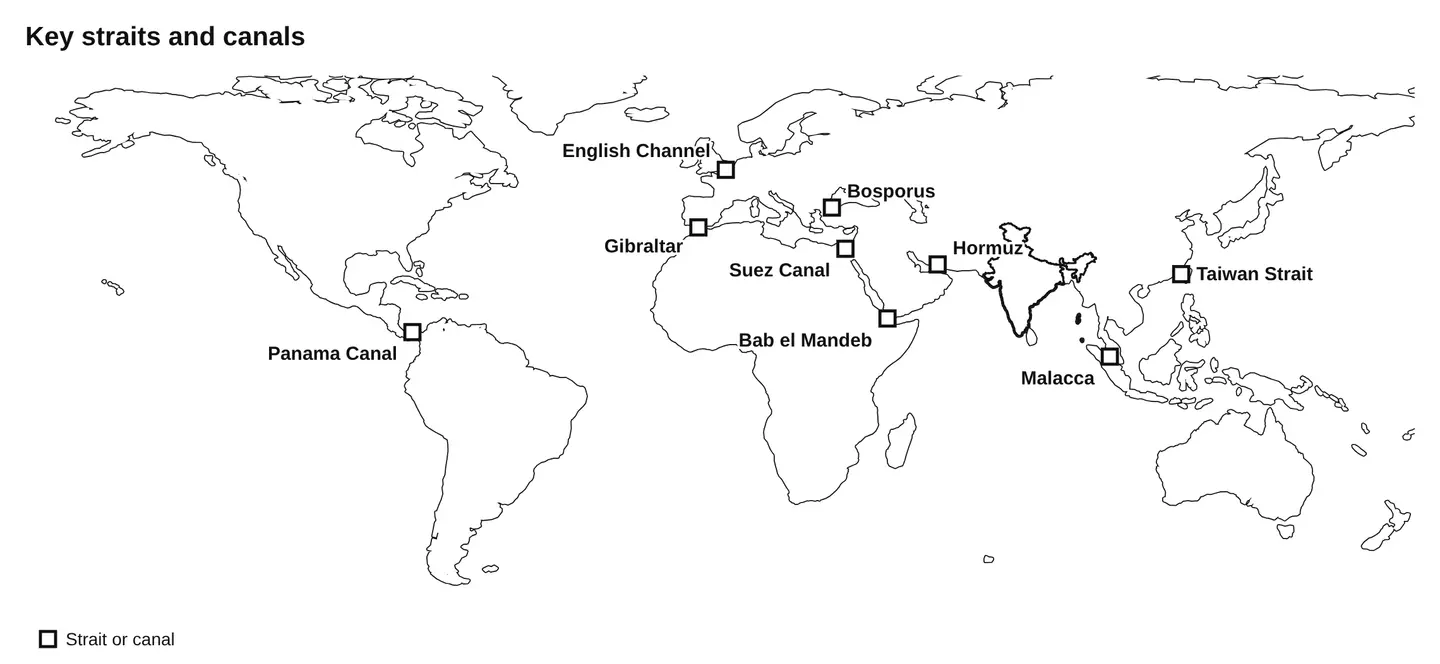
Straits
Strait of Malacca: The shortest route between the Indian and Pacific Oceans. It carries much of the oil bound for China, Japan and Korea.
Strait of Hormuz: About a fifth of the world's oil passes through it from the Persian Gulf.
Bab el Mandeb: It links the Red Sea to the Indian Ocean. Attacks on ships in 2023 and 2024 forced many to sail round Africa.
Bosporus and Gibraltar: The Bosporus carries Black Sea grain, and Gibraltar is the Atlantic gate to the Mediterranean.
Taiwan Strait: A key route for semiconductors and East Asian trade.
Isthmuses and canals
Suez Canal (1869): Cut through the Isthmus of Suez, it saves the long voyage round Africa. The Ever Given blockage of 2021 showed its importance.
Panama Canal (1914): It links the Atlantic and Pacific. Drought in 2023 cut transits and raised costs.
Significance
Straits and isthmuses shorten routes and cut costs, but as chokepoints they invite conflict and piracy. India's Andaman and Nicobar Islands overlook Malacca, and the India Middle East Europe Economic Corridor (2023) seeks alternatives.
World trade flows through a few narrow gates, so whoever keeps them open keeps the world economy moving.
Show how the answer was builtHide how the answer was built
Decode
Explain the trade significance of straits and isthmuses.
Implicit demand
The examiner wants named examples and their wider significance.
Architecture
Definitions, a sketch, five straits, two canals, significance, then a verdict.
Articulation
Recent disruptions make it current. Money line: whoever keeps the gates open.
Show value added materialHide value added material
Facts
Malacca dilemma in Chinese strategy.
Black Sea Grain Initiative, 2022.
Kra Canal proposal in Thailand.
19 · GS1 202115 marks250 words
Discuss the multi-dimensional implications of uneven distribution of mineral oil in the world.
Show the model answerHide the model answer
Oil lies where ancient seas buried organic matter, so its distribution is very uneven. A handful of countries hold most proven reserves, and this imbalance shapes the world.
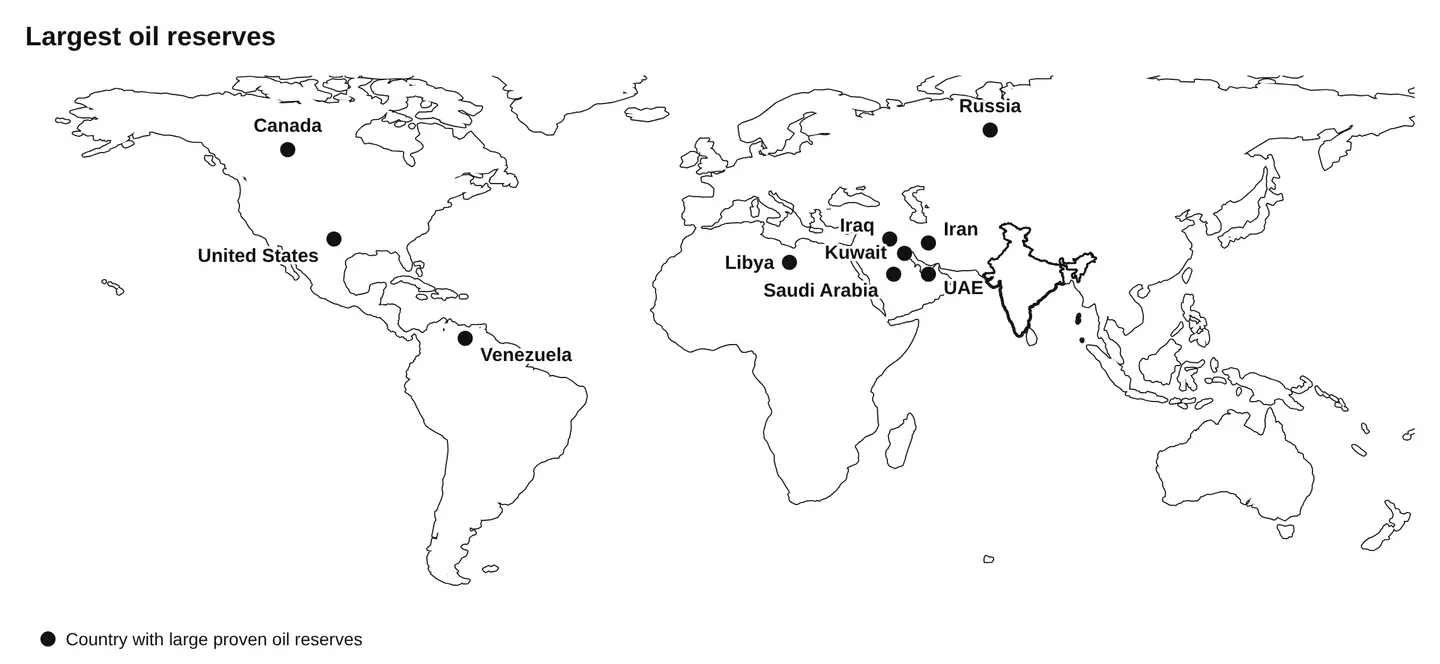
The distribution
The Middle East holds nearly half of proven reserves. Venezuela, Canada, Russia and the United States also hold large shares, while most of Asia and Europe hold little.
Implications
Economic: Oil exporters such as the Gulf states grew rich. Importers such as India, which buys most of its crude abroad, face large import bills and price shocks.
Political: OPEC (Organisation of the Petroleum Exporting Countries) and its partners can sway prices, as in the oil crisis of 1973.
Conflict: Oil has fuelled wars, from the Gulf War of 1991 to tensions around the Strait of Hormuz.
Resource curse: Countries such as Venezuela and Nigeria suffer corruption and instability despite oil wealth.
Sanctions and trade: Sanctions on Iran, Russia and Venezuela reshape oil flows. India has bought more Russian crude since 2022.
Migration: Gulf oil wealth drew millions of Indian workers, whose remittances support families back home.
Environment: Spills, gas flaring and emissions harm ecosystems.
Responses
Importers build strategic petroleum reserves, as India has at Visakhapatnam, Mangaluru and Padur. Renewables and electric vehicles reduce dependence.
Uneven oil has made geology a driver of geopolitics, and the energy transition may finally loosen its grip.
Show how the answer was builtHide how the answer was built
Decode
Discuss the implications of uneven oil distribution.
Implicit demand
The examiner wants distribution in brief and varied implications.
Architecture
An introduction, a sketch, distribution, seven implications, responses, then a verdict.
Articulation
India's import dependence links it home. Money line: geology a driver of geopolitics.
Show value added materialHide value added material
Facts
Oil crisis of 1973.
OPEC Plus formed in 2016.
India's strategic reserves at Visakhapatnam, Mangaluru and Padur.
20 · GS1 201715 marks250 words
What characteristics can be assigned to monsoon climate that succeeds in feeding more than 50 percent of the world population residing in Monsoon Asia?
Show the model answerHide the model answer
Monsoon Asia, from India to China and Southeast Asia, feeds more than half of humanity. Its climate has special features that make this possible.
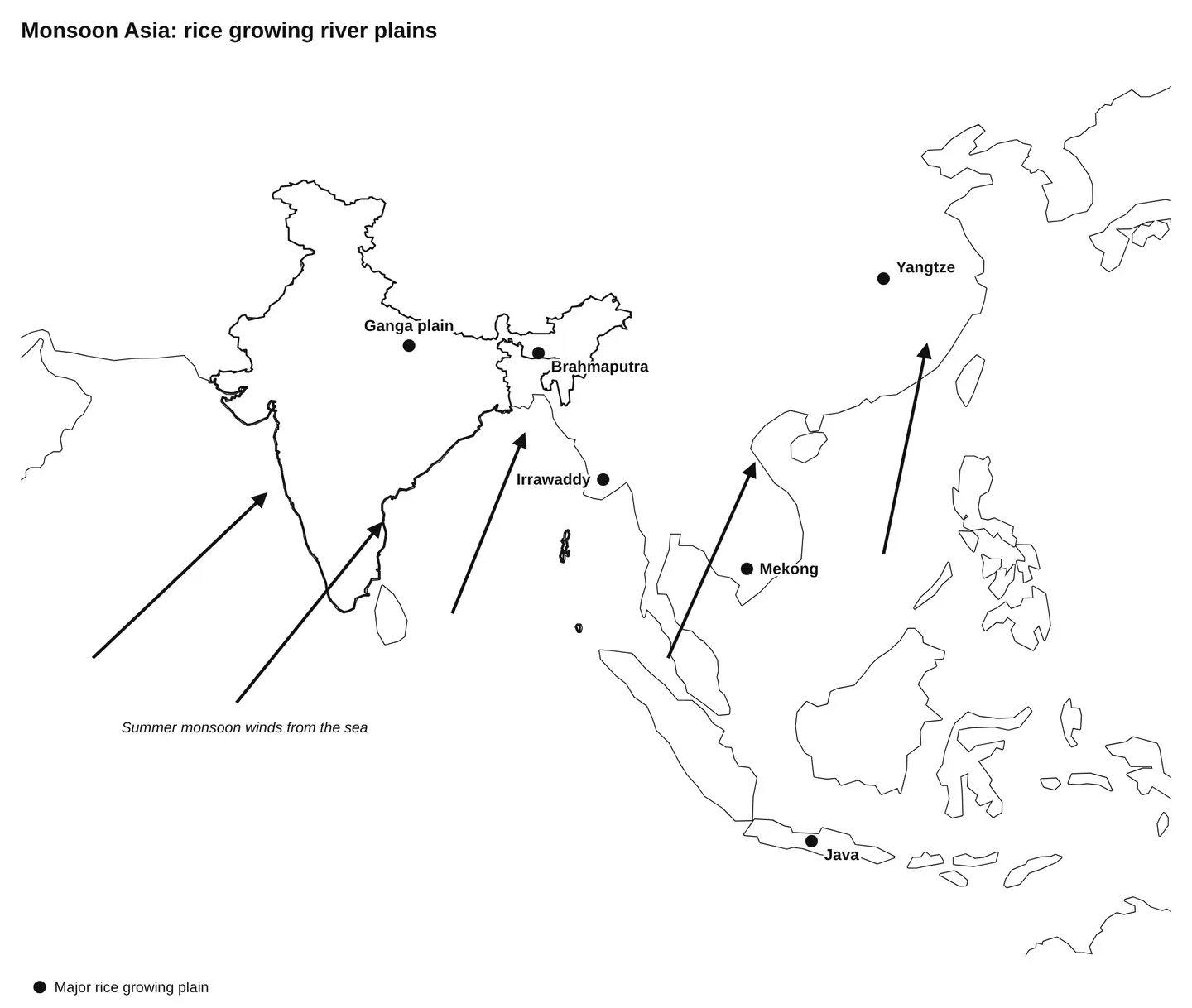
Rain with warmth: Summer rain arrives with high temperatures, creating an ideal growing season.
Rice: Heavy rain suits paddy, which yields more food per hectare than most crops and supports dense populations.
Long growing season: Warmth lasts much of the year, allowing two or even three crops in the Ganga delta and Java.
Fertile river plains: Monsoon floods renew alluvial soils in the Ganga, Brahmaputra, Mekong and Yangtze plains.
Dry harvest season: A dry winter allows harvesting and storage.
Winter crops: Snow fed rivers and winter rain from western disturbances support wheat in north India.
Predictable rhythm: The seasonal reversal of winds gave farmers a calendar around which cultures and festivals grew.
Mountain rain: The Western Ghats and Himalaya force heavy orographic rain that feeds perennial rivers.
Stored water: Monsoon rain refills reservoirs, tanks and groundwater used in the dry season.
Limits
The monsoon is also variable. Droughts and floods cause crop losses, and climate change makes rainfall more erratic.
The monsoon's marriage of heat and rain turned Asia's river plains into the world's largest granary.
Show how the answer was builtHide how the answer was built
Decode
Identify monsoon features that let Monsoon Asia feed so many.
Implicit demand
The examiner wants climatic features linked to food production.
Architecture
An introduction, a sketch, seven features, limits, then a verdict.
Articulation
Rice links climate to population. Money line: the world's largest granary.
Show value added materialHide value added material
Facts
Indian Ocean Dipole and El Nino affect the monsoon.
International Year of Millets, 2023.
Tropical rice belt from India to the Philippines.