

26 Nov 2026GS1Revision
Revision: the whole GS1 paper
Questions you have written before will appear here. That is by design. Writing an answer a second time, after reading the model answer, is the point of the day.
Previous year questions
10 as set1 · GS1 202215 marks250 words
Describing the distribution of rubber producing countries, indicate the major environmental issues faced by them.
Show the model answerHide the model answer
Natural rubber comes from Hevea brasiliensis, a tree native to the Amazon. It needs a hot, wet equatorial climate with heavy, evenly spread rain and deep, well drained soil.
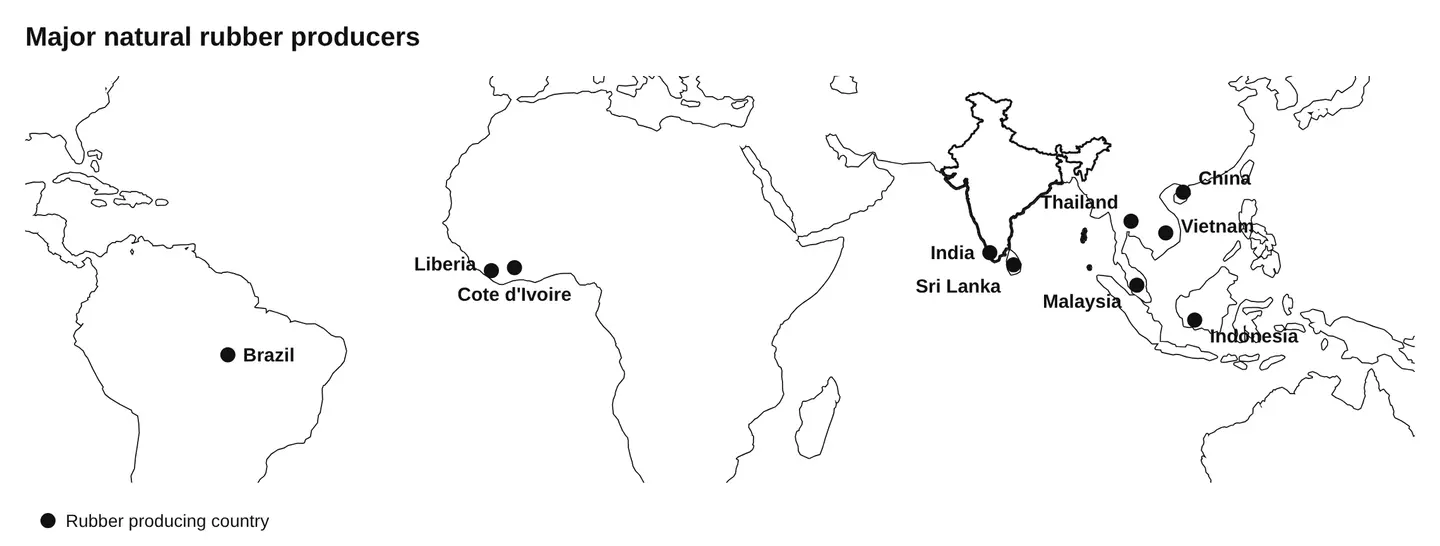
Distribution
Southeast Asia: Thailand, Indonesia and Vietnam produce most of the world's rubber. Thailand is the largest. Malaysia, once the leader, has shifted to oil palm.
South Asia and China: India grows rubber mainly in Kerala and increasingly in Tripura. China grows it in Hainan and Yunnan.
Africa: Cote d'Ivoire has become a leading producer, along with Liberia and Nigeria.
Latin America: Brazil, the original home, produces little because of leaf blight disease.
Environmental issues
Deforestation: Plantations replace tropical rain forests in Southeast Asia and West Africa.
Biodiversity loss: Monocultures in Yunnan's Xishuangbanna have pushed out forest species.
Soil and water: Clearing slopes causes erosion, and dense plantations reduce local water availability.
Chemical pollution: Fertilisers, pesticides and latex processing effluents pollute streams.
Climate stress: Drought and new leaf diseases have cut yields in Indonesia and Thailand.
Way forward
Agroforestry, traceable supply chains under rules such as the European Union's deforestation regulation, and support for smallholders can make rubber sustainable.
Rubber thrives where rain forests grow, so its expansion must not come at the forest's cost.
Show how the answer was builtHide how the answer was built
Decode
Describe where rubber is grown and its environmental problems.
Implicit demand
The examiner wants the climatic basis, named producers, and specific issues.
Architecture
An introduction, a sketch, four regions, five issues, a way forward, then a verdict.
Articulation
Xishuangbanna shows the cost of monoculture. Money line: not at the forest's cost.
Show value added materialHide value added material
Facts
Global Platform for Sustainable Natural Rubber, 2018.
Rubber Board of India is based in Kottayam.
Synthetic rubber comes from petroleum.
2 · GS1 201910 marks150 words
What makes the Indian society unique in sustaining its culture? Discuss.
Show the model answerHide the model answer
Indian civilisation has lasted over four thousand years while many ancient cultures vanished. A few features explain this continuity.
Synthesis: India absorbed new influences and blended them, from Indo Islamic architecture to the Bhakti and Sufi traditions.
Pluralism: Many faiths, languages and customs coexist, so no single force could erase the culture.
Family and community: Joint families, kinship and village life pass on values, rituals and skills.
Oral and festive traditions: Epics, folk songs and festivals keep culture alive without depending on texts.
Reform from within: Movements from Buddhism to the nineteenth century reformers renewed society without breaking it.
Adaptation: Yoga, classical arts and festivals now use digital media and reach a global diaspora.
Constitutional protection: The Constitution protects the right of communities to conserve their language and culture.
Indian culture survives because it bends and absorbs rather than breaks.
Show how the answer was builtHide how the answer was built
Decode
Discuss what lets Indian culture survive.
Implicit demand
The examiner wants distinctive mechanisms of continuity with examples.
Architecture
An introduction, seven features, then a verdict.
Articulation
Synthesis and pluralism carry the core argument. Money line: bends rather than breaks.
Show value added materialHide value added material
Facts
Little and great traditions, described by Robert Redfield and applied by McKim Marriott.
Sanskritisation, M. N. Srinivas.
Yogendra Singh on the modernisation of Indian tradition.
3 · GS1 202110 marks150 words
Examine the role of 'Gig Economy' in the process of empowerment of women in India.
Show the model answerHide the model answer
NITI Aayog estimated about 77 lakh gig workers in 2020 to 2021, a number expected to rise sharply. For many women, this work opens a new door.
How it empowers women
Flexibility: Women can choose hours that fit care duties at home.
Low entry barriers: Beauty services, tutoring, delivery and content work need little capital.
Income and confidence: Earnings and digital payments build financial independence.
Limits
No security: Most gig work offers no pension, leave or health cover, and income swings.
Safety and control: Night work brings risk, and algorithms decide pay without appeal.
Digital gap: Fewer women own smartphones, so many cannot join.
Way forward
The Code on Social Security (2020) recognises gig workers. Rajasthan's gig workers law of 2023 and registration on the e Shram portal extend protection.
The gig economy can empower women only when flexibility comes with security.
Show how the answer was builtHide how the answer was built
Decode
Examine how gig work affects women's empowerment.
Implicit demand
The examiner wants benefits, limits and policy.
Architecture
A data introduction, three gains, three limits, a way forward, then a verdict.
Articulation
The Code on Social Security gives the policy anchor. Money line: flexibility with security.
Show value added materialHide value added material
Facts
Social security for gig workers under the Ayushman Bharat health scheme announced in 2025.
Karnataka gig workers law, 2025.
Women's smartphone ownership lags men's in India.
4 · GS1 201810 marks150 words
Throw light on the significance of the thoughts of Mahatma Gandhi in the present times.
Show the model answerHide the model answer
Gandhi's ideas were shaped for the freedom struggle, yet they answer many problems of today.
Non violence: In an age of wars and polarisation, peaceful resistance remains the most humane method of change.
Antyodaya: His talisman of thinking of the poorest person guides welfare targeting.
Trusteeship: The idea that wealth is held in trust for society underlies corporate social responsibility under the Companies Act (2013).
Sustainable living: His warning against greed speaks to the climate crisis and India's Mission LiFE (2022).
Decentralisation: Gram swaraj inspired the 73rd Amendment (1992) and village self government.
Cleanliness: Swachh Bharat Mission (2014) drew directly on his emphasis on sanitation.
Ethics in public life: His insistence that means matter as much as ends guides honest governance.
Gandhi's thought remains a moral compass for a world that has more power than restraint.
Show how the answer was builtHide how the answer was built
Decode
Show why Gandhi's ideas still matter.
Implicit demand
The examiner wants each idea linked to a present day issue or policy.
Architecture
An introduction, seven ideas, then a verdict.
Articulation
Each point pairs an idea with a current policy. Money line: a moral compass.
Show value added materialHide value added material
Facts
Nai Talim influenced vocational education in the National Education Policy (2020).
Hind Swaraj, 1909.
Martin Luther King and Nelson Mandela drew on Gandhi.
5 · GS1 201915 marks250 words
Explain how the foundations of the modern world were laid by the American and French Revolutions.
Show the model answerHide the model answer
The American Revolution of 1776 and the French Revolution of 1789 turned subjects into citizens. Their ideas still shape governments everywhere.
The American Revolution
Natural rights and consent: The Declaration of Independence (1776) held that governments rest on the consent of the governed.
Written constitution: The United States Constitution (1787) set up federalism, separation of powers and checks and balances.
Bill of Rights (1791): It guaranteed freedom of speech, religion and the press.
Anti colonial example: A colony winning freedom inspired independence movements in Latin America.
The French Revolution
Rights of Man: The Declaration of the Rights of Man and of the Citizen (1789) proclaimed equality before law.
End of privilege: Feudal dues and the privileges of nobles and clergy were abolished.
Nationalism: The idea of the nation as a community of citizens spread across Europe.
Legal equality: The Napoleonic Code (1804) carried equality before law across conquered lands.
Secular state: Church and state were separated, and education became a public task.
Limits
Slavery continued in America, women were excluded from rights, and the Reign of Terror showed revolution's dangers.
Legacy
Democracy, constitutionalism, rights and nationalism all trace back to these revolutions. India's Preamble promises liberty, equality and fraternity.
The two revolutions gave the modern world its vocabulary of rights and its idea of the citizen.
Show how the answer was builtHide how the answer was built
Decode
Explain how the two revolutions shaped the modern world.
Implicit demand
The examiner wants each revolution's contributions and their shared legacy.
Architecture
An introduction, four American and five French contributions, limits, legacy, then a verdict.
Articulation
India's Preamble ties the legacy home. Money line: rights and the citizen.
Show value added materialHide value added material
Facts
Olympe de Gouges wrote the Declaration of the Rights of Woman, 1791.
Tipu Sultan joined a Jacobin club.
Haitian Revolution, 1791.
6 · GS1 202410 marks150 words
Underline the changes in the field of society and economy from the Rig Vedic to the later Vedic period.
Show the model answerHide the model answer
From the Rig Vedic period (about 1500 to 1000 BCE) to the later Vedic period (about 1000 to 600 BCE), the Aryans moved east. They left the Sapta Sindhu for the Ganga plain, and society and economy changed with them.
Society
Varna: Varna was flexible and based on occupation in the Rig Vedic age. It became hereditary and rigid later.
Women: Women attended the sabha and samiti and composed hymns, as Ghosha and Apala did. Later their status declined.
Ritual: Simple prayers gave way to elaborate sacrifices such as the Ashvamedha, raising the Brahmin's power.
Economy
From cattle to crops: Rig Vedic wealth meant cattle. Later Vedic people farmed rice and wheat in settled villages.
Iron: Iron tools helped clear forests in the Ganga plain.
Crafts and trade: New crafts and trade grew, and bali became a regular tax.
The Vedic age moved from a pastoral, open society to a settled, hierarchical one.
Show how the answer was builtHide how the answer was built
Decode
Underline social and economic changes across the Vedic age.
Implicit demand
The examiner wants clear before and after contrasts.
Architecture
An introduction, three social changes, three economic changes, then a verdict.
Articulation
Each point contrasts both periods. Money line: pastoral to settled.
Show value added materialHide value added material
Facts
Rajasuya and Vajapeya sacrifices.
Painted Grey Ware culture of the later Vedic period.
Gotra and ashrama systems emerged later.
7 · GS1 202315 marks250 words
Comment on the resource potentials of the long coastline of India and highlight the status of natural hazard preparedness in these areas.
Show the model answerHide the model answer
India's coastline stretches over 11,000 kilometres under the latest measurement, with an Exclusive Economic Zone of over two million square kilometres. It holds vast resources and faces serious hazards.
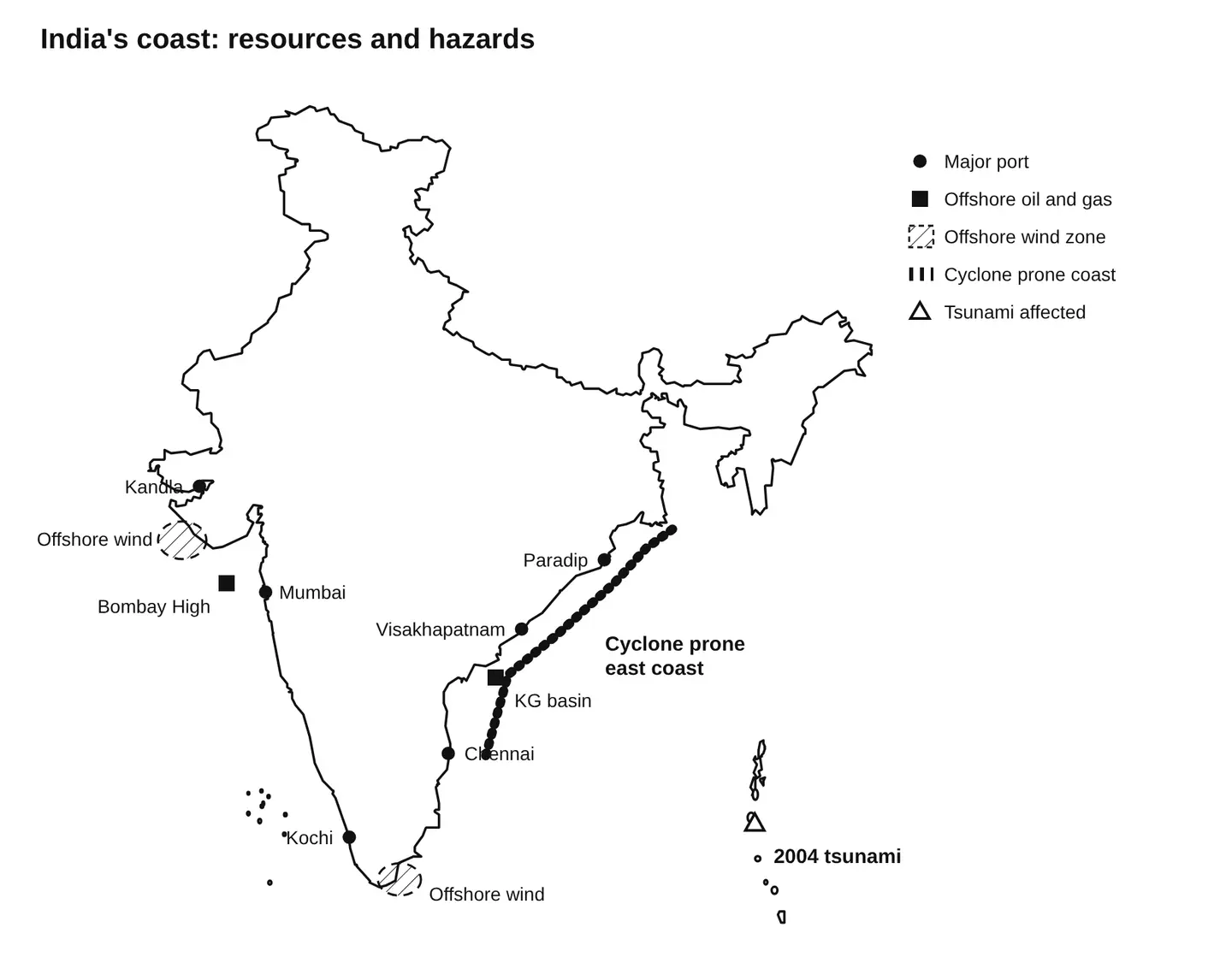
Resource potential
Fisheries: India is among the world's largest fish producers, supporting millions of coastal families.
Ports and trade: Most of India's trade by volume moves by sea. The Sagarmala programme (2015) modernises ports.
Energy: Bombay High and the Krishna Godavari basin hold oil and gas. Gujarat and Tamil Nadu have strong offshore wind.
Minerals: Beach sands hold monazite and ilmenite, and the seabed holds polymetallic nodules.
Tourism and salt: Goa and Kerala draw tourists, and Gujarat produces most of India's salt.
Ecosystem services: Mangroves and coral reefs shield coasts and nurture fish.
Hazard preparedness
Cyclones: Odisha's model of early warning, shelters and mass evacuation kept deaths low in Cyclone Fani (2019).
Tsunami: The Indian Tsunami Early Warning Centre (2007) at Hyderabad now gives alerts within minutes.
Gaps: Cyclones such as Tauktae and Biparjoy show the west coast is less prepared. Erosion, urban flooding in Mumbai and Chennai, and violations of coastal regulation persist.
The MISHTI scheme (2023) for mangroves and the Coastal Regulation Zone rules must be backed by strict enforcement.
India's coast is a blue economy asset, but only preparedness can keep its wealth from being washed away.
Show how the answer was builtHide how the answer was built
Decode
Comment on coastal resources and hazard preparedness.
Implicit demand
The examiner wants varied resources and an honest status of preparedness.
Architecture
An introduction, a sketch, six resources, preparedness with gaps, then a verdict.
Articulation
Odisha versus the west coast shows uneven readiness. Money line: keep its wealth from being washed away.
Show value added materialHide value added material
Facts
National Cyclone Risk Mitigation Project.
Coastal Regulation Zone Notification, 2019.
Indian National Centre for Ocean Information Services runs the tsunami warning centre.
8 · GS1 201715 marks250 words
Account for variations in oceanic salinity and discuss its multi-dimensional effects.
Show the model answerHide the model answer
Ocean water holds on average about 35 grams of salt per litre. This salinity varies across space and depth, and the variations matter far beyond the sea.
Causes of variation
Evaporation: High evaporation in the subtropics raises salinity.
Rainfall: Heavy rain near the equator lowers it.
River inflow: The Ganga and Brahmaputra make the Bay of Bengal less salty than the Arabian Sea.
Ice: Freezing leaves salt behind, while melting ice freshens polar seas.
Enclosed seas: The Red Sea is very salty due to heat and little inflow, while the Baltic is almost fresh.
Currents and mixing: Currents carry salty or fresh water to new regions.
Multi dimensional effects
Ocean circulation: Salty, cold water sinks and drives the thermohaline circulation, which moves heat across the globe.
Climate and monsoon: A fresh layer on the Bay of Bengal keeps surface water warm, feeding cyclones and monsoon rain.
Marine life: Species are adapted to narrow salinity ranges, so changes alter where they live.
Navigation: Saltier water is denser and gives ships more buoyancy, which load lines account for.
Resources: Salinity sets the cost of desalination and supports salt production.
Climate change is making salty regions saltier and fresh regions fresher, signalling a faster water cycle.
Salinity is a small number with large effects, linking the ocean to climate, life and economy.
Show how the answer was builtHide how the answer was built
Decode
Explain why salinity varies and what it affects.
Implicit demand
The examiner wants causes and effects across climate, life and economy.
Architecture
A definition, six causes, five effects, a climate note, then a verdict.
Articulation
The Bay of Bengal links salinity to the monsoon. Money line: a small number with large effects.
Show value added materialHide value added material
Facts
The Dead Sea is far saltier than any ocean.
The halocline separates layers of different salinity.
Average salinity is about 35 parts per thousand.
9 · GS1 202010 marks150 words
The process of desertification does not have climate boundaries. Justify with examples.
Show the model answerHide the model answer
Desertification is land degradation that turns productive land barren. The Indian Space Research Organisation's Desertification and Land Degradation Atlas (2021) found nearly a third of India's land degraded, including in high rainfall states.
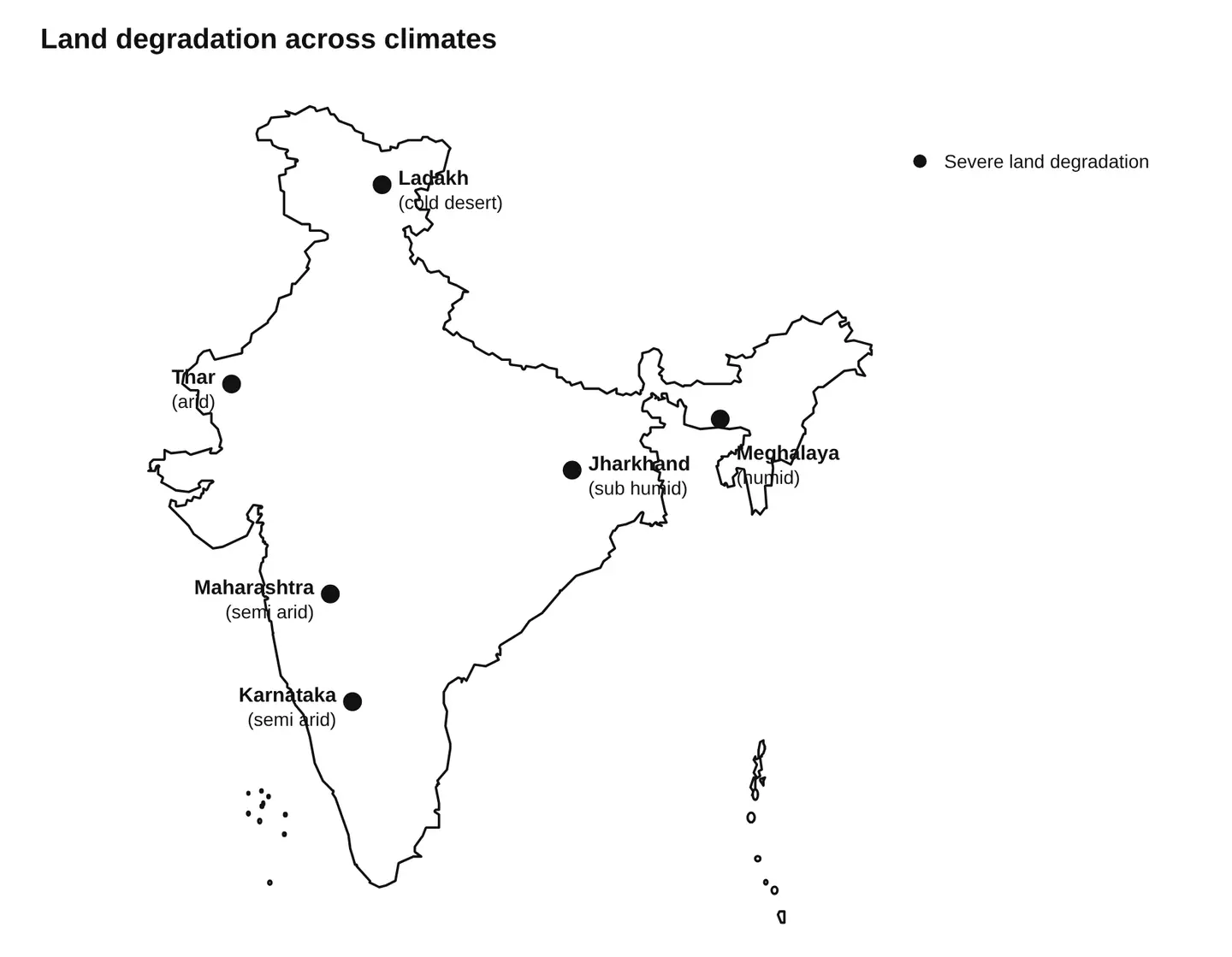
Arid zones: The Thar spreads through overgrazing and wind erosion.
Cold deserts: Ladakh faces degradation from shrinking glaciers and fragile soils.
Semi arid zones: Maharashtra and Karnataka lose soil to erosion and salinity.
Humid zones: Mining in Jharkhand and shifting cultivation in Meghalaya strip soil despite heavy rain.
Beyond India: The Dust Bowl of the United States in the 1930s hit grassland, and the Sahel suffers from drought and overuse.
India aims to restore 26 million hectares by 2030. The Aravalli Green Wall project targets the land around the hills.
Desertification follows misuse of land more than lack of rain, so it can strike any climate.
Show how the answer was builtHide how the answer was built
Decode
Justify that desertification occurs in all climates.
Implicit demand
The examiner wants examples from varied climates in India and abroad.
Architecture
A data introduction, a sketch, five climate examples, a response, then a verdict.
Articulation
Meghalaya surprises the reader. Money line: misuse more than lack of rain.
Show value added materialHide value added material
Facts
United Nations Convention to Combat Desertification, 1994.
Bonn Challenge on land restoration.
Great Green Wall of Africa.
10 · GS1 202410 marks150 words
In dealing with socio-economic issues of development, what kind of collaboration between government, NGOs and private sector would be most productive?
Show the model answerHide the model answer
No single actor, whether government, non governmental organisations (NGOs) or business, can solve poverty, health or education alone. The most productive model gives each partner the role it does best.
Government steers: It sets policy, funds at scale and ensures accountability.
NGOs connect: They bring grassroots trust, community voice and innovation, as Pratham's Teaching at the Right Level shows with state governments.
Private sector scales: Firms add finance, technology and efficiency. The corporate social responsibility rule under the Companies Act (2013) channels funds.
Examples of what works
Akshaya Patra runs mid day meals with government support and corporate funding. The Aspirational Districts Programme (2018) pairs officials with foundations.
Principles
Partners should plan with communities, share data, pay for outcomes and stay transparent.
The best partnership lets government steer, NGOs connect and business scale, with people at the centre.
Show how the answer was builtHide how the answer was built
Decode
Suggest the most productive collaboration for development.
Implicit demand
The examiner wants clear roles, real examples and principles.
Architecture
An introduction, three roles, examples, principles, then a verdict.
Articulation
Akshaya Patra shows all three partners at work. Money line: steer, connect and scale.
Show value added materialHide value added material
Facts
Educate Girls development impact bond in Rajasthan.
Self help group and bank linkage programme.
NGO Darpan portal for registration.