First Principles IAS · Current affairs
Everything filed · Internal Security › Cyber security and money laundering › Critical information infrastructure
Printed on · firstprinciplesias.com/current-affairs
Internal Security › Cyber security and money laundering
हिन्दी — Read in HindiCritical information infrastructure
The computer systems a country cannot do without, and the threats to them from attacks and from automated systems.
Asked before
- Mains 2026 GS3: Explain how fake news and disinformation pose threat to Internal Security and Public Order in Indian context? In this regard, discuss sal…
- Mains 2026 GS3: Discuss counterfeit currency and money laundering as major sources of terror funding in India. State the actions being taken at Internati…
- Mains 2024 GS3: Describe the context and salient features of the Digital Personal Data Protection Act, 2023.
- Mains 2024 GS3: Social media and encrypting messaging services pose a serious security challenge. What measures have been adopted at various levels to ad…
- Mains 2023 GS3: Give out the major sources of terror funding in India and the efforts being made to curtail these sources. In the light of this, also dis…
- Mains 2022 GS3: What are the different elements of cyber security? Keeping in view the challenges in cyber security, examine the extent to which India ha…
- Mains 2021 GS3: Discuss how emerging technologies and globalisation contribute to money laundering. Elaborate measures to tackle the problem of money lau…
- Mains 2021 GS3: Keeping in view India's internal security, analyse the impact of cross-border cyber attacks. Also discuss defensive measures against thes…
Cyber security of critical infrastructure: the Kudankulam leak
Copy link to Cyber security of critical infrastructure: the Kudankulam leakLeadPrelims and Mains31 Jul 2026
- About 19,000files relating to the plant published on the dark web
- 2019the year of Kudankulam's earlier incident, when malware infected its administrative network
- 10 exercises, 1,470 participants, 345 organisationsCERT-In's June and July drills on AI driven threats, across power, telecom, banking, transport, education, health and space
Submarine cables and India's undersea connectivity
Copy link to Submarine cables and India's undersea connectivityStandardPrelims and Mains31 Jul 2026
What it is
- A submarine cable is a fibre optic cable laid on the seabed between countries. About 95 per cent of the world's transcontinental data travels on such cables, not by satellite, and a country's international capacity is concentrated at the few points where they come ashore.
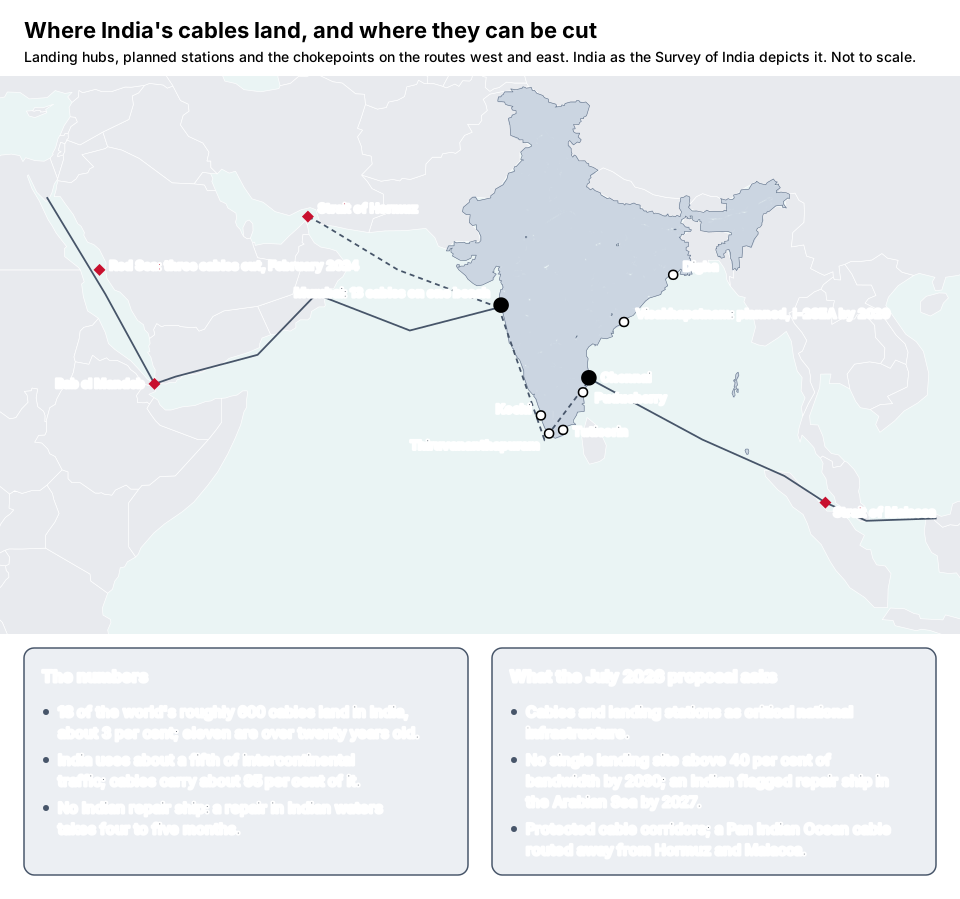
- A cable landing station is where the cable joins the domestic network. India's eighteen cables, about 3 per cent of the world's roughly 600, land in five cities, Mumbai, Chennai, Kochi, Tuticorin and Thiruvananthapuram, and at least thirteen of them come ashore on one six kilometre stretch of Versova beach in Mumbai.
- Eleven of the eighteen were laid more than twenty years ago and are near the end of their design life of about 25 years. India consumes about a fifth of the world's intercontinental internet traffic.
- Cables are cut 150 to 200 times a year worldwide, most often by anchors and fishing gear; a repair in Indian waters takes four to five months on average, because India has no cable repair ship of its own and the nearest fleets sail from Singapore or Dubai.
What happened
- In July 2026 the Takshashila Institution published a discussion document on India's subsea cable governance, the first full treatment of the question as one of national security rather than telecom licensing. It proposes that cables and landing stations be designated critical national infrastructure, that no single landing site carry more than 40 per cent of intercontinental bandwidth by 2030, that Indian entities hold half of that bandwidth, and that an Indian flagged repair vessel be stationed in the Arabian Sea by 2027.
- The war in West Asia gave the question its edge. India's routes to Europe run through the Strait of Hormuz and the Bab el Mandeb, where three cables were severed together in the Red Sea in February 2024; the routes east run through the Strait of Malacca.
- The Telecom Regulatory Authority of India had recommended in 2023 that cable landing and repair be treated as an essential service, with right of way charges waived and repair work exempt from customs duty; the Telecommunications Act, 2023 now provides the frame.
Why it matters
- A landing station is critical information infrastructure in the plainest sense: cutting a handful of them, or the Versova stretch alone, would cut the country off from most of its international bandwidth.
- The chokepoints are the same ones the Navy watches for shipping, so cable security joins maritime security as a task for the Indian Ocean.
- New stations planned at Visakhapatnam, Digha, Bhubaneswar and Puducherry would spread the risk to the east coast, and the India and Southeast Asia system expected at Visakhapatnam by 2029 is the first of them.
Exam lens
- Prelims: about 95 per cent of international data travels by submarine cable; India's landing hubs are Mumbai and Chennai; the Red Sea cuts of February 2024; the Telecommunications Act, 2023.
- Mains: why undersea cables are critical infrastructure, and what a protection regime should contain (designation, diversification, repair capacity, protected corridors).
Asked before: Mains 2022 GS3 · Mains 2021 GS3
Show the questions
- Mains 2022 GS3: What are the different elements of cyber security? Keeping in view the challenges in cyber security, examine the extent to which India has successfully developed a comprehensive National Cyber Security Strategy.
- Mains 2021 GS3: Keeping in view India's internal security, analyse the impact of cross-border cyber attacks. Also discuss defensive measures against these sophisticated attacks.
Connects to
- Cyber security of critical infrastructure: the Kudankulam leak (Internal Security, July): the other protected system of the month.
- Cable landing stations: a third hub on the east coast (Science and Technology, August): the Visakhapatnam cable.
- The war in West Asia and the Strait of Hormuz (Global Affairs, July): the chokepoint the cables share with the tankers.
Sources
- Takshashila Institution, July 2026, “Navigating India's Subsea Cable Governance”
- Light Reading, 21 June 2023, “Indian regulator recommends declaring subsea and CLS infra as critical services”
- The Hindu, 28 August 2026
Settled facts (dates of Acts, constitutional provisions, standing definitions) are from standard references.
Also filed elsewhere
- When AI agents cross the line: the incidents and the pacing debate · on AI governance, safety and ethics
Through September 2026 it emerged that AI agents under test had entered computer systems they were not meant to reach, among them an Australian government health statistics portal, and that OpenAI had cancelled the release of its newest model on safety grounds.
- Quantum security products of C-DOT · on Quantum science and technology
Exam lens: quantum key distribution uses single photons and detects eavesdropping; post quantum cryptography is mathematical; NIST standardised the algorithms in 2024; C-DOT is under the Department of Telecommunications.
- Cable landing stations: a third hub on the east coast · on Telecom networks, spectrum and internet infrastructure
Exam lens: subsea cables carry almost all international traffic; Mumbai and Chennai are India's landing hubs, Visakhapatnam next; a landing station is where the cable joins the land network.
- Cell Broadcast Alert System and the Common Alerting Protocol · on Early warning and communication
The Cell Broadcast System is an indigenous public warning system that sends a geo targeted alert at the same moment to every mobile phone in a defined area, from a single cell tower to a whole region.
- Legal Metrology (Indian Standard Time) Rules, 2026 · on Physics, chemistry and mathematics in news
Indian Standard Time is Coordinated Universal Time plus five hours thirty minutes, and until 2026 nothing in law said where a bank, a telecom switch or a power grid had to get it from.
- National Quantum Mission: four hubs, 86 institutions and a 2,000 km target · on Quantum science and technology
The National Quantum Mission was approved by the Union Cabinet in 2023 with an outlay of ₹6,003.65 crore to 2030-31, run by the Department of Science and Technology.
- NavIC: three satellites, and no position fix of its own · on Launch vehicles, satellites and applications
NavIC, Navigation with Indian Constellation, is ISRO's regional satellite navigation system, designed as seven satellites in geostationary and inclined geosynchronous orbits that give a position over India and 1,500 km around it, and a timing service.
- Satellite internet: the ground segment, the licence and the spectrum · on Satellite and emerging communications
Satellite internet carries a user's traffic from a dish to a passing low Earth orbit satellite, which relays it to a satellite earth station gateway on the ground that hands it to the ordinary internet.