
First Principles IAS · Current affairs
Everything filed · Culture › Art and culture in news › Languages and literature
Printed on · firstprinciplesias.com/current-affairs
Culture › Art and culture in news
हिन्दी — Read in HindiLanguages and literature
The classical and other languages of India, their literature and the institutions that keep them alive.
Asked before
- Prelims 2024: Consider the following statements: 1. There are no parables in Upanishads. 2. Upanishads were composed earlier than the Puranas. Which of…
- Prelims 2024: Which one of the following is a work attributed to playwright Bhasa?
- Prelims 2024: Sanghabhuti, an Indian Buddhist monk, who travelled to China at the end of the fourth century AD, was the author of a commentary on:
- Prelims 2023: With reference to ancient Indian History, consider the following pairs: 1. Devichandragupta - Bilhana 2. Hammira-Mahakavya - Nayachandra…
- Prelims 2022: With reference to Indian history, consider the following texts: 1. Nettipakarana 2. Parishishtaparvan 3. Avadanashataka 4. Trishashtilaks…
- Prelims 2022: "Yogavasistha" was translated into Persian by Nizamuddin Panipati during the reign of:
- Prelims 2021: With reference to the history of ancient India, Bhavabhuti, Hastimalla and Kshemeshvara were famous
- Prelims 2021: With reference to India, the terms 'Halbi, Ho and Kui' pertain to
Five Centres of Excellence for the classical languages recognised in 2024, from Tezpur to Deccan College
Copy link to Five Centres of Excellence for the classical languages recognised in 2024, from Tezpur to Deccan CollegeBriefPrelims31 Oct 2026
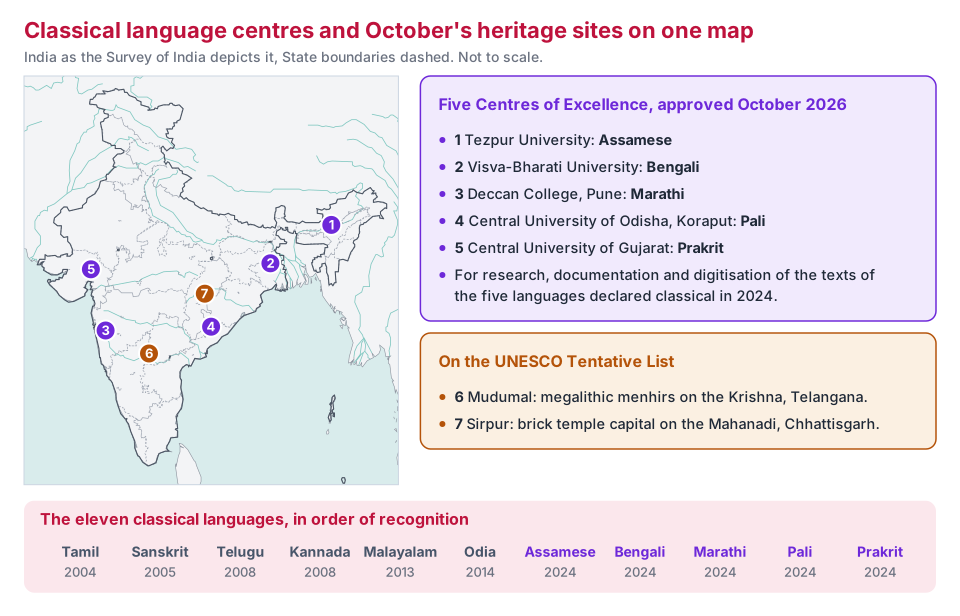
In October 2026 the Ministry of Education approved Centres of Excellence for the five languages the Cabinet declared classical in 2024, to support research, documentation and digitisation of their texts.
- The map places the five host institutions, from Tezpur University for Assamese to the Central University of Gujarat for Prakrit, with the month's two Tentative List sites, Mudumal and Sirpur.
- India has eleven classical languages: Tamil (2004), Sanskrit (2005), Telugu and Kannada (2008), Malayalam (2013), Odia (2014) and the five of 2024.
Exam lens: match each language to its host institution; the order in which languages gained classical status.
Sources
- The Hindu, 3 October 2026
- PIB, 3 October 2026