

First Principles IAS · Current affairs
The monthly magazine, August 2026 · Environment and Disaster Management › Land degradation, desertification and drylands
Printed on · firstprinciplesias.com/current-affairs
Land restoration and drought: UNCCD COP17 at Ulaanbaatar
LeadPrelims and Mains28 Aug 2026
Why in news
- The 17th Conference of the Parties to the United Nations Convention to Combat Desertification met at Ulaanbaatar in Mongolia from 17 to 28 August 2026 under the theme "Restoring Land, Restoring Hope", in the year the United Nations has named the International Year of Rangelands and Pastoralists.
- The parties adopted a drought policy framework and decisions on the Convention's strategy beyond 2030.
- India launched its first Guide to Grasslands and Other Open Natural Ecosystems, reported 21.76 million hectares brought under restoration against its Bonn Challenge pledge of 26 million by 2030, and asked that drought be treated as a predictable risk rather than an emergency met afresh each year.
- 26 million hectaresIndia's Bonn Challenge pledge, to be under restoration by 2030, raised from its 2015 commitment at COP14 in New Delhi
- 21.76 million hectaresbrought under restoration between 2011 and 2020, by the second progress report, with about 1.22 billion person days of work
- 29.77 per centthe share of India's land under degradation, by the Desertification and Land Degradation Atlas
- About 25,000community protected sacred groves, covering about 0.6 million hectares
- 197parties to the Convention, adopted in 1994
Background
- Desertification is land degradation in the dry areas, caused by human activity and climate variation; it does not mean the spread of existing deserts.
- The Convention, adopted in 1994, is one of the three Rio Conventions with the climate and biodiversity conventions, and the only one with land as its subject. Its central goal is land degradation neutrality, so that a country ends a period with no net loss of productive land.
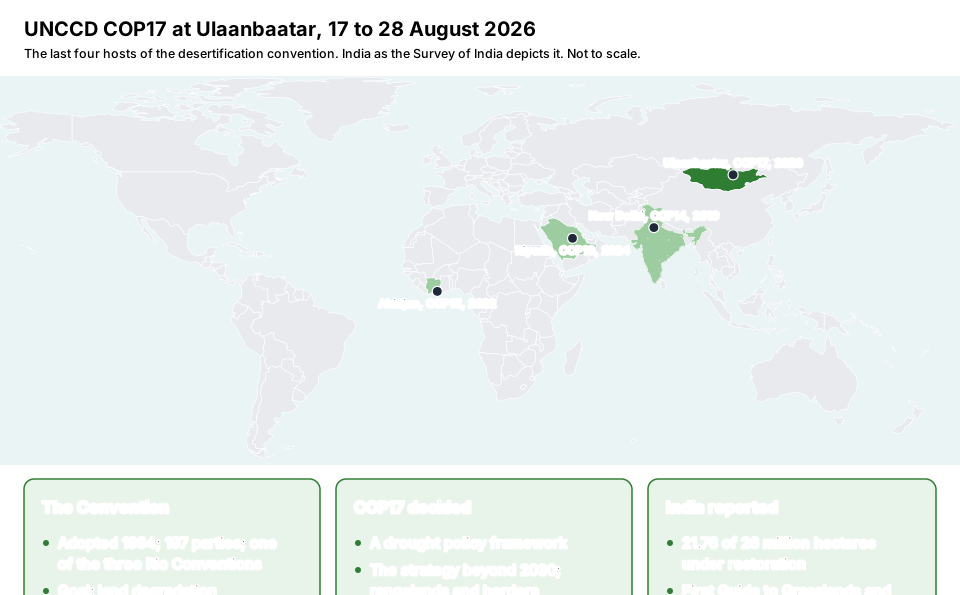
- India hosted COP14 at New Delhi in 2019, where it raised its restoration pledge to 26 million hectares.
- 2026 is the International Year of Rangelands and Pastoralists, declared by the General Assembly at Mongolia's initiative, which is why rangelands and herders ran through the conference.
What COP17 decided
- A drought policy framework, which moves drought from relief to preparedness, early warning and planning.
- The final report of the working group on the Convention's future strategic framework, and a decision to go on developing it beyond 2030.
- Decisions on the sustainable management, protection and restoration of rangelands and on the participation of herders in them.
- Measures to make the Conference and its subsidiary bodies more effective.
India at the conference
- On drought, the Environment Minister told the ministerial dialogue that drought is "no longer an occasional event, but a defining development challenge", and asked for preparedness before response and prevention before crisis management. India's own instruments, he said, are satellite triggered preparedness, watershed work on a ridge to valley approach, spring revival in the hills, crop insurance that covers drought, and disaster funds behind them.
- On land and water he said "restore the forest, before the flow": catchment and riverscape forestry to hold water in the landscape.
- On rangelands he said restoration begins with pastoralists as custodians, not beneficiaries, and pointed to grazing rights and community forest resource rights, to the orans of Rajasthan among the 25,000 sacred groves, and to about 10 million hectares of permanent pastures whose deep rooted grasses store carbon.
- The Bonn Challenge report counted 21.76 million hectares under restoration in 2011 to 2020 through the Green India Mission, compensatory afforestation under CAMPA, the Nagar Van Yojana, watershed development and agroforestry; the next report, for 2021 to 2025, is being prepared with ICFRE and the IUCN.
Grasslands are not wastelands
- Open natural ecosystems are grasslands, savannas, scrub, ravines and deserts. Many are still recorded as wastelands in land records, so they are handed over for plantations, solar parks and other projects.
- A grassland is not an unfinished forest: the great Indian bustard lives only on open ground, so planting trees there destroys habitat, and the proposed expansion of the cheetah into Banni rests on the same point.
- The Guide, India's first, prepared by ATREE with the IUCN, ICFRE's Centre of Excellence on Sustainable Land Management and ISRO's Space Applications Centre, covers the geography, ecology and the communities of these ecosystems, with sections on pastoralism, fire ecology and carbon in soils.
Analysis
- The report card reads well until the second line is set against the first. 21.76 million hectares under restoration, and nearly 30 per cent of the land still degraded; "under restoration" counts the area where work began, not the area that recovered.
- The audit says the same. The Comptroller and Auditor General's report on the Green India Mission this month found the Mission 92 per cent short of its target for improving forest quality.
- Waste land is not waste. A restoration target met by planting trees on a grassland is a loss recorded as a gain, and the Guide to open natural ecosystems is the first official document to say so; it was India's best contribution to the conference.
- Preparedness, not relief, on drought. India argued for it and the new drought policy framework agrees; the test at home is whether the Sixteenth Finance Commission's mitigation funds, which exist for exactly this, are spent before the season fails rather than after.
- Link the three in a Mains answer. The restoration pledge, the grassland question and the move from relief to risk are one argument.
The way forward
- Reclassify open natural ecosystems in land records, so that restoration targets are not met by planting trees on grasslands.
- Count restoration by what survives, through the ICFRE and IUCN methodology for the 2021 to 2025 report, not by the area where work began.
- Move drought policy from relief to preparedness: water budgeting, crop planning and the mitigation funds spent before the season fails.
- Give the rangeland decisions legal shape at home through grazing and community forest resource rights under the Forest Rights Act.
Exam lens
- Prelims: UNCCD adopted 1994, 197 parties, the only Rio Convention on land; COP17 at Ulaanbaatar, 17 to 28 August 2026; COP14 at New Delhi in 2019; India's Bonn Challenge pledge is 26 million hectares by 2030; 2026 is the International Year of Rangelands and Pastoralists; land degradation neutrality is SDG Target 15.3; orans are the sacred groves of Rajasthan.
- Mains: "India's land restoration record is better on paper than on the ground." Examine, with reference to the Bonn Challenge report and the treatment of grasslands as wastelands.
Asked before: Prelims 2016 · Mains 2020 GS1 · Mains 2026 GS1
Show the questions
- Prelims 2016: What is/are the importance/importances of 'United Nations Convention to Combat Desertification'? 1. It aims to promote effective action through innovative national programmes and supportive international partnerships. 2. It has a special/particular focus on South Asia and North Africa regions, and its Secretariat facilitates the allocation of major portion of financial resources to these regions. 3. It is committed to bottom-up approach, encouraging the participation of local people in combating the desertification. Select the correct answer using the code given below.
- Mains 2020 GS1: The process of desertification does not have climate boundaries. Justify with examples.
- Mains 2026 GS1: Discuss the role of aeolian processes in desertification and land degradation.
Connects to
- How a drought is declared (Environment, September): the relief machinery the drought policy framework wants to replace.
- The Green India Mission: the CAG's audit (Environment, August): the programme that carries most of the restoration count.
- Watershed development (Environment, September): the ridge to valley work India cited at the conference.
Sources
- The Star, 31 August 2026, “UNCCD COP17 concludes successfully in Mongolia”
- PIB, 17 August 2026
- PIB, 24 August 2026
- PIB, 25 August 2026
- PIB, 26 August 2026
- The Hindu, 26 August 2026
- The Hindu, 15 August 2026
Settled facts (dates of Acts, constitutional provisions, standing definitions) are from standard references.
Filed under: Land degradation, desertification and drylands · The monthly magazine, August 2026