

First Principles IAS · Current affairs
Everything filed · Environment and Disaster Management › Disaster Management › Hydro meteorological hazards
Printed on · firstprinciplesias.com/current-affairs
Environment and Disaster Management › Disaster Management
हिन्दी — Read in HindiHydro meteorological hazards
Floods, drought, cyclones, heat and cold waves: how they are declared, measured and managed.
Asked before
- Prelims 2026: With reference to the climate of Andaman and Nicobar Islands, which of the following statements is/are correct? 1. The climate can be def…
- Prelims 2026: Which of the following statements with regard to India's indigenous new high resolution weather model, the 'Bharat Forecast System,' is/a…
- Mains 2026 GS3: Discuss how the contradiction between 'rapid infrastructure development' and 'disaster-risk reduction' in ecologically-sensitive areas of…
- Mains 2026 GS3: “Community participation is the cornerstone of effective disaster management”. Analyse this statement with suitable examples from India.…
- Prelims 2025: Consider the following statements : Statement I : The amount of dust particles in the atmosphere is more in subtropical and temperate are…
- Prelims 2025: Consider the following statements : Statement I : In January, in the Northern Hemisphere, the isotherms bend equatorward while crossing t…
- Prelims 2025: Consider the following statements : I. Without the atmosphere, temperature would be well below freezing point everywhere on the Earth's s…
- Prelims 2024: Consider the following statements: Statement-I: The atmosphere is heated more by incoming solar radiation than by terrestrial radiation.…
The Nepal flood of August 2026
Copy link to The Nepal flood of August 2026StandardPrelims and Mains26 Aug 2026
What it is
- A cascading hazard is a chain in which one failure sets off the next: a slope fails, the debris dams a river, the dam breaks, and the surge erodes the banks and grows as it goes. The result is a debris flow, a moving mass of water, rock, sediment and ice, far more destructive than clear floodwater.
- It is not a glacial lake outburst flood, in which a lake dammed by moraine or ice drains at once. The two hazards need different warning systems, which is the point the September Lead makes.
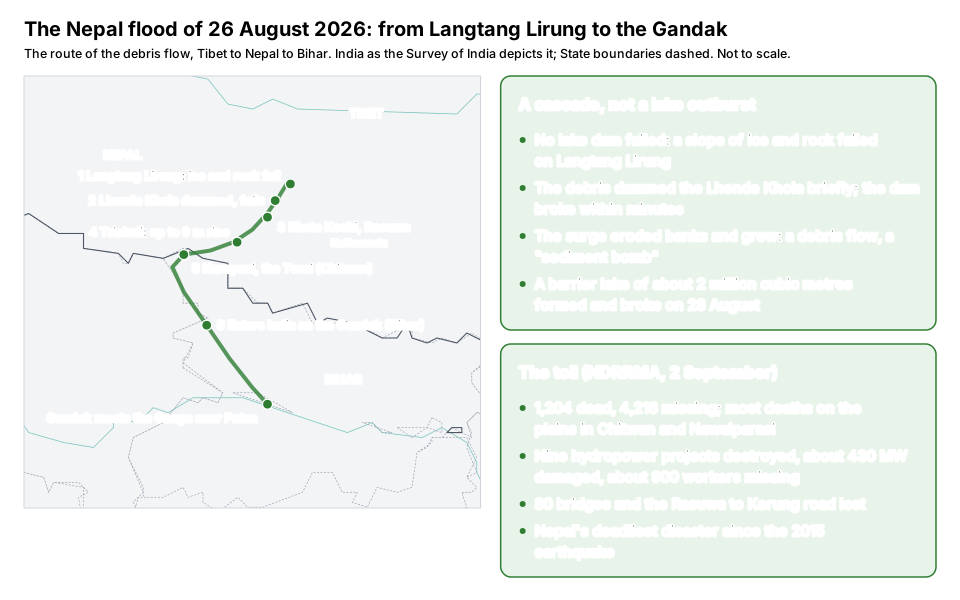
- The Bhote Koshi rises in Tibet, becomes the Trishuli in Nepal, joins the Narayani and enters India in Bihar as the Gandak.
What happened
- On the morning of 26 August 2026 a surge reached Timure and Syabrubesi in Rasuwa district on the Tibet border, with no rain in the valley. Ice and rock had broken away on the Langtang Lirung massif and fallen into the valley; the United States Geological Survey found no earthquake, only the seismic signal of the slide itself.
- The mass picked up waterlogged sediment in the Lhende Khola, dammed it briefly, and the dam failed within minutes. The surge ran down the Bhote Koshi and the Trishuli to the Terai; a barrier lake of about two million cubic metres formed behind debris and broke on 28 August.
- By Nepal's bulletin of 2 September the flood had killed 1,204 people with 4,216 missing, most of them in Chitwan, Nawalparasi and Nuwakot on the plains; the count kept rising and stood at 1,410 dead and over 6,000 missing by mid September. It was Nepal's deadliest disaster since the 2015 earthquake.
- Nine hydropower projects were destroyed and about 430 MW damaged, a tenth of Nepal's capacity, with about 900 hydropower workers missing; 80 bridges and the Rasuwa Kerung road to Tibet were lost. Text alerts went out only after the surge had begun.
- In India, Bihar's border districts went on alert along the Gandak; in September Nepal claimed on the loss and damage fund, naming India among the emitters.
Why it matters
- The flow began on a slope, not in a lake, so the glacial lake inventories and sensors that India and Nepal have built would not have caught it; the hazard that killed most was the one not being watched.
- It crossed two borders in a morning: Tibet to Nepal in minutes, Nepal to India in a day. There is no shared data feed across the first border, and the warning on the second depends on gauges that the flood itself destroyed.
- For India's disaster finance the flood is a reminder that the Himalayan States, whose share of the Sixteenth Finance Commission's funds rose least, face the fastest growing hazard.
Exam lens
- Prelims: Bhote Koshi, Trishuli, Narayani, Gandak; Langtang Lirung in Rasuwa district; a cascading hazard against a glacial lake outburst; Nepal's deadliest disaster since the 2015 earthquake.
- Mains: why early warning for slope failures is harder than for lakes, and what a cross border warning system would need.
Asked before: Mains 2022 GS3 · Mains 2019 GS3 · Mains 2026 GS3
Show the questions
- Mains 2022 GS3: Explain the mechanism and occurrence of cloudburst in the context of the Indian subcontinent. Discuss two recent examples.
- Mains 2019 GS3: Disaster preparedness is the first step in any disaster management process. Explain how hazard zonation mapping will help disaster mitigation in the case of landslides.
- Mains 2026 GS3: Discuss how the contradiction between 'rapid infrastructure development' and 'disaster-risk reduction' in ecologically-sensitive areas of India can be managed, with suitable examples.
Connects to
- Himalayan hazards: lake outbursts and avalanche cascades (Environment, September): the full analysis of the two hazards and India's warning programme.
- Paying for disasters (Environment, August): the funds that would pay for a flood like this in India.
- Loss and damage: Nepal sends India the bill (Environment, September): the claim that followed.
Sources
- Smart Water Magazine, 3 September 2026, “At least 98 dead and 403 unaccounted for as a flash flood from Tibet sweeps Nepal's Bhote Koshi valley (developing)”
- UNI, 26 August 2026
- The Indian Express, 31 August 2026
- Frontline, 28 August 2026
- Frontline, 1 September 2026
Settled facts (dates of Acts, constitutional provisions, standing definitions) are from standard references.
Read as a case study: Relief after the Nepal flood: who gets what first
How a drought is declared: Maharashtra's 265 talukas
Copy link to How a drought is declared: Maharashtra's 265 talukasStandardPrelims and Mains26 Sep 2026
What it is
- India has no single definition of drought, and it is the State government that declares one. To draw central money, the State's report must follow the norms of the National Disaster Response Fund.
- The norms look at rainfall deficit, the moisture adequacy index, crop loss, sowing below half the usual area, falling groundwater, and shortage of drinking water and fodder. A central team verifies the report before money is released.
- Maharashtra's Drought Management Code, 2016 sets the sequence inside the State: Trigger-1, the first alert, rests on rainfall deficiency and a dry spell of at least 21 days; Collectors then conduct panchnamas, field surveys of crop condition; compensation for crop loss follows the surveys.
What happened
- On 26 September 2026 Maharashtra declared drought in 265 of its 358 talukas under the Code, after a monsoon 18 per cent short across the State and 38 per cent short in Marathwada.
- The declaration could not come earlier because the Code's triggers run on the season's rainfall and the dry spell, which is why the State was parched in mid September with no declaration in place.
Why it matters
- A declaration is a legal act with money attached: compensation for crop loss follows the panchnamas, and the State's report is the basis for a claim on the National Disaster Response Fund.
- Because the triggers are built on rainfall, a drought is declared after the crop has failed. The Mains argument is for forecast based triggers that release relief during the dry spell.
Exam lens
- Prelims: the State declares, the Centre verifies and funds; the National Disaster Response Fund norms; the moisture adequacy index; Maharashtra's Code of 2016 and Trigger-1.
- Mains: why relief arrives after the loss, and what anticipatory action would change.
Asked before: Prelims 2016 · Prelims 2014
Show the questions
- Prelims 2016: With reference to 'Pradhan Mantri Fasal Bima Yojana', consider the following statements: 1. Under this scheme, farmers will have to pay a uniform premium of two percent for any crop they cultivate in any season of the year. 2. This scheme covers post-harvest losses arising out of cyclones and unseasonal rains. Which of the statements given above is/are correct?
- Prelims 2014: Consider the following pairs: Programme/Project and Ministry. 1. Drought-Prone Area Programme : Ministry of Agriculture. 2. Desert Development Programme : Ministry of Environment and Forests. 3. National Watershed Development Project for Rainfed Areas : Ministry of Rural Development. Which of the above pairs is/are correctly matched?
Sources
- The Hindu, 29 September 2026, “Why has Maharashtra declared drought in 265 talukas and what do farmers get?”
- The Indian Express, 23 September 2026, “Maharashtra is parched, but here's why drought can't be declared before October”
The floods of July 2026: cloudbursts, embankments and warning
Copy link to The floods of July 2026: cloudbursts, embankments and warningLeadPrelims and Mains19 Jul 2026
- 5.65 lakhpeople affected in 12 districts of Assam, as told to the Assembly on 22 July; at least 31 dead by then
- 3 to 4 metresthe height by which water ran over embankments that held, in the worst hit areas
- 60 yearshow long since eastern Assam had seen a flood of this scale, by the State's account
Heat stress in India, and the cooling paradox
Copy link to Heat stress in India, and the cooling paradoxLeadPrelims and Mains30 Jun 2026
- About 8 per centthe share of India under uncompensable heat stress in summer now
- More than halfthe share that could be under it at 2°C of global warming, in the monsoon as well as the summer
- 14Indian cities among the world's fifty most heat vulnerable, more than any other country; Ahmedabad is second and Nagpur fourth
Lightning deaths and the lightning safety programme
Copy link to Lightning deaths and the lightning safety programmeBriefPrelims30 Jun 2026
- Lightning has killed at least 2,000 people a year in India since 2004, the Earth Sciences Ministry told the Lok Sabha in 2022.
- Damini, an app built by the Indian Institute of Tropical Meteorology, Pune, in 2020, alerts users by location when lightning strikes within 20 or 40 km, with warnings valid for the next 40 minutes. It draws on a lightning location network installed at 83 places, accurate to under 500 m.
- The Home Ministry's Mitigation Project on Lightning Safety covers ten States at ₹186.78 crore, with ₹121.14 crore from the National Disaster Mitigation Fund, including training for gram panchayat members and village task forces.
- In June 2026 Uttar Pradesh had seven lightning sensors against none in 2014, and the new Cell Broadcast System lists lightning strikes among the time critical events it is meant for.
Exam lens: Damini is IITM Pune's app; IMD issues thunderstorm nowcasts for the next three hours, updated every three hours; the National Disaster Mitigation Fund pays for mitigation, the Response Fund for relief.
Sources
- Ministry of Earth Sciences, 6 April 2022, “Lok Sabha Unstarred Question 5533”
- PIB, 22 July 2025
- PIB, 8 June 2026
- PIB, 29 April 2026
Also filed elsewhere
- The Brahmaputra Board · on Rivers: sharing, linking and disputes
The Brahmaputra Board is a statutory body under the Brahmaputra Board Act, 1980, under the Jal Shakti Ministry, set up to prepare master plans for flood control, bank erosion and drainage in the Brahmaputra and Barak basins and to build the works the plans propose.
- Cloud seeding against drought: Karnataka's ₹28.52 crore programme · on Ocean, polar and earth science missions
Cloud seeding sprays particles into clouds from an aircraft so that moisture already in them condenses and falls as rain; it can add to a cloud that exists, not make one where the sky is clear, which is why its results are hard to separate from the rain that would have fallen anyway.
- Relief after the Nepal flood: who gets what first · on Case studies
Relief after the Nepal flood: who gets what first
- A dry monsoon under a strong El Niño · on Extreme weather, monsoon and forecasting
The southwest monsoon ended on 30 September 2026 at 87 per cent of the long period average, the driest season in eleven years and the thirteenth driest since 1901.