
First Principles IAS · Current affairs
The monthly magazine, October 2026 · Polity and Governance › Union Territories, special provisions and the Fifth and Sixth Schedules
Printed on · firstprinciplesias.com/current-affairs
Ladakh's groups reject the Centre's Article 371K draft while hill councils are redrawn for eight districts
LeadPrelims and Mains31 Oct 2026
Why in news
- In October 2026 the Leh Apex Body and the Kargil Democratic Alliance rejected "in principle" the Ministry of Home Affairs' draft constitutional and statutory framework for Ladakh. They called it a "significant departure" from the minutes signed in July.
- The draft proposes a new Article 371K for a Union Territory level elected body whose regulations would need the Lieutenant Governor's assent. The groups say it gives no legislature and no real Article 371 safeguards.
- In the same month the President promulgated a regulation extending hill councils to all eight districts, and the administration dissolved the Kargil hill council and announced panchayat elections for 21 November. The talks set for late October did not take place.
Background
- Ladakh became a Union Territory without a legislature in 2019 under the Jammu and Kashmir Reorganisation Act, 2019. A Lieutenant Governor administers it. The President makes regulations for it under Article 240.
- Its two alliances demand Statehood and inclusion in the Sixth Schedule, on the strength of a population that is about four fifths Scheduled Tribe.
- The July Lead explained the compromise.
- Trust has worn thin since police fire killed four protesters in Leh in September 2025.
What Ladakh was promised and what it was offered
The minutes signed in July
- The body: a Union Territory level elected body with executive, financial and legislative powers
- Its powers: legislative powers and control over officers in its subjects
- Who has the last word: not settled
- Central laws: not addressed
The draft of October
- The body: an elected body with constitutional status under a new Article 371K, set up by a Presidential regulation under Article 240
- Its powers: "regulations" on listed subjects such as land, forests, culture, natural resources and budgets
- Who has the last word: every regulation needs the Lieutenant Governor's assent; the Union can issue directions; the Lieutenant Governor can remove members on listed grounds
- Central laws: continue to apply
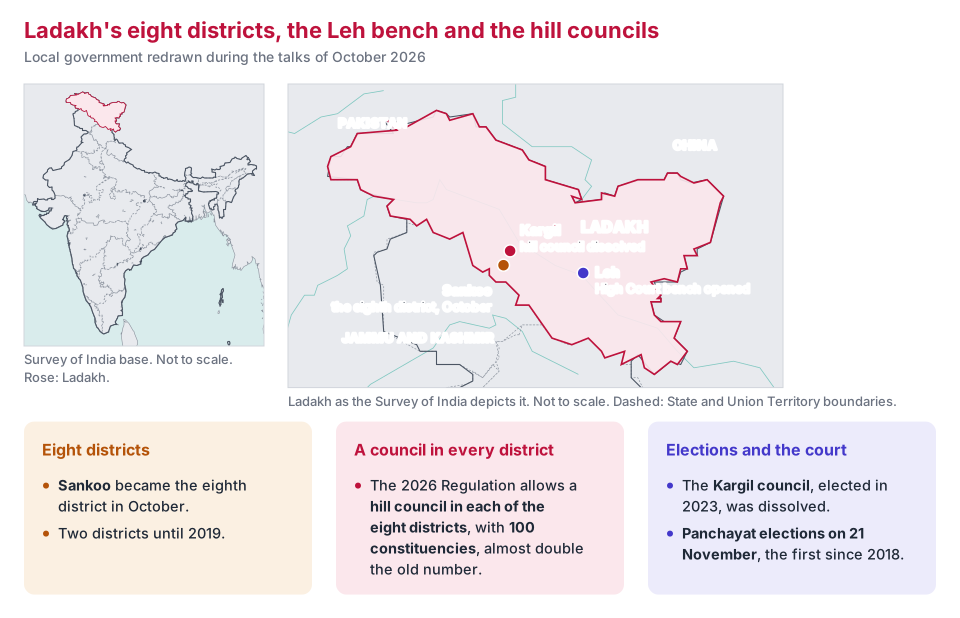
Local government redrawn during the talks
Sankoo became Ladakh's eighth district in October. The map shows the eight districts, the two hill councils and the Leh bench of the High Court, which opened in October.
Analysis
- The dispute is over who holds the last word, not over the list of subjects. The draft gives the body most of the subjects the minutes named, then makes every regulation wait for the Lieutenant Governor's assent and puts the body under Union directions. Delhi has fought the same fight since Parliament added Article 239AA in 1991.
- The Nagaland model is a different kind of protection. The draft keeps Central laws in force and lets the body regulate within them. The groups read the difference as the loss of the safeguard.
Districts and councils cut both ways.
- For: eight districts bring administration closer in a territory of long distances; 100 council seats widen representation
- Against: analysts argue new districts and councils could limit any future elected body; the Kargil alliance objected that the Centre changed the councils during talks without consulting it
- The border shapes the Centre's choice. The Centre, in the reading of most analysts, wants direct control because of the China border, and fears that other regions would ask for what Ladakh gets. Ladakh's leaders have an answer: Arunachal Pradesh, a border State since 1987.
The way forward
- Put the model into the Constitution by amendment, so that no later government can withdraw it by executive action.
- Settle the Lieutenant Governor's role in the text itself, with assent limited to listed grounds and a time limit, as the Delhi dispute taught.
Exam lens
- Prelims:
- Ladakh: a Union Territory without a legislature since 2019, administered under Article 240 regulations
- The Sixth Schedule applies to tribal areas of Assam, Meghalaya, Tripura and Mizoram
- Article 371A Nagaland, 371G Mizoram, 371F Sikkim
- Ladakh now has eight districts; the hill councils date from the Act of 1997
- The first permanent High Court bench at Leh opened in October 2026
- Mains: "Ladakh wants a voice, the Centre offers administration." Examine the options for Ladakh's governance in the light of the draft framework of October 2026.
Asked before: Prelims 2015 · Mains 2026 GS3 · Mains 2025 GS2
Show the questions
- Prelims 2015: The provisions in Fifth Schedule and Sixth Schedule in the Constitution of India are made in order to
- Mains 2026 GS3: Ladakh is strategically located between China and Pakistan. As a measure to win hearts and minds of locals, discuss the Border Area Development Programmes (BADP) by the Central Government and civic actions by the Army. Also discuss demand of promulgation of provision of the Sixth Schedule of constitution for Ladakh.
- Mains 2025 GS2: Discuss the nature of Jammu and Kashmir Legislative Assembly after the Jammu and Kashmir Reorganization Act, 2019. Briefly describe the powers and functions of the Assembly of the Union Territory of Jammu and Kashmir.
Connects to
- Ladakh: an Article 371 model in place of the Sixth Schedule (Polity, July): the minutes the October draft departs from, and the Sixth Schedule against Article 371 side by side.
- Ladakh: the High Court bench Regulation (Polity, August): the regulation under which the Leh bench opened in October.
- India names 28 places in Ladakh and the Centre admits face offs in Arunachal Pradesh (Internal Security, October): the border that shapes the Centre's choice.
- Census 2027: private enumerators allowed, 13 new questions, and the ward boundary question before the Court (Polity, October): the count that began in Ladakh before the snow.
Sources
- The Hindu, 16 October 2026
- The Hindu, 17 October 2026
- The Indian Express, 24 October 2026
- The Hindu, 20 October 2026
- The Hindu, 21 October 2026
- The Indian Express, 22 October 2026
- The Hindu, 18 October 2026
- The Indian Express, 19 October 2026
- The Hindu, 22 October 2026
- Frontline, 16 October 2026
Settled facts (dates of Acts, constitutional provisions, standing definitions) are from standard references.
Filed under: Union Territories, special provisions and the Fifth and Sixth Schedules · The monthly magazine, October 2026