Droughts and heat waves
- Syllabus
- Disaster and disaster management
- As of
- October 2026
- meteorological drought
- agricultural drought
- hydrological drought
- socioeconomic drought
- Manual for Drought Management
- ground truthing
- Swaraj Abhiyan case
- heat wave criteria
- heat action plan
- impact based warning
- wet bulb temperature
- notified calamity
- State Disaster Response Fund
- urban heat island
The first principle
Drought and heat do not arrive as a single violent event; they build up quietly over weeks, so the damage is done before anyone calls it a disaster. That is why they are called creeping or slow onset hazards, and why their management depends on two things that sudden disasters do not need in the same way: an agreed rule for when the emergency has begun, and steady action long before it begins. Most of what India has built for drought and heat, from the drought manual to the heat action plan, is an attempt to fix that moment of declaration and to act ahead of it.
The core
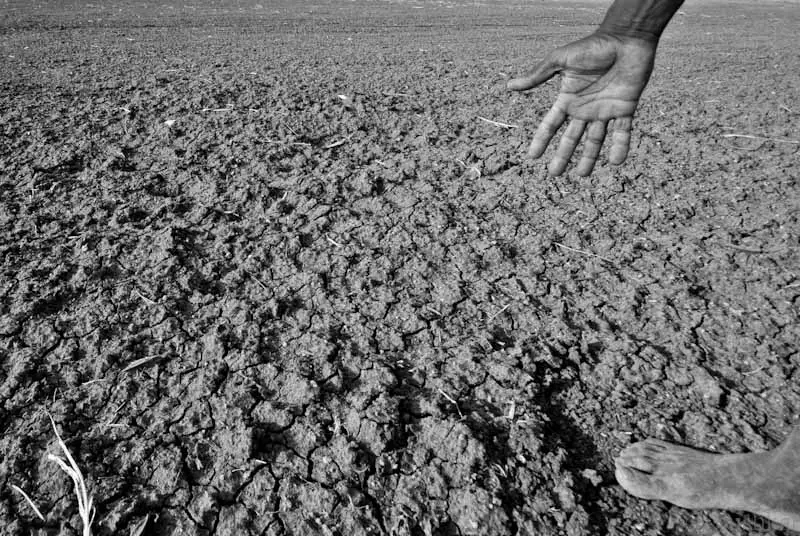
Drought is a chain, not one event
- Meteorological drought is a shortfall of rain against the normal for that place and season. The India Meteorological Department (IMD) has long treated a seasonal deficit of more than 25 per cent as drought, moderate up to 50 per cent and severe beyond it.
- Agricultural drought follows when soil moisture falls too low for crops during the growing season, so sowing drops and standing crops wilt. A dry spell of three to four weeks at the wrong time can cause it even in a year of normal total rain.
- Hydrological drought is the fall of rivers, reservoirs and groundwater below normal. It lags behind the rain and can persist for a season after the rain returns, because aquifers recharge slowly.
- Socioeconomic drought is the stage at which demand for water, fodder, food and work exceeds what is available, so incomes collapse and people migrate in distress. It depends as much on how water is used as on how much rain fell.
Heat as a hazard
- The body cools by sweating, and sweat cools only when it evaporates, so humid heat is more dangerous than dry heat at the same temperature. Heat kills through heat stroke and, more often, by straining the heart and kidneys of old, sick and outdoor working people.
- IMD's heat wave criteria are set per station. The maximum must first reach 40°C in the plains, 37°C on the coast or 30°C in the hills, and then either the departure from normal must be 4.5 to 6.4°C (severe above 6.4°C) or the actual maximum must reach 45°C (severe at 47°C). A heat wave is declared when this holds at two or more stations in a meteorological subdivision on two consecutive days.
- Wet bulb temperature is the lowest temperature to which evaporation can cool a surface; at about 35°C even a healthy person resting in shade cannot shed heat for long, and later studies place the danger line lower, near 31°C.
- Cities add heat. Concrete, asphalt and waste heat from vehicles and air conditioners keep cities warmer than the countryside, especially at night, and this urban heat island denies the body its night time recovery.
Dimensions
- Economic. Roughly half of India's net sown area is rainfed, so a failed monsoon cuts farm income, rural demand and hydropower together. Heat cuts the hours outdoor workers can safely work, a loss that falls on daily wage earners.
- Social. Drought falls hardest on small and marginal farmers, landless labourers and women, who walk farther for water. Heat falls on construction workers, street vendors, traffic police and people in tin roofed slums.
- Federal and financial. States declare drought and run the response, but central money from the National Disaster Response Fund (NDRF) depends on a memorandum and a central team's assessment, so the rules of declaration become a matter of federal bargaining.
- Environmental. Over pumping of groundwater in dry years deepens the next hydrological drought, and climate change is making heat waves longer and more frequent; the Environment note on climate change impacts on India carries that evidence.

In practice
How drought is declared
- The Manual for Drought Management was issued by the Department of Agriculture and Farmers Welfare, the nodal department for drought, in December 2016 and updated in 2020. It replaced the looser manual of 2009, under which States leaned heavily on the area sown, and States must follow it when they determine drought.
- Step one is the trigger: rainfall deviation, the Standardised Precipitation Index and dry spells. Step two checks impact indicators, any three of four types: the crop situation, vegetation indices from satellites, soil moisture and hydrology. Step three is ground truthing in a random 10 per cent of villages, preferably with a mobile application, where crop loss of 33 per cent or more supports declaration.
- Timelines and money. A kharif drought should be notified by 31 October and a rabi drought by 31 March, with severity stated as moderate or severe. Relief starts from the State Disaster Response Fund (SDRF); for severe drought the State sends a memorandum to the Centre, an Inter Ministerial Central Team visits, and the Centre may add money from the NDRF.
The Supreme Court's push
- Swaraj Abhiyan v Union of India (May 2016). A bench of Justices Madan B Lokur and N V Ramana directed the Centre to revise the drought manual with fixed weights for indicators and a time limit for declaration, to set up the National Disaster Mitigation Fund and a specialist response force under the Disaster Management Act 2005, and to prepare a national plan. It also directed full food entitlements under the National Food Security Act and compensation for delayed wages under the Mahatma Gandhi National Rural Employment Guarantee Act (MGNREGA) in drought areas. The 2016 manual was the direct result.
Heat action plans
- Ahmedabad, 2013. A heat wave in May 2010 caused about 1,344 more deaths in the city than in the same month of the years around it. In response the Ahmedabad Municipal Corporation, IMD, the Indian Institute of Public Health Gandhinagar and the Natural Resources Defense Council built South Asia's first heat action plan: a colour coded early warning, public messaging, training for hospitals and attention to the most exposed groups.
- NDMA guidelines. The National Disaster Management Authority (NDMA) issued national guidelines for heat action plans in 2016 and revised them in 2019. Plans run in three phases: before the heat season (mapping vulnerable people, training, stocking), during it (warnings, cooling centres, changed working hours, school timings) and after it (review). By 2025, 23 States and over 250 cities and districts had plans.
- Heat as a notified disaster. Relief from the SDRF and NDRF goes only to notified calamities, and for years heat was not among them; States such as Odisha, Kerala, Telangana and Tamil Nadu notified it as a State specific disaster and could spend only up to 10 per cent of their SDRF on such local disasters. In August 2026, on the recommendation of the Sixteenth Finance Commission, the Ministry of Home Affairs told Parliament that heat wave and lightning are now notified calamities eligible for SDRF and NDRF relief.
Issues and way forward
- Declaration is late and contested. Strict indicators and slow field surveys mean drought is often notified after the damage, and States complain that the severe category is too hard to meet. Real time satellite and soil moisture data, published openly, would let declaration follow the evidence rather than negotiation.
- Relief is reactive. Most money still goes to relief after a drought, not to the watershed work, crop diversification and groundwater recharge that reduce the next one. The State Disaster Mitigation Funds, created on the Fifteenth Finance Commission's advice, and the watershed component of the Pradhan Mantri Krishi Sinchayee Yojana are the tools to shift spending earlier.
- Water use, not only rainfall. Sugarcane in Marathwada and paddy in dry Punjab turn ordinary deficits into crises, so pricing of power and water for irrigation and procurement that rewards millets and pulses matter as much as rain.
- Heat deaths are undercounted. Death certificates rarely name heat, so the toll looks small and plans stay weak. Counting excess deaths during heat waves, as Ahmedabad did, gives the true picture.
- Heat plans lack money and law. A review of 37 plans by the Centre for Policy Research in 2023 found that most lack local thresholds, ward level vulnerability maps, a budget and legal backing. Notification of heat wave now opens disaster funds, and building codes for cool roofs, shaded streets and legal limits on working hours in extreme heat should follow.
Common confusions
- Drought and aridity. Drought is a temporary shortfall against the local normal, while aridity is the permanent dryness of a climate; Jaisalmer is arid every year, but it is in drought only when it gets less than its usual little rain.
- Heat wave and high temperature. A heat wave is defined against the normal for that place, which is why 30°C can be a heat wave in the hills but not in the plains.
- Declaring drought and notifying a calamity. A State declares drought in a given area and season under the manual, while the list of notified calamities is the national list of hazards for which the disaster funds may pay.
- SDRF and SDMF. The State Disaster Response Fund pays for relief after a disaster, while the State Disaster Mitigation Fund pays for work that lowers risk before one.
For the exam
- Keyword bank: slow onset disaster, meteorological drought, agricultural drought, hydrological drought, socioeconomic drought, Manual for Drought Management, ground truthing, Swaraj Abhiyan case, heat action plan, impact based warning, wet bulb temperature, urban heat island, notified calamity, State Disaster Mitigation Fund, excess mortality.
- Previous year questions: Practise the previous year questions on this topic →
- Use in an answer:
- Introduction with data: Ahmedabad recorded about 1,344 more deaths than usual in the heat wave of May 2010, and the heat action plan it launched in 2013 became the model for over 250 Indian cities and districts.
- Introduction with a judgement: In Swaraj Abhiyan v Union of India (2016) the Supreme Court held that the Centre cannot leave drought to the discretion of States and directed a revised drought manual, a mitigation fund and a national plan.
- Conclusion: Drought and heat are managed well only before they are declared, through watersheds, water pricing, cool cities and protected outdoor work, while relief remains the last line of defence.
- Conclusion: The notification of heat wave as a calamity in 2026 opens the disaster funds, but lives will be saved by local thresholds, honest counting of deaths and plans that have money behind them.