Climate change impacts on India
- Syllabus
- Conservation, environmental pollution and degradation, environmental impact assessment
- As of
- October 2026
- climate risk
- hazard exposure vulnerability
- monsoon variability
- extreme rainfall
- heat stress
- wet bulb temperature
- Himalayan glacier retreat
- sea level rise
- coastal erosion
- crop yield loss
- climate resilient agriculture
- climate and health
- adaptation
The first principle
The harm a changing climate does is not set by the weather alone: the Intergovernmental Panel on Climate Change (IPCC) defines risk as hazard combined with exposure (how many people and assets are in harm's way) and vulnerability (how badly they suffer and how fast they recover). India scores high on all three, because its farming depends on a four month monsoon, hundreds of millions live on the plains of glacier fed rivers and along a long coast, and many households have little savings to absorb a shock. That is why adaptation in India is as much about reducing poverty as about building walls.
The core
What has already changed
- Temperature. The Ministry of Earth Sciences (MoES) assessment of 2020 found India's average temperature up by about 0.7 °C over 1901 to 2018, and the India Meteorological Department (IMD) found 2024 the warmest year since its records began in 1901. Warm days and warm nights have both become more frequent.
- Rain. Summer monsoon rainfall fell by about 6 per cent between 1951 and 2015, most over the Indo-Gangetic plains and the Western Ghats, while days of extreme rain above 150 mm rose by about 75 per cent between 1950 and 2015. The pattern is fewer rainy days and heavier spells, because warmer air holds more moisture and releases it in bursts, while aerosols and uneven warming of land and sea weaken the steady monsoon flow.
- Drought and sea. Droughts became more frequent and covered more area between 1951 and 2016, the North Indian Ocean rose by about 3.3 mm a year from 1993 to 2017, and severe cyclones over the Arabian Sea grew more frequent after the monsoon between 1998 and 2018.
Heat
- Why humid heat kills. The body cools by sweating, which needs the air to take up water vapour, so the measure that matters is the wet bulb temperature, which combines heat and humidity. A wet bulb temperature of 35 °C is the theoretical limit for survival for a few hours, and studies on volunteers suggest the real limit is lower, which puts the humid coasts and the Gangetic plains at particular risk.
- What is projected. The MoES assessment projects heatwaves three to four times more frequent by the end of the century under high emissions. Heatwaves as disasters, with their criteria and heat action plans, are covered in the droughts and heatwaves note.
Glaciers and rivers
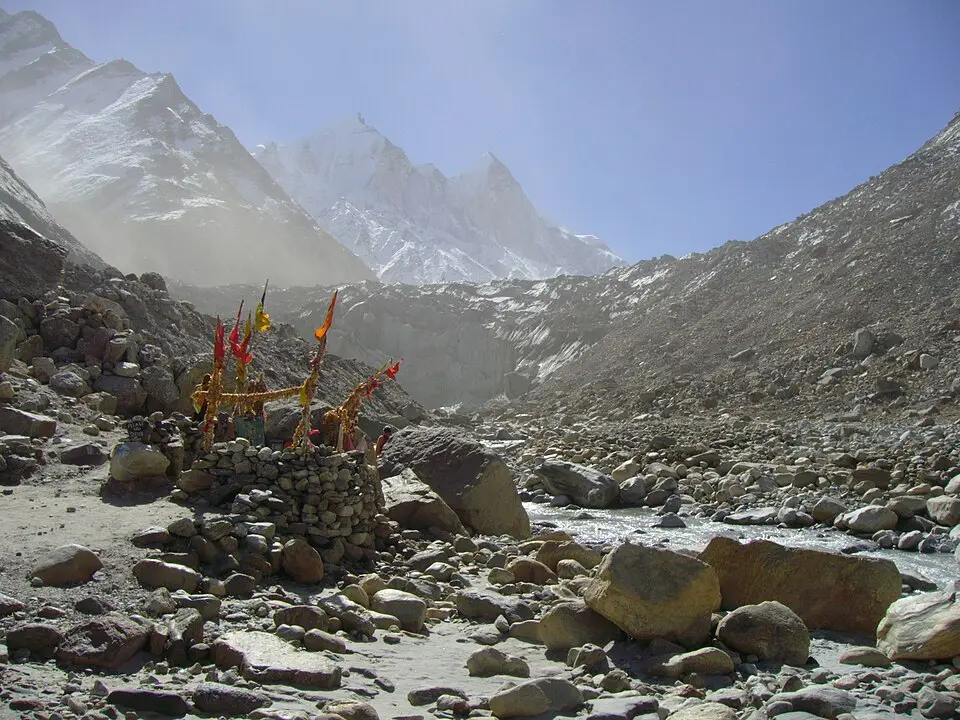
- The Third Pole is shrinking. The Hindu Kush Himalaya holds the largest store of ice outside the poles, and the International Centre for Integrated Mountain Development (ICIMOD) found in 2023 that its glaciers lost ice 65 per cent faster in 2011 to 2020 than in the decade before, and could lose 30 to 50 per cent of their volume by 2100 even at 1.5 °C to 2 °C of warming.
- More water, then less. Melting first raises summer flow in the Indus, Ganga and Brahmaputra, but once the ice shrinks enough the flow falls, and the dry season suffers most. Glacial lake outburst floods and cloudbursts are covered in the Himalayan hazards note.

Coasts
- Rising and eroding. Sea level rise brings saltwater into coastal aquifers and farmland, raises storm surges and speeds erosion along a coastline now measured at about 11,098 km, with low deltas such as the Sundarbans and dense cities such as Mumbai and Kolkata most exposed. Cyclones and storm surge are covered in the cyclones and coastal hazards note.
Food and health
- Crops. The National Innovations in Climate Resilient Agriculture (NICRA) project of the Indian Council of Agricultural Research (ICAR) projects, without adaptation, rainfed rice yields down 20 per cent by 2050 and 47 per cent by 2080, and wheat down 19.3 per cent by 2050 and 40 per cent by 2080. Extra carbon dioxide helps rice and wheat a little, but heat during flowering and grain filling cuts yield more, as a hot March did to wheat in 2022.
- Health. Heat stroke, malaria and dengue reaching higher hills, water borne disease after floods and poorer nutrition from failed crops are the main pathways, and the burden falls on outdoor workers, the old and the poor.
Dimensions
- Economic. The Reserve Bank of India's Report on Currency and Finance 2022-23 warned that lost working hours from heat and humidity could cost up to 4.5 per cent of gross domestic product (GDP) by 2030, and farm shocks feed food inflation that the central bank must then fight.
- Social. Small and marginal farmers, landless workers, fisherfolk and women, who fetch water and work in fields in the heat, carry most of the loss, and distress migration to cities is one way households cope.
- Regional. The Himalaya faces ice loss and slope failure, the coasts face the sea, the Deccan and the north west face drought, and the Gangetic plain faces humid heat and floods, so one national policy must work through State plans.
- Urban. Concrete and asphalt store heat and the lack of trees adds to it, so cities run hotter than the countryside around them, the urban heat island, while paved ground worsens urban floods.
- Ecological. Warm seas bleach the coral reefs of the Gulf of Mannar, Lakshadweep and the Andaman Islands, and species move uphill or north until they run out of room.
- Security and federal. Shared rivers with Pakistan, China, Nepal and Bangladesh carry ice loss across borders, and disputes over water between States can sharpen when flows become less reliable.
In practice
- The plan. The National Action Plan on Climate Change of 2008 carries adaptation through its missions on sustainable agriculture, water, the Himalayan ecosystem, green India and sustainable habitat, and every State has a State Action Plan on Climate Change that turns these into local programmes. India reported its adaptation needs in its Third National Communication and Initial Adaptation Communication to the United Nations Framework Convention on Climate Change (UNFCCC) in December 2023.
- Money. The National Adaptation Fund for Climate Change, started in 2015, pays for State projects that other schemes do not cover, such as coastal restoration and drought proofing.
- Farms. NICRA, launched by ICAR in 2011, runs climate resilient villages, contingency crop plans for every district and stress tolerant varieties, and crop insurance under the Pradhan Mantri Fasal Bima Yojana (2016) spreads the remaining risk.
- Health. The National Programme on Climate Change and Human Health, launched by the Ministry of Health and Family Welfare in 2019, tracks heat related illness and prepares hospitals and State health action plans.
- Heat. Ahmedabad's Heat Action Plan of 2013 was the first in South Asia, joining early warning, cool shelters, changed working hours and trained health workers, and the National Disaster Management Authority later issued national guidelines that many cities now follow.
- Coasts. Mangrove Initiative for Shoreline Habitats and Tangible Incomes (MISHTI), launched in 2023, restores mangroves that blunt storm surge and store carbon.
Issues and way forward
- Adaptation money is scarce. Adaptation projects earn no direct return, so private money avoids them, and international adaptation finance is a small part of climate finance; India's position in the negotiations is that developed countries must pay a fair share, while at home adaptation should be built into every scheme's budget.
- Data stops at the district. Farmers and city planners need village and ward level forecasts, so IMD's impact based forecasting and block level weather stations need to reach every panchayat.
- Maladaptation. Groundwater pumped to beat drought, air conditioners that heat the street and embankments that move a flood downstream can make things worse, so every adaptation project should be checked for such side effects.
- Heat is underestimated. Heat deaths are poorly counted and heat is not a notified disaster at the national level, so better death registration and long term heat plans with cool roofs, shade and working hour rules are needed.
- Nature as infrastructure. Mangroves, wetlands and forests on slopes protect at low cost, so restoring them should sit beside sea walls and dams in every coastal and mountain plan.
Common confusions
- Mitigation and adaptation. Mitigation cuts the emissions that cause warming; adaptation reduces harm from warming that will happen anyway, and India needs both at once.
- Hazard and risk. A cyclone is a hazard; the risk it carries depends on who lives in its path and how ready they are, which is why the Odisha coast now loses far fewer lives to cyclones of similar strength.
- Sea level rise and storm surge. Sea level rise is a slow, lasting rise of the mean sea; storm surge is a short rise of several metres pushed by a cyclone's winds, and the first makes the second reach farther inland.
- Heatwave and heat stress. A heatwave is defined by air temperature above a threshold; heat stress depends on humidity too, so a humid 38 °C can be more dangerous than a dry 44 °C.
For the exam
- Keyword bank: hazard, exposure and vulnerability, monsoon variability, extreme rainfall events, wet bulb temperature, urban heat island, glacier mass loss, peak water, sea level rise, saltwater intrusion, yield loss, climate resilient agriculture, heat action plan, maladaptation, nature based adaptation.
- Previous year questions: Practise the previous year questions on this topic →
- Use in an answer:
- Introduction with data: India's average temperature has risen by about 0.7 °C since 1901, while days with extreme rainfall above 150 mm rose by about 75 per cent between 1950 and 2015 (MoES, 2020).
- Introduction with a report: ICIMOD's assessment of 2023 found that Himalayan glaciers lost ice 65 per cent faster in 2011 to 2020 than in the decade before, a direct threat to the rivers that feed the Gangetic plain.
- Conclusion: Because exposure and vulnerability, not just the hazard, decide the damage, India's best adaptation is development itself: secure water, insured farms, cooler cities and health systems that see heat coming.
- Conclusion: Climate change is already a present risk for India, so adaptation must move from a separate mission to a part of every budget, scheme and plan.