Nuclear power: reactors, safety, law and the future
- Syllabus
- Developments in science and technology and their applications and effects in everyday life; indigenisation of technology and developing new technology
- As of
- October 2026
- pressurised water reactor
- boiling water reactor
- defence in depth
- decay heat
- passive safety
- spent fuel
- vitrification
- deep geological repository
- SHANTI Act 2025
- operator liability
- right of recourse
- Atomic Energy Regulatory Board
- small modular reactor
- Nuclear Energy Mission
- 100 GW by 2047
The first principle
A nuclear reactor makes heat from fission, and that heat does not stop when the chain reaction is stopped: the radioactive fission products keep releasing energy, about 6 to 7 per cent of full power at the moment of shutdown and still around one per cent after some hours. Almost every serious accident, from Three Mile Island to Fukushima, was a failure to remove this decay heat, so reactor safety is above all the art of keeping the fuel cool and the radioactivity contained in every circumstance. Waste, liability and public trust follow from the same fact: radioactivity lasts long after the electricity is sold.
The core
How a power reactor works
- The common plan. Fuel rods undergo fission, a moderator slows neutrons (except in fast reactors), control rods absorb neutrons to set the power, and a coolant carries heat to make steam that turns a turbine, as in a coal plant.
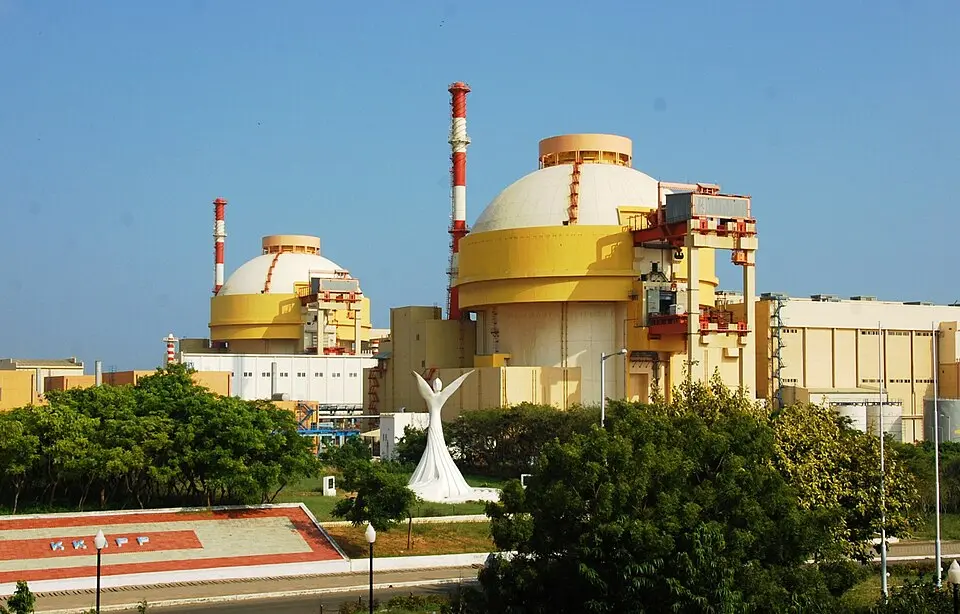
- Pressurised water reactors (PWR) use ordinary water as moderator and coolant, kept under high pressure so it does not boil, with enriched uranium fuel; they are the most common type in the world, and the Russian built units at Kudankulam are of this kind.
- Boiling water reactors (BWR) let the water boil in the core and send the steam straight to the turbine; Tarapur 1 and 2, commissioned in 1969, are India's oldest power reactors and are of this type.
- Pressurised heavy water reactors (PHWR) run on natural uranium and form India's indigenous fleet, as the three stage programme note explains.
- Small modular reactors (SMR) are reactors of up to about 300 MWe whose parts are built in a factory and shipped to site, which promises shorter construction, smaller sites and passive safety, though no design has yet shown lower costs at scale.
How safety is built
- Defence in depth. Radioactivity is held behind several barriers in series, namely the ceramic fuel pellet, the sealed metal cladding, the pressure boundary of the coolant circuit and a thick concrete containment, and each barrier is protected by independent systems so that one failure does not cause a release.
- Negative feedback. A well designed core loses reactivity as it heats up, so a rise in power reduces itself; the Chernobyl reactor of 1986 lacked this property under the conditions of the test that destroyed it.
- Passive safety. Newer designs remove decay heat by gravity, natural circulation and stored water, without pumps or power, so that the plant stays safe even after a total power loss of the kind that struck Fukushima in 2011.
Waste
- Spent fuel is intensely radioactive and hot when it leaves the reactor, so it is first cooled in water pools for years and then stored in dry casks or, in a closed fuel cycle like India's, reprocessed.
- High level waste from reprocessing is vitrified, that is fixed in glass, and stored under cooling; the accepted long term answer is a deep geological repository in stable rock, and Finland is the first country to near operation of one.
Dimensions
- Climate. Nuclear power emits almost no carbon dioxide in operation and runs round the clock, so it provides the firm low carbon power that solar and wind cannot supply alone.
- Economic. Plants are cheap to run but costly and slow to build, so delays and finance costs turn into high tariffs.
- Safety and health. Normal operation exposes the public to a tiny fraction of natural background radiation, but a severe accident can displace people for decades, which shapes public opinion more than statistics.
- Legal. Accident compensation needs a law that channels liability to the operator, so victims know whom to sue, and caps it, so that the operator can insure; India's law on this changed in 2025.
- Social. The protests at Kudankulam and Jaitapur showed that a plant needs the trust of the people around it.
- International. Fuel and reactor trade depend on India's safeguards agreement with the International Atomic Energy Agency (IAEA), and non proliferation as diplomacy is covered in GS2 International Relations.
In practice
The fleet and the target
- Size. India has 24 operating reactors with 8,780 MW of capacity, operated by the Nuclear Power Corporation of India Limited (NPCIL), and nuclear power gave about 3.1 per cent of electricity generated in 2024-25 (Press Information Bureau, PIB, December 2025).
- Growth. Capacity is planned to reach about 22.4 GW by 2031-32 as reactors under construction are completed, including the fleet of indigenous 700 MWe PHWRs and further Russian units at Kudankulam. Mahi Banswara in Rajasthan, four 700 MWe units whose foundation stone was laid in September 2025, is being built by Anushakti Vidhyut Nigam Limited (ASHVINI), a joint venture of NPCIL and NTPC Limited.
- The 2047 target. The government aims for 100 GW of nuclear capacity by 2047, to be met through large reactors and SMRs.
- The Nuclear Energy Mission. Announced in the Union Budget 2025-26 with Rs 20,000 crore for research on SMRs, it aims to have at least five indigenously designed SMRs operating by 2033. The Bhabha Atomic Research Centre (BARC) is designing the Bharat Small Modular Reactor (BSMR-200) and a 55 MWe SMR, both pressurised water reactors, with Tarapur approved as their site, while the 220 MWe PHWR is being adapted as the Bharat Small Reactor for industries that want captive power.

The SHANTI Act, 2025
- What it is. The Sustainable Harnessing and Advancement of Nuclear Energy for Transforming India (SHANTI) Act, 2025 was passed by Parliament on 17 and 18 December 2025 and received assent on 20 December 2025. It replaces both the Atomic Energy Act, 1962 and the Civil Liability for Nuclear Damage Act, 2010.
- Private participation. Under the 1962 Act only the Central government and its companies could build and run reactors. The new law allows the government to license any company incorporated in India, joint ventures of government entities with private firms, and other persons it permits, to build, own and operate plants and to make, transport and store fuel. Enrichment beyond a notified limit, reprocessing of spent fuel, management of high level waste and heavy water production stay with the Central government.
- Liability. The operator remains liable without proof of fault, must insure, and the government bears damage beyond the cap. The single cap of Rs 1,500 crore in the 2010 Act is replaced by a graded cap from Rs 100 crore to Rs 3,000 crore by size of installation. The operator's right of recourse against a supplier for defective equipment, which foreign vendors had resisted since 2010, is removed, leaving recourse only where a contract provides for it or for a deliberate act.
- Regulation. The Atomic Energy Regulatory Board (AERB), created in 1983 by an executive order, becomes a statutory body. Appeals go to an Atomic Energy Redressal Advisory Council and then to the Appellate Tribunal for Electricity.
Issues and way forward
- Is the cap enough? A severe accident can cost far more than Rs 3,000 crore, as Fukushima showed, so the real guarantee for victims is the state's backing and an adequately funded liability pool, which must be built before private reactors run.
- Supplier accountability. Removing recourse for defective equipment draws investment but shifts risk to operators and the public, so strict design approval and quality inspection by the regulator have to carry the weight the law no longer places on suppliers.
- Regulatory independence. The AERB is now statutory, but its members are appointed on the advice of a committee constituted by the Atomic Energy Commission, the body it regulates, and a regulator answerable to Parliament and seen to be independent is what public trust needs.
- Cost and speed. Reaching 100 GW from under 9 GW in two decades needs fleet construction, standard designs, assured finance and a domestic supply chain.
- Waste policy. India stores and reprocesses spent fuel but has no long term repository; the law lets the Centre frame a national policy on spent fuel and waste, and a site and plan will be needed as the fleet grows.
- Consent and emergency planning. Early consultation and drilled offsite emergency plans, covered in the disaster management note, are conditions for new sites.
Common confusions
- Nuclear accident and nuclear explosion. A power reactor cannot explode like a bomb, because its fuel is far too dilute in fissile material; reactor accidents release radioactivity through overheating, steam or hydrogen explosions and fires.
- Shutdown and cooling. Inserting control rods stops the chain reaction in seconds, but decay heat continues for days, so a shut down reactor still needs cooling.
- Operator liability and supplier liability. The operator pays victims first, without proof of fault, and the supplier is liable only if the operator can claim recourse against it, which the 2025 law now limits to contract and deliberate acts.
- Installed capacity and generation. Capacity is the rated power of the plants, while generation is the electricity actually produced, which depends on how much of the time they run.
For the exam
- Keyword bank: decay heat, defence in depth, containment, passive safety, pressurised water reactor, spent fuel, vitrification, deep geological repository, no fault liability, graded liability cap, right of recourse, statutory regulator, small modular reactor, firm low carbon power, Nuclear Energy Mission.
- Previous year questions: Practise the previous year questions on this topic →
- Use in an answer:
- Introduction with data: Nuclear power gave about 3.1 per cent of India's electricity in 2024-25 from 8,780 MW of capacity, against a national target of 100 GW by 2047.
- Introduction with a law: The SHANTI Act, 2025 replaced the Atomic Energy Act, 1962 and the Civil Liability for Nuclear Damage Act, 2010, opening reactor operation to Indian companies and making the AERB a statutory regulator.
- Conclusion: India needs firm low carbon power, and nuclear can supply it, but the opening to private capital will last only if the regulator is independent, the liability pool is credible and the waste problem has a plan.
- Conclusion: The safety of a reactor rests on removing decay heat in every circumstance, and the safety of a nuclear programme rests on the trust of the people who live beside it.