

19 Nov 2026GS1Topic
Geography: world physical, geophysical phenomena and changing features
Previous year questions
5 as set1 · GS1 201710 marks150 words
How does the Juno Mission of NASA help to understand the origin and evolution of the Earth?
Show the model answerHide the model answer
NASA's Juno spacecraft has orbited Jupiter since 2016. Jupiter formed first and is the largest planet, so it holds clues to how the whole solar system, Earth included, took shape.
Original building material: Jupiter's gases preserve the composition of the early solar nebula. Measuring its water and oxygen shows how volatiles were distributed when Earth formed.
Where Earth's water came from: Water abundance on Jupiter helps locate the snow line and explains how water reached the inner, rocky planets.
Jupiter's migration: Models suggest Jupiter moved inward and back out early on. This shaped the size of Mars and Earth and scattered material across the inner solar system.
Interior and core: Juno's gravity data revealed a large, diluted core, testing theories of how planets build up from rock and ice.
Magnetic field: Mapping Jupiter's dynamo helps scientists understand how Earth's own magnetic field works.
By studying the eldest planet, Juno reads the early chapters of Earth's own story.
Show how the answer was builtHide how the answer was built
Decode
Explain how a Jupiter mission helps explain Earth's origin.
Implicit demand
The examiner wants the link between Jupiter's science and Earth's formation, not a mission profile.
Architecture
An introduction, five links, then a verdict.
Articulation
Each point ends with what it tells us about Earth. Money line: Earth's own story.
Show value added materialHide value added material
Facts
Juno launched in 2011 and entered Jupiter's orbit in 2016.
Juno found Jupiter's Great Blue Spot, a magnetic anomaly.
Europa Clipper, launched 2024, will study Jupiter's icy moon.
2 · GS1 202015 marks250 words
Account for the huge flooding of million cities in India including the smart ones like Hyderabad and Pune. Suggest lasting remedial measures.
Show the model answerHide the model answer
Hyderabad flooded in October 2020, Bengaluru in 2022, Delhi in 2023 and Chennai in 2023. Even cities listed under the Smart Cities Mission (2015) now drown after a few hours of heavy rain.
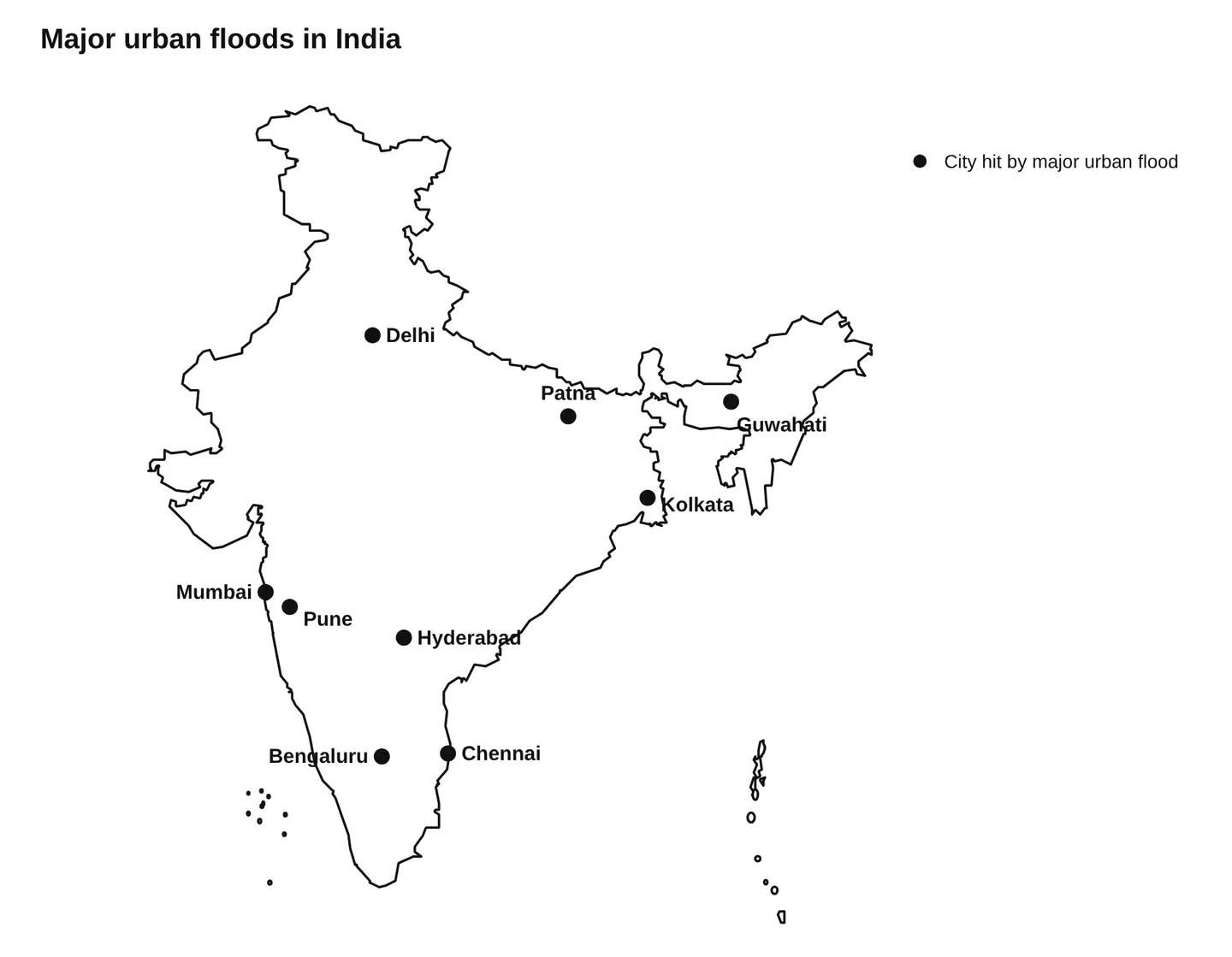
Why cities flood
Extreme rain: Climate change has made short, intense downpours more frequent. A single night can bring a month's rain.
Lost lakes and drains: Hyderabad and Bengaluru built over many lakes and natural drains that once held storm water.
Concrete surfaces: Paved ground stops rain from soaking in, so runoff rises sharply.
Old, clogged drainage: Storm drains were built for far less rain and are choked with solid waste.
Building on floodplains: Construction along rivers such as Pune's Mutha narrows their flow.
Poor coordination: Many agencies share responsibility, and dam releases, as in Chennai in 2015, are not timed with city needs.
Lasting remedies
Restore the natural sponge: Clear encroachments and revive lakes, wetlands and drains.
Sponge city design: Permeable pavements, parks and rain gardens absorb water where it falls.
Modern drainage: Redesign drains for heavier rain using drainage master plans, as Mumbai did after 2005.
Early warning: Real time flood forecasting, such as Chennai's system, gives residents time to act.
Planning and governance: Enforce floodplain zoning, follow the urban flooding guidelines of the National Disaster Management Authority (2010), and give one agency clear charge.
Cities flood because they forgot where water goes, and lasting remedies must give that space back.
Show how the answer was builtHide how the answer was built
Decode
Explain why large Indian cities flood and how to fix it for good.
Implicit demand
The examiner wants causes specific to cities and lasting remedies, not relief measures.
Architecture
A current affairs introduction, a sketch, six causes, five remedies, then a verdict.
Articulation
Lost lakes explain why smart cities still flood. Money line: give water its space back.
Show value added materialHide value added material
Facts
Mumbai floods, 2005.
AMRUT 2.0, 2021, funds storm water drainage.
Chennai Flood Warning System, launched 2019.
3 · GS1 201810 marks150 words
Define mantle plume and explain its role in plate tectonics.
Show the model answerHide the model answer
A mantle plume is a column of unusually hot rock rising from deep in the mantle, possibly from the core mantle boundary. Its broad head melts near the surface and forms a hotspot.
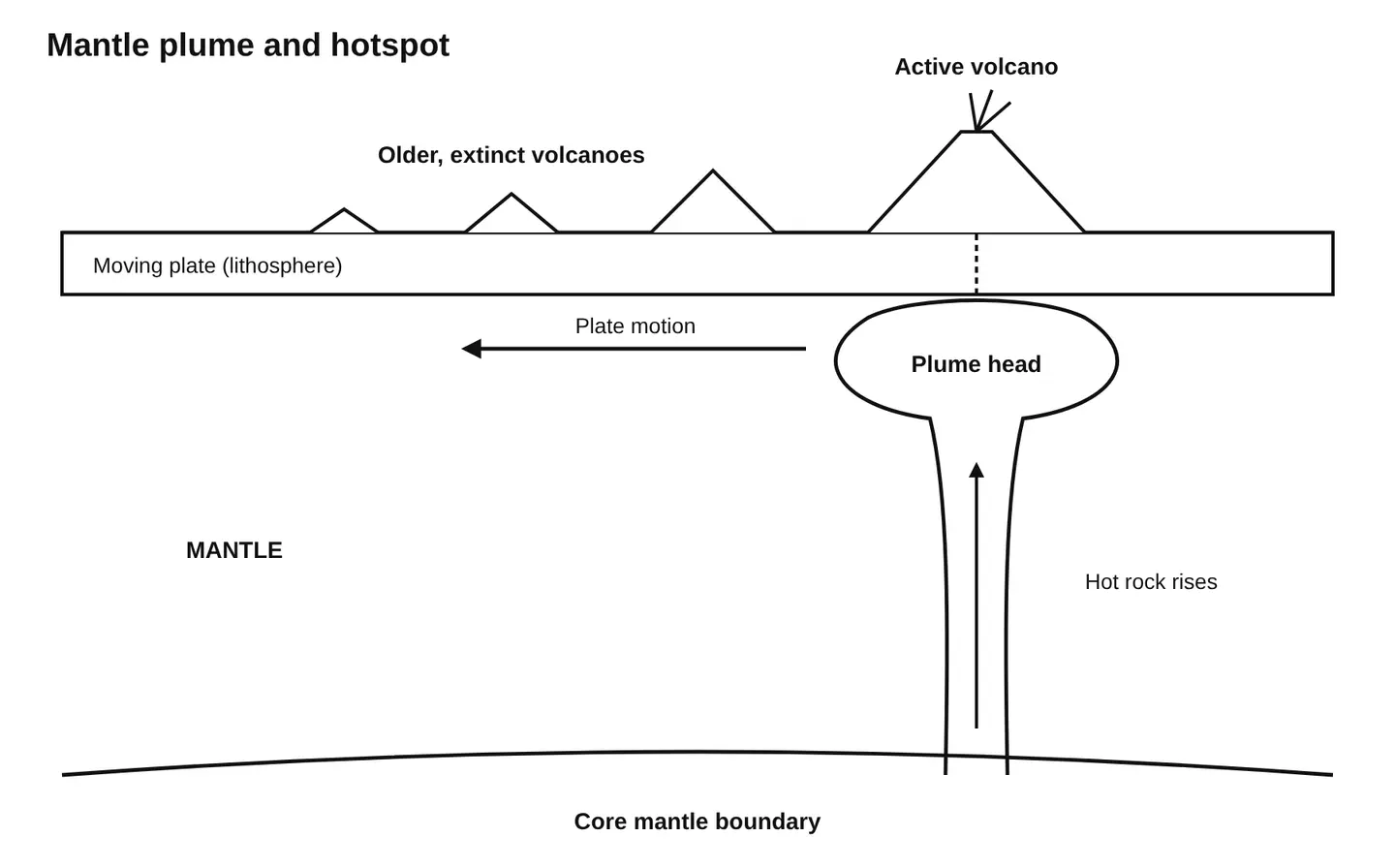
Volcanoes away from plate edges: Plumes explain volcanoes in plate interiors, such as Hawaii.
Tracking plate motion: As a plate moves over a fixed plume, it leaves a chain of volcanoes. The Hawaii Emperor chain records the Pacific Plate's movement.
Flood basalts: Huge plume heads erupt vast lava flows. The Deccan Traps formed over the Reunion plume.
Splitting continents: Plumes can weaken and rift continents, as in East Africa and in India's separation from Madagascar and the Seychelles.
Islands and plateaus: Plumes build ocean islands such as Reunion and Iceland and large undersea plateaus.
Mantle plumes add a vertical engine to the horizontal story of plate tectonics.
Show how the answer was builtHide how the answer was built
Decode
Define a mantle plume and explain its role in plate tectonics.
Implicit demand
The examiner wants a precise definition, a diagram and examples of each role.
Architecture
A definition, a diagram, four roles, then a verdict.
Articulation
The Deccan Traps link the concept to India. Money line: a vertical engine.
Show value added materialHide value added material
Facts
Iceland sits where a plume meets the Mid Atlantic Ridge.
Siberian Traps linked to the largest mass extinction.
The Hawaii Emperor chain bends sharply, marking a change in plate direction.
4 · GS1 202215 marks250 words
What are the forces that influence ocean currents? Describe their role in fishing industry of the world.
Show the model answerHide the model answer
Ocean currents are steady flows of seawater. They decide where the world's richest fishing grounds lie.
Forces behind ocean currents
Planetary winds: Trade winds and westerlies drag surface water, setting up large circular gyres.
Coriolis force: Earth's rotation deflects currents to the right in the north and to the left in the south.
Heating and gravity: Solar heating makes equatorial water expand and stand slightly higher, and gravity pulls it downslope.
Density differences: Cold, salty water sinks and drives the deep thermohaline circulation.
Coastlines and sea floor: Landmasses and ridges bend and split currents.
Role in the fishing industry
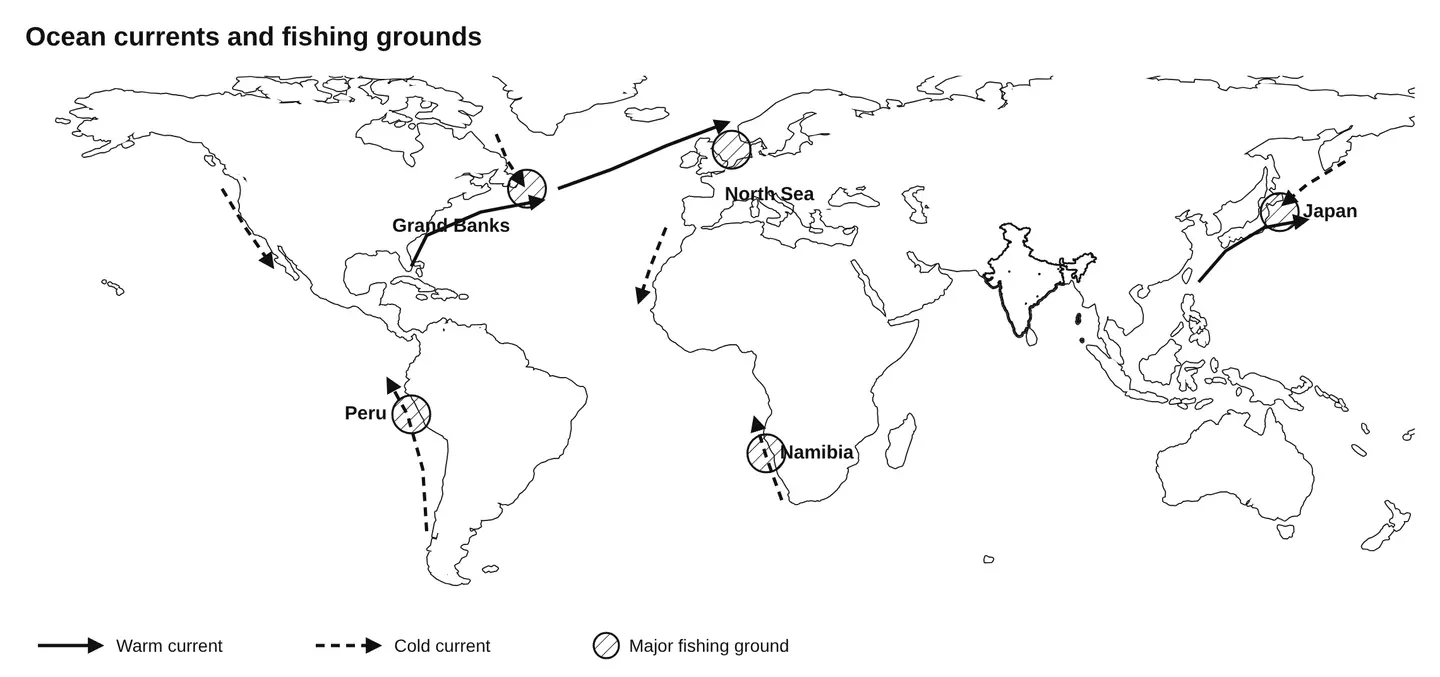
Where warm meets cold: Mixing brings nutrients and plankton. The Grand Banks, where the Gulf Stream meets the Labrador Current, and the waters off Japan, where the Kuroshio meets the Oyashio, are rich grounds.
Upwelling: Cold currents along western coasts lift nutrient rich water. The Humboldt Current makes Peru a leading fishing nation, and the Benguela Current supports Namibia.
Ice free ports: The North Atlantic Drift keeps Norway's ports open all year for the North Sea fishery.
Disruption: El Nino weakens upwelling off Peru and causes fish catches to collapse.
Currents carry the ocean's food supply, so fishing follows where they rise and meet.
Show how the answer was builtHide how the answer was built
Decode
Explain the forces behind ocean currents and their effect on fishing.
Implicit demand
The examiner wants primary and secondary forces, then named fishing grounds with reasons.
Architecture
An introduction, a sketch, five forces, four roles in fishing, then a verdict.
Articulation
The sketch places every example. Money line: fishing follows where currents rise and meet.
Show value added materialHide value added material
Facts
Canary and California currents also support fisheries.
Somali Current upwelling enriches the Arabian Sea.
Oil sardine catches off Kerala depend on monsoon upwelling.
5 · GS1 201910 marks150 words
Assess the impact of global warming on the coral life system with examples.
Show the model answerHide the model answer
The world saw its fourth global coral bleaching event between 2023 and 2025, affecting most of the world's reefs. Global warming is the main cause.
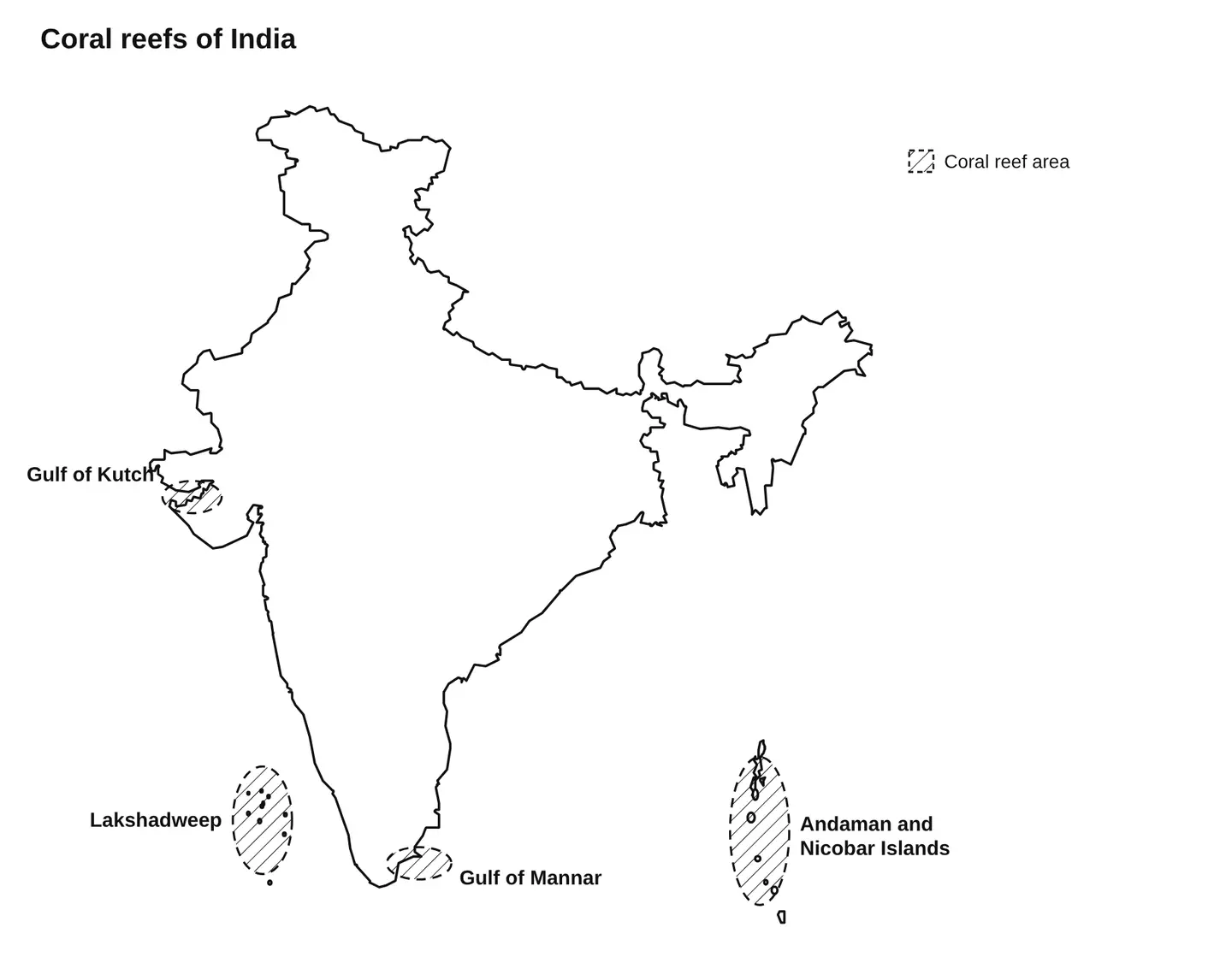
Bleaching: Warm water makes corals expel the algae that feed them. Repeated bleaching hit the Great Barrier Reef and, in 2024, the reefs of Lakshadweep and the Gulf of Mannar.
Ocean acidification: Absorbed carbon dioxide lowers the pH of seawater and weakens coral skeleton building.
Stronger storms: Intense cyclones break reefs physically and slow recovery.
Disease and rising seas: Warmer water spreads coral diseases, and slow growing reefs struggle with sea level rise.
Consequences
Reef loss hurts fisheries, tourism and coastal protection.
Way forward
Cutting emissions is the only lasting cure. Marine protected areas, less pollution and coral restoration, as in the Gulf of Kutch, buy reefs time.
Coral reefs are the first ecosystem warming could erase, so they test the world's climate resolve.
Show how the answer was builtHide how the answer was built
Decode
Assess how global warming affects coral reefs, with examples.
Implicit demand
The examiner wants each impact with a named reef and the wider consequences.
Architecture
A current affairs introduction, a sketch, four impacts, consequences, then a verdict.
Articulation
Lakshadweep and the Gulf of Mannar bring the answer home. Money line: a test of climate resolve.
Show value added materialHide value added material
Facts
Corals thrive between about 23 and 29 degrees Celsius.
Coral restoration in the Gulf of Kutch by the Zoological Survey of India.
Paris Agreement, 2015, aims to limit warming to well below 2 degrees Celsius.