

23 Nov 2026GS1Revision
Revision: the whole GS1 paper
Questions you have written before will appear here. That is by design. Writing an answer a second time, after reading the model answer, is the point of the day.
Previous year questions
10 as set1 · GS1 202515 marks250 words
Give a geographical explanation of the distribution of off-shore oil reserves of the world. How are they different from the on-shore occurrences of oil reserves?
Show the model answerHide the model answer
Nearly a third of the world's oil now comes from beneath the sea. Its distribution follows the geology of sedimentary basins along continental margins.
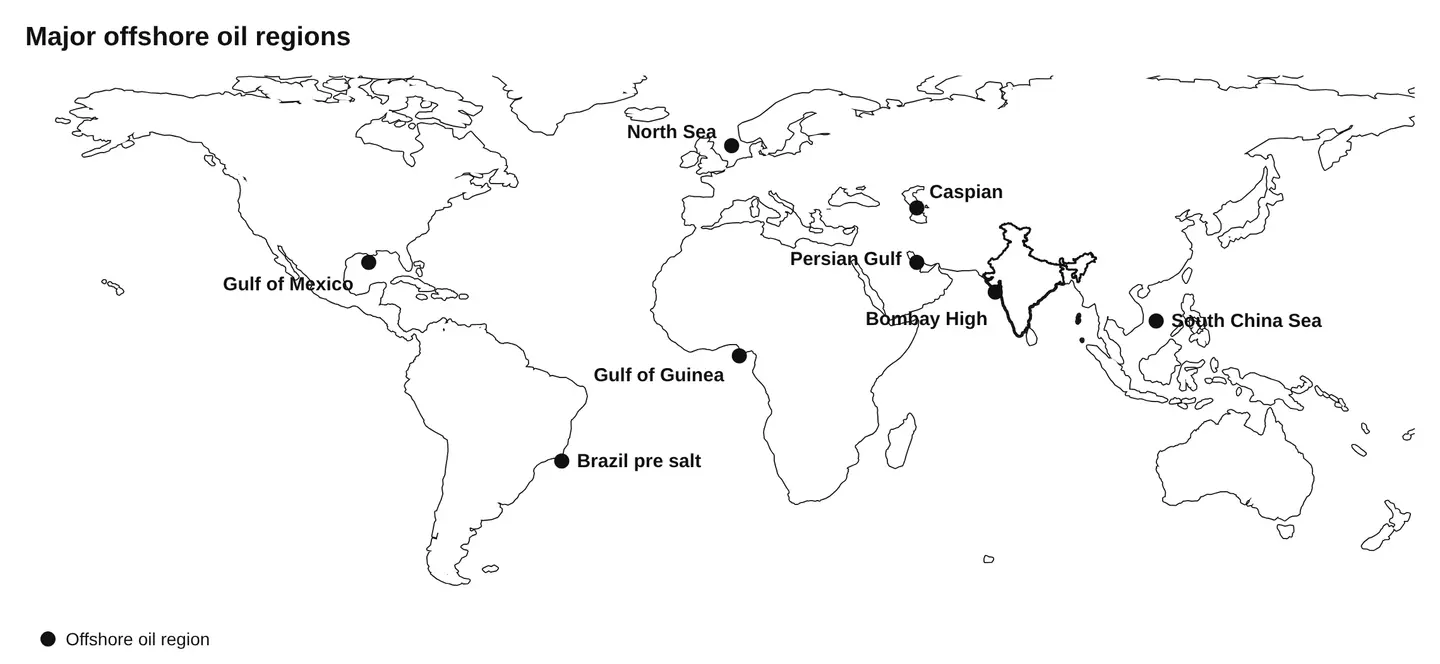
Geographical explanation
Continental shelves: Shelves and slopes hold thick layers of marine sediment rich in plankton remains, the raw material of oil.
Rift margins of the Atlantic: When the Atlantic opened, mirror image basins formed off Brazil and West Africa. Salt layers there seal huge pre salt reserves.
Shallow inland seas: The Persian Gulf, North Sea and Caspian Sea are sinking basins where sediment and oil accumulated over millions of years.
River deltas: Deltas such as the Niger and Krishna Godavari bury organic matter quickly, preserving it.
India: Bombay High on the western shelf and the deep water Krishna Godavari basin are India's main offshore fields.
How they differ from onshore reserves
Setting: Onshore oil lies in interior and foreland basins and in folded belts, as in Assam, Gujarat and Rajasthan. Offshore oil lies in younger sediments under the sea.
Extraction: Offshore drilling needs platforms and costly deep water technology.
Risk: Spills such as Deepwater Horizon (2010) spread fast and harm marine life.
Law: Offshore rights follow the Exclusive Economic Zone under the United Nations Convention on the Law of the Sea (1982). Overlapping claims fuel disputes, as in the South China Sea.
Oil follows ancient seas, so the world's continental margins have become its new oil frontier.
Show how the answer was builtHide how the answer was built
Decode
Explain where offshore oil occurs and how it differs from onshore oil.
Implicit demand
The examiner wants geological reasons with named basins, then clear contrasts.
Architecture
An introduction, a sketch, five explanations, four differences, then a verdict.
Articulation
Atlantic mirror basins show geographic logic. Money line: the new oil frontier.
Show value added materialHide value added material
Facts
Bombay High was discovered in 1974.
Brazil's pre salt reserves lie below thick salt layers.
Ghawar in Saudi Arabia is the largest onshore field.
2 · GS1 202110 marks150 words
Differentiate the causes of landslides in the Himalayan region and Western Ghats.
Show the model answerHide the model answer
The Wayanad landslide of 2024 and the Joshimath subsidence of 2023 show that both ranges are vulnerable, but for different reasons.
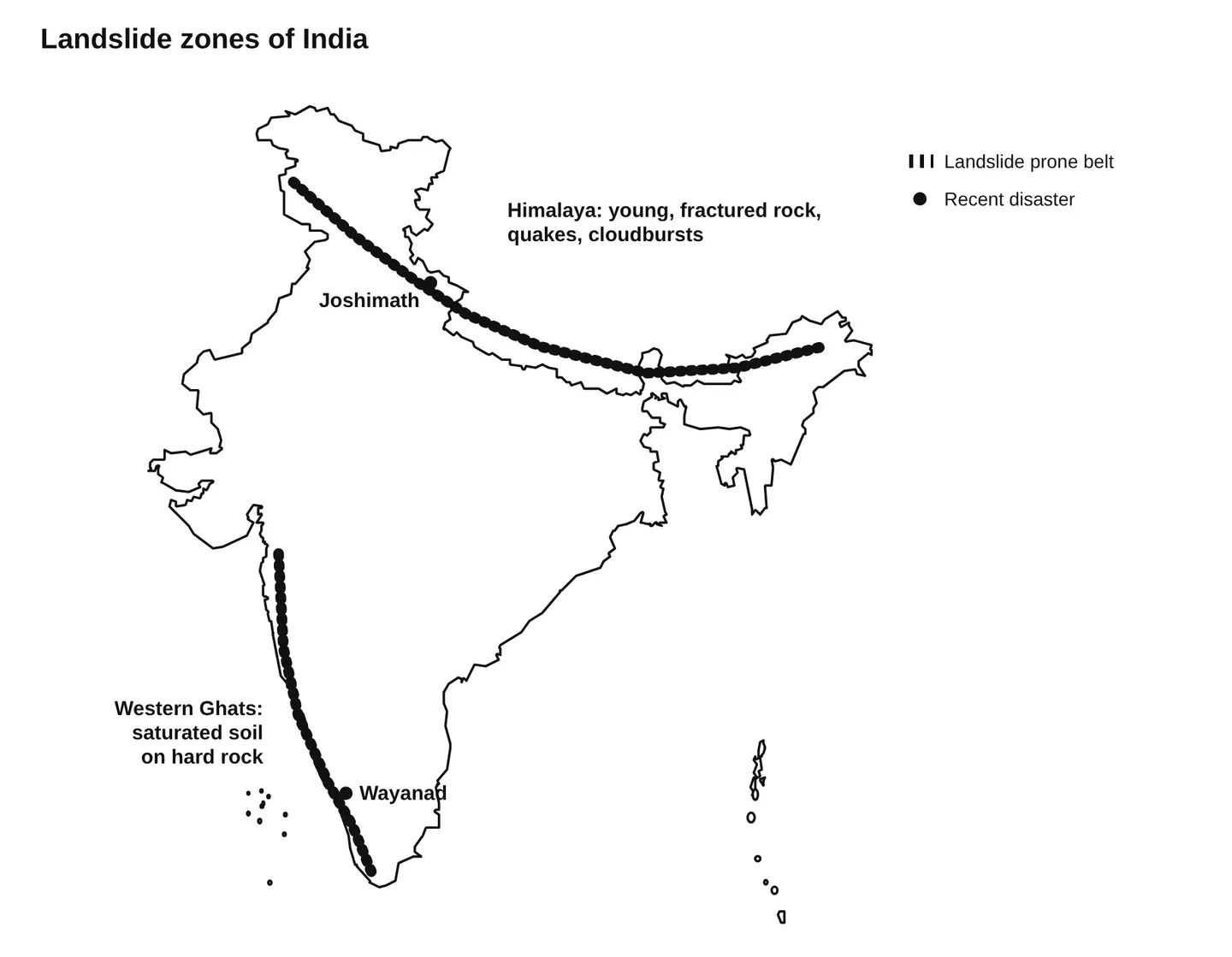
Himalaya
Young and active: The Himalaya are young fold mountains with fractured rock and frequent earthquakes.
Steep slopes and cloudbursts: Cloudbursts and glacial floods, as at Kedarnath in 2013, trigger slides.
Human pressure: Road widening, hydropower tunnels and unplanned towns weaken slopes.
Western Ghats
Old but steep: The Ghats are old and stable, but their western escarpment is very steep.
Soil over rock: A thick layer of laterite soil sits on hard basalt or gneiss. Heavy monsoon rain saturates the soil, which slides off as debris flows.
Land use change: Plantations, quarrying and deforestation on slopes add to the risk.
Himalayan slides begin in unstable rock, while Ghats slides begin in saturated soil, so each needs its own remedy.
Show how the answer was builtHide how the answer was built
Decode
Differentiate landslide causes in two mountain systems.
Implicit demand
The examiner wants contrasting causes, each with an example.
Architecture
An introduction, a sketch, three Himalayan causes, three Ghats causes, then a verdict.
Articulation
Rock versus soil is the core contrast. Money line: each needs its own remedy.
Show value added materialHide value added material
Facts
Geological Survey of India's landslide susceptibility mapping.
Madhav Gadgil report on the Western Ghats, 2011.
Malin landslide in Pune, 2014.
3 · GS1 202515 marks250 words
Achieving sustainable growth with emphasis on environmental protection could come into conflict with poor people's needs in a country like India – Comment.
Show the model answerHide the model answer
Green rules often fall first on the poor. Yet the poor also suffer most from a damaged environment, so the conflict is real but not permanent.
Where conflict arises
Livelihoods in mining regions: Coal supports lakhs of jobs in Jharkhand and Chhattisgarh. A fast exit from coal without alternatives would hurt them.
Forests and tribal rights: Strict conservation has displaced forest dwellers, though the Forest Rights Act (2006) now recognises their claims.
Cost of clean energy: Poor families under Ujjwala (2016) often return to firewood because cooking gas refills are costly.
Bans and small earners: Bans on stubble burning, single use plastic and sand mining raise costs for farmers, vendors and labourers.
Land for green projects: Solar parks on common lands in Rajasthan can cut grazing access.
Why it need not be a conflict
The poor suffer most: Polluted air, heatwaves and floods hit those with the least protection.
Environmentalism of the poor: Movements such as Chipko showed that the poor defend forests because they live off them.
Green jobs: Water conservation under the Mahatma Gandhi National Rural Employment Guarantee Act (2005) and rooftop solar under the PM Surya Ghar scheme (2024) link income with the environment.
Way forward
A just transition, community managed forests and targeted subsidies can protect both the poor and the planet.
Growth that ignores the environment fails the poor tomorrow, while protection that ignores the poor fails them today.
Show how the answer was builtHide how the answer was built
Decode
Comment on the conflict between green growth and the needs of the poor.
Implicit demand
The examiner wants both the conflict and why it can be resolved.
Architecture
An introduction, five conflicts, three reasons it need not be a conflict, a way forward, then a verdict.
Articulation
Chipko reverses the assumption. Money line: fails the poor tomorrow or today.
Show value added materialHide value added material
Facts
Mission LiFE, 2022.
Ramachandra Guha described the environmentalism of the poor.
Great Indian Bustard case on power lines, 2021.
4 · GS1 202410 marks150 words
What is the concept of a 'demographic winter'? Is the world moving towards such a situation? Elaborate.
Show the model answerHide the model answer
A demographic winter is a long period when fertility stays below the replacement level of about 2.1. Populations then age, workforces shrink and total numbers fall.
Is the world moving towards it?
Already there: South Korea's fertility rate is below 1, the lowest in the world. Japan, Italy and China face shrinking populations.
A global trend: More than half of all countries now have fertility below replacement. World population may peak later this century.
India: India's fertility rate fell to 2.0 in the National Family Health Survey 5 (2019 to 2021). Southern states are already well below replacement.
Exceptions: Sub Saharan Africa still has high fertility and a young, growing population.
Consequences
Fewer workers must support more pensioners, labour shortages grow and growth slows.
The world is moving towards a demographic winter unevenly, and India must get rich before it grows old.
Show how the answer was builtHide how the answer was built
Decode
Explain demographic winter and judge whether the world is heading there.
Implicit demand
The examiner wants a definition, global evidence, India and exceptions.
Architecture
A definition, four points of evidence, consequences, then a verdict.
Articulation
South Korea and Africa show the range. Money line: rich before old.
Show value added materialHide value added material
Facts
United Nations World Population Prospects, 2024.
China's population began falling in 2022.
Japan's elderly share is near 30 percent.
5 · GS1 202010 marks150 words
The rock-cut architecture represents one of the most important sources of our knowledge of early Indian art and history. Discuss.
Show the model answerHide the model answer
Rock cut caves and temples have survived where wooden and brick buildings perished. They record India's art, faith and society across more than a thousand years.
Evolution of religion: The Barabar caves were gifted to Ajivikas by Ashoka. Early chaityas such as Karle show the stupa without images, while later caves show the Buddha in human form.
Living art: Ajanta murals depict Jataka tales, dress, music and court life.
Religious harmony: Ellora holds Buddhist, Hindu and Jain caves side by side.
Dynasties and patronage: The Kailasa temple at Ellora shows Rashtrakuta power, and inscriptions at Karle name merchants and guilds as donors.
Trade routes: Many caves line passes of the Western Ghats, marking ancient trade routes.
Engineering skill: Early caves imitate wooden beams, showing how craftsmen moved from timber to stone.
Carved into living rock, these monuments are India's most durable history books.
Show how the answer was builtHide how the answer was built
Decode
Discuss rock cut architecture as a historical source.
Implicit demand
The examiner wants examples linked to what each teaches.
Architecture
An introduction, six sources of knowledge, then a verdict.
Articulation
Each point pairs a site with a lesson. Money line: durable history books.
Show value added materialHide value added material
Facts
Udayagiri and Khandagiri caves of Kharavela in Odisha.
Pallava rathas at Mahabalipuram.
Elephanta caves near Mumbai.
6 · GS1 202110 marks150 words
Assess the main administrative issues and socio-cultural problems in the integration process of Indian Princely States.
Show the model answerHide the model answer
At independence, over 560 princely states had to join India. Sardar Patel and V. P. Menon completed most of this task within two years.
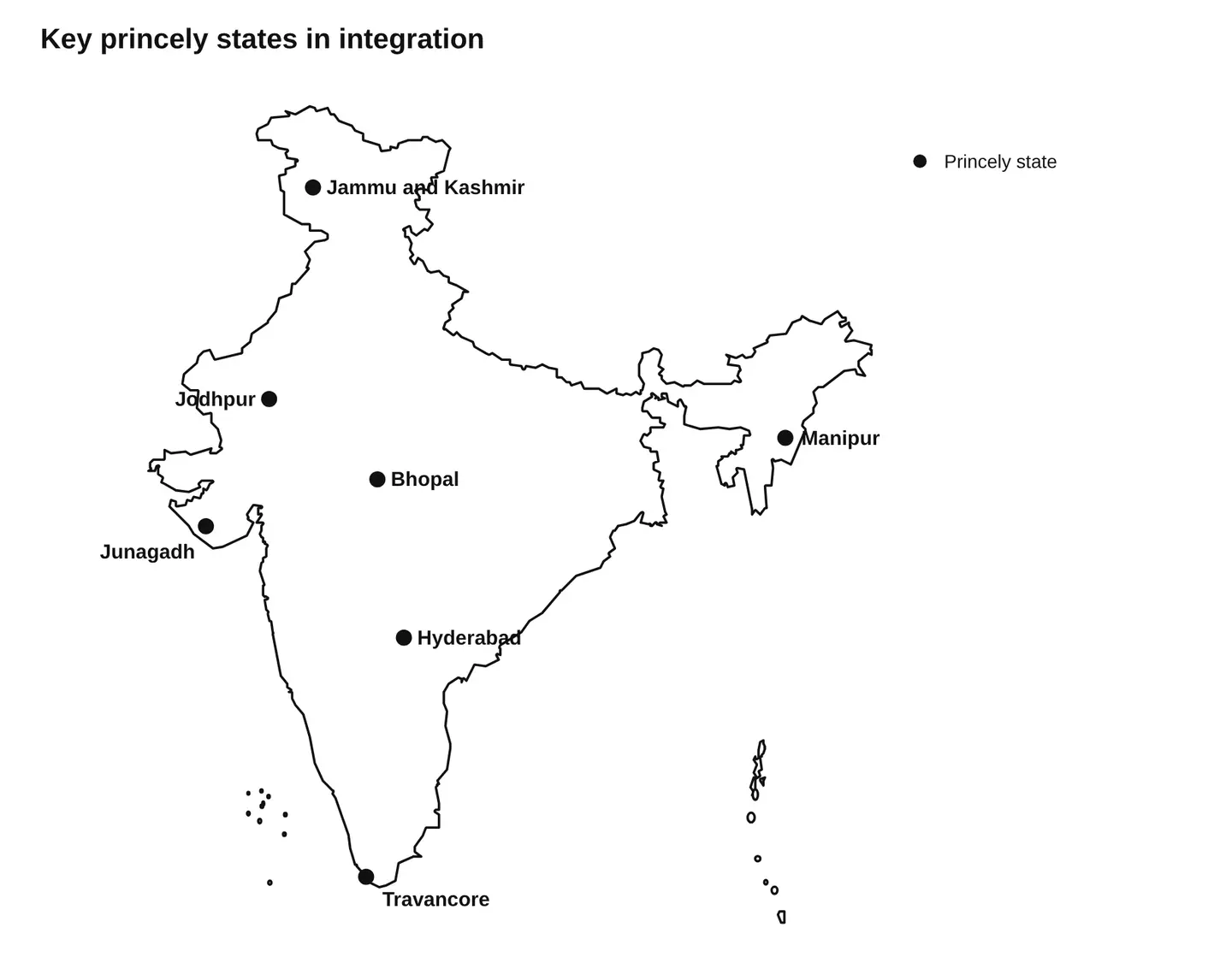
Administrative issues
Reluctant rulers: Junagadh needed a plebiscite, Hyderabad a police action in 1948, and Kashmir acceded under invasion.
Uneven systems: States had separate laws, armies and revenue systems. They were merged into unions such as Saurashtra and Rajasthan.
Privy purses: Rulers received privy purses until 1971.
Socio cultural problems
Loyalties and identity: Subjects felt attached to dynasties, and merging old rivals into one union caused friction.
Communal tension: The Razakars in Hyderabad spread violence, and Kashmir's accession became a lasting dispute.
Feudal structures: Jagirdari and landlord power had to be dismantled through land reform.
Integration was won with diplomacy and firmness, but its social healing took decades.
Show how the answer was builtHide how the answer was built
Decode
Assess administrative and social problems in integrating princely states.
Implicit demand
The examiner wants named states and both kinds of problems.
Architecture
An introduction, a sketch, three administrative issues, three social problems, then a verdict.
Articulation
Junagadh, Hyderabad and Kashmir show three routes. Money line: social healing took decades.
Show value added materialHide value added material
Facts
Instrument of Accession and Standstill Agreement.
Twenty Sixth Amendment, 1971, abolished privy purses.
Telangana peasant struggle, 1946 to 1951.
7 · GS1 201715 marks250 words
Examine how the decline of traditional artisanal industry in colonial India crippled the rural economy.
Show the model answerHide the model answer
Indian textiles once clothed much of the world. Under colonial rule, the collapse of artisan industry pushed millions back onto the land and weakened the village economy.
Why artisan industry declined
Machine competition: Cheap Manchester cloth flooded Indian markets.
Unequal trade: Britain taxed Indian goods heavily while forcing one way free trade on India.
Loss of patrons: The decline of princely courts ended demand for luxury crafts.
Railways: Railways carried machine goods deep into the countryside, reaching village markets.
How it crippled the rural economy
Pressure on land: Unemployed weavers and smiths turned to farming. The share of people dependent on agriculture rose, causing fragmentation and disguised unemployment.
Broken village economy: Villages lost the balance between farming and crafts that kept them self sufficient.
Debt and poverty: Without a second income, families fell into moneylenders' hands.
Famine vulnerability: Crop failures turned into famines because rural people had no other work.
Decline of towns: Craft centres such as Dhaka and Murshidabad lost population, shrinking rural markets.
Nationalist response
Dadabhai Naoroji and R. C. Dutt exposed this damage. The Swadeshi movement (1905) and Gandhi's khadi sought to revive village industry.
Deindustrialisation turned India into a land of overcrowded fields, a burden independent India inherited.
Show how the answer was builtHide how the answer was built
Decode
Examine how artisan decline damaged the rural economy.
Implicit demand
The examiner wants causes in brief, then rural effects in depth.
Architecture
An introduction, four causes, five effects, the nationalist response, then a verdict.
Articulation
Pressure on land is the core mechanism. Money line: overcrowded fields.
Show value added materialHide value added material
Facts
R. C. Dutt, Economic History of India, 1901.
Drain theory of Dadabhai Naoroji.
Handloom survived in coarse cloth for local markets.
8 · GS1 202310 marks150 words
Bring out the socio-economic effects of the introduction of railways in different countries of the world.
Show the model answerHide the model answer
Railways, born in Britain in the 1820s, changed economies and societies wherever they spread.
Britain: Railways cut transport costs, fed industry and created standard time across the country.
United States: The transcontinental railroad of 1869 built a national market. It also displaced Native Americans and relied on Chinese labour.
Russia: The Trans Siberian Railway opened Siberia to settlement and secured the Pacific coast.
India: Railways served raw material exports and the drain of wealth, yet built national unity.
Africa: The Uganda Railway used Indian indentured workers and opened Kenya to settler colonialism.
Argentina: British financed lines turned the pampas into a beef and wheat exporter.
Japan: Meiji era railways sped up industrialisation and tied the country into one market.
Railways also drove urbanisation, tourism and the rise of labour unions.
Railways spread modernity and markets, but in colonies they also deepened dependence.
Show how the answer was builtHide how the answer was built
Decode
Bring out the social and economic effects of railways across countries.
Implicit demand
The examiner wants a spread of countries, each with a distinct effect.
Architecture
An introduction, six countries, common effects, then a verdict.
Articulation
Colonies and free nations show contrasting results. Money line: modernity and dependence.
Show value added materialHide value added material
Facts
Stockton and Darlington Railway, 1825.
Trans Siberian Railway built between 1891 and 1916.
First Indian passenger train, 1853.
9 · GS1 201915 marks250 words
How do ocean currents and water masses differ in their impacts on marine life and coastal environment? Give suitable examples.
Show the model answerHide the model answer
Ocean currents are moving streams of water. Water masses are large bodies with a uniform temperature and salinity, set by the region where they formed. Their effects differ in reach and in kind.
Impacts of ocean currents
Coastal climate: The warm North Atlantic Drift keeps Norway's ports ice free. The cold Humboldt and Benguela currents create the Atacama and Namib deserts.
Fisheries: Cold currents bring upwelling, making Peru and Namibia rich fishing grounds.
Spread of life: Warm currents carry coral larvae. The East Australian Current supports the Great Barrier Reef.
Pollution: Gyres collect plastic, forming the Great Pacific Garbage Patch.
Impacts of water masses
Deep ocean life: Cold, oxygen rich Antarctic Bottom Water ventilates the deep sea and supports life there.
Species limits: Each water mass has its own temperature and salinity, so marine species stay within it.
Fronts: Where water masses meet, nutrients mix, and fish and whales gather.
Oxygen poor layers: Intermediate water masses in the Arabian Sea form oxygen minimum zones that squeeze fish habitat.
Key difference
Currents act fast and shape coastal climate and surface life. Water masses act slowly and shape deep ocean conditions and species ranges. Climate change is altering both.
Currents move the ocean's life across space, while water masses decide where that life can survive.
Show how the answer was builtHide how the answer was built
Decode
Differentiate the impacts of currents and water masses.
Implicit demand
The examiner wants clear definitions and separate impacts with examples.
Architecture
Definitions, four current impacts, four water mass impacts, a key difference, then a verdict.
Articulation
Separating surface from deep effects sharpens the answer. Money line: move life versus decide survival.
Show value added materialHide value added material
Facts
North Atlantic Deep Water drives the global conveyor belt.
Mediterranean outflow water is warm and very salty.
El Nino shifts warm water masses across the Pacific.
10 · GS1 201810 marks150 words
What are the consequences of spreading of 'Dead Zones' on marine ecosystem?
Show the model answerHide the model answer
Dead zones are ocean areas where oxygen falls too low for most life. Fertiliser and sewage runoff feed algal blooms, and their decay uses up oxygen. Warming makes it worse.
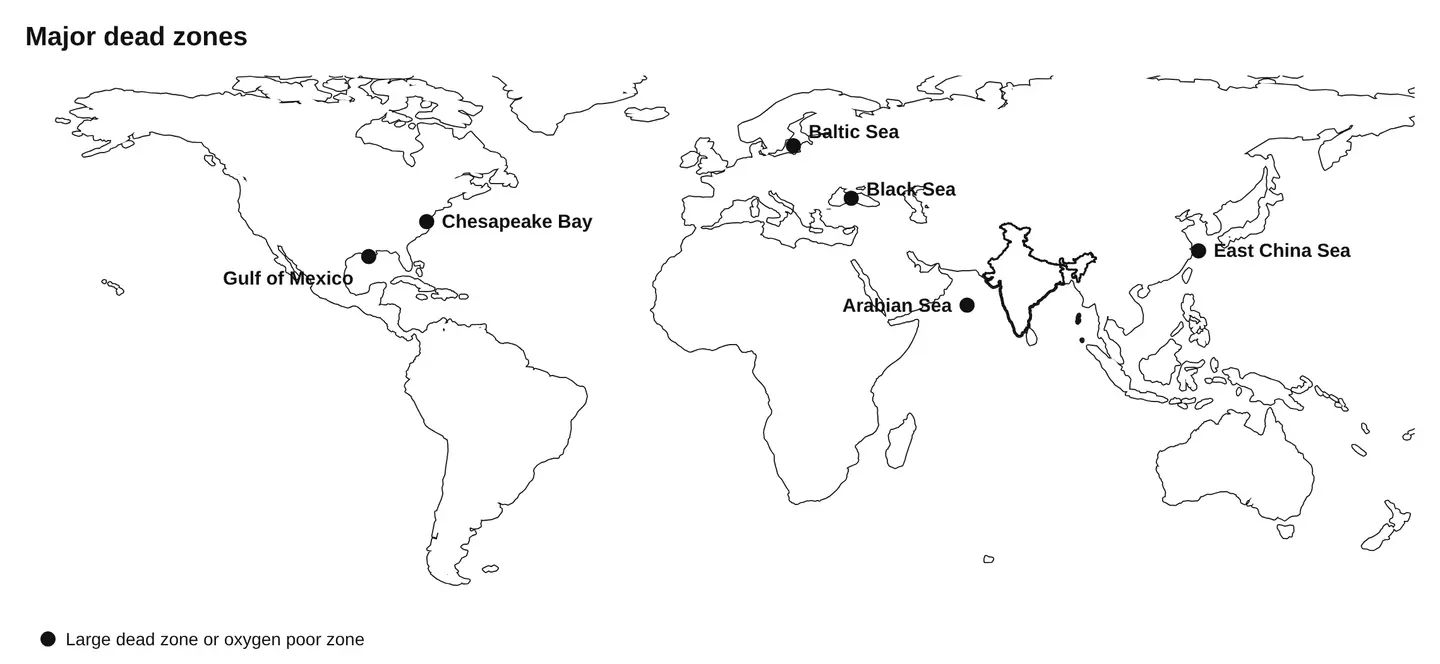
Mass deaths: Fish, crabs and other animals that cannot escape suffocate.
Lost habitat: Mobile species flee, crowding into smaller areas where they are easier to overfish.
Changed food webs: Jellyfish and microbes replace fish.
Fisheries loss: Shrimp catches suffer in the Gulf of Mexico, hurting coastal livelihoods.
Toxic gases: Low oxygen water releases hydrogen sulphide and nitrous oxide, a greenhouse gas.
India's concern: The Arabian Sea holds one of the world's largest oxygen poor zones.
The Black Sea recovered partly when fertiliser use fell, showing dead zones can be reversed.
Dead zones turn rich seas into empty water, and cutting nutrient runoff is the surest cure.
Show how the answer was builtHide how the answer was built
Decode
Explain the consequences of dead zones for marine ecosystems.
Implicit demand
The examiner wants the cause in brief and varied consequences.
Architecture
A definition, a sketch, six consequences, a hopeful example, then a verdict.
Articulation
The Arabian Sea links the answer to India. Money line: cutting nutrient runoff.
Show value added materialHide value added material
Facts
The Baltic Sea holds one of the largest dead zones.
Baltic Sea Action Plan, 2007.
Oxygen below about 2 milligrams per litre defines hypoxia.