

25 Nov 2026GS1Revision
Revision: the whole GS1 paper
Questions you have written before will appear here. That is by design. Writing an answer a second time, after reading the model answer, is the point of the day.
Previous year questions
10 as set1 · GS1 202315 marks250 words
Identify and discuss the factors responsible for diversity of natural vegetation in India. Assess the significance of wildlife sanctuaries in rain forest regions of India.
Show the model answerHide the model answer
India's vegetation ranges from evergreen rain forests to thorn scrub, mangroves and alpine meadows. This diversity follows a few clear geographical factors.
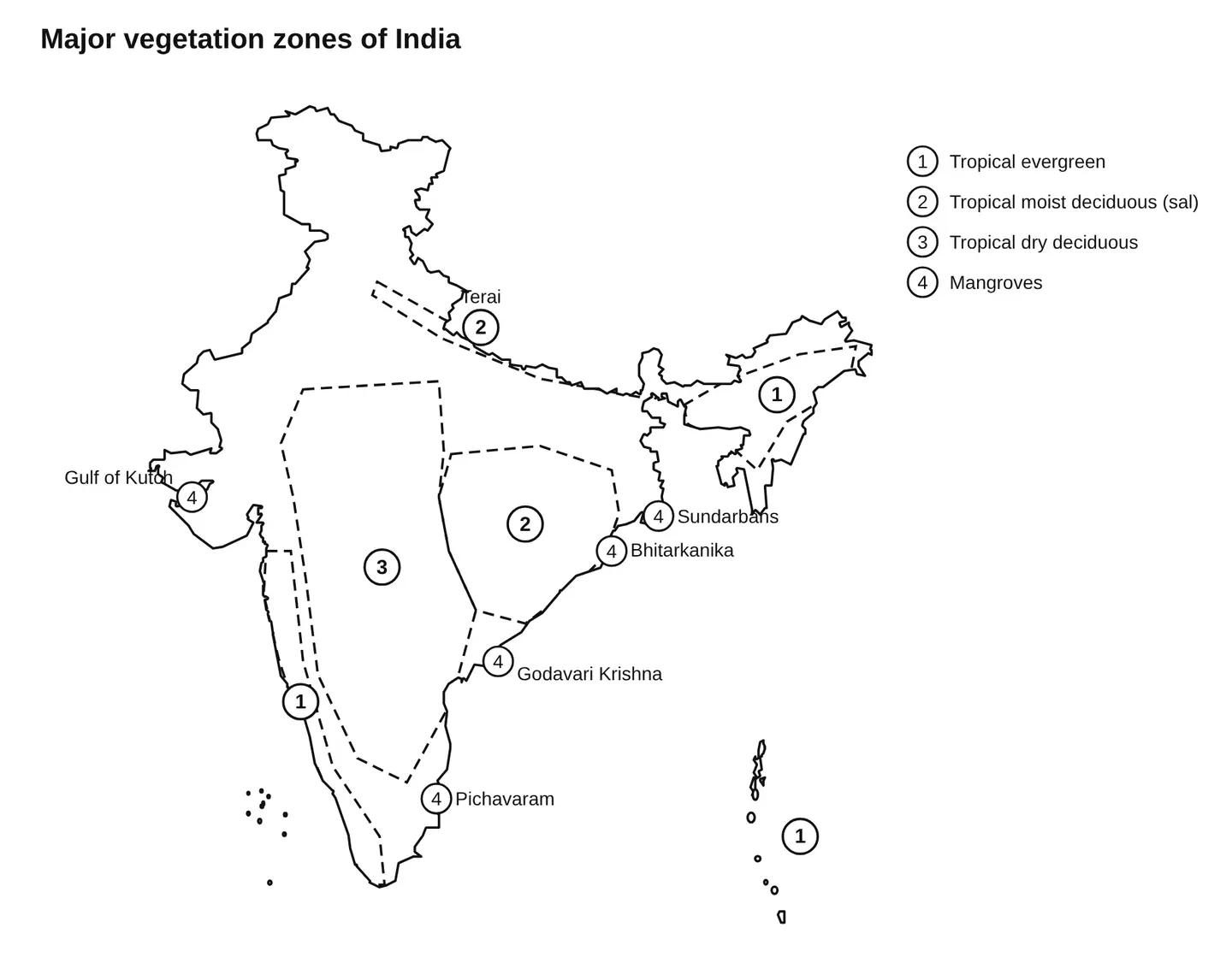
Factors behind the diversity
Rainfall: Areas with over 200 cm of rain carry evergreen forests. Drier areas grade into deciduous forests and, below 50 cm, thorn scrub.
Altitude: The Himalaya rise from tropical forests at their foot to alpine meadows near the snowline.
Temperature: Cold limits trees in Ladakh, while heat and moisture favour dense growth in the south and east.
Soil: Saline coastal soils support mangroves in the Sundarbans, and laterite supports hardy species.
Human use: Clearing, grazing and plantations have replaced natural forest in many regions.
Significance of sanctuaries in rain forests
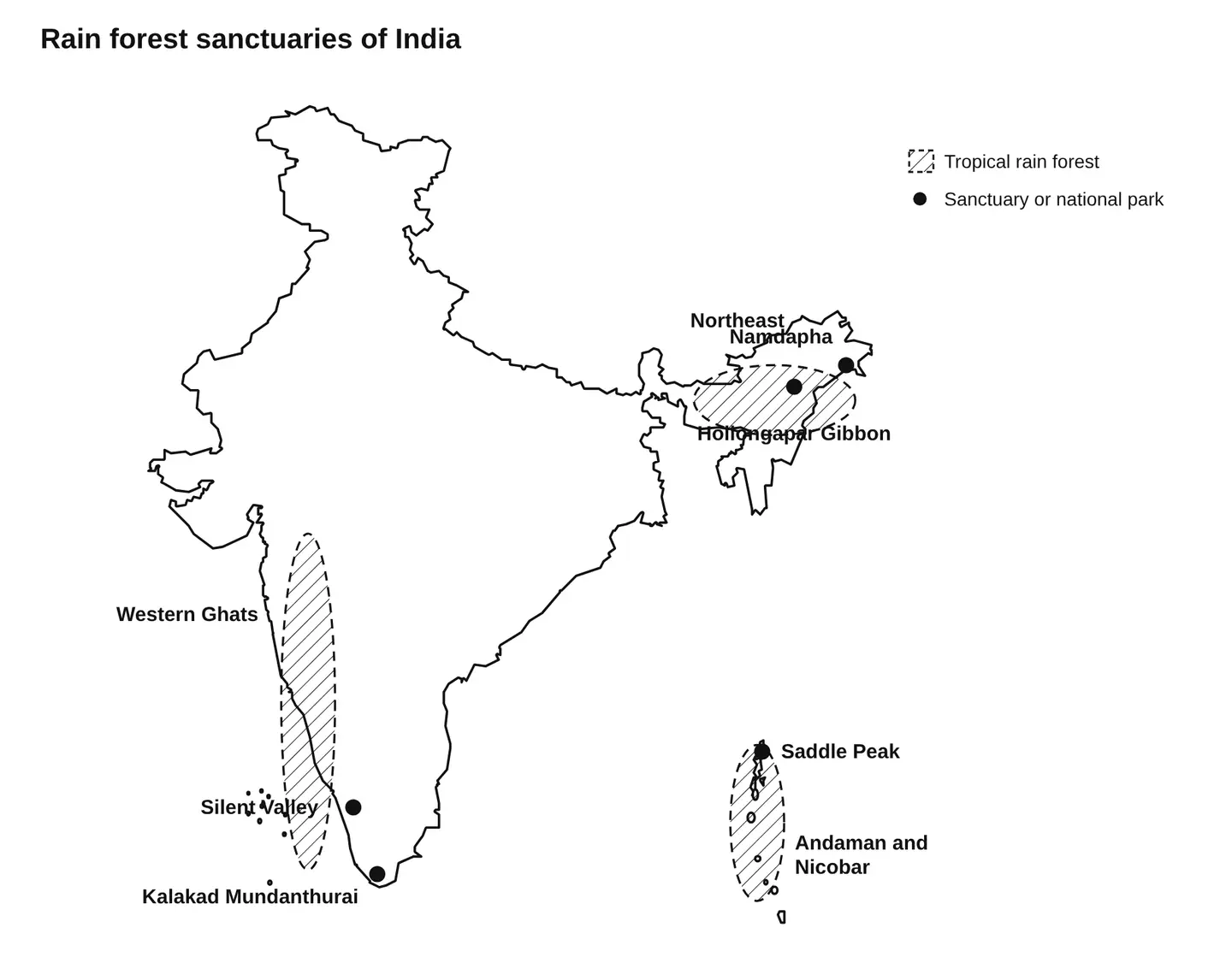
Biodiversity hotspots: The Western Ghats and the Northeast hold many endemic species, such as the lion tailed macaque in Silent Valley and the hoolock gibbon in Assam.
Water towers: Rain forests in the Ghats feed rivers such as the Kaveri and Krishna.
Carbon and climate: Dense forests store carbon and help sustain local rainfall.
Genetic wealth: Forest plants yield medicines, as the Kani tribe's knowledge of arogyapacha showed.
Livelihoods and tourism: Well managed sanctuaries support ecotourism and forest communities.
Fragmentation, plantations and encroachment threaten them. Wildlife corridors and community conservation can strengthen protection.
India's vegetation reflects its climate and relief, and its rain forest sanctuaries guard its richest living wealth.
Show how the answer was builtHide how the answer was built
Decode
Identify factors behind vegetation diversity and assess rain forest sanctuaries.
Implicit demand
The examiner wants clear geographic factors, then the value of sanctuaries with examples.
Architecture
An introduction, a sketch, five factors, five significances, threats, then a verdict.
Articulation
Silent Valley anchors the second part. Money line: richest living wealth.
Show value added materialHide value added material
Facts
Western Ghats and Indo Burma are global biodiversity hotspots.
Hollongapar Gibbon Sanctuary in Assam.
Forest Survey of India's State of Forest Report.
2 · GS1 202010 marks150 words
Do you agree that regionalism in India appears to be a consequence of rising cultural assertiveness? Argue.
Show the model answerHide the model answer
Demands such as Kannada signboards in Bengaluru suggest cultural pride drives regionalism. That is only part of the story.
Where cultural assertion drives it
Language: The anti Hindi agitation (1965) and the demand for Andhra State in 1953 grew from linguistic pride.
Ethnic identity: Movements for Gorkhaland and Bodoland assert distinct identities.
Regional parties: Parties such as the Dravida Munnetra Kazhagam built their base on cultural pride.
Where other forces drive it
Economic neglect: Telangana was formed in 2014 over water, jobs and funds, not language.
Jobs and migration: Sons of the soil politics reflects job competition, as in Haryana's 2020 law reserving private jobs for locals.
Centre state tensions: Southern states object to fund sharing based on population, and disputes over powers fuel regional grievance.
Cultural assertion is often the language of regionalism, but economic grievance is usually its engine.
Show how the answer was builtHide how the answer was built
Decode
Argue whether regionalism is mainly cultural assertion.
Implicit demand
The examiner wants a stand with evidence on both sides.
Architecture
An introduction, three cultural drivers, three other drivers, then a verdict.
Articulation
Telangana shows a non cultural case. Money line: language versus engine.
Show value added materialHide value added material
Facts
Sarkaria Commission, 1988.
Punchhi Commission, 2010.
Assam Movement, 1979 to 1985.
3 · GS1 202315 marks250 words
Does urbanization lead to more segregation and/or marginalization of the poor in Indian metropolises?
Show the model answerHide the model answer
Indian metropolises are engines of opportunity, yet the poor often live at their margins. Whether urbanisation segregates them depends on how cities are planned and governed.
How it segregates and marginalises
Slums: A large share of Mumbai's people live in informal settlements with poor water and sanitation.
Eviction to the edge: Resettlement colonies such as Savda Ghevra in Delhi and Perumbakkam in Chennai lie far from jobs.
Gated enclaves: Gated communities and malls privatise space and separate classes.
Informal work: Most urban poor work without social security, as the migrant exodus of 2020 exposed.
Environmental risk: The poor live on floodplains and near landfills, facing the worst floods and pollution.
Caste and religion: Housing discrimination creates religious and caste ghettos, as in Ahmedabad.
Why it is not inevitable
Mobility: Cities offer higher wages, schools and anonymity that weakens caste control.
Inclusive policy: Pradhan Mantri Awas Yojana Urban (2015), the Street Vendors Act (2014) and One Nation One Ration Card (2019) extend rights.
In situ upgrading: Odisha's Jaga Mission (2017) gives slum dwellers land rights where they live.
Urbanisation itself does not segregate the poor, but cities planned without them do.
Show how the answer was builtHide how the answer was built
Decode
Judge whether urbanisation segregates and marginalises the urban poor.
Implicit demand
The examiner wants evidence of exclusion and of opportunity, with a clear stand.
Architecture
An introduction, six forms of exclusion, three counterpoints, then a verdict.
Articulation
Savda Ghevra and Jaga Mission show both outcomes. Money line: cities planned without them.
Show value added materialHide value added material
Facts
Affordable Rental Housing Complexes, 2020.
PM SVANidhi, 2020, for street vendors.
Census 2011 counted about 6.5 crore slum dwellers.
4 · GS1 202210 marks150 words
Why did the armies of the British East India Company – mostly comprising of Indian soldiers – win consistently against the more numerous and better equipped armies of the then Indian rulers? Give reasons.
Show the model answerHide the model answer
At Plassey (1757) and Assaye (1803), small Company forces defeated much larger Indian armies. Indian soldiers fought on both sides, so the difference lay elsewhere.
Discipline and pay: Company sepoys were drilled daily and paid regularly, which built loyalty. Indian armies were often unpaid and loyal to chiefs.
Unified command: European officers led a single chain of command. Indian armies were feudal levies under rival nobles.
Tactics and artillery: Infantry volleys, coordinated artillery and disciplined squares beat cavalry charges.
Money: Bengal's revenue after 1765 and Indian bankers' credit funded long wars.
Disunity and diplomacy: The Company used rivalries, bribes and the subsidiary alliance, as with Mir Jafar at Plassey.
Sea power: Naval control kept supplies and reinforcements flowing.
The Company won through organisation, money and Indian disunity more than through numbers or weapons.
Show how the answer was builtHide how the answer was built
Decode
Explain why Company armies won against larger Indian armies.
Implicit demand
The examiner wants organisational, financial and political reasons with examples.
Architecture
An introduction, six reasons, then a verdict.
Articulation
Regular pay explains sepoy loyalty. Money line: organisation, money and disunity.
Show value added materialHide value added material
Facts
Battle of Buxar, 1764.
Tipu Sultan and Ranjit Singh modernised their armies but still lost.
Subsidiary alliance under Lord Wellesley.
5 · GS1 202210 marks150 words
How will you explain that medieval Indian temple sculptures represent the social life of those days?
Show the model answerHide the model answer
Medieval temple walls are more than religious art. Sculptors carved the life of their own times around the gods.
Daily life: Khajuraho shows women writing letters, applying make up and playing with children.
Music and dance: Chola temples such as Thanjavur depict dance postures, and the Hoysala bracket figures at Belur show dancers and musicians.
War and royalty: Friezes at Halebidu show elephants, horses and battle scenes, reflecting military culture.
Trade and foreigners: The Hazara Rama temple at Hampi shows horse traders and processions of the Mahanavami festival.
Dress and ornaments: Sculptures record hairstyles, jewellery and clothing across regions.
Love and society: Konark and Khajuraho depict couples openly, showing a frank view of human life.
These images idealise elite life, so they show courts and towns more than villages.
Temple sculpture is medieval India's visual diary, carved in stone.
Show how the answer was builtHide how the answer was built
Decode
Explain how temple sculpture reflects medieval social life.
Implicit demand
The examiner wants named temples linked to aspects of society.
Architecture
An introduction, six aspects with temples, a limit, then a verdict.
Articulation
Each point pairs a site and a social theme. Money line: a visual diary.
Show value added materialHide value added material
Facts
Konark Sun Temple, Eastern Ganga dynasty.
Hoysala temples at Belur and Halebidu.
Chidambaram gopurams depict dance postures of the Natya Shastra.
6 · GS1 201710 marks150 words
What problems were germane to the decolonization process in the Malay Peninsula?
Show the model answerHide the model answer
British Malaya moved to independence in 1957, but the path was troubled by war, ethnic division and regional rivalry.
Shaken authority: The Japanese occupation of 1942 to 1945 broke British prestige and stirred nationalism.
Malayan Union (1946): It reduced the sultans' power and offered equal citizenship to non Malays. Malay protests formed the United Malays National Organisation, and the plan was dropped.
Communist insurgency: The Malayan Emergency (1948 to 1960) saw a mostly Chinese communist revolt, and the British resettled villagers into guarded camps.
Plural society: Malays, Chinese and Indians had different economic roles. The Alliance bargain traded citizenship for non Malays against special status for Malays.
Singapore and Malaysia: Singapore joined Malaysia in 1963 but left in 1965 after racial tensions.
Regional opposition: Indonesia opposed Malaysia's formation through Konfrontasi.
Malaya's decolonisation was a struggle to build one nation from many communities.
Show how the answer was builtHide how the answer was built
Decode
Identify the problems in Malaya's decolonisation.
Implicit demand
The examiner wants political, ethnic, security and regional problems.
Architecture
An introduction, six problems, then a verdict.
Articulation
The Malayan Union shows the ethnic knot. Money line: one nation from many communities.
Show value added materialHide value added material
Facts
Malaya became independent on 31 August 1957.
Briggs Plan created New Villages.
Lee Kuan Yew led Singapore after 1965.
7 · GS1 202415 marks250 words
The groundwater potential of the gangetic valley is on a serious decline. How may it affect the food security of India?
Show the model answerHide the model answer
The Indo Gangetic plain grows much of India's wheat and rice. Its alluvial aquifers are falling fast, especially in Punjab, Haryana and western Uttar Pradesh, where pumping far exceeds recharge.
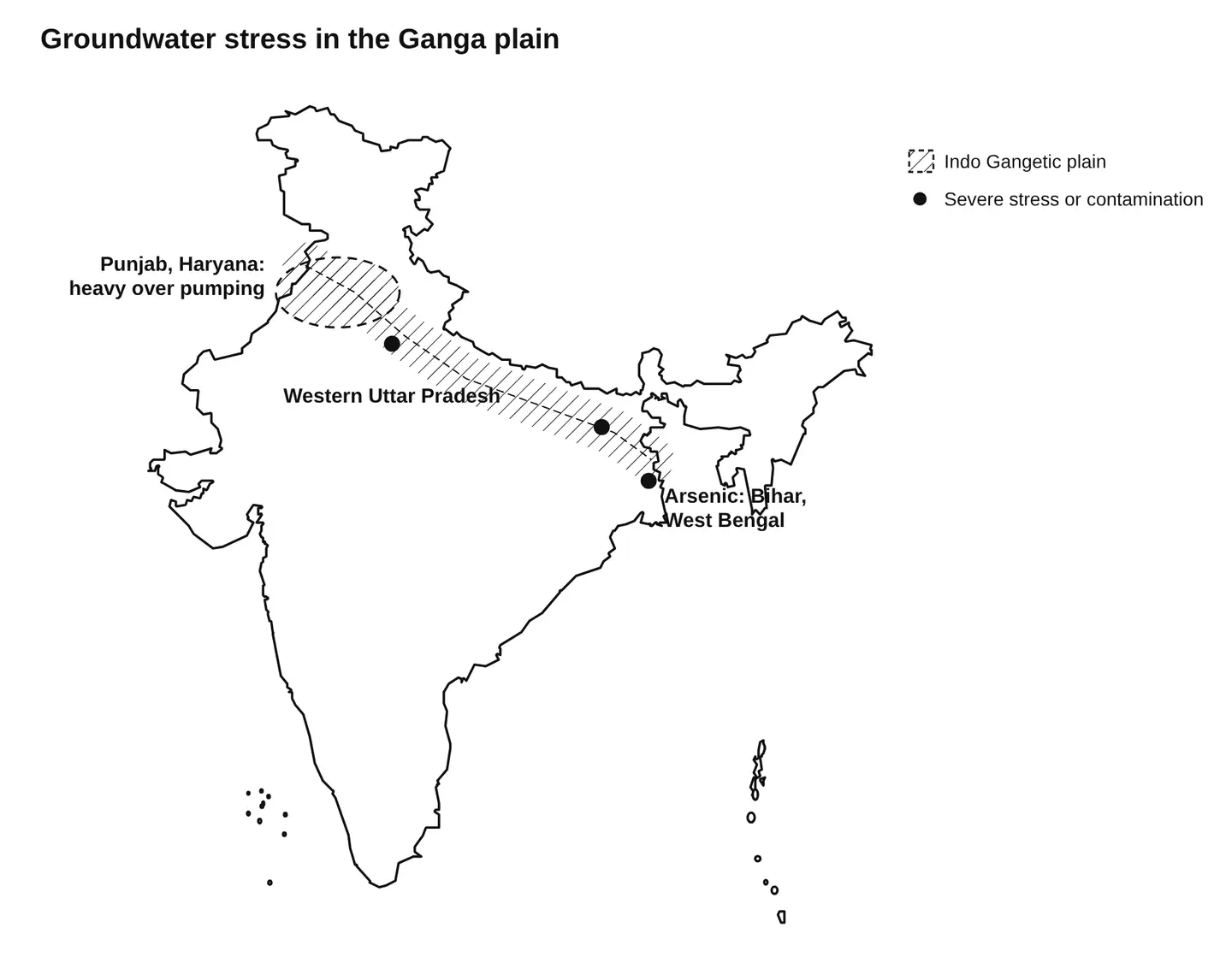
Why groundwater is falling
Rice and wheat cycle: Paddy needs huge water, and assured procurement keeps farmers growing it.
Free power: Cheap electricity encourages tubewells to run for long hours.
Less recharge: Paved cities and erratic monsoons reduce natural recharge.
Effects on food security
Central pool at risk: Punjab and Haryana supply a large share of the grain for the public distribution system, which serves crores under the National Food Security Act (2013).
Falling yields: Groundwater irrigates most of the rabi crop. Dry wells mean lower wheat output.
Rising costs: Deeper borewells raise costs, pushing small farmers into debt.
Poisoned water: Arsenic in Bihar and West Bengal enters rice and harms health.
Less buffer: Heatwaves and failed monsoons hurt more when groundwater cannot cushion them.
Way forward
Crop diversification, direct seeded rice, micro irrigation and metered solar pumps can save water. Atal Bhujal Yojana (2019) builds community groundwater management.
India's food security rests on aquifers it is emptying, so saving groundwater is saving the grain bowl.
Show how the answer was builtHide how the answer was built
Decode
Explain how falling groundwater in the Gangetic plain threatens food security.
Implicit demand
The examiner wants causes in brief and specific effects on food supply.
Architecture
An introduction, a sketch, three causes, five effects, a way forward, then a verdict.
Articulation
The central pool links the region to national food security. Money line: saving the grain bowl.
Show value added materialHide value added material
Facts
Punjab Preservation of Subsoil Water Act, 2009.
Pradhan Mantri Krishi Sinchayee Yojana, 2015.
Satellite data show steep groundwater loss in northwest India.
8 · GS1 202515 marks250 words
Discuss how the changes in shape and sizes of continents and ocean basins of the planet take place due to tectonic movements of the crustal masses.
Show the model answerHide the model answer
Continents and oceans are not fixed. The rigid lithosphere is broken into plates that move a few centimetres a year over the softer asthenosphere. Mantle convection, ridge push and slab pull drive them.
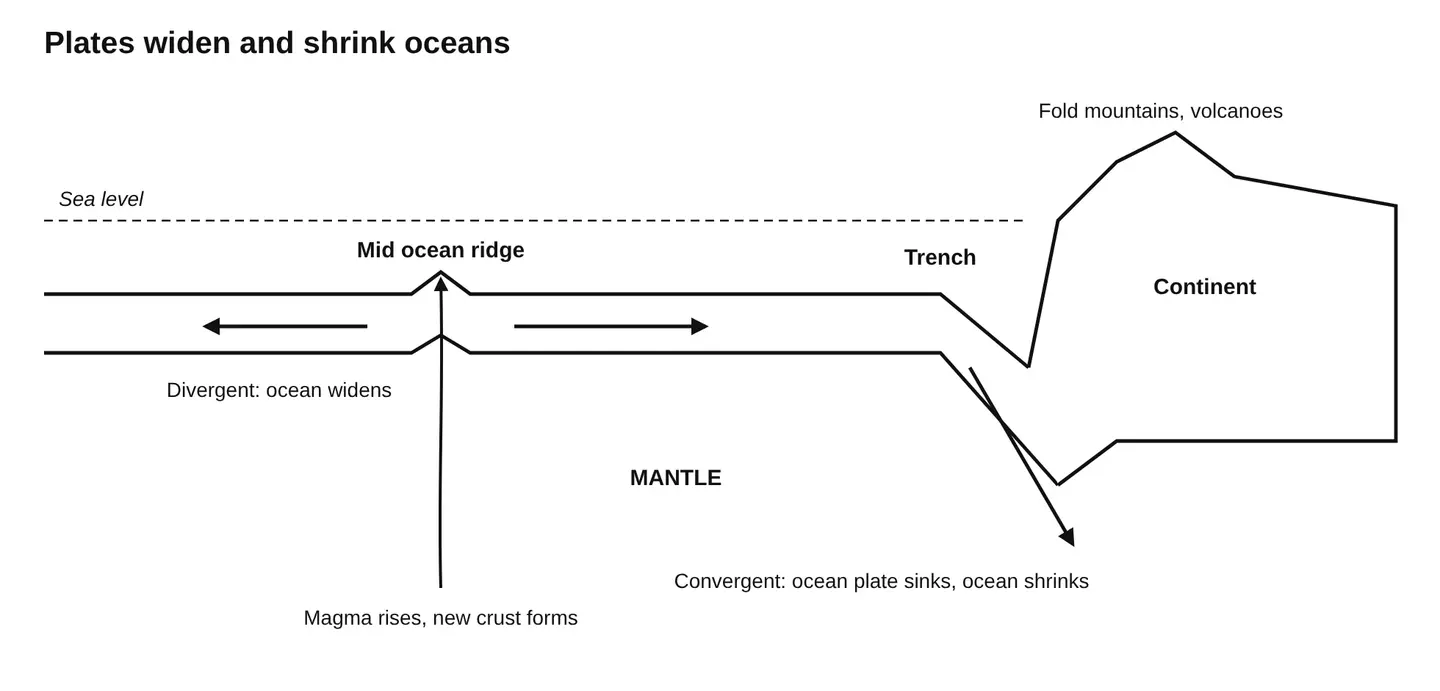
Divergent boundaries widen oceans
Sea floor spreading: Magma rises at mid ocean ridges and forms new crust. The Atlantic widens by a few centimetres a year.
New oceans: Continents split at rift valleys. The Red Sea is a young ocean, and the East African Rift may form one.
Convergent boundaries shrink oceans and build continents
Subduction: Ocean crust sinks at trenches such as the Mariana, so the Pacific is slowly shrinking.
Collision: When continents meet, they weld together. India's collision with Asia closed the Tethys Sea and raised the Himalaya.
Growth by accretion: Island arcs and fragments add new land to continental edges.
Transform boundaries
Plates slide past each other, as along the San Andreas Fault, shifting shapes without creating or destroying crust.
The long cycle
About 300 million years ago, all continents formed Pangaea. It broke into Laurasia and Gondwana, and India drifted north. Today Africa pushes towards Europe, closing the Mediterranean.
Plate movements constantly redraw the world map, opening some oceans while closing others.
Show how the answer was builtHide how the answer was built
Decode
Discuss how plate movements reshape continents and oceans.
Implicit demand
The examiner wants each boundary type linked to changes in shape and size.
Architecture
An introduction, a diagram, divergent, convergent and transform effects, the long cycle, then a verdict.
Articulation
Atlantic, Pacific and Tethys show growth, shrinking and closing. Money line: redraw the world map.
Show value added materialHide value added material
Facts
Alfred Wegener proposed continental drift in 1912.
Harry Hess proposed sea floor spreading.
Glossopteris fossils link Gondwana continents.
9 · GS1 201910 marks150 words
Can the strategy of regional resource-based manufacturing help in promoting employment in India?
Show the model answerHide the model answer
Regional resource based manufacturing means making goods close to local raw materials and skills. It can create jobs where people live.
How it promotes employment
Agro processing: Dairy at Anand, cashew in Kerala and fruit processing employ lakhs of rural workers.
Textile clusters: Tiruppur grew on the cotton belt and employs many women.
Crafts: Brass in Moradabad and handlooms use local skills. The One District One Product scheme (2018) builds on them.
Forest and marine produce: Bamboo in the Northeast and fish processing on the coasts add value locally.
Less distress migration: Local jobs reduce the need to move to crowded cities.
Limits
Mineral industries such as steel employ few people for their capital. Poor roads, power and credit also hold clusters back.
Resource based manufacturing creates jobs only when clusters get infrastructure, skills and markets.
Show how the answer was builtHide how the answer was built
Decode
Judge whether regional resource based manufacturing can create jobs.
Implicit demand
The examiner wants examples by sector and honest limits.
Architecture
An introduction, five ways, limits, then a verdict.
Articulation
Anand and Tiruppur make the case. Money line: infrastructure, skills and markets.
Show value added materialHide value added material
Facts
PM Formalisation of Micro Food Processing Enterprises scheme, 2020.
National Bamboo Mission.
Mega Food Parks scheme.
10 · GS1 201810 marks150 words
“Caste system is assuming new identities and associational forms. Hence, caste system cannot be eradicated in India.” Comment.
Show the model answerHide the model answer
Caste has changed form rather than disappeared. Yet change in form is not proof that it can never end.
New identities and associations
Caste associations: Caste sabhas and federations act as pressure groups for education and jobs.
Political mobilisation: Parties use caste as a vote bank, and groups such as Jats and Marathas agitate for reservation.
Digital caste: Matrimonial sites and social media groups keep endogamy alive.
Why eradication is still possible
Ritual hierarchy is weakening: Purity rules on food, touch and occupation have faded, especially in cities.
Law and assertion: The Scheduled Castes and Scheduled Tribes (Prevention of Atrocities) Act (1989) and Dalit movements challenge oppression.
Mixing: Education, urban jobs and growing inter caste marriages loosen caste walls.
Caste is shifting from hierarchy to identity, and ending it needs equal opportunity and mixing, not just time.
Show how the answer was builtHide how the answer was built
Decode
Comment on whether caste's new forms make it impossible to eradicate.
Implicit demand
The examiner wants the new forms and a reasoned rebuttal of the conclusion.
Architecture
An introduction, three new forms, three reasons for hope, then a verdict.
Articulation
Hierarchy versus identity is the key distinction. Money line: equal opportunity and mixing.
Show value added materialHide value added material
Facts
M. N. Srinivas on dominant caste and Sanskritisation.
Dr Ambedkar Scheme for Social Integration through Inter Caste Marriages.
Bihar caste survey, 2023.