

First Principles IAS · Current affairs
The monthly magazine, June 2026 · Social Issues › Fertility, ageing and migration
Printed on · firstprinciplesias.com/current-affairs
India's declining fertility: below replacement and what follows
LeadPrelims and Mains30 Jun 2026
Why in news
- The Sample Registration System (SRS) Statistical Report 2024, released on 20 May 2026 by the Office of the Registrar General of India, put India's total fertility rate at 1.9 for the second year running, below the replacement level of 2.1.
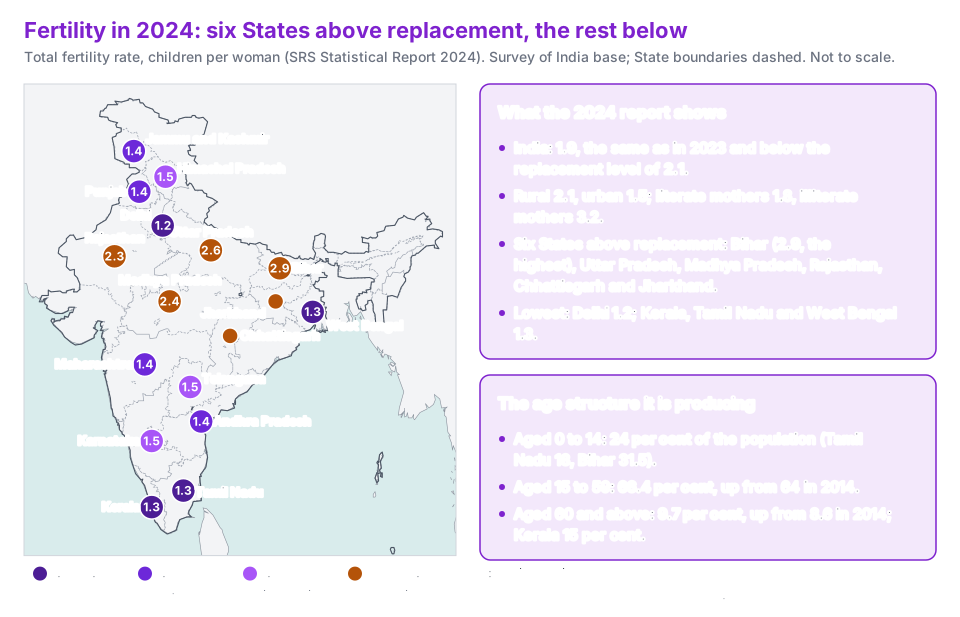
- All but six States, all in the north, are now below replacement; Bihar is the highest at 2.9 and Delhi the lowest at 1.2.
- The report's age tables show the other side of the same change: the share of children is falling and the share of people aged 60 and above is rising in every State.
- The numbers, debated through June, set the terms for two arguments that follow in the year: how seats are shared among the States, and whether the population programme should change course.
- 1.9India's total fertility rate in 2024, the same as in 2023; 2.0 in 2020 to 2022
- Rural 2.1, urban 1.5
- 2.9Bihar, the highest; 1.2: Delhi, the lowest
- 3.2 and 1.8the rate for illiterate and for literate mothers
- 9.7 per centthe share aged 60 and above, up from 8.6 per cent in 2014
Background
- The total fertility rate is the number of children a woman would have over her life at the present age specific rates. At about 2.1 a population replaces itself in the long run; below it each generation is smaller than the last, once the age structure settles.
- The SRS, run by the Registrar General since 1970, is a large demographic survey of a sample of villages and urban blocks and is the main annual source of birth, death and fertility rates for India and the States.
- India's family planning programme began in 1952, the first national programme of its kind. The National Population Policy, 2000 set replacement fertility as its medium term goal for 2010; the country reached it about a decade later.
- National rates have fallen from 5.2 in 1971 to 3.6 in 1991 and 1.9 in 2024; rural rates from 5.4 to 2.1 and urban rates from 4.1 to 1.5 over 1971 to 2024.
Where the States stand
- Above replacement: Bihar (2.9), Uttar Pradesh (2.6), Madhya Pradesh (2.4), Rajasthan (2.3), Chhattisgarh and Jharkhand.
- Lowest: Delhi (1.2); Kerala, Tamil Nadu and West Bengal (1.3); Andhra Pradesh, Jammu and Kashmir, Maharashtra and Punjab (1.4); Himachal Pradesh, Karnataka and Telangana (1.5).
- Fastest falls over 2012-14 to 2022-24: Delhi (29.4 per cent), Gujarat (25 per cent) and Tamil Nadu (23.5 per cent). Slowest: Bihar (9.4 per cent, from 3.2 to 2.9) and Chhattisgarh (11.5 per cent).
- Urban rates are lower than rural ones in almost every major State; Kerala, where urban fertility is higher, and Tamil Nadu, where the two are equal, are the exceptions.
- Institutional deliveries reached 95.4 per cent of births in 2024.
The age structure that follows
- Children aged 0 to 14 are 24 per cent of the population, from 18 per cent in Tamil Nadu to 31.5 per cent in Bihar.
- The working age share, 15 to 59, is 66.4 per cent, up from 64 per cent in 2014, and still rising even in the States with the lowest fertility.
- People aged 60 and above rose from 8.6 to 9.7 per cent between 2014 and 2024, in every State. Kerala has the highest share at 15 per cent; Tamil Nadu had the largest rise, from 10.6 to 14.2 per cent; Assam has the lowest at 7.6 per cent.
- India is therefore in its demographic dividend years, with a large working age share, but the dividend is unequal: the southern States are already ageing, while the northern States still have the youngest populations.
Why it matters
- Representation: seats in the Lok Sabha are frozen on the 1971 Census until the first census after 2026. The States that brought fertility down fastest fear that a redistribution by population will cost them seats, which is the dispute the Tamil Nadu resolution of August 2026 took to the Union.
- Federal finance: population is a weight in the Finance Commission's formula, so the same shift moves money as well as seats.
- Labour and migration: a young north and an ageing south mean that workers will keep moving south and west, and that services in the south must plan for the old rather than the young.
- Policy instruments: incentives and disqualifications built to bring births down are still in force in States where fertility is already far below replacement.
Analysis
- The headline is settled; the distribution is the story. A national rate of 1.9 averages Bihar at 2.9 with Delhi at 1.2, and almost every policy question, from seats to schools to pensions, turns on that gap rather than on the average.
- Education explains more than region. A rate of 3.2 for illiterate mothers against 1.8 for literate ones says that the fall follows girls' schooling, which is why the northern States' rates are coming down, slowly, as their enrolment rises.
- Ageing has arrived before prosperity in the south. Kerala and Tamil Nadu have the age structures of much richer countries, with a seventh of their people over 60, and their care and pension systems were not built for it.
- The old programme is aimed at the wrong target. Where fertility is 1.3, sterilisation incentives and two child norms spend public money to push a number that is already low; the services the programme also runs, spacing, contraception, safe delivery, remain worth funding everywhere.
- For a Mains answer: treat the fall as success with costs, separate the national rate from the State picture, and link it to the three decisions it forces: seats, money and care.
The way forward
- Re-aim family planning at the high fertility districts of the six northern States, through girls' education and reproductive health services rather than targets.
- Review incentives and disqualifications that reward small families in States already below replacement.
- Plan for ageing in the southern States now: pensions, geriatric care and the care workforce.
- Settle the representation question by consensus before the next census is published, so that the States that met the national goal are not penalised for it.
Schemes to know
Mission Parivar Vikas (2016, Ministry of Health and Family Welfare)
- A family planning drive for the high fertility districts, launched in 146 districts of seven States: Bihar, Uttar Pradesh, Madhya Pradesh, Rajasthan, Chhattisgarh, Jharkhand and Assam.
- Extended in 2021 to all districts of those seven States and six North Eastern States.
- Tools: the Nayi Pahel kit for newly married couples, Saas Bahu Sammelans and a wider basket of contraceptives, including the injectable Antara.
Pradhan Mantri Matru Vandana Yojana (2017; PMMVY 2.0 from April 2022, Ministry of Women and Child Development)
- ₹5,000 in two instalments for the first living child.
- ₹6,000 in one instalment for a second child if she is a girl.
- Part of the Samarthya vertical of Mission Shakti; paid to an Aadhaar linked account.
National Programme for Health Care of the Elderly (2010-11, Ministry of Health and Family Welfare)
- Geriatric outpatient clinics, ten bed geriatric wards and physiotherapy in district hospitals; covers all 713 health districts.
Exam lens
- Prelims: SRS Statistical Report 2024 released by the Registrar General; total fertility rate 1.9 (rural 2.1, urban 1.5); replacement level 2.1; Bihar highest at 2.9, Delhi lowest at 1.2; six States above replacement; 60 and above at 9.7 per cent, Kerala highest at 15 per cent; family planning programme of 1952; National Population Policy, 2000; Mission Parivar Vikas 2016.
- Mains: "India's fertility has fallen below replacement, but its consequences are being decided State by State." Examine the economic, federal and social implications of India's declining fertility.
Asked before: Prelims 2024 · Prelims 2024 · Mains 2026 GS1
Show the questions
- Prelims 2024: The total fertility rate in an economy is defined as:
- Prelims 2024: Consider the following countries: 1. Italy 2. Japan 3. Nigeria 4. South Korea 5. South Africa. Which of the above countries are frequently mentioned in the media for their low birth rates, or ageing population or declining population?
- Mains 2026 GS1: Critically examine the challenges of demographic transition in contemporary India.
Connects to
- Rethinking population policy (Social Issues, September): the EAC-PM's call to end population control incentives, which builds on these figures.
- Delimitation and women's reservation (Polity, August): why the low fertility States watch the seat count.
- Senior care in an ageing India (Social Issues, June): the care the age structure now demands.
Sources
- Down To Earth, 28 May 2026
- The Wire, 24 May 2026
- PIB, 28 October 2025, “Elderly in India”
Settled facts (dates of Acts, constitutional provisions, standing definitions) are from standard references.
Filed under: Fertility, ageing and migration · The monthly magazine, June 2026