

First Principles IAS · Current affairs
The monthly magazine, September 2026 · Social Issues › Fertility, ageing and migration
Printed on · firstprinciplesias.com/current-affairs
Rethinking population policy: the EAC-PM call to end control incentives
LeadPrelims and Mains30 Sep 2026
Why in news
- In September 2026 the Economic Advisory Council to the Prime Minister published a working paper, The Ghost of Population Past: How Population Control Persists in India, which says the machinery built to bring births down is still running after births have fallen below the level needed to replace the population.
- It asks the Centre and the States to withdraw the incentives, awards and disqualifications that reward small families, and to stop speaking of "population stabilisation" in a country that has already stabilised.
- 1.9India's total fertility rate; 2.1 is replacement level
- 1.6the rate excluding Bihar and Uttar Pradesh, the same as the United States and close to Northern Europe's 1.5
- About 29.3 millionbirths at their peak, in 2001; about 23.2 million in 2023, the level of 1974
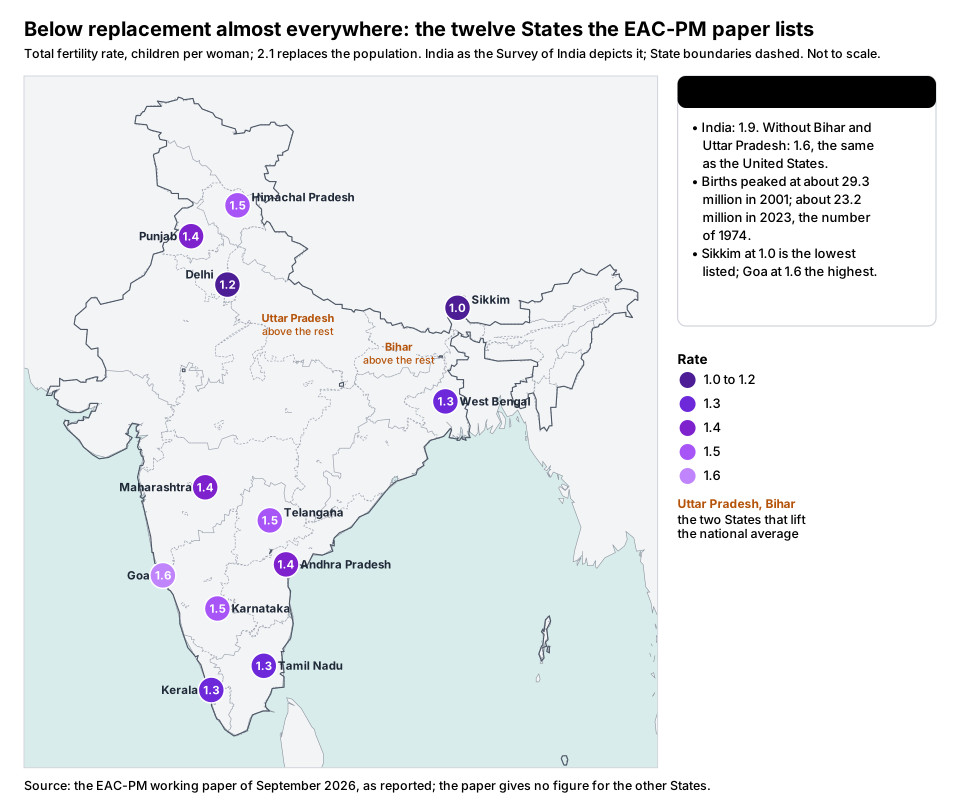
- 1.0 to 1.6the rate in the twelve States and Union Territories the paper lists, from Sikkim at 1.0 to Goa at 1.6
Background
- India's family planning programme began in 1952, the first in the world. The National Population Policy of 2000 set replacement fertility as the goal for 2010. The country reached it a decade late and has since gone past it.
- The programme's instruments survive from the years of high fertility: compensation for sterilisation, paid through direct benefit transfer; a payment to ASHA workers for couples who stop at two children; awards to districts and workers for family planning performance; a Vasectomy Fortnight and World Population Day observances; and Mission Parivar Vikas, which was built for the high fertility districts of seven States.
- Several States bar people with more than two children from panchayat and municipal office, government jobs or welfare, under laws passed in the 1990s and 2000s.
What the paper says
- Fertility has fallen in every region. The twelve States and Union Territories it lists are all below 1.6: Sikkim 1.0; Delhi 1.2; Kerala, Tamil Nadu and West Bengal 1.3; Andhra Pradesh, Punjab and Maharashtra 1.4; Telangana, Karnataka and Himachal Pradesh 1.5; Goa 1.6.
- Births peaked at about 29.3 million in 2001 and were about 23.2 million in 2023, the number India recorded in 1974. The absolute count of children is falling, not only the rate.
- A programme that pays people to have fewer children, in a State where women already have fewer than 1.5, is spending public money to push a number that is already too low.
What it recommends
- End sterilisation linked incentives in the States that are below replacement, and roll back the direct benefit transfer payments for sterilisation.
- Drop the ASHA incentive for the two child family.
- Discontinue the family planning awards, World Population Day and Vasectomy Fortnight as performance events.
- Repeal the two child norm disqualifications in every State that has them.
- Re-work Mission Parivar Vikas for the districts that still have high fertility, rather than running it as a national programme.
- Remove "stabilisation" from the vocabulary of policy.
Why it matters
- Very low fertility has proved hard to reverse wherever it has arrived. Policy made now decides whether India's large States follow South Korea and Japan, where the working age population is already shrinking, or settle close to replacement.
- The question is tied to the census and delimitation that the Polity lead covers: the States with the lowest fertility are the ones that fear losing seats in Parliament for having succeeded at the old policy.
- An ageing South and a young North is a federal problem before it is a demographic one: pensions, migration and the finance commission's formula all turn on it.
Analysis
- The paper's strength: it argues from numbers nobody disputes, a fertility rate of 1.9 (1.6 without the two largest States) and births back at the level of fifty years ago.
- Its difficulty: it reads a national average over a country with Bihar at one end and Sikkim at the other, while the policy it attacks was always run State by State.
- The sensible middle: end the incentives where fertility is below replacement and keep the services, contraception, spacing and safe delivery, everywhere, since those are health measures, not population measures.
- "Pro natal" needs care: the paper asks India to stop pushing down, not to start pushing up, and East Asian experience is that cash for babies moves the rate very little.
- What would move it: maternity protection that reaches the informal worker, crèches that function, and a labour market that does not make a child the end of a career. The best answer links the three.
The way forward
- A Centre and State review of every family planning incentive, with a sunset for each in States below replacement.
- A national position on the two child norm laws, which the Centre can lead by example in central schemes.
- Shift the Population Division's targets from fertility to the health outcomes that were always the point: maternal mortality, spacing, the unmet need for contraception.
- Prepare for the age structure that is coming: the June lead's ageing agenda, from pensions to care.
Schemes to know
Mission Parivar Vikas (2016)
- The Health Ministry's family planning drive for the high fertility districts, 146 districts in seven States at launch (Bihar, Uttar Pradesh, Madhya Pradesh, Rajasthan, Chhattisgarh, Jharkhand and Assam), extended in 2021 to all districts of those States and six North Eastern States.
- Its tools are the Nayi Pahel kit for newly married couples, Saas Bahu Sammelans and an expanded contraceptive basket, including the injectable Antara.
- The paper asks for it to be narrowed again to the districts that still need it.
Pradhan Mantri Matru Vandana Yojana (PMMVY 2.0, from April 2022)
- ₹5,000 in two instalments for the first living child and ₹6,000 in one instalment for a second child if she is a girl, paid into an Aadhaar linked account
- Part of the Samarthya vertical of Mission Shakti under the Women and Child Development Ministry.
- It is the one central scheme whose design already leans the way the paper points, toward the second child rather than against it.
NFHS-5 (2019-21)
- Is the survey that recorded the national rate at 2.0 and 31 States and Union Territories at or below replacement; NFHS-6 is the next reading.
Exam lens
- Prelims: total fertility rate 1.9 (1.6 excluding Bihar and Uttar Pradesh); replacement level 2.1; births peaked in 2001 at about 29.3 million; Sikkim 1.0 is the lowest listed; Mission Parivar Vikas began in 2016 in 146 districts of seven States; PMMVY pays ₹5,000 for the first child and ₹6,000 for a second girl child; Javed v. State of Haryana (2003) upheld the two child norm for panchayats.
- Mains: "India's population policy is fighting a war it has already won." Discuss, with reference to the fertility figures and the incentives still in force.
Asked before: Prelims 2024 · Mains 2024 GS1 · Mains 2026 GS1
Show the questions
- Prelims 2024: The total fertility rate in an economy is defined as:
- Mains 2024 GS1: What is the concept of a 'demographic winter'? Is the world moving towards such a situation? Elaborate.
- Mains 2026 GS1: Critically examine the challenges of demographic transition in contemporary India.
Connects to
- India's declining fertility: below replacement and what follows (Social Issues, June): the State by State figures and the ageing agenda this paper builds on.
- Census 2027: caste returns, and the road to delimitation (Polity, September): why the low fertility States watch the seat count.
- Maternity rights beyond the pay slip (Social Issues, September): the policy a pro family turn would need.
Sources
- ThePrint/PTI, 16 September 2026
- Economic Advisory Council to the Prime Minister
- PIB, 11 July 2024, “World Population Day”
- PIB, 6 March 2026, “Foundations of Women Empowerment”
Settled facts (dates of Acts, constitutional provisions, standing definitions) are from standard references.
Filed under: Fertility, ageing and migration · The monthly magazine, September 2026