First Principles IAS · Current affairs
The monthly magazine, July 2026 · Social Issues › Cash transfers and welfare
Printed on · firstprinciplesias.com/current-affairs
Why in news
- On 6 July 2026 the Economic Advisory Council to the Prime Minister published a working paper, Unconditional Women Cash Transfer Programmes in India: Evidence from Maharashtra and Odisha, the first study of the new State schemes that pay women a fixed sum every month with no conditions attached.
- Using the bank accounts of over one lakh women, it found that the money is largely saved, that spending rises modestly, and that the men of the household spend less once the woman has an income of her own.
- It asks the States to keep the schemes, tighten who gets them, and review the amounts against inflation.
- With more than fifteen States now running such schemes at a cost of about ₹1.7 lakh crore a year, the paper lands in the middle of a live argument about whether cash empowers or merely buys votes.
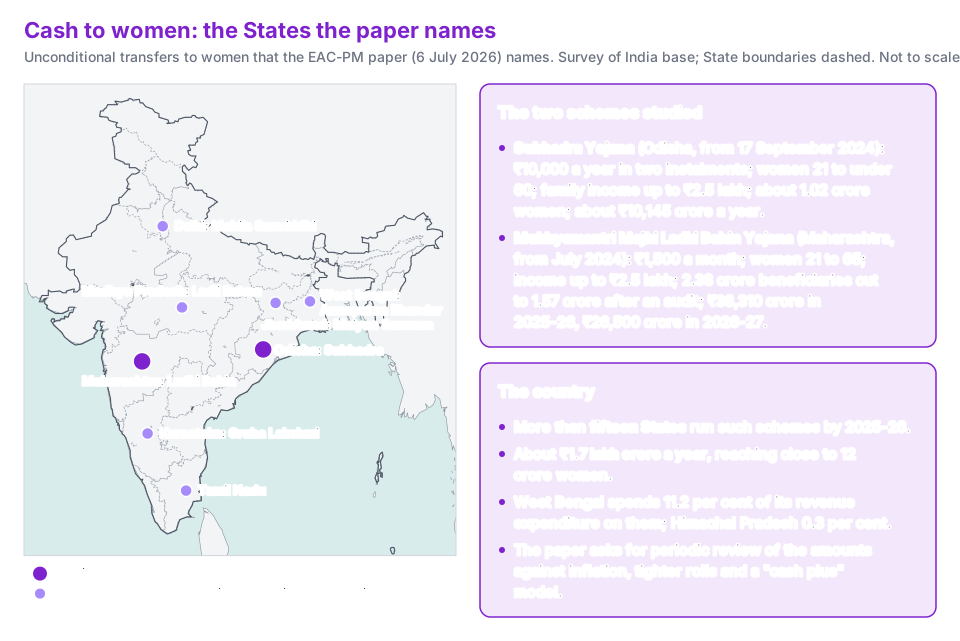
- ₹1,500 a monthMaharashtra's Mukhyamantri Majhi Ladki Bahin Yojana, for women aged 21 to 65 with family income up to ₹2.5 lakh a year
- ₹10,000 a year, in two instalmentsOdisha's Subhadra Yojana, for women aged 21 to under 60; about 1.02 crore beneficiaries by March 2026
- 84 per cent and 45 per centthe rise in month end bank balances of beneficiaries in Maharashtra and Odisha, about ₹6,900 in each
- 46 per cent and 28 per centthe rise in their monthly spending
- 49 per centthe fall in spending by beneficiaries' relatives in Maharashtra
- About ₹1.7 lakh crore a yearwhat over fifteen States spend on such schemes, reaching close to 12 crore women
Background
- Direct cash to women is not new: the Pradhan Mantri Matru Vandana Yojana has paid mothers since 2017, and the Jan Dhan accounts opened since 2014 made a woman's own account the rule.
- What is new since 2023 is the unconditional monthly transfer to every adult woman below an income line, begun by Karnataka's Gruha Lakshmi and Madhya Pradesh's Ladli Behna and copied across the country, usually in the run up to a State election. Maharashtra announced Ladki Bahin in June 2024, months before its Assembly election; Odisha's Subhadra followed the change of government there in 2024.
- By 2025-26 the schemes had become the single largest new item in several State budgets: Maharashtra budgeted ₹38,310 crore, West Bengal ₹36,000 crore and Karnataka ₹28,608 crore; West Bengal spends 11.2 per cent of its revenue expenditure on them.
How the paper measured it
- The authors used account level monthly bank data rather than a survey: 30,861 beneficiaries in Maharashtra over 36 months and 75,750 in Odisha from August 2024, each compared with women just above the income line who did not qualify.
- The two outcomes were the month end balance, a measure of saving, and total monthly withdrawals, a proxy for spending; transaction codes showed what the money bought.
- The method is a difference in differences: the change in beneficiaries' accounts after the scheme began, minus the change in the comparison group's accounts over the same months.
What it found
- Saving first: balances rose by about ₹6,884 in Maharashtra, from a base of ₹8,201, and by about ₹6,887 in Odisha, from ₹15,146. The effect was largest among the least educated women.
- Spending second: monthly spending rose by ₹1,349 in Maharashtra and about ₹1,920 in Odisha. In Maharashtra about 90 paise of every rupee of the transfer was spent over time, the rest saved.
- What it bought: education's share of ATM spending in Maharashtra rose from 18 to 24 per cent; medical spending's share of UPI payments rose from 8 to 10 per cent.
- Inside the household: in Maharashtra the balances of beneficiaries' relatives rose by 23 per cent while their spending fell by 49 per cent, and in Odisha a 10 per cent rise in a woman's balance went with a 1.9 per cent fall in her relatives' spending. The authors read this as the household shifting ordinary expenses on to the woman's money, and the woman keeping control of the rest.
- What it did not measure: whether women worked more or less, and who decided the spending; autonomy is inferred from the accounts, not asked.
| What the paper found | Maharashtra (Ladki Bahin) | Odisha (Subhadra) |
|---|---|---|
| Beneficiaries studied | 30,861, over 36 months | 75,750, from August 2024 |
| Rise in month end bank balance | 84 per cent (about ₹6,884, from ₹8,201) | 45 per cent (about ₹6,887, from ₹15,146) |
| Rise in monthly spending | 46 per cent (₹1,349) | 28 per cent (about ₹1,920) |
| Relatives' spending | fell 49 per cent | a 10 per cent rise in her balance went with a 1.9 per cent fall |
| What it bought | education's share of ATM spending 18 to 24 per cent; medical's share of UPI payments 8 to 10 per cent | |
| Not measured | whether women worked more or less; who decided the spending |
What it recommends
- Keep both schemes, and move to a "cash plus" model that adds digital literacy, skills and self help group linkages to the money.
- Tighten targeting through a hybrid verification of eligibility, without excluding the eligible; Maharashtra's own audit removed about 81 lakh names and cut its outlay to ₹26,500 crore for 2026-27.
- Review the amounts periodically for adequacy against inflation, and put the savings from better targeting into higher benefits and services.
- Link part of the transfer to outcomes such as child nutrition, which would make the schemes partly conditional.
The argument the paper enters
- For: the money reaches women directly, is saved and spent on education and health, and gives a woman with no income a balance in her own name.
- Against: a transfer announced before an election is a purchase; the cost crowds out capital spending; a woman who receives ₹1,500 while her husband withholds ₹1,500 of housekeeping is no better off; and a benefit that cannot be withdrawn without an electoral price becomes permanent whatever it achieves.
- The paper helps the first side on saving and on what the money buys, and the second on the fiscal arithmetic and on the household shifting its costs.
Analysis
- The best evidence yet, because it reads accounts rather than answers. Its central finding is modest and credible: women save most of the money and spend the rest carefully.
- The spillover is the result to think about. If relatives' spending falls by half when the woman's rises, the household has not grown richer by ₹1,500; it has moved the task of paying for school fees and medicines to the woman's account.
- Empowerment or a transfer of burden depends on who decides, which the accounts cannot say; the paper infers autonomy, it does not measure it.
- The fiscal point is harder to argue away. ₹1.7 lakh crore a year is paid by the States with the least room to pay it, and the paper's advice to review the amounts for inflation would raise it further.
- For a Mains answer: the schemes have become a standing feature of State welfare, the evidence supports keeping them, and their design should move the way the paper points, tighter rolls, cash plus services and a public account of what the money achieves, so that the next election is not the only review.
The way forward
- A common eligibility test across States, built on the Socio Economic and Caste Census successor data the 2027 Census will produce, so that rolls are cleaned once and not before each election.
- Cash plus: link every beneficiary to a self help group, a skills programme and a crèche, which is where the time the money frees can go.
- Publish an annual evaluation for each scheme, as the paper has done for two, with the accounts data the banks already hold.
- Fiscal rules that count the schemes against the revenue deficit targets, so that the price is visible in the budget rather than in the capital account.
Schemes to know
Subhadra Yojana (Odisha, from 17 September 2024)
- ₹10,000 a year in two instalments of ₹5,000, to women aged 21 to under 60 with family income up to ₹2.5 lakh or covered by the food security law
- About 1.02 crore women received the fourth instalment in March 2026
- Annual outlay about ₹10,145 crore.
- Odisha has announced a Subhadra Plus layer of call centre, savings, insurance and scholarship components.
Mukhyamantri Majhi Ladki Bahin Yojana (Maharashtra, from July 2024)
- ₹1,500 a month to women aged 21 to 65 with family income up to ₹2.5 lakh
- 2.38 crore beneficiaries in 2025-26, cut to 1.57 crore after an audit
- Outlay ₹38,310 crore in 2025-26 and ₹26,500 crore in 2026-27.
The others
- Delhi's Mahila Samriddhi Yojana and Jharkhand's Maiyan Samman Yojana pay ₹2,500 a month, the latter with an income ceiling of ₹8 lakh
- West Bengal's Annapurna Bhandar pays ₹3,000 and replaces Lakshmir Bhandar
- Karnataka's Gruha Lakshmi and Madhya Pradesh's Ladli Behna are the two that began the wave in 2023.
Pradhan Mantri Matru Vandana Yojana (2017; PMMVY 2.0 from 2022)
- The Union's conditional transfer, ₹5,000 for the first living child and ₹6,000 for a second girl child, paid on registration and immunisation.
Exam lens
- Prelims: the EAC-PM working paper of July 2026 and its two schemes; Subhadra ₹10,000 a year, Ladki Bahin ₹1,500 a month, both with a ₹2.5 lakh income line; over fifteen States, about ₹1.7 lakh crore, close to 12 crore women; PMMVY's amounts; the difference between a conditional and an unconditional transfer.
- Mains: "Unconditional cash transfers to women are the largest new welfare instrument of the decade, designed by elections rather than by evidence." Examine, in the light of the EAC-PM's findings, whether the evidence now supports them and how they should be redesigned.
Asked before: Mains 2022 GS2 · Mains 2024 GS1 · Mains 2023 GS2
Show the questions
- Mains 2022 GS2: Reforming the government delivery system through the Direct Benefit Transfer Scheme is a progressive step, but it has its limitations too. Comment.
- Mains 2024 GS1: Distinguish between gender equality, gender equity and women's empowerment. Why is it important to take gender concerns into account in programme design and implementation?
- Mains 2023 GS2: "Development and welfare schemes for the vulnerable, by its nature, are discriminatory in approach." Do you agree? Give reasons for your answer.
Connects to
- The care economy in India (Social Issues, August): the unpaid hours behind the transfers.
- Rethinking population policy (Social Issues, September): the EAC-PM's other paper of the quarter.
- India's declining fertility (Social Issues, June): the women these schemes reach.
Sources
- EAC-PM, 6 July 2026
- Outlook Money, 7 July 2026, “EAC-PM calls for periodic review of women centric cash transfer schemes”
- ThePrint, 10 July 2026, “Maharashtra, Odisha women cash schemes drive financial autonomy, alter household spending: EAC-PM paper”
Settled facts (dates of Acts, constitutional provisions, standing definitions) are from standard references.
Filed under: Cash transfers and welfare · The monthly magazine, July 2026