

First Principles IAS · Current affairs
Everything filed · Internal Security › Border security › Maritime security and the Indian Ocean
Printed on · firstprinciplesias.com/current-affairs
Internal Security › Border security
हिन्दी — Read in HindiMaritime security and the Indian Ocean
Threats at sea and on the shipping lanes, from piracy and shadow fleets to the security groupings of the Indian Ocean.
Asked before
- Prelims 2026: Match List I with List II and select the answer using the code given below the Lists. List I, INTERPOL Notice: A. Silver Notice, B. Blue…
- Mains 2026 GS3: Ladakh is strategically located between China and Pakistan. As a measure to win hearts and minds of locals, discuss the Border Area Devel…
- Mains 2025 GS3: Why is maritime security vital to protect India's sea trade? Discuss maritime and coastal security challenges and the way forward.
- Prelims 2024: Consider the following pairs: 1. Argentina / Worst economic crisis 2. Sudan / War between the country's regular army and paramilitary for…
- Prelims 2024: Consider the following statements: Statement-I: There is instability and worsening security situation in the Sahel region. Statement-II:…
- Mains 2024 GS3: Explain how narco-terrorism has emerged as a serious threat across the country. Suggest suitable measures to counter narco-terrorism.
- Mains 2024 GS3: India has a long and troubled border with China and Pakistan fraught with contentious issues. Examine the conflicting issues and security…
- Prelims 2023: Which one of the following countries has been suffering from decades of civil strife and food shortages and was in news in the recent pas…
Piracy returns to the Gulf of Aden: the Indian Navy's anti piracy role
Copy link to Piracy returns to the Gulf of Aden: the Indian Navy's anti piracy roleStandardPrelims and Mains17 Aug 2026
What it is
- Piracy under the United Nations Convention on the Law of the Sea is an act of violence or detention for private ends on the high seas; within a State's territorial waters the same act is armed robbery at sea. Somali piracy peaked in 2009 to 2011, with more than 200 attacks a year, and was suppressed by naval patrols and armed guards on ships.
- The Indian Navy has kept a warship on anti piracy patrol in the Gulf of Aden since 2008, and its Information Fusion Centre for the Indian Ocean Region at Gurugram, set up in December 2018, shares shipping information with 28 countries and hosts liaison officers from 17 of them.
- The Djibouti Code of Conduct of 2009, revised by the Jeddah Amendment of 2017, is the regional agreement of the western Indian Ocean States against piracy and, since 2017, trafficking and illegal fishing; India joined it as an observer in 2020.
What happened
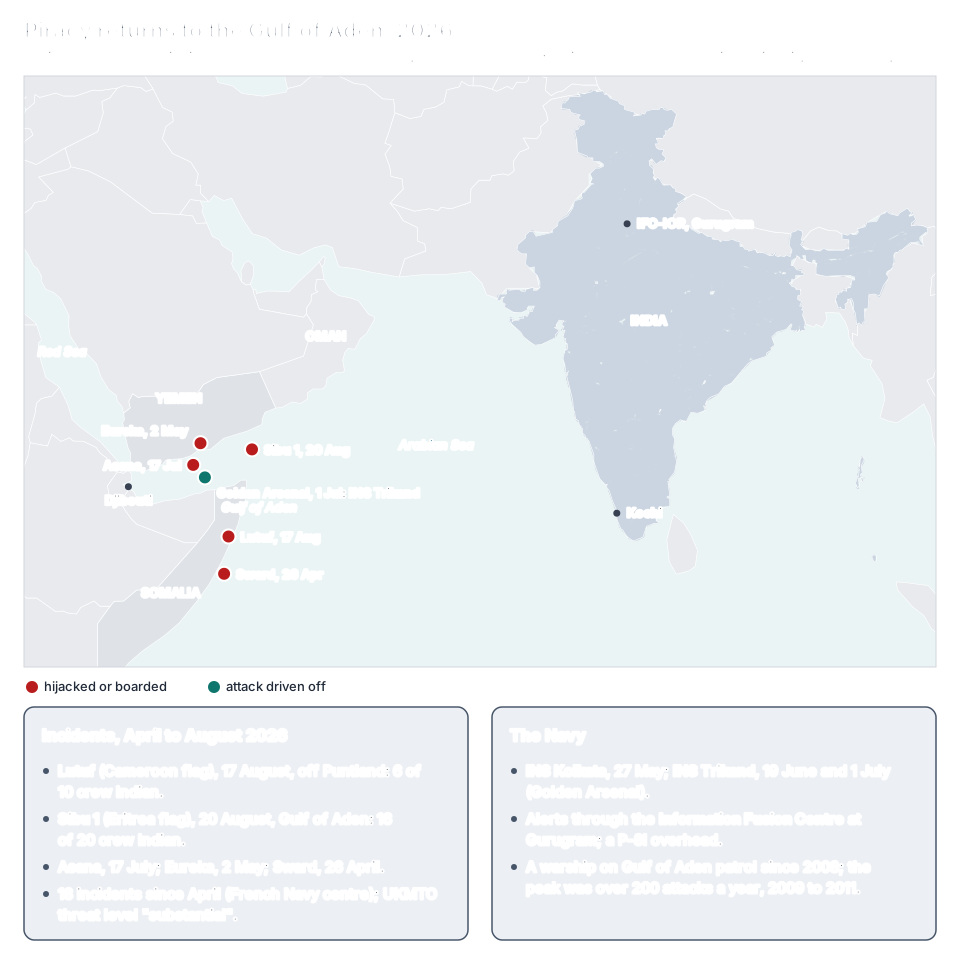
- Piracy off Somalia has revived with the Red Sea crisis. The French Navy's maritime information centre counted 18 incidents and hijackings between April and August 2026, with at least three vessels held for ransom, and the United Kingdom Maritime Trade Operations office raised the threat level off the Somali coast to "substantial".
- On 17 August eight armed men seized the Cameroon flagged cargo ship Lutuf about 3.5 nautical miles off Puntland; six of its ten crew were Indian. On 20 August six armed men boarded the Eritrea flagged tanker Sibu 1 about 136 nautical miles east of Al Mukalla, Yemen, in the Gulf of Aden; sixteen of its twenty crew were Indian. The Directorate General of Shipping reported the crews safe.
- The Navy's year: INS Kolkata responded to a suspected attack on a merchant vessel on 27 May, INS Trikand answered a distress call on 19 June and, on 1 July, drove off pirates boarding the bulk carrier Golden Arsenal about 300 nautical miles east north east of Djibouti after an alert through the Fusion Centre, with a P-8I aircraft overhead and the crew sheltering in the ship's citadel.
Why it matters
- The Gulf of Aden carries roughly 12 to 15 per cent of world trade by value and about 30 per cent of container traffic; India's trade with Europe and its crude from the Gulf pass through it, and Indian seafarers crew a large share of the ships: 22 of the 30 crew on the two August vessels.
- Piracy has returned because the navies that suppressed it are busy with the Houthi threat in the Red Sea and the West Asia war, and because the Somali State has not recovered; the Navy's deployment is one of the few constants.
- The fight is now one of information as much as warships: the Fusion Centre's alert, not a patrol, put INS Trikand on the Golden Arsenal in time.
Exam lens
- Prelims: the Fusion Centre at Gurugram, December 2018, 28 partner countries, 17 liaison officers; the Djibouti Code of Conduct (2009) and the Jeddah Amendment (2017), India an observer; piracy is on the high seas, armed robbery in territorial waters; the Navy's Gulf of Aden patrol since 2008.
- Mains: why piracy revives when the great powers' navies look elsewhere, and what a resident Indian Ocean navy can do about it.
Asked before: Mains 2025 GS3 · Mains 2022 GS3
Show the questions
- Mains 2025 GS3: Why is maritime security vital to protect India's sea trade? Discuss maritime and coastal security challenges and the way forward.
- Mains 2022 GS3: What are the maritime security challenges in India? Discuss the organisational, technical and procedural initiatives taken to improve the maritime security.
Connects to
- MQ-9B Sea Guardian: two leased for the Navy (Internal Security, August): the eyes that maritime domain awareness over this stretch of sea needs.
- The shadow fleet: how sanctioned oil still moves (Internal Security, September): the other unregulated traffic in the same waters.
- The war in West Asia and the Strait of Hormuz (Global Affairs, September Update): why the navies that kept the pirates down are elsewhere.
Sources
- Safety4Sea, 20 August 2026, “Fresh piracy alarm in Gulf of Aden after tanker hijacking”
- The Pamphlet, 26 August 2026, “Fresh hijackings raise maritime security concerns for India”
- Marine Insight, 3 July 2026, “Indian Navy prevents pirates' hijacking attempt on bulk carrier in Gulf of Aden”
- Bharat Shakti, 10 July 2026, “Indonesia, Germany post first liaison officer at India's IFC-IOR”
- International Maritime Organization
Settled facts (dates of Acts, constitutional provisions, standing definitions) are from standard references.
The shadow fleet: how sanctioned oil still moves
Copy link to The shadow fleet: how sanctioned oil still movesBriefPrelims and Mains30 Sep 2026
- A shadow fleet tanker is one that is sanctioned, or is neither owned nor insured in a G7 country, so that it can carry oil the G7 price cap is meant to restrain.
- Many are old, many sail under flags their registry does not recognise, and most switch off their tracking.
- In September 2026 sanctioned shadow tankers carried 67 per cent of Russia's seaborne crude, and 45 per cent of shadow cargoes travelled on ships at least twenty years old; falsely flagged shadow vessels had fallen from 120 a year earlier to 48, as coastal States detained and delayed them.
- India was the second largest buyer of Russian fossil fuels in the month, after China, though its crude intake fell for a second month. Since the price cap began in December 2022, India has taken 37 per cent of Russia's crude exports, after China's 50 per cent.
- The security question is the ship, not the cargo: an uninsured, unflagged tanker that spills or sinks in the Arabian Sea is nobody's responsibility, and the American sanctions law of September (see Economy) makes the buyer, not the carrier, the target.
Sources
- Centre for Research on Energy and Clean Air, “September 2026: monthly analysis of Russian fossil fuel exports and sanctions”
Also filed elsewhere
- Colombo Security Conclave · on South Asian and Bay of Bengal groupings
The Colombo Security Conclave is a security grouping of India, Bangladesh, the Maldives, Mauritius, Sri Lanka and Seychelles for their shared maritime neighbourhood.
- India's island diplomacy: Seychelles at fifty and the MAHASAGAR vision · on Indian Ocean and Indo Pacific
The Prime Minister paid a state visit to Seychelles from 27 to 29 June 2026 and was Guest of Honour at the fiftieth anniversary of its independence, which falls on 29 June.
- The war in West Asia: tankers, the Houthis and a shipping initiative · on West Asia
In early September the United States struck Iranian oil tankers, one near Iran's export hub of Kharg Island on 5 September, and both sides attacked commercial vessels.