Coastal and maritime security
- Syllabus
- Security challenges and their management in border areas
- As of
- October 2026
- coastal security
- layered security
- Indian Coast Guard
- marine police
- Coastal Security Scheme
- coastal radar chain
- NC3I
- IMAC
- IFC-IOR
- maritime domain awareness
- National Maritime Security Coordinator
- Maritime Anti-Piracy Act 2022
- chokepoints
- Sagar Kavach
The first principle
The sea has no fence and no checkpoint, and a small boat looks the same whether it carries fish or attackers, so coastal security can never rest on stopping everything at the waterline. It rests instead on knowing what is moving at sea, which is called maritime domain awareness, and on having more than one layer of guards between the open ocean and the shore, so that whatever slips past one layer is caught by the next. The attack on Mumbai in November 2008 showed what happens when neither condition holds, and India's coastal security architecture since then is built on those two ideas.
The core
What India has to guard
- A long and newly measured coast. India's coastline was long given as 7,516.6 km. A fresh measurement by the National Hydrographic Office and the Survey of India was adopted in April 2025, and the official figure is now 11,098.81 km, with Gujarat's coast alone at about 2,340 km. The coastline did not grow; the new method follows its bends more closely.
- Who lives along it. Nine States (Gujarat, Maharashtra, Goa, Karnataka, Kerala, Tamil Nadu, Andhra Pradesh, Odisha and West Bengal) and four Union Territories (Dadra and Nagar Haveli and Daman and Diu, Puducherry, Lakshadweep, and the Andaman and Nicobar Islands) touch the sea.
- The zones at sea. Under the Territorial Waters, Continental Shelf, Exclusive Economic Zone and Other Maritime Zones Act 1976, India's territorial waters run to 12 nautical miles from the baseline, the contiguous zone to 24 nautical miles and the exclusive economic zone (EEZ) to 200 nautical miles; the EEZ covers about 2.02 million square km.
The threats
- Terrorism from the sea. In March 1993 explosives for the Bombay serial blasts were landed on the Raigad coast by a smuggling network, and in November 2008 ten terrorists sailed from Karachi, hijacked the Indian fishing trawler Kuber on the way and came ashore in south Mumbai in an inflatable boat. The 2008 attack killed 166 people and exposed gaps in surveillance, coordination and the tracking of small boats.
- Smuggling and drugs. The sea route carries heroin from the Golden Crescent towards the Gujarat and Kerala coasts and methamphetamine from Myanmar through the Andaman Sea; in November 2024 the Coast Guard seized about six tonnes of methamphetamine from a boat off the Andaman Islands.
- Piracy and attacks on shipping. Somali piracy in the Gulf of Aden peaked around 2011, revived in late 2023, and now sits alongside attacks on merchant ships in the Red Sea; most of India's trade by volume moves by sea, so these threats touch the economy directly.
- Illegal fishing, infiltration and the island territories. Remote, uninhabited islands, a large fishing fleet and porous maritime boundaries with Sri Lanka, Bangladesh and Pakistan create room for illegal entry and for fishermen to be arrested across the line.
Dimensions
- Security. The coast is the front door to India's largest cities, ports, refineries, nuclear plants and naval bases, so an attack there can cost lives and money far beyond the target.
- Economic. Ports, offshore oil and gas, fisheries and seaborne trade all need safe waters, and the cost of insurance and freight rises whenever a sea lane becomes dangerous; the note on ports, shipping and airports covers the economic side.
- Federal. Police and public order are State subjects, but the sea beyond the shore is guarded by Central forces, so coastal security depends on Centre–State cooperation more than almost any other area.
- Social. Fishing communities are both the most exposed and the best informed people on the coast; when they trust the police they become its eyes and ears, and when they are harassed they stop reporting.
- Strategic and international. Three chokepoints, the Strait of Hormuz, Bab el Mandeb and the Strait of Malacca, control most of the oil and trade that India depends on. India's vision of Security and Growth for All in the Region (SAGAR, 2015), widened in March 2025 into Mutual and Holistic Advancement for Security and Growth Across Regions (MAHASAGAR), treats the Indian Ocean as a shared space that India helps keep safe.
In practice
The layered architecture after 2008
- Three layers at sea. In 2009 the Government made the Indian Navy responsible for overall maritime security, including coastal and offshore security; gave the Indian Coast Guard the additional responsibility for coastal security in territorial waters; and made the State marine police responsible for patrolling shallow waters close to the shore. Customs watches up to 24 nautical miles and the Central Industrial Security Force guards the major ports.
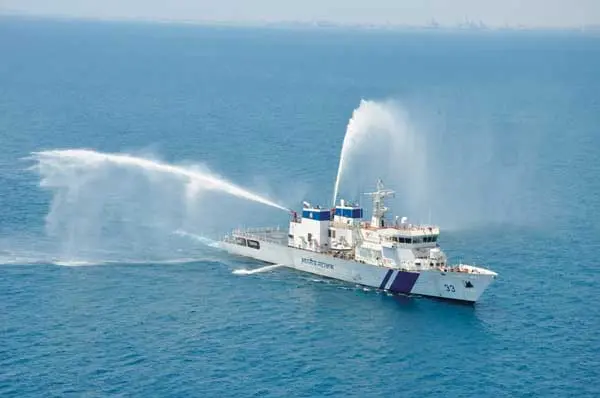
- The Coast Guard. Set up in 1977 and given its statute by the Coast Guard Act 1978, the Coast Guard protects India's maritime zones, fights pollution and smuggling, rescues people at sea and protects fishermen; it works under the Ministry of Defence.
- Marine police. Under the Coastal Security Scheme, run by the Ministry of Home Affairs, Phase I set up 73 coastal police stations with interceptor boats, and Phase II added 131 more. Many stations still lack trained crews and boats in working order, a point raised repeatedly in audit and parliamentary committee reports.
- Oversight. A National Committee for Strengthening Maritime and Coastal Security, chaired by the Cabinet Secretary, was formed in August 2009 to review the system, and the post of National Maritime Security Coordinator, in the National Security Council Secretariat, was filled for the first time in 2022 to bring the many maritime agencies under one adviser.
Knowing what is at sea
- Sensors. A chain of 46 coastal radar stations, 36 on the mainland and 10 on the islands, was built in the first phase, with more added later, along with receivers for the Automatic Identification System (AIS) that ships use to broadcast their identity and position.
- Networks and fusion. The National Command Control Communication and Intelligence (NC3I) network links Navy and Coast Guard stations, and the Information Management and Analysis Centre (IMAC) at Gurugram fuses their data into one picture. Joint Operations Centres at Mumbai, Kochi, Visakhapatnam and Port Blair coordinate the response.
- Regional picture. The Information Fusion Centre – Indian Ocean Region (IFC-IOR), set up by the Navy at Gurugram on 22 December 2018, shares shipping information with partner countries and hosts liaison officers from partner navies, so that piracy, smuggling and suspicious vessels are tracked across the ocean, not only in Indian waters.
- People and drills. Fishermen carry biometric identity cards, community groups act as lookouts, and exercises such as Sagar Kavach on each coast and the national exercise Sea Vigil, first held in 2019, test the whole chain.
Piracy and the law
- Patrols. The Navy has kept anti piracy patrols in the Gulf of Aden since 2008. In March 2024 INS Kolkata forced the surrender of 35 pirates who had seized the merchant ship MV Ruen off Somalia and brought them to Mumbai for trial.
- The law. The United Nations Convention on the Law of the Sea (UNCLOS) 1982 defines piracy and lets any state seize pirates on the high seas, and the Maritime Anti-Piracy Act 2022 made piracy a crime in Indian law for the first time, applying in the EEZ and beyond.

Issues and way forward
- Small boats remain hard to see. Radars and AIS track large ships well, but India has a very large fleet of small fishing boats, many without working transponders; fitting them with low cost transponders linked to satellites, and enforcing it, is the most direct fix.
- Marine police are weak. Police recruits are trained for land, boats lie idle for want of fuel and repair, and postings to coastal stations are unpopular; a separate marine police cadre in each coastal State, trained with the Coast Guard, has long been recommended.
- Too many agencies. Navy, Coast Guard, marine police, customs, fisheries, port authorities and intelligence agencies all have a share of the coast, and coordination still depends on goodwill; giving the National Maritime Security Coordinator real authority and passing a law that sets out each agency's role would settle this.
- Islands are exposed. Many of India's islands are uninhabited and far from the mainland, so radars, airstrips and regular patrols in the Andaman and Nicobar Islands and Lakshadweep need to grow with the threat.
- Fishermen across the line. Fishermen who stray across maritime boundaries are arrested by neighbours, and foreign boats fish illegally in Indian waters; joint working groups with Sri Lanka, Bangladesh and Pakistan and humane return of fishermen reduce friction.
Common confusions
- Coastal security and maritime security. Coastal security protects the shore and territorial waters against threats that come from the sea, such as terrorists and smugglers, while maritime security is wider and covers the EEZ, sea lanes, chokepoints, piracy and naval rivalry.
- Navy and Coast Guard. The Navy is a military force for war at sea and holds overall charge of maritime security, while the Coast Guard is an armed force of the Union for policing the maritime zones in peacetime, fighting smuggling, pollution and piracy and saving lives.
- Territorial waters and EEZ. India is sovereign over its territorial waters up to 12 nautical miles, much as over land, while in the EEZ up to 200 nautical miles it has only rights over resources such as fish, oil and gas.
- IMAC and IFC-IOR. IMAC fuses data for India's own coastal security, while IFC-IOR shares maritime information with partner countries across the Indian Ocean; both sit in Gurugram.
For the exam
- Keyword bank: layered coastal security, maritime domain awareness, Indian Coast Guard, marine police, Coastal Security Scheme, coastal radar chain, NC3I, IMAC, IFC-IOR, Joint Operations Centres, National Maritime Security Coordinator, Maritime Anti-Piracy Act 2022, chokepoints, SAGAR and MAHASAGAR.
- Previous year questions: Practise the previous year questions on this topic →
- Use in an answer:
- Introduction with data: India's coastline, officially revised in 2025 to 11,098.81 km, touches nine States and four Union Territories and guards an exclusive economic zone of about 2.02 million square km.
- Introduction with a law or case: The Mumbai attack of November 2008, carried out by ten terrorists who came by sea from Karachi, led to a layered coastal security system under the Navy, the Coast Guard and the State marine police.
- Conclusion: Coastal security depends less on how many ships India has than on how well it knows what is moving at sea, so small boat tracking, strong marine police and one coordinating authority are the next steps.
- Conclusion: From IFC-IOR to anti piracy patrols, India is turning its coastal defence into a regional service, in line with the vision of MAHASAGAR.