Security forces and agencies and their mandate
- Syllabus
- Various security forces and agencies and their mandate
- As of
- October 2026
- Chief of Defence Staff
- Department of Military Affairs
- Central Armed Police Forces
- one border one force
- aid to civil power
- National Security Council
- National Security Adviser
- Multi Agency Centre
- NATGRID
- National Investigation Agency
- intelligence oversight
- jointness
- Kargil Review Committee
The first principle
A state protects itself with three kinds of power: armed force for war, police force for order, and intelligence to tell both where to act. India gives each to different institutions, and most of its security failures have come at the joints between them, as the Kargil war of 1999 and the Mumbai attack of 2008 showed, so each reform since has tried to make them act as one system.
The core
Who commands and who advises
- Political control sits with the Cabinet Committee on Security (CCS). Chaired by the Prime Minister, it takes the final decisions on defence, internal security and intelligence.
- The National Security Council (NSC), set up in November 1998, advises the CCS. It works through three bodies: the Strategic Policy Group of secretaries and service chiefs, chaired by the National Security Adviser since 2018; the National Security Advisory Board of experts from outside government, which drafted the nuclear doctrine of 1999; and the National Security Council Secretariat (NSCS), which absorbed the Joint Intelligence Committee and prepares strategic assessments.
- The National Security Adviser (NSA) heads the NSCS, coordinates the intelligence agencies, advises the Prime Minister on internal and external security and has held Cabinet rank since 2019.
The armed forces
- The Army, Navy and Air Force defend India against external aggression under the Ministry of Defence, and the Army also serves at home in aid of civil power, on a State's request or under the Armed Forces (Special Powers) Act (AFSPA) 1958 in areas declared disturbed. The Rashtriya Rifles, raised in 1990, are the Army's counter insurgency force in Jammu and Kashmir.
- The Chief of Defence Staff (CDS) was created by a Cabinet decision of December 2019, and the first CDS, General Bipin Rawat, took office on 1 January 2020. The CDS is Permanent Chairman of the Chiefs of Staff Committee, the principal military adviser to the Defence Minister on matters that concern all three services and the military adviser to the Nuclear Command Authority, but does not command the three chiefs.
- The Department of Military Affairs (DMA), created at the same time with the CDS as its Secretary, handles the three services, joint planning, training and procurement, and the move towards joint or theatre commands. The Inter-Services Organisations (Command, Control and Discipline) Act 2023 lets the commander of a joint organisation discipline personnel of all three services.
- The Indian Coast Guard (Coast Guard Act 1978) enforces law in the maritime zones under the Ministry of Defence.
The Central Armed Police Forces
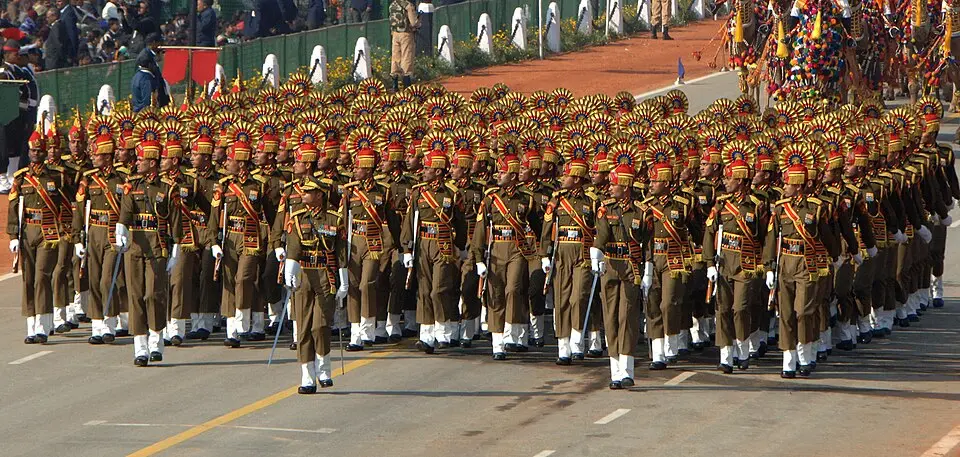
The Ministry of Home Affairs (MHA) counts seven Central Armed Police Forces (CAPFs). They are armed forces of the Union, sent into a State in aid of civil power under List I, Entry 2A, when its own police cannot cope.
- Border guarding forces follow the principle of one border one force, recommended by the Group of Ministers in 2001: the Border Security Force (BSF, 1965) on the Pakistan and Bangladesh borders, the Indo-Tibetan Border Police (ITBP, 1962) on the China border, the Sashastra Seema Bal (SSB, raised in 1963 as the Special Service Bureau) on the Nepal and Bhutan borders, and the Assam Rifles (1835) on the Myanmar border.
- The Central Reserve Police Force (CRPF), raised in 1939 as the Crown Representative's Police and renamed under the CRPF Act 1949, is the main internal security force, deployed against left wing extremism, in Jammu and Kashmir and in riots, with a Rapid Action Force for riots and the Commando Battalion for Resolute Action (CoBRA) for jungle warfare.
- The Central Industrial Security Force (CISF), raised in 1969, guards airports, ports, metro systems, power plants and government buildings, and took charge of the Parliament complex in May 2024.
- The National Security Guard (NSG), raised in 1984 and governed by the NSG Act 1986, is a federal contingency force for terror attacks and hijacks, drawn from the Army and the police, with regional hubs added after 2008.
Intelligence and investigation
- The Intelligence Bureau (IB), under the MHA, traces its origin to 1887 and handles domestic intelligence and counter intelligence. Its Multi Agency Centre (MAC), set up in 2001 and strengthened after 2008, receives inputs from all agencies round the clock and shares them with Subsidiary MACs in the States.
- The Research and Analysis Wing (R&AW), set up in September 1968 under the Cabinet Secretariat, gathers external intelligence. The National Technical Research Organisation (NTRO), created in 2004 under the NSA, collects technical intelligence from satellites, signals and cyberspace. The Defence Intelligence Agency (DIA), created in 2002, coordinates military intelligence for the three services.
- The National Investigation Agency (NIA), set up under the NIA Act 2008 weeks after the Mumbai attack, investigates and prosecutes scheduled offences such as terrorism across States without waiting for State consent. The 2019 amendment added human trafficking, counterfeit currency, prohibited arms and cyber terrorism to its list and let it investigate offences against Indians and Indian interests abroad.
- NATGRID, the National Intelligence Grid, approved in 2011 and run as an attached office of the MHA, gives authorised central agencies one secure window to query databases such as travel, banking and telecom records.
Dimensions
- Constitutional. Police and public order are State subjects, while the Union may deploy its forces in aid of civil power under List I, Entry 2A, and must protect every State against internal disturbance under Article 355.
- Operational. One incident may involve the IB, a CAPF, the State police and the NIA, so the speed at which information and orders pass between them decides the outcome.
- Civil and military. The armed forces are trained to defeat an enemy, not to police citizens, so long use at home under AFSPA strains their readiness for war and their relations with local people.
- Legal and democratic. The IB and R&AW rest on executive orders, not an Act, and no parliamentary committee oversees them.
- Technological. Drones, encrypted messaging and cyber attacks now reach the hinterland, so forces need technical intelligence and new skills (the technology is covered in the note on drones and emerging warfare technology).
In practice
- Kargil, 1999. The Kargil Review Committee chaired by K Subrahmanyam found that intrusions across the Line of Control had gone undetected and that intelligence was not assessed jointly. The Group of Ministers chaired by L K Advani (2001) followed, and its report led to the DIA, the NTRO, the MAC, the Headquarters Integrated Defence Staff and the one border one force rule; its proposal for a CDS waited until 2019.
- Mumbai, November 2008. Ten terrorists who came by sea held parts of the city for about three days while NSG commandos were flown in from near Delhi; the response was the NIA Act and an amended Unlawful Activities (Prevention) Act within weeks, NSG hubs in major cities, a round the clock MAC and a new coastal security architecture.
- Size of the forces. On 30 September 2024 the six CAPFs other than the NSG had a sanctioned strength of 10,55,462 and a posted strength of 9,48,204, so about one post in ten was vacant, and women made up 4.44 per cent of those posted (MHA, Lok Sabha, December 2024).
- Cadre and leadership. In Sanjay Prakash v Union of India (May 2025) the Supreme Court held that the CAPFs are Organised Group A Services and ordered a phased reduction of deputation by Indian Police Service (IPS) officers in their senior posts. Parliament then passed the Central Armed Police Forces (General Administration) Bill in April 2026, which reserves fixed shares of senior posts for IPS officers on deputation; the Act came into force on 8 October 2026 and has been challenged before the Supreme Court.

Issues and way forward
- Overuse of the CAPFs. States lean on central forces instead of building their own police, so CAPF companies move from elections to riots to insurgency with little time to train or rest; States should raise their own armed police and keep central forces for what only they can do.
- Vacancies and stress. About one sanctioned post in ten is unfilled, and long postings away from family raise stress; faster recruitment, assured leave, family housing and counselling are the remedies.
- Leadership from within. Officers who join a CAPF directly rise slowly because senior posts go to IPS officers on deputation; the 2025 judgment and the 2026 Act take opposite approaches, and the Supreme Court will settle it.
- Jointness. Theatre commands, joint logistics and a common doctrine are still being built, and the CDS and DMA must overcome loyalties to each service, which is why the Naresh Chandra Task Force (2012) proposed a permanent chairman of the Chiefs of Staff Committee.
- Intelligence without oversight and turf. Agencies with no statute and no parliamentary review risk misuse and poor performance, and since they guard their sources, the MAC and NATGRID work only as well as the willingness to share; a law defining their charter, with a committee of Parliament to oversee them, has been proposed in private members' Bills but not enacted.
Common confusions
- CAPFs and the armed forces. The CAPFs are police forces under the MHA, while the armed forces are under the Ministry of Defence and act inside the country only in aid of civil power.
- Assam Rifles and the Army. The Assam Rifles is a CAPF under the MHA for administration, but its officers come largely from the Army and the Army controls its operations.
- NSA and NSC. The NSC is the advisory body chaired by the Prime Minister; the NSA is the official who runs its secretariat.
- IB and R&AW. The IB looks inward under the MHA; R&AW looks outward under the Cabinet Secretariat.
- MAC and NATGRID. The MAC fuses intelligence reports, while NATGRID looks up records in existing databases.
For the exam
- Keyword bank: Cabinet Committee on Security, National Security Council, National Security Adviser, Chief of Defence Staff, Department of Military Affairs, jointness, Central Armed Police Forces, one border one force, aid to civil power (List I, Entry 2A), Multi Agency Centre, NATGRID, National Investigation Agency, intelligence oversight, Kargil Review Committee, Organised Group A Service.
- Previous year questions: Practise the previous year questions on this topic →
- Use in an answer:
- Introduction with data: The six border and internal security forces under the Home Ministry other than the NSG had a sanctioned strength of over 10.5 lakh in September 2024, with about one post in ten vacant (MHA, Lok Sabha, December 2024).
- Introduction with a source: The Kargil Review Committee (1999) traced India's failure less to a lack of force than to a lack of joint assessment, which shaped every reform from the DIA to the CDS.
- Conclusion: India has built the institutions it lacked in 1999 and 2008, and the task now is to make them work as one system through jointness, intelligence sharing and strong State police.
- Conclusion: Forces that are well led, well rested and answerable to law serve security better than more battalions alone.