The ozone layer and the Montreal Protocol
- Syllabus
- Conservation, environmental pollution and degradation, environmental impact assessment
- As of
- October 2026
- stratospheric ozone
- Chapman cycle
- catalytic destruction
- polar stratospheric clouds
- Dobson unit
- ozone depleting substances
- Vienna Convention
- Montreal Protocol
- Multilateral Fund
- Kigali Amendment
- hydrofluorocarbons
- India Cooling Action Plan
- phase out and phase down
The first principle
Ozone is made and broken by sunlight in a balance that shields life on land, and a little catalyst can tip that balance because a catalyst is not used up. Chlorine and bromine from man made gases are such catalysts, so a few parts per billion of them were enough to thin the ozone layer. The cure followed from the same logic: stop making the catalysts, and the natural balance restores itself over decades.
The core
Where ozone is and what it does
- Most ozone sits in the stratosphere. About 90 per cent of the atmosphere's ozone (O₃) lies in the stratosphere, mostly between about 15 and 35 km, while ozone near the ground is a pollutant covered in the air pollution note.
- It is measured in Dobson units. One Dobson unit (DU) is the ozone that would make a layer 0.01 mm thick at standard temperature and pressure, and the global average is about 300 DU, a shield only about 3 mm thick.
- It filters ultraviolet light. Stratospheric ozone absorbs all ultraviolet C and most ultraviolet B (UVB, about 280 to 315 nm), while ultraviolet A passes largely through.
How ozone is made and broken: the Chapman cycle
- Making ozone. Ultraviolet light of wavelength below about 242 nm splits an oxygen molecule into two atoms (O₂ → 2O), and each atom joins another oxygen molecule with the help of a third molecule M, which carries away the extra energy (O + O₂ + M → O₃ + M).
- Breaking ozone. Ozone absorbs ultraviolet light below about 320 nm and splits (O₃ → O₂ + O), and the energy released as heat is the reason temperature rises with height in the stratosphere. A slower reaction, O + O₃ → 2O₂, removes ozone for good.
- A steady state. Production and loss balance, and ozone peaks in the middle stratosphere because higher up there is too little oxygen and lower down too little short wave ultraviolet light.
How chlorine destroys ozone
- The catalytic cycle. Chlorofluorocarbons (CFCs) are so stable that they survive years in the lower atmosphere and drift up to the stratosphere, where hard ultraviolet light breaks them and frees chlorine atoms. A chlorine atom attacks ozone (Cl + O₃ → ClO + O₂), and chlorine monoxide then meets an oxygen atom (ClO + O → Cl + O₂), so the net reaction is O₃ + O → 2O₂ and the chlorine atom comes out unchanged.
- Why so little does so much. Because the chlorine atom is regenerated, one atom can destroy many thousands of ozone molecules before it is locked into a reservoir compound such as hydrogen chloride (HCl) or chlorine nitrate (ClONO₂). Bromine, from halons and methyl bromide, runs a similar cycle and is far more destructive per atom.
- The science was honoured. Paul Crutzen, Mario Molina and Sherwood Rowland shared the 1995 Nobel Prize in Chemistry.
Why the hole forms over Antarctica
- Cold, isolated air. In the southern winter a ring of strong winds, the polar vortex, isolates the air over Antarctica, and temperatures fall below about −78 °C, cold enough for polar stratospheric clouds to form.
- Reservoirs turned into active chlorine. On the surfaces of these cloud particles the reservoirs react (HCl + ClONO₂ → Cl₂ + HNO₃), and the nitric acid stays in the particles, so nitrogen oxides cannot lock chlorine away again.
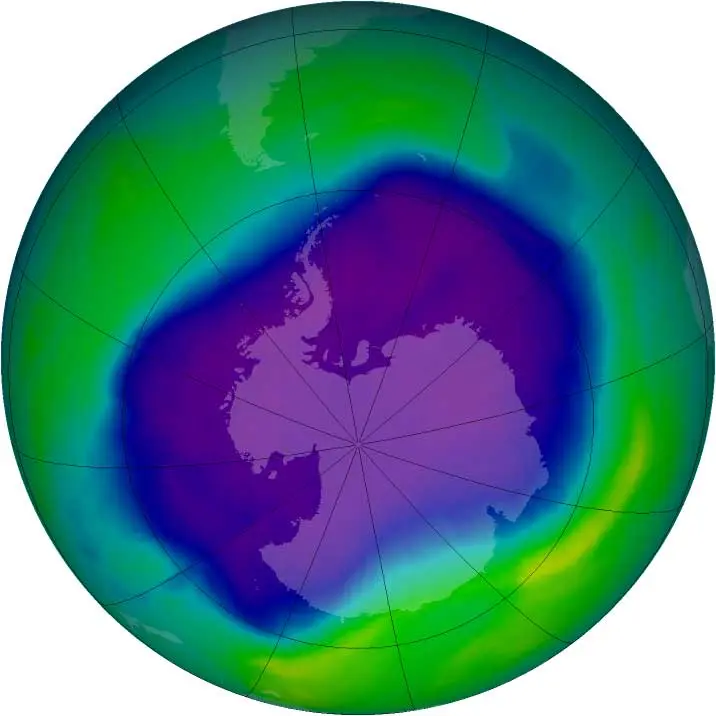
- Spring sunlight starts the loss. When the sun returns in September it splits Cl₂ into chlorine atoms, and ozone is destroyed fast enough to fall below 220 DU, the threshold that defines the ozone hole. The hole closes when the vortex breaks up in November or December.
Dimensions
- Health and ecology. UVB causes most skin cancers and contributes to cataracts, and it harms phytoplankton in the Southern Ocean, the base of the Antarctic food web, as well as amphibian eggs and young fish.
- Climate. CFCs, HCFCs and HFCs are all powerful greenhouse gases, so the Montreal Protocol has done more to slow warming than the Kyoto Protocol, and the 2022 scientific assessment estimates that full compliance with the Kigali Amendment will avoid about 0.3 to 0.5 °C of warming by 2100.
- Economic and technological. The protocol worked because industry had substitutes, and every phase out has been a change of technology; for India, still building its cooling stock, the choice of gas now locks in emissions for decades.
- Equity. Developing countries, called Article 5 countries, received a ten year grace period and money from the Multilateral Fund, an early working form of common but differentiated responsibilities.
In practice
The treaties
- Vienna Convention for the Protection of the Ozone Layer (1985, in force 1988). It is a framework treaty that commits Parties to research, monitoring and cooperation without setting any cuts, and India joined it in 1991.
- Montreal Protocol on Substances that Deplete the Ozone Layer (1987, in force 1989). It sets binding schedules to phase out CFCs, halons, carbon tetrachloride, methyl chloroform, methyl bromide and HCFCs, and India acceded in 1992. In 2009 the two became the first treaties in United Nations history ratified by every country, and about 99 per cent of the controlled substances have now been phased out.
- How it stays strong. Schedules can be tightened by an "adjustment" that binds all Parties without fresh ratification, new gases are added by amendment (London 1990, Copenhagen 1992, Montreal 1997, Beijing 1999 and Kigali 2016), and trade with non Parties is restricted.
- The Multilateral Fund. Created by the London Amendment of 1990, it pays developing countries the agreed extra costs of switching technology.
- The Kigali Amendment (2016, in force 2019). It brings hydrofluorocarbons (HFCs), which do not harm ozone but warm strongly, under the Montreal Protocol and phases them down by 80 to 85 per cent, between 2036 for developed countries and 2047 for the last group of developing countries. India ratified it in 2021. India is in the group of developing countries with the later schedule: its baseline is its average use in 2024 to 2026, consumption freezes in 2028, and it must then cut 10 per cent by 2032, 20 per cent by 2037, 30 per cent by 2042 and 85 per cent by 2047.
India's record
- Law. The Ozone Depleting Substances (Regulation and Control) Rules, 2000, made under the Environment (Protection) Act, 1986, license production, import and use, and the Ozone Cell of the Ministry of Environment, Forest and Climate Change (MoEFCC) runs the programme.
- Phase outs. India stopped producing and consuming CFCs from 1 August 2008, except for medical inhalers, ahead of the 2010 deadline, and it completed the phase out of HCFC-141b, a foam blowing agent, on 1 January 2020. The HCFC Phase out Management Plan now aims to end HCFC use by 2030, with a small servicing allowance to 2040 as the protocol allows. In 2016 India also directed HCFC-22 producers to capture and destroy HFC-23, a byproduct gas with a global warming potential near 15,000.
- India Cooling Action Plan (ICAP), 2019. One of the first such national plans, it aims, by 2037-38, to cut cooling demand by 20 to 25 per cent, refrigerant demand by 25 to 30 per cent and cooling energy by 25 to 40 per cent, through better building design, efficient appliances and low warming refrigerants.
What the latest science says
- Recovery is under way. The WMO and UNEP Scientific Assessment of Ozone Depletion 2022 projects that, if current policies hold, the ozone layer will return to its 1980 values around 2066 over Antarctica, around 2045 over the Arctic and around 2040 for the rest of the world; the next assessment is due at the end of 2026.
- The 2025 hole was small. NASA and NOAA ranked the 2025 Antarctic ozone hole as the fifth smallest since 1992, with a peak of about 22.9 million km² on 9 September.

Issues and way forward
- Illegal production. Scientists found in 2018 that emissions of CFC-11 had stopped falling, the extra emissions were traced to eastern China, and they fell back after action there, which shows the value of independent monitoring.
- Old banks of gases. Equipment and foams in use still hold large stocks of CFCs and HCFCs that leak at the end of their life, so recovering and destroying them is cheap mitigation the protocol does not fully cover.
- Gases outside the treaty. Nitrous oxide, from fertiliser and manure, is now the largest ozone depleting emission and is not controlled by the Montreal Protocol.
- Cooling demand in a warming India. Room air conditioners are spreading fast as incomes and heat rise, so the HFC freeze in 2028 needs efficient appliances and low warming gases to spread together.
- Safety and skills. Propane and some HFOs are flammable and ammonia is toxic, so India's large informal servicing sector needs training and certification.
- Way forward. India should license HFCs from its baseline years, link refrigerant rules with Bureau of Energy Efficiency labels and promote passive cooling, as the ICAP recommends.
Common confusions
- HCFCs and HFCs. HCFCs contain chlorine and deplete some ozone and are being phased out, while HFCs contain no chlorine but are controlled under Kigali because they warm the climate.
- Phase out and phase down. A phase out ends production and consumption, as for CFCs, while a phase down cuts it to a small residual share, as for HFCs.
- Vienna Convention and Montreal Protocol. The Vienna Convention is the framework with no targets, and the Montreal Protocol is the protocol under it with binding schedules; Kigali is an amendment to the protocol, not a separate treaty.
- Ozone depletion potential and global warming potential. The first compares ozone damage with CFC-11 and the second compares heat trapping with carbon dioxide.
For the exam
- Keyword bank: Chapman cycle, catalytic destruction, polar vortex, polar stratospheric clouds, Dobson unit, ozone depleting substances, Article 5 countries, Multilateral Fund, adjustment and amendment, Kigali Amendment, hydrofluorocarbons, phase down, India Cooling Action Plan, ozone depletion potential, global warming potential.
- Previous year questions: Practise the previous year questions on this topic →
- Use in an answer:
- Introduction with data: The 2025 Antarctic ozone hole was the fifth smallest since 1992 (NASA and NOAA), and the layer is projected to recover to its 1980 level by about 2066 over Antarctica and 2040 elsewhere.
- Introduction with a report: The WMO and UNEP Scientific Assessment of Ozone Depletion 2022 credits the Montreal Protocol with putting the ozone layer on track to recover and estimates that the Kigali Amendment can avoid 0.3 to 0.5 °C of warming by 2100.
- Conclusion: The Montreal Protocol shows that a treaty works when science is clear, substitutes exist, money flows to developing countries and trade measures deter free riders, and those conditions are worth copying in the climate regime.
- Conclusion: For India, the HFC freeze in 2028 is a chance to build a cooling sector that is efficient and low warming from the start, which the India Cooling Action Plan has already mapped.