

2011 · Q24
Consider the following figures:
Figure 1:
| 2 | 6 |
| 80 | 24 |
Figure 2:
| 3 | ? |
| 120 | 36 |
What is the missing number?
- (a)7
- (b)8
- (c)9
- (d)10
Show answerHide answer
UPSC key: (c)
Logical reasoning · Series and patterns
VidBodh has grown into First Principles IAS. Same teachers, same free answer writing.
41 questions, from 2011 to 2026.
2011 · Q24
Consider the following figures:
Figure 1:
| 2 | 6 |
| 80 | 24 |
Figure 2:
| 3 | ? |
| 120 | 36 |
What is the missing number?
UPSC key: (c)
Logical reasoning · Series and patterns
2013 · Q48
Consider the following matrix:
| 3 | 370 | 7 |
| 2 | 224 | 6 |
| 1 | 730 | X |
What is the number at ‘X’ in the above matrix?
UPSC key: (c)
Logical reasoning · Series and patterns
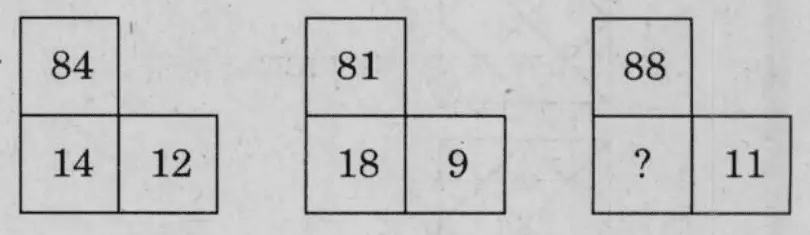
2013 · Q50
Examine the following three figures in which the numbers follow a specific pattern:
| Figure 1: top 84; bottom 14 | 12 |
| Figure 2: top 81; bottom 18 | 9 |
| Figure 3: top 88; bottom? | 11 |
The missing number (?) in the third figure above is
UPSC key: (b)
Logical reasoning · Series and patterns
2014 · Q42
Consider the table given below in which the numbers bear certain relationship among themselves along the rows:
| 29 | 13 | 18 |
| 33 | X | 19 |
| 30 | 27 | 3 |
Which one of the following numbers is the missing number indicated above by X?
Logical reasoning · Series and patterns
2015 · Q12
Consider the following matrix:
| 3 | 8 | 10 | 2 | ? | 1 |
| 6 | 56 | 90 | 2 | 20 | 0 |
What is the missing number at '?' in the matrix?
UPSC key: (a)
Logical reasoning · Series and patterns
2015 · Q13
What is the missing number 'X' of the series 7, X, 21, 31, 43?
UPSC key: (c)
Logical reasoning · Series and patterns
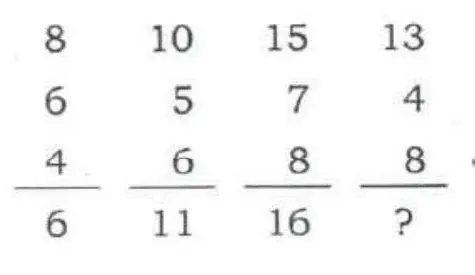
2018 · Q3
Consider the following pattern of numbers:
| 8 | 10 | 15 | 13 |
| 6 | 5 | 7 | 4 |
| 4 | 6 | 8 | 8 |
| 6 | 11 | 16 | ? |
What is the number at? in the above pattern?
UPSC key: (a)
Logical reasoning · Series and patterns
2018 · Q59
Consider the sequence given below:
4/12/95, 1/1/96, 29/1/96, 26/2/96, ....
What is the next term of the series?
UPSC key: (b)
Logical reasoning · Series and patterns
2019 · Q48
What is X in the sequence
132, 129, 124, 117, 106, 93, X?
UPSC key: (c)
Logical reasoning · Series and patterns
2019 · Q51
What is X in the sequence
4, 196, 16, 144, 36, 100, 64, X?
UPSC key: (b)
Logical reasoning · Series and patterns
2019 · Q54
Consider the following sequence that follows some arrangement:
c_accaa_aa_bc_b
The letters that appear in the gaps are
UPSC key: (b)
Logical reasoning · Series and patterns
2019 · Q70
In the sequence 1, 5, 7, 3, 5, 7, 4, 3, 5, 7, how many such 5s are there which are not immediately preceded by 3 but are immediately followed by 7?
UPSC key: (a)
Logical reasoning · Series and patterns
2020 · Q13
A simple mathematical operation in each number of the sequence 14, 18, 20, 24, 30, 32, ... results in a sequence with respect to prime numbers. Which one of the following is the next number in the sequence?
UPSC key: (c)
Logical reasoning · Series and patterns
2020 · Q15
Consider the following arrangement that has some missing letters:
abab_b_bcb_dcdcded_d
The missing letters which complete the arrangement are
UPSC key: (c)
Logical reasoning · Series and patterns
2020 · Q34
Consider the following sequence of numbers:
5 1 4 7 3 9 8 5 7 2 6 3 1 5 8 6 3 8 5 2 2 4 3 4 9 6
How many odd numbers are followed by the odd number in the above sequence?
UPSC key: (b)
Logical reasoning · Series and patterns
2020 · Q49
What is the missing term @ in the following?
ACPQ: BESU :: MNGI: @
UPSC key: (d)
Logical reasoning · Series and patterns
2021 · Q26
Replace the incorrect term by the correct term in the given sequence
3, 2, 7, 4, 13, 10, 21, 18, 31, 28, 43, 40
where odd terms and even terms follow the same pattern.
UPSC key: (a)
Logical reasoning · Series and patterns
2021 · Q27
Following is a matrix of certain entries. The entries follow a certain trend row-wise. Choose the missing entry (?) accordingly.
| 7B | 10A | 3C |
| 3C | 9B | 6A |
| 10A | 13C | ? |
UPSC key: (c)
Logical reasoning · Series and patterns
2021 · Q28
You are given two identical sequences in two rows:
| Sequence-I: | 8 | 4 | 6 | 15 | 52·5 | 236·25 |
| Sequence-II: | 5 | A | B | C | D | E |
What is the entry in the place of C for the Sequence-II?
UPSC key: (c)
Logical reasoning · Series and patterns
2021 · Q40
In the English alphabet, the first 4 letters are written in opposite order; and the next 4 letters are written in opposite order and so on; and at the end Y and Z are interchanged. Which will be the fourth letter to the right of the 13ᵗʰ letter?
UPSC key: (b)
Logical reasoning · Series and patterns
2021 · Q50
What is the value of 'X' in the sequence 2, 7, 22, 67, 202, X, 1822?
UPSC key: (c)
Logical reasoning · Series and patterns
2021 · Q65
In the series _b_a_ba_b_abab_aab; fill in the six blanks ( _ ) using one of the following given four choices such that the series follows a specific order.
UPSC key: (d)
Logical reasoning · Series and patterns
2022 · Q4
What is the value of X in the sequence 20, 10, 10, 15, 30, 75, X?
UPSC key: (d)
Logical reasoning · Series and patterns
2022 · Q29
In the series AABABCABCDABCDE..., which letter appears at the 100th place?
UPSC key: (c)
Logical reasoning · Series and patterns
2022 · Q75
What is the value of X in the sequence 2, 12, 36, 80, 150, X?
UPSC key: (b)
Logical reasoning · Series and patterns
2023 · Q24
If 7 ⊕ 9 ⊕ 10 = 8, 9 ⊕ 11 ⊕ 30 = 5, 11 ⊕ 17 ⊕ 21 = 13, what is the value of 23 ⊕ 4 ⊕ 15?
UPSC key: (a)
Logical reasoning · Series and patterns
2023 · Q40
Choose the group which is different from the others:
UPSC key: (d)
Logical reasoning · Series and patterns
2023 · Q54
40 children are standing in a circle and one of them (say child-1) has a ring. The ring is passed clockwise. Child-1 passes on to child-2, child-2 passes on to child-4, child-4 passes on to child-7 and so on. After how many such changes (including child-1) will the ring be in the hands of child-1 again?
UPSC key: (b)
Logical reasoning · Series and patterns
2023 · Q55
What is the middle term of the sequence Z, Z, Y, Y, Y, X, X, X, X, W, W, W, W, W, ..., A?
UPSC key: (b)
Logical reasoning · Series and patterns
2023 · Q75
Consider the sequence
ABC_ _ ABC_ DABBCD_ ABCD
that follows a certain pattern.
Which one of the following completes the sequence?
UPSC key: (d)
Logical reasoning · Series and patterns
2023 · Q80
The letters of the word “INCOMPREHENSIBILITIES” are arranged alphabetically in reverse order. How many positions of the letter/letters will remain unchanged?
UPSC key: (c)
Logical reasoning · Series and patterns
2024 · Q24
Consider the sequence
A _ BCD _ BBCDABC _ DABC _ D
that follows a certain pattern. Which one of the following completes the sequence?
UPSC key: (c)
Logical reasoning · Series and patterns
2024 · Q46
What is the sum of the first 28 terms in the following sequence?
1, 1, 2, 1, 3, 2, 1, 4, 3, 2, 1, 5, 4, 3, 2, ⋯
UPSC key: (b)
Logical reasoning · Series and patterns
2024 · Q79
What will come in place of ∗ in the sequence 3, 14, 39, 84, ∗, 258?
UPSC key: (b)
Logical reasoning · Series and patterns
2025 · Q8
What comes at X and Y respectively in the following sequence?
January, January, December, October, X, March, October, Y, September
UPSC key: (b)
Logical reasoning · Series and patterns
2025 · Q16
If 7 * 24 = 25 and 12 * 16 = 20, then what is 16 * 63 equal to?
UPSC key: (c)
Logical reasoning · Series and patterns
2025 · Q30
Consider the sequence AB_CC_A_BCCC_BBC_C that follows a certain pattern. Which one of the following completes the sequence?
UPSC key: (c)
Logical reasoning · Series and patterns
2025 · Q36
What is X in the sequence 24, X, 12, 18, 36, 90?
UPSC key: (b)
Logical reasoning · Series and patterns
2025 · Q60
What is X in the sequence 1, 3, 6, 11, 18, X, 42?
UPSC key: (c)
Logical reasoning · Series and patterns
2026 · Q18
A pattern formed by two characters a and b is repeated more than once in the following string:
× b × a × a × × a × a × bab
What is × × in the 7th and 8th positions from the left in the above string?
UPSC key: (d)
Logical reasoning · Series and patterns
2026 · Q57
In a sequence of numbers, each number other than the first two is the sum of the two immediately preceding numbers from it. If the first two numbers in the sequence are 4 and 7, then the sixth number is
UPSC key: (d)
Logical reasoning · Series and patterns