VidBodh has grown into First Principles IAS. Same teachers, same free answer writing.

First Principles IASFirst Principles IAS

CSAT · Logical reasoning

Visual reasoning

34 questions, from 2011 to 2026.

2011

2 questions
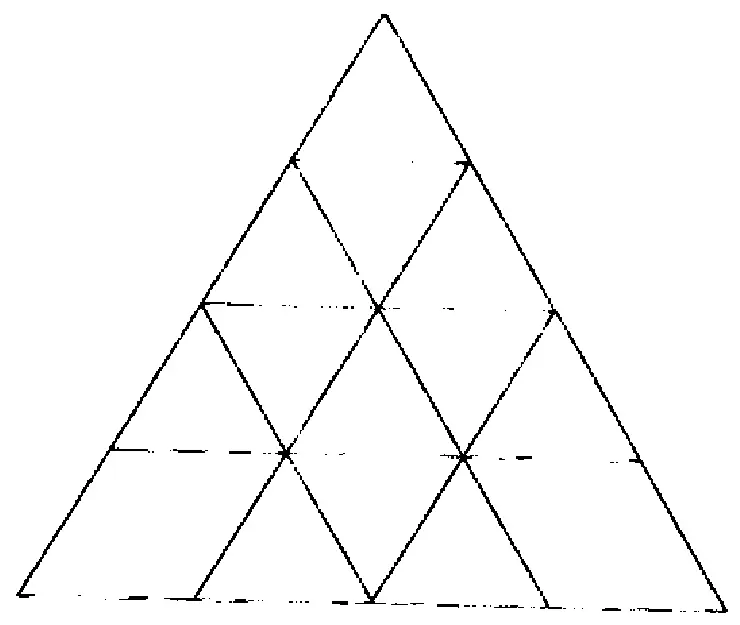
A large upright triangle. Label points dividing the left side into four equal parts from the apex as L1, L2, L3, the right side similarly R1, R2, R3, and the base from left to right B0, B1, B2, B3, B4 (B0 and B4 are the bottom corners). Lines drawn inside: horizontal lines L2-R2 and L3-R3 (no horizontal line at L1-R1); lines parallel to the right side L1-B3 and L2-B2; lines parallel to the left side R1-B1 and R2-B2. This forms a lattice of small triangles and rhombuses inside the big triangle.

2011 · Q26

Consider the following figure and answer the item that follows:

What is the total number of triangles in the above grid?

  1. (a)27
  2. (b)26
  3. (c)23
  4. (d)22
Show answer

UPSC key: (c)

Logical reasoning · Visual reasoning
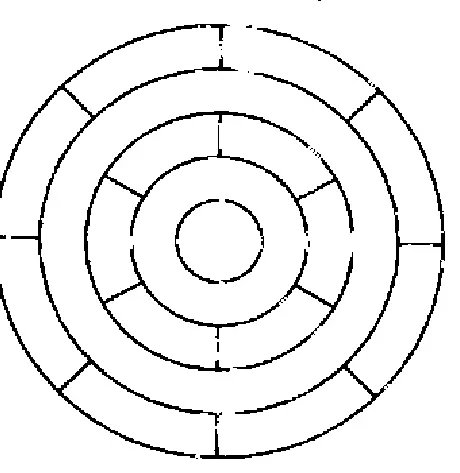
Five concentric circles forming a central disc and four rings around it. From the centre outwards: central disc (one region); first ring, undivided; second ring, divided by radial lines into 6 segments; third ring, undivided; outermost ring, divided by radial lines into 8 segments.

2011 · Q37

Consider the following figure and answer the item that follows:

What is the minimum number of different colours required to paint the figure given above such that no two adjacent regions have the same colour?

  1. (a)3
  2. (b)4
  3. (c)5
  4. (d)6
Show answer

UPSC key: (a)

Logical reasoning · Visual reasoning
2012

4 questions
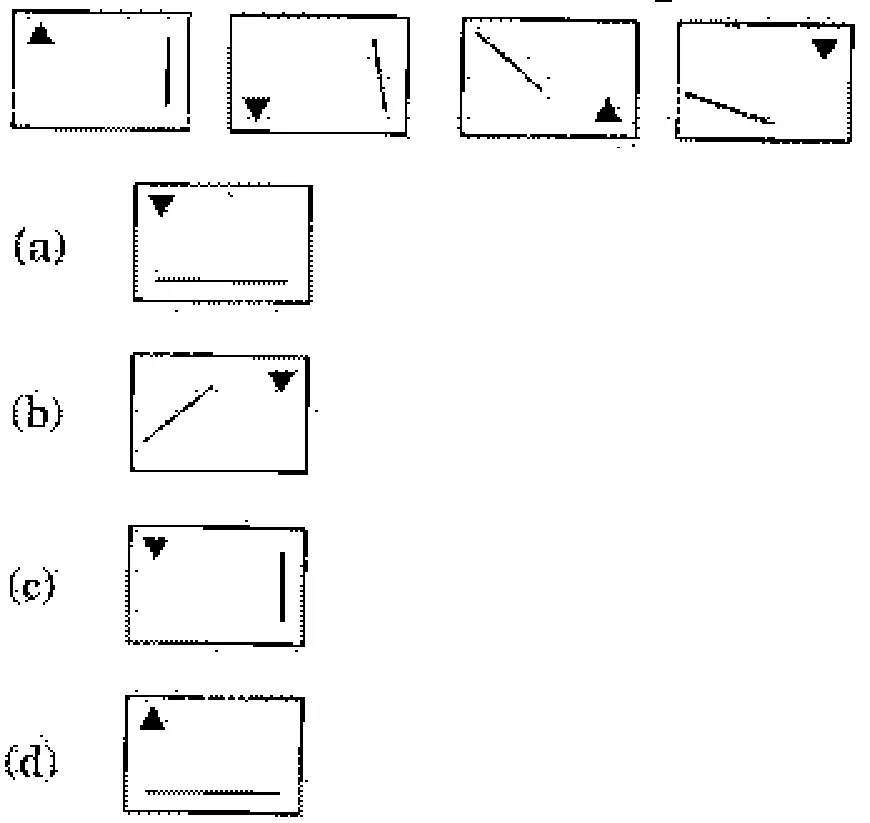
Four problem figures, each a rectangle containing a small black triangle and a straight line. Fig 1: triangle pointing up at top-left corner; vertical line near the right side. Fig 2: triangle pointing down at bottom-left corner; line near the right, slightly tilted from vertical (top leaning left). Fig 3: triangle pointing up at bottom-right corner; diagonal line from top-left toward centre (falling to the right, about 45°). Fig 4: triangle pointing down at top-right corner; line in lower-left part, nearly horizontal, gently falling to the right. (The triangle moves around the corners anticlockwise, alternately pointing up and down, while the line rotates step by step from vertical toward horizontal.)

2012 · Q45

The elements of the problem figures given below are changing with a certain rule as we observe them from left to right:

[Problem figures]

According to this rule, which of the following would be the next figure if the changes were continued with the same rule?

  1. (a)[Figure: black triangle pointing down at top-left; horizontal line at the bottom]
  2. (b)[Figure: line slanting up from lower-left to centre; black triangle pointing down at top-right]
  3. (c)[Figure: black triangle pointing down at top-left; vertical line at the right]
  4. (d)[Figure: black triangle pointing up at top-left; horizontal line at the bottom]
Show answer

UPSC key: (d)

Logical reasoning · Visual reasoning
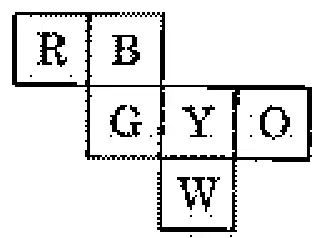
Net of six squares: top row R, B (B to the right of R); second row G, Y, O, with G directly below B; W directly below Y in a third row. Layout:
R B . .
. G Y O
. . W .

2012 · Q47

Six squares are coloured, front and back, red (R), blue (B), yellow (Y), green (G), white (W) and orange (O) and are hinged together as shown in the figure given below. If they are folded to form a cube, what would be the face opposite the white face?

  1. (a)R
  2. (b)G
  3. (c)B
  4. (d)O
Show answer

UPSC key: (c)

Logical reasoning · Visual reasoning
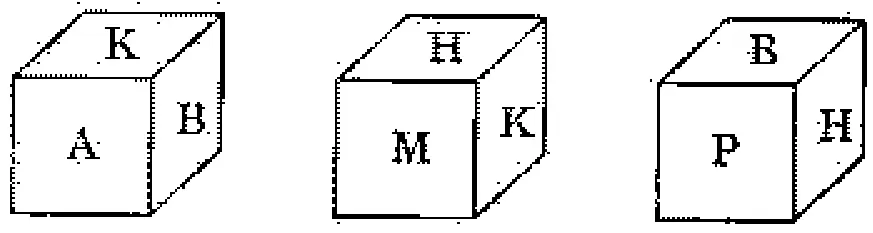
Three views of a cube (front, top, right faces): View 1: front A, top K, right B. View 2: front M, top H, right K. View 3: front P, top B, right H.

2012 · Q49

Three views of a cube following a particular motion are given below:

What is the letter opposite to A?

  1. (a)H
  2. (b)P
  3. (c)B
  4. (d)M
Show answer

UPSC key: (a)

Logical reasoning · Visual reasoning
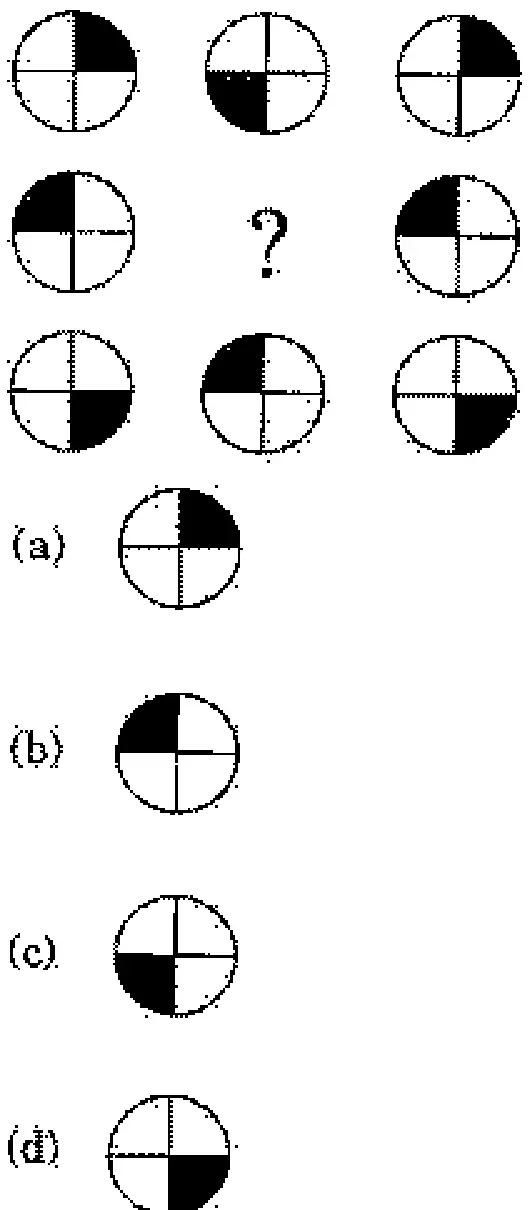
3×3 matrix of circles divided into four quadrants, one quadrant shaded black in each. Row 1: top-right, bottom-left, top-right. Row 2: top-left, ?, top-left. Row 3: bottom-right, top-left, bottom-right.

2012 · Q50

Which one of the figures shown below occupies the blank space (?) in the matrix given above?

  1. (a)Circle with top-right quadrant shaded
  2. (b)Circle with top-left quadrant shaded
  3. (c)Circle with bottom-left quadrant shaded
  4. (d)Circle with bottom-right quadrant shaded
Show answer

UPSC key: (d)

Logical reasoning · Visual reasoning
2013

5 questions
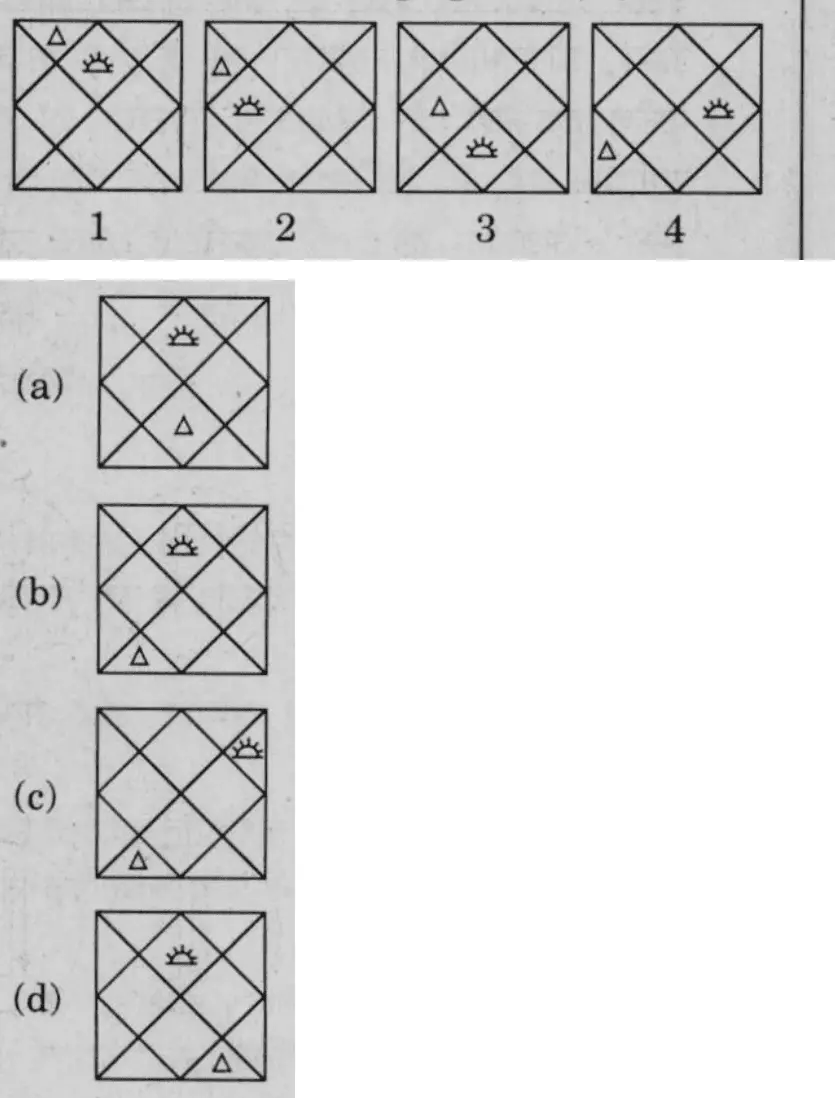
Each figure is a square divided by its two diagonals and by a diamond joining the mid-points of the sides, giving 4 inner regions (top, right, bottom, left, inside the diamond) and 8 small outer triangles (each corner triangle split by a diagonal into a part along the horizontal edge and a part along the vertical edge). Two symbols: a small triangle (Δ) and a sun symbol. Fig 1: Δ in the top-left corner, part along the top edge; sun in the top inner region. Fig 2: Δ in the top-left corner, part along the left edge; sun in the left inner region. Fig 3: Δ in the left inner region; sun in the bottom inner region. Fig 4: Δ in the bottom-left corner, part along the left edge; sun in the right inner region. Options: (a) sun in top inner region, Δ in bottom inner region; (b) sun in top inner region, Δ in bottom-left corner, part along the bottom edge; (c) sun in top-right corner, part along the right edge, Δ in bottom-left corner, part along the bottom edge; (d) sun in top inner region, Δ in bottom-right corner, part along the bottom edge.

2013 · Q44

Consider the following figures 1, 2, 3 and 4:

In the figures from 1 to 4 above, two symbols are shown to change their position in a regular direction. Following the same sequence, which one of the following will appear at the fifth stage?

  1. (a)Figure (a)
  2. (b)Figure (b)
  3. (c)Figure (c)
  4. (d)Figure (d)
Show answer

UPSC key: (b)

Logical reasoning · Visual reasoning

Directions

Directions for the following 2 (two) items: In each item, there are two sets of figures; first four figures named Problem figures and next four figures named Answer figures indicated as (a), (b), (c) and (d). The problem figures follow a particular sequence. In accordance with the same, which one of the four answer figures should appear as the fifth figure?
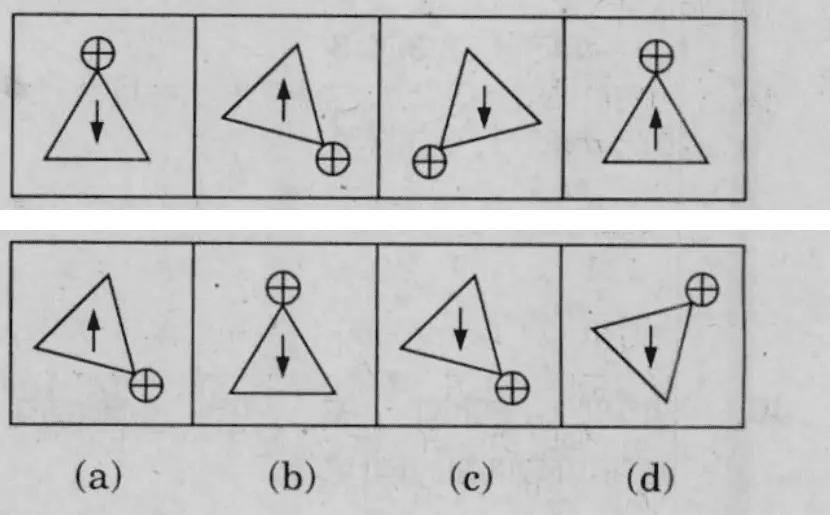
Each figure is a triangle with a vertical arrow inside it and a small circle-with-plus (⊕) attached at one vertex. Problem figures: 1. upright triangle, ⊕ at the top vertex, arrow pointing down; 2. triangle tilted so the ⊕ vertex is at the lower right, arrow pointing up; 3. triangle tilted so the ⊕ vertex is at the lower left, arrow pointing down; 4. upright triangle, ⊕ at the top vertex, arrow pointing up. Answer figures: (a) triangle tilted with ⊕ vertex at the lower right, arrow pointing up (same as problem figure 2); (b) upright triangle, ⊕ at the top vertex, arrow pointing down (same as problem figure 1); (c) triangle tilted with ⊕ vertex at the lower right, arrow pointing down; (d) triangle tilted with ⊕ vertex at the upper right, arrow pointing down.

2013 · Q45

Problem figures:

Answer figures:

  1. (a)Figure (a)
  2. (b)Figure (b)
  3. (c)Figure (c)
  4. (d)Figure (d)
Show answer

UPSC key: (c)

Logical reasoning · Visual reasoning

2013 · Q46

Problem figures:

Answer figures:

  1. (a)Figure (a)
  2. (b)Figure (b)
  3. (c)Figure (c)
  4. (d)Figure (d)
Show answer

UPSC key: (b)

Logical reasoning · Visual reasoning
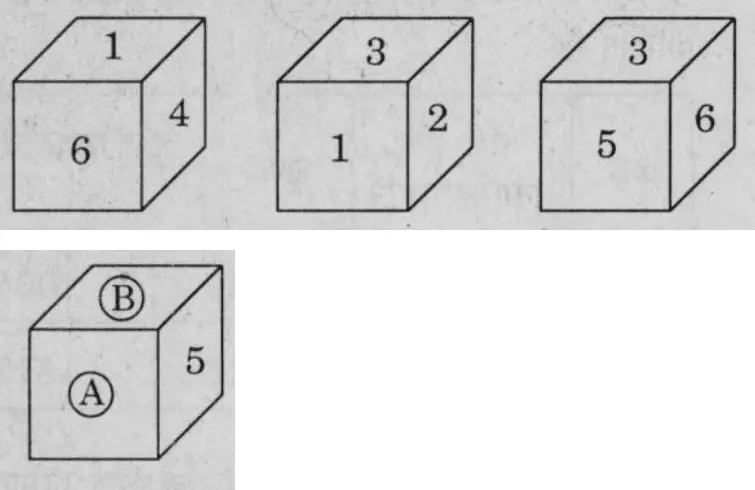
Three views of the cube: view 1 – top 1, front 6, right side 4; view 2 – top 3, front 1, right side 2; view 3 – top 3, front 5, right side 6. Query cube: top face B, front face A, right side 5.

2013 · Q51

A cube has six numbers marked 1, 2, 3, 4, 5 and 6 on its faces. Three views of the cube are shown below:

What possible numbers can exist on the two faces marked (A) and (B), respectively on the cube?

  1. (a)2 and 3
  2. (b)6 and 1
  3. (c)1 and 4
  4. (d)3 and 1
Show answer

UPSC key: (a)

Logical reasoning · Visual reasoning
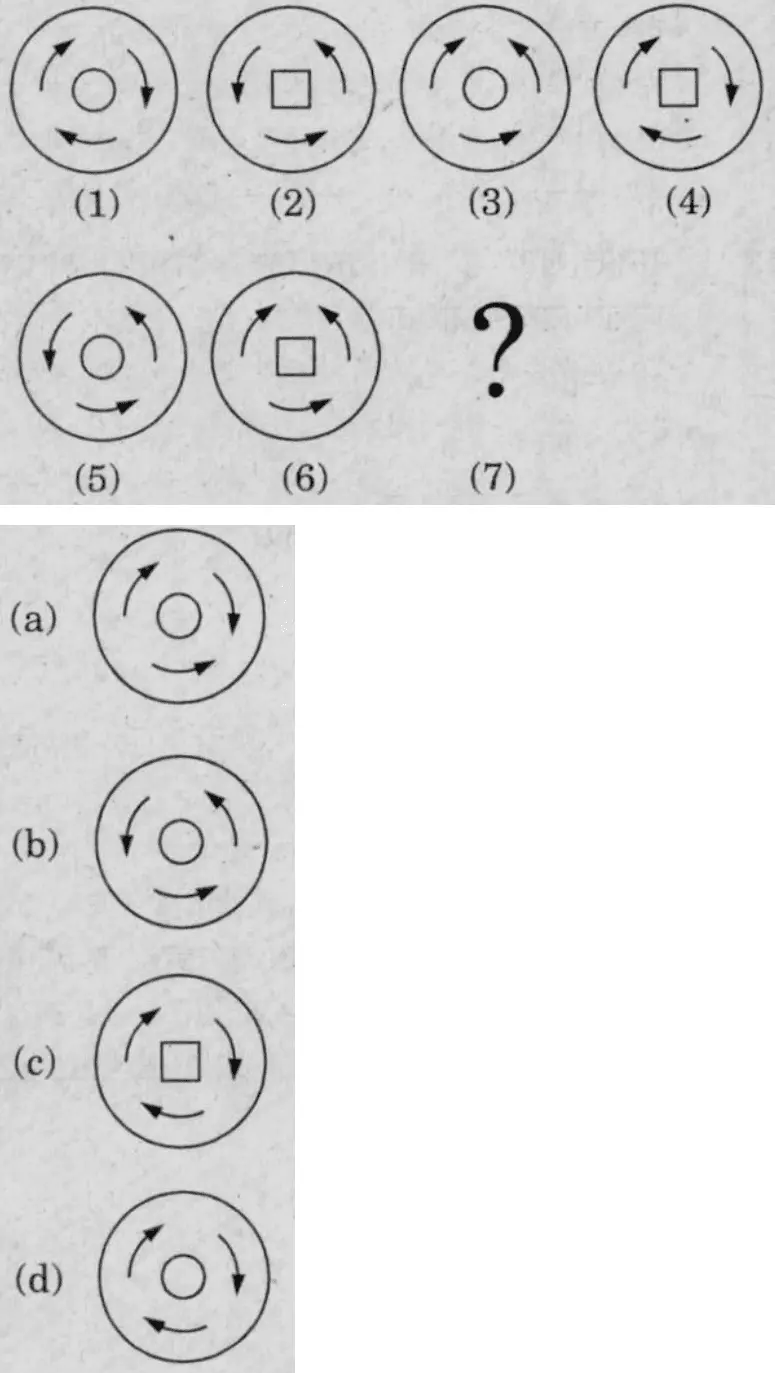
Each figure is a circle containing a central shape (small circle or square) surrounded by three curved arrows: upper-left arc, upper-right arc and bottom arc. CW = arrow points clockwise, ACW = anticlockwise (listed as upper-left, upper-right, bottom). (1) circle; CW, CW, CW. (2) square; ACW, ACW, ACW. (3) circle; CW, ACW, ACW. (4) square; CW, CW, CW. (5) circle; ACW, ACW, ACW. (6) square; CW, ACW, ACW. (7) ?. Options: (a) circle; CW, CW, ACW. (b) circle; ACW, ACW, ACW. (c) square; CW, CW, CW. (d) circle; CW, CW, CW.

2013 · Q57

Consider the following figures:

Which one of the following figures would logically come in the 7th position indicated above by a question mark?

  1. (a)Figure (a)
  2. (b)Figure (b)
  3. (c)Figure (c)
  4. (d)Figure (d)
Show answer

UPSC key: (d)

Logical reasoning · Visual reasoning
2014

4 questions
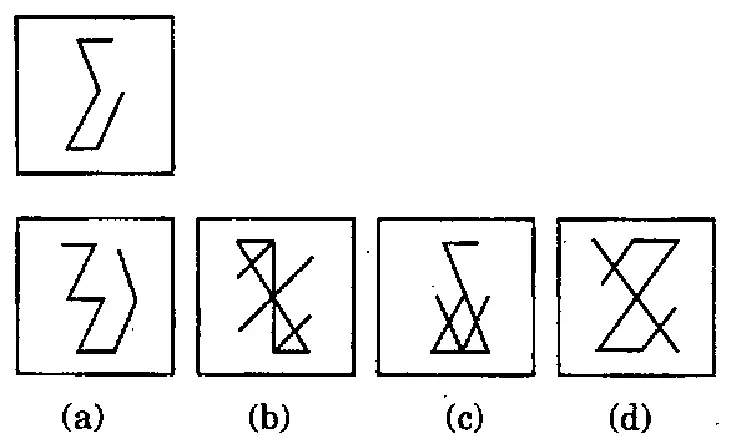
Given figure: a sigma-like open shape: a short horizontal stroke at top-left, a line slanting down-right to a vertex, a line slanting back down-left to the bottom, a short horizontal stroke at the bottom going right, and from its end a line slanting up-right (parallel to the second slant). Options are four boxed line drawings: (a) a zigzag 'Z'-like shape beside a '>'-like bracket; (b) a figure of crossing slanted lines with a small triangle at the bottom-right; (c) a sigma-like top stroke with crossing slanted lines forming triangles at the bottom; (d) a large 'X/Z'-like figure of crossing lines with top and bottom horizontals.

2014 · Q39

Examine the following figure:

Which one of the following figures has the above figure embedded in it?

  1. (a)Figure (a)
  2. (b)Figure (b)
  3. (c)Figure (c)
  4. (d)Figure (d)
Show answer

UPSC key: (c)

Logical reasoning · Visual reasoning
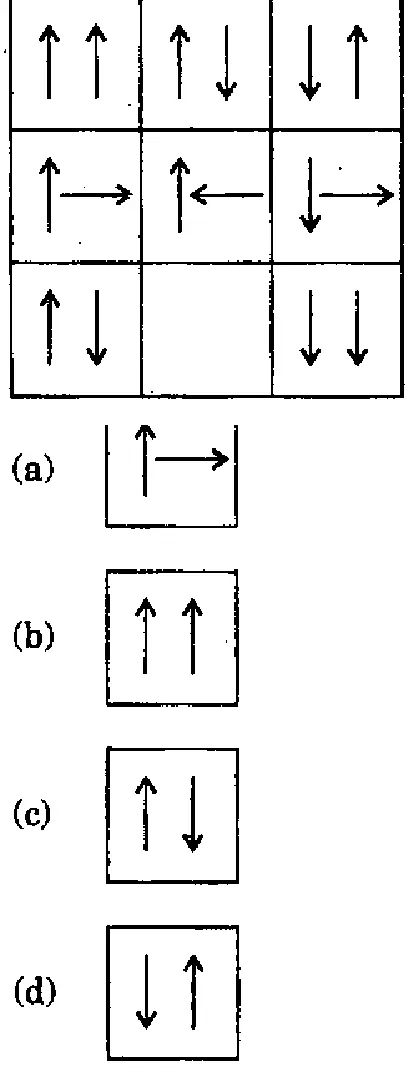
3×3 matrix of boxes containing pairs of arrows. Row 1: ↑↑ | ↑↓ | ↓↑. Row 2: ↑→ | ↑← | ↓→ (vertical arrow with a horizontal arrow at its middle). Row 3: ↑↓ | [blank] | ↓↓. Options: (a) ↑→ ; (b) ↑↑ ; (c) ↑↓ ; (d) ↓↑.

2014 · Q40

Consider the following matrix:

Which one of the following figures fits into the blank part of the above matrix?

  1. (a)↑→
  2. (b)↑↑
  3. (c)↑↓
  4. (d)↓↑
Show answer

UPSC key: (b)

Logical reasoning · Visual reasoning
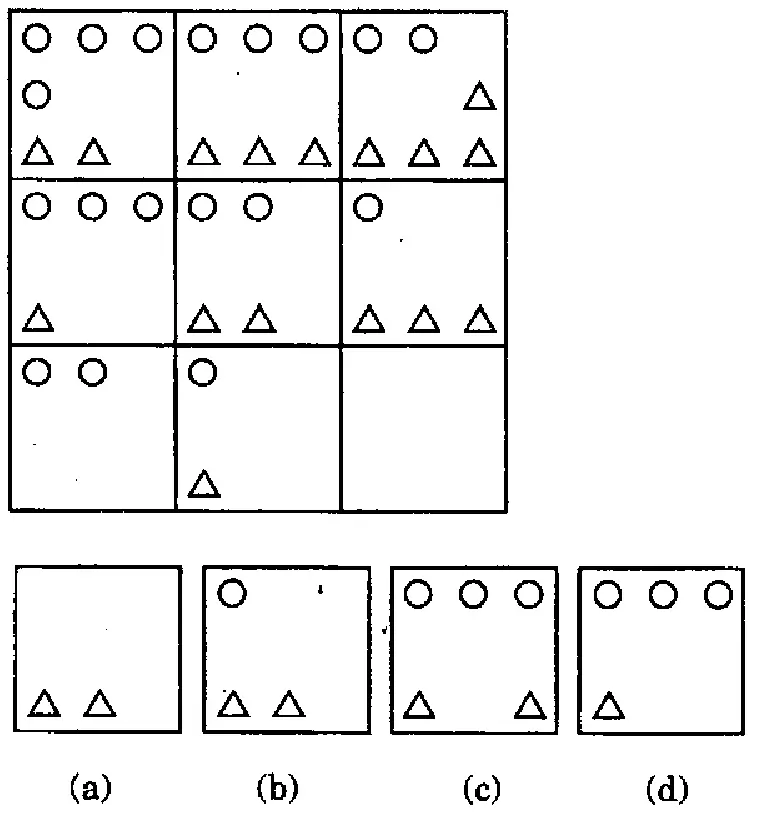
3×3 matrix of blocks containing small circles (○) and triangles (△). Row 1: 4 circles (3 at top, 1 below) and 2 triangles | 3 circles and 3 triangles | 2 circles and 4 triangles (1 triangle at middle right, 3 at bottom). Row 2: 3 circles and 1 triangle | 2 circles and 2 triangles | 1 circle and 3 triangles. Row 3: 2 circles and no triangle | 1 circle and 1 triangle | [empty]. Options: (a) 2 triangles, no circle; (b) 1 circle and 2 triangles; (c) 3 circles and 2 triangles; (d) 3 circles and 1 triangle.

2014 · Q43

Consider the following matrix with one empty block in the lower extreme corner:

Which of the following figures could fit in the empty block and thus complete the matrix?

  1. (a)Figure (a)
  2. (b)Figure (b)
  3. (c)Figure (c)
  4. (d)Figure (d)
Show answer

UPSC key: (a)

Logical reasoning · Visual reasoning
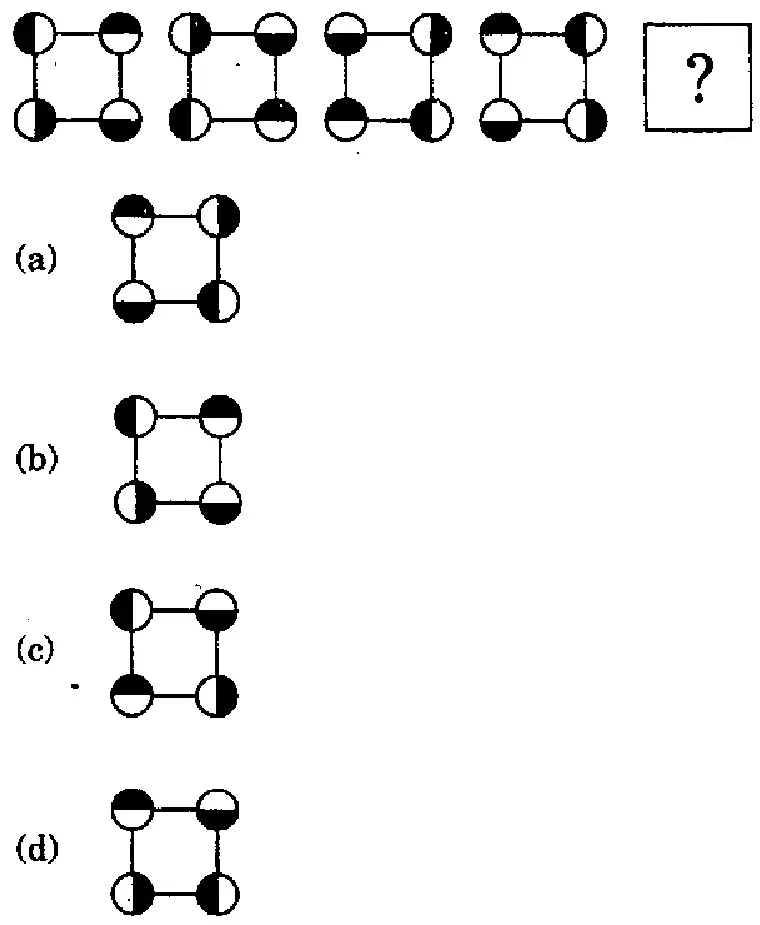
Each figure is a square with a bead (circle) at each corner; each bead is half black. Listed as the black half for (top-left, top-right, bottom-left, bottom-right). Fig 1: (left, top, right, bottom). Fig 2: (right, bottom, left, top). Fig 3: (bottom, right, top, left). Fig 4: (top, left, bottom, right). Fig 5: ?. Options: (a) (top, right, bottom, left); (b) (left, top, right, bottom); (c) (left, bottom, top, right); (d) (top, bottom, right, left).

2014 · Q45

Consider the following figures:

Change in positions of beads in the four figures above follows a sequence. Following the same sequence, which of the figures below should appear as the fifth figure above?

  1. (a)Figure (a)
  2. (b)Figure (b)
  3. (c)Figure (c)
  4. (d)Figure (d)
Show answer

UPSC key: (b)

Logical reasoning · Visual reasoning
2015

3 questions
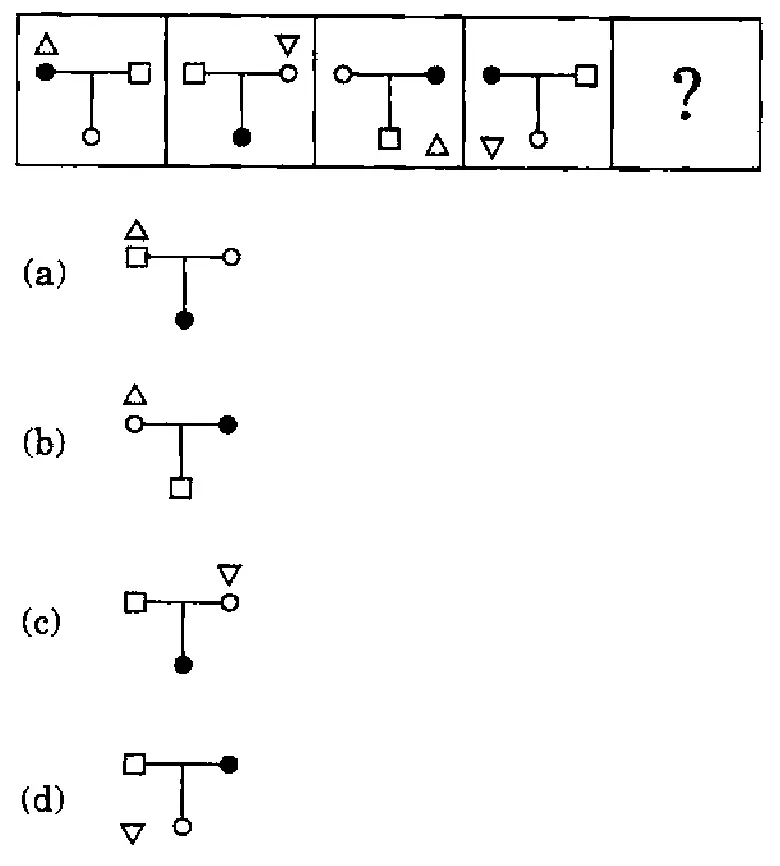
A series of four boxes followed by '?'. Each figure is a T-shape: a horizontal bar with a symbol at its left end and right end, and a vertical stem with a symbol at its bottom end; a small triangle is placed near one end. Fig 1: left filled circle, right square, bottom open circle; upward triangle above the left end. Fig 2: left square, right open circle, bottom filled circle; downward triangle above the right end. Fig 3: left open circle, right filled circle, bottom square; upward triangle to the lower right (beside the bottom end). Fig 4: left filled circle, right square, bottom open circle; downward triangle to the lower left (beside the bottom end). Options: (a) left square, right open circle, bottom filled circle; upward triangle above the left end. (b) left open circle, right filled circle, bottom square; upward triangle above the left end. (c) left square, right open circle, bottom filled circle; downward triangle above the right end. (d) left square, right filled circle, bottom open circle; downward triangle to the lower left.

2015 · Q11

Consider the figures given below:

To fit the question mark, the correct answer is

  1. (a)Figure (a)
  2. (b)Figure (b)
  3. (c)Figure (c)
  4. (d)Figure (d)
Show answer

UPSC key: (a)

Logical reasoning · Visual reasoning
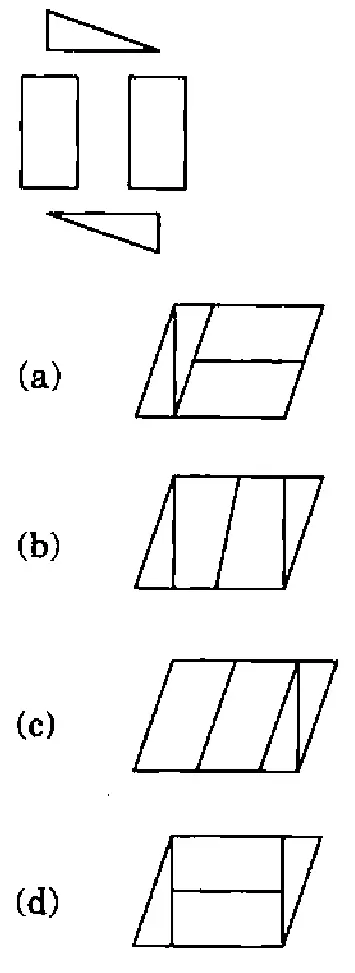
Pieces: two identical tall rectangles (height about twice the width) and two identical thin right-angled triangles (one with its right angle at top-left, one at bottom-right). Options are parallelograms leaning right, internally divided: (a) a right triangle at the left end (vertical line), then a slanted line, with the remaining right part divided by a horizontal line into two pieces; (b) a right triangle at each end (vertical lines) with a slanted line dividing the middle part into two; (c) divided by two slanted lines into three parallelogram strips with a vertical line cutting a small triangle at the right end; (d) a right triangle at each end (vertical lines) and the central rectangle divided by a horizontal line into two equal rectangles lying horizontally.

2015 · Q14

Four cardboard pieces of specific shapes are shown in the following figure:

Which one of the following figures given can be formed by joining these pieces together?

  1. (a)Figure (a)
  2. (b)Figure (b)
  3. (c)Figure (c)
  4. (d)Figure (d)
Show answer

UPSC key: (d)

Logical reasoning · Visual reasoning

2015 · Q54

Each of the six different faces of a cube has been coated with a different colour i.e., V, I, B, G, Y and O. Following information is given:

1.Colours Y, O and B are on adjacent faces.

2.Colours I, G and Y are on adjacent faces.

3.Colours B, G and Y are on adjacent faces.

4.Colours O, V and B are on adjacent faces.

Which is the colour of the face opposite to the face coloured with O?

  1. (a)B
  2. (b)V
  3. (c)G
  4. (d)I
Show answer

UPSC key: (c)

Logical reasoning · Visual reasoning

2016

1 question

2016 · Q59

A cube has all its faces painted with different colours. It is cut into smaller cubes of equal sizes such that the side of the small cube is one-fourth the big cube. The number of small cubes with only one of the sides painted is:

  1. (a)32
  2. (b)24
  3. (c)16
  4. (d)8
Show answer

UPSC key: (b)

Logical reasoning · Visual reasoning

2017

1 question

2017 · Q58

The outer surface of a 4 cm × 4 cm × 4 cm cube is painted completely in red. It is sliced parallel to the faces to yield sixty four 1 cm × 1 cm × 1 cm small cubes. How many small cubes do not have painted faces?

  1. (a)8
  2. (b)16
  3. (c)24
  4. (d)36
Show answer

UPSC key: (a)

Logical reasoning · Visual reasoning
2018

7 questions
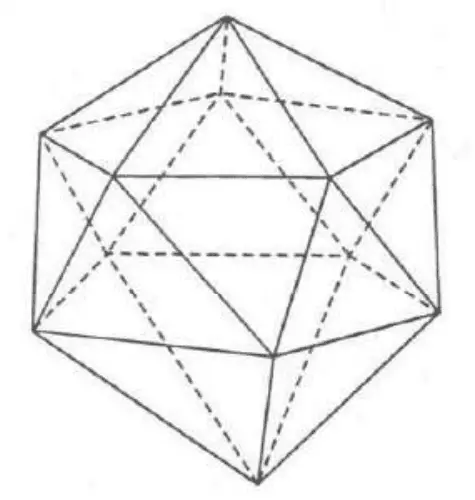
Wire-frame drawing of an icosahedron (top vertex, upper ring of five vertices, lower ring of five vertices, bottom vertex), with hidden edges shown dashed; all faces are triangles.

2018 · Q1

Consider the following three-dimensional figure:

How many triangles does the above figure have?

  1. (a)18
  2. (b)20
  3. (c)22
  4. (d)24
Show answer

UPSC key: (b)

Logical reasoning · Visual reasoning

Directions

Directions for the following 3 (three) items: Rotated positions of a single solid are shown below. The various faces of the solid are marked with different symbols like dots, cross and line. Answer the three items that follow the given figures.
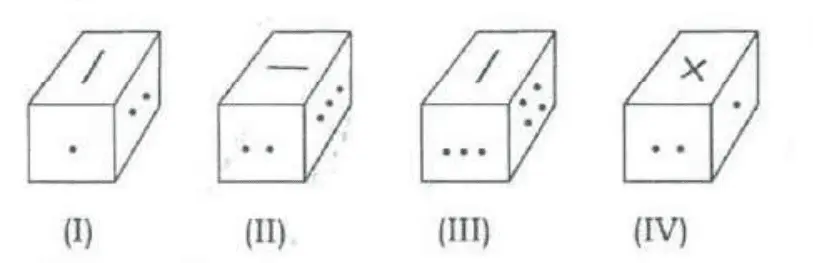
Four views (I)–(IV) of the same cube, each showing top, front and right faces. (I) top: line, front: single dot, right: three dots. (II) top: line (drawn horizontal), front: two dots, right: three dots. (III) top: line, front: three dots, right: four dots. (IV) top: cross, front: two dots, right: single dot.

2018 · Q14

What is the symbol on the face opposite to that containing a single dot?

  1. (a)Four dots
  2. (b)Three dots
  3. (c)Two dots
  4. (d)Cross
Show answer

UPSC key: (b)

Logical reasoning · Visual reasoning

2018 · Q15

What is the symbol on the face opposite to that containing two dots?

  1. (a)Single dot
  2. (b)Three dots
  3. (c)Four dots
  4. (d)Line
Show answer

UPSC key: (c)

Logical reasoning · Visual reasoning

2018 · Q16

What is the symbol on the face opposite to that containing the cross?

  1. (a)Single dot
  2. (b)Two dots
  3. (c)Line
  4. (d)Four dots
Show answer

UPSC key: (c)

Logical reasoning · Visual reasoning

2018 · Q35

A solid cube of 3 cm side, painted on all its faces, is cut up into small cubes of 1 cm side. How many of the small cubes will have exactly two painted faces?

  1. (a)12
  2. (b)8
  3. (c)6
  4. (d)4
Show answer

UPSC key: (a)

Logical reasoning · Visual reasoning
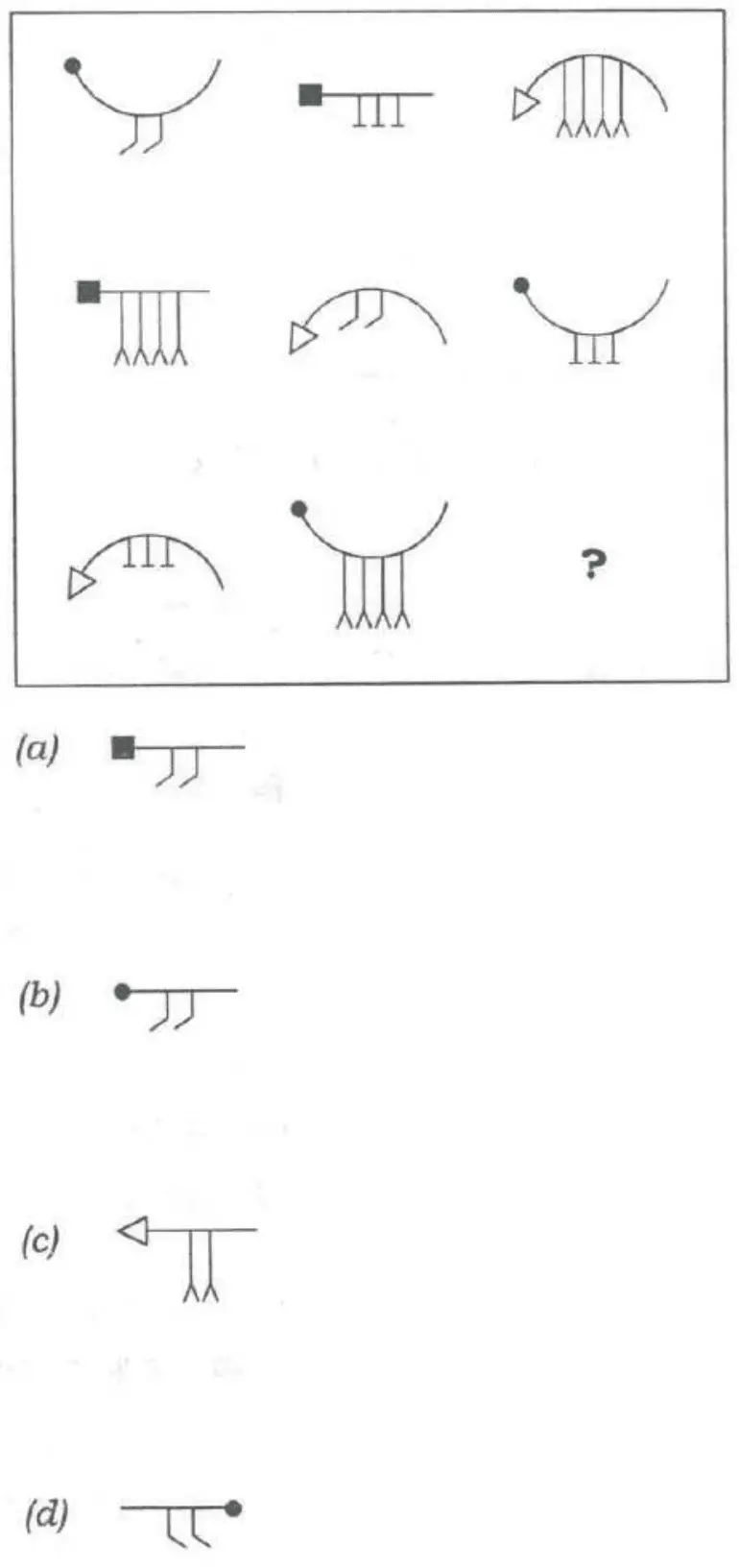
3×3 grid. Three base shapes: (U) a U-shaped curve with a dot at its left end; (L) a straight horizontal line with a filled square at its left end; (A) an arc open downward with a hollow triangular arrowhead at its left end. Three kinds of attachments hanging below: two hooked strokes; three plain vertical strokes; four vertical strokes with forked (Λ) feet. Row 1: U + two hooks; L + three plain strokes; A + four forked strokes. Row 2: L + four forked strokes; A + two hooks; U + three plain strokes. Row 3: A + three plain strokes; U + four forked strokes; ?. Options (a)–(d) are drawn figures, described in the option texts.

2018 · Q66

Consider the figures given below:

To fit the question mark, the correct answer is

  1. (a)Straight line with a filled square at its left end and two hooked strokes hanging below
  2. (b)Straight line with a dot at its left end and two hooked strokes hanging below
  3. (c)Straight line with a hollow triangular arrowhead at its left end and two vertical strokes with forked (Λ) feet hanging below
  4. (d)Straight line with a dot at its right end and two hooked strokes (curled the other way) hanging below
Show answer

UPSC key: (a)

Logical reasoning · Visual reasoning
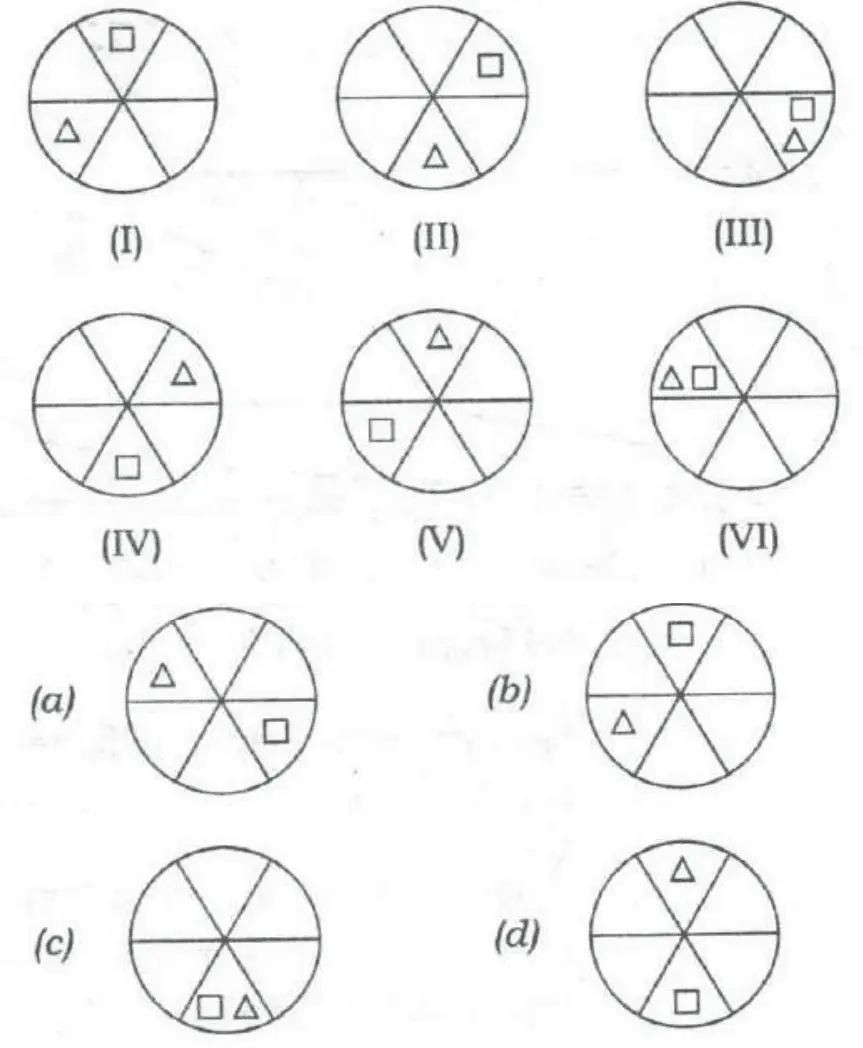
Each figure is a circle divided into six sectors by a horizontal diameter and two diagonals (sectors: top, upper-right, lower-right, bottom, lower-left, upper-left), containing a small square and a small triangle. (I) square: top, triangle: lower-left. (II) square: upper-right, triangle: bottom. (III) square and triangle both: lower-right. (IV) triangle: upper-right, square: bottom. (V) triangle: top, square: lower-left. (VI) triangle and square both: upper-left. Options (a)–(d) are circles of the same kind, described in the option texts.

2018 · Q70

Consider the following figures:

In the figures (I) to (VI) above, some parts are shown to change their positions in regular directions. Following the same sequence, which of the figures given below will appear at (VII) stage?

  1. (a)Triangle in upper-left sector, square in lower-right sector
  2. (b)Square in top sector, triangle in lower-left sector
  3. (c)Square and triangle both in bottom sector
  4. (d)Triangle in top sector, square in bottom sector
Show answer

UPSC key: (b)

Logical reasoning · Visual reasoning

2019

1 question

2019 · Q10

A solid cube is painted yellow, blue and black such that opposite faces are of same colour. The cube is then cut into 36 cubes of two different sizes such that 32 cubes are small and the other four cubes are big. None of the faces of the bigger cubes is painted blue. How many cubes have only one face painted?

  1. (a)4
  2. (b)6
  3. (c)8
  4. (d)10
Show answer

UPSC key: (c)

Logical reasoning · Visual reasoning

2021

1 question

2021 · Q17

Images of consonants of the English alphabet (Capitals) are observed in a mirror. What is the number of images of these which do not look like their original shapes?

  1. (a)13
  2. (b)14
  3. (c)15
  4. (d)16
Show answer

UPSC key: (b)

Logical reasoning · Visual reasoning

2023

2 questions

2023 · Q18

125 identical cubes are arranged in the form of a cubical block. How many cubes are surrounded by other cubes from each side?

  1. (a)27
  2. (b)25
  3. (c)21
  4. (d)18
Show answer

UPSC key: (a)

Logical reasoning · Visual reasoning

2023 · Q79

A cuboid of dimensions 7 cm × 5 cm × 3 cm is painted red, green and blue colour on each pair of opposite faces of dimensions 7 cm × 5 cm, 5 cm × 3 cm, 7 cm × 3 cm respectively. Then the cuboid is cut and separated into various cubes each of side length 1 cm. Which of the following statements is/are correct?

1.There are exactly 15 small cubes with no paint on any face.

2.There are exactly 6 small cubes with exactly two faces, one painted with blue and the other with green.

Select the correct answer using the code given below:

  1. (a)1 only
  2. (b)2 only
  3. (c)Both 1 and 2
  4. (d)Neither 1 nor 2
Show answer

UPSC key: (a)

Logical reasoning · Visual reasoning

2024

1 question

2024 · Q5

What is the least possible number of cuts required to cut a cube into 64 identical pieces?

  1. (a)8
  2. (b)9
  3. (c)12
  4. (d)16
Show answer

UPSC key: (b)

Logical reasoning · Visual reasoning

2025

1 question

2025 · Q15

A solid cube is painted yellow on all its faces. The cube is then cut into 60 smaller but equal pieces by making the minimum number of cuts. Which of the following statements is/are correct?

I.The minimum number of cuts is 9.

II.The number of smaller pieces which are not painted on any face is 6.

Select the correct answer using the code given below:

  1. (a)I only
  2. (b)II only
  3. (c)Both I and II
  4. (d)Neither I nor II
Show answer

UPSC key: (c)

Logical reasoning · Visual reasoning

2026

1 question

2026 · Q24

A cut on a solid object divides the object into two parts where the new surfaces thus produced are plane. On the other hand, one single cut can be used to cut more than one object at a time. In an experiment, the total number of pieces produced by applying n cuts is denoted by xₙ. The experiment is performed on a solid cube where pieces remain unmoved after each cut. In this experiment, if after the third cut, the pieces are identical, then which of the following is not a possible value for x₄?

  1. (a)16
  2. (b)12
  3. (c)8
  4. (d)5
Show answer

UPSC key: (a)

Logical reasoning · Visual reasoning

← All of Logical reasoning