Elephants, rhinos and other large mammals
- Syllabus
- Conservation, environmental pollution and degradation, environmental impact assessment
- As of
- October 2026
- megaherbivore
- ecosystem engineer
- keystone species
- Project Elephant
- elephant reserve
- elephant corridor
- national heritage animal
- DNA based elephant estimation
- greater one horned rhinoceros
- Indian Rhino Vision 2020
- wild water buffalo
- hangul
- Nilgiri tahr
- Project Tiger and Elephant
- minimum viable population
The first principle
Large herbivores shape the land they live on. An elephant pulls down trees, opens paths and spreads seeds in its dung over long distances, a rhino grazes tall grassland into a mosaic, and a wild buffalo keeps wetland grasses in check, so losing them changes the whole ecosystem. Because they are big, they breed slowly, need large areas and come into conflict with farmers, which makes them both the most important and the hardest animals to conserve. Their conservation therefore turns on space and connection, more than on any single protected area.
The core
Why large mammals matter and why they are vulnerable
- Ecosystem engineers. Elephants create gaps in the forest canopy, dig for water in dry riverbeds and carry seeds of large fruited trees that few other animals can swallow, so they are called ecosystem engineers and keystone species.
- Slow life histories. An elephant cow gives birth about once every four to five years after a pregnancy of about 22 months, and a rhino about once every three years, so populations recover slowly from poaching or disease.
- Large ranges. Elephant herds move seasonally across hundreds of square kilometres, following water and fodder, so a population needs several protected areas linked by corridors.
- Small, isolated populations. When a population falls to a few hundred animals in one place, as with the hangul or the wild buffalo, inbreeding, a skewed sex ratio or a single epidemic can push it towards extinction; ecologists speak of a minimum viable population below which chance alone becomes a threat.
The programmes
- Project Elephant (1992). A Centrally Sponsored Scheme to protect elephants, their habitat and corridors, reduce conflict and improve the welfare of captive elephants. It works through elephant reserves notified by States; the first was Singhbhum in Jharkhand in 2001, and there are now 33 across 14 States, but they have no separate status in law.
- The Gajah report (2010). The Elephant Task Force, chaired by Mahesh Rangarajan, recommended that the elephant be declared a national heritage animal, which the government did in 2010, and proposed stronger protection for corridors.
- The merger. In 2023 Project Elephant and Project Tiger were merged into one scheme, Project Tiger and Elephant, run by the Ministry of Environment, Forest and Climate Change (MoEFCC).
- Rhino programmes. Indian Rhino Vision 2020, launched by Assam in 2005, aimed for 3,000 rhinos spread over seven protected areas so that no single disaster could wipe out the species, and moved rhinos from Kaziranga and Pobitora to Manas. The National Conservation Strategy for the Indian One Horned Rhinoceros (2019) and the New Delhi Declaration on Asian Rhinos (2019) of the five range countries followed.
Dimensions
- Ecological. Elephants and rhinos maintain forest and grassland structure, and their corridors also serve tigers, leopards and many smaller species.
- Economic. Kaziranga, the elephant forests of the Nilgiris and the tahr grasslands of Eravikulam draw large numbers of tourists, but elephants also cause heavy crop losses in the east and south.
- Cultural. Elephants hold a central place in temples, festivals and royal history, which helps win public support but also sustains the keeping of captive elephants.
- Legal. Wildlife is in the Concurrent List, protected areas are notified by States, and elephant reserves and corridors rest mostly on executive orders, which leaves them exposed to projects.
- International. Rhino horn and ivory are traded illegally to East Asia, so protection depends on CITES and on cooperation with Nepal and Bhutan, whose rhino and elephant populations share India's.
In practice
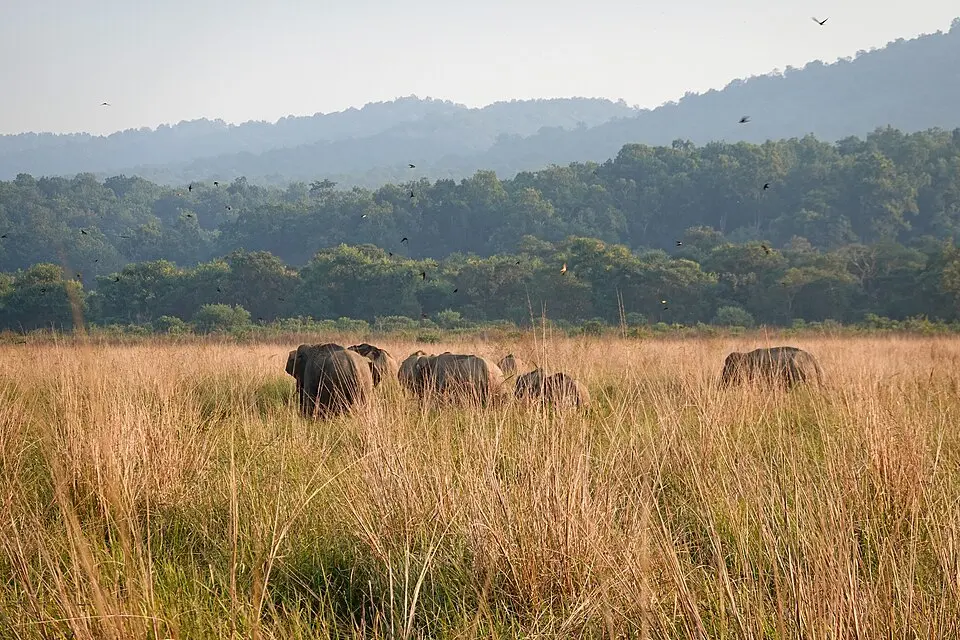
Asian elephant
- Status block. Elephas maximus. IUCN: Endangered. Wildlife (Protection) Act: Schedule I. CITES: Appendix I. Range in India: four regions, the south (Karnataka, Kerala, Tamil Nadu), east central India (Odisha, Jharkhand, Chhattisgarh, south West Bengal), the north west (the Shivalik and terai of Uttarakhand and Uttar Pradesh) and the Northeast. Main threats: broken corridors, conflict, electrocution and train collisions. Programme: Project Tiger and Elephant.
- Numbers. The first estimate based on deoxyribonucleic acid (DNA) from dung, the Synchronous All India Population Estimation of Elephants 2021 to 2025, released in October 2025, put India's wild elephants at 22,446, with Karnataka the highest State. The 2017 count of 27,312 used direct sightings and dung counts, so the two figures are not strictly comparable; DNA profiling lets each animal be counted once.
- Corridors. The Elephant Corridors of India report of 2023 identified 150 corridors across 15 States, and many are crossed by roads, railways, canals and farms.

Greater one horned rhinoceros
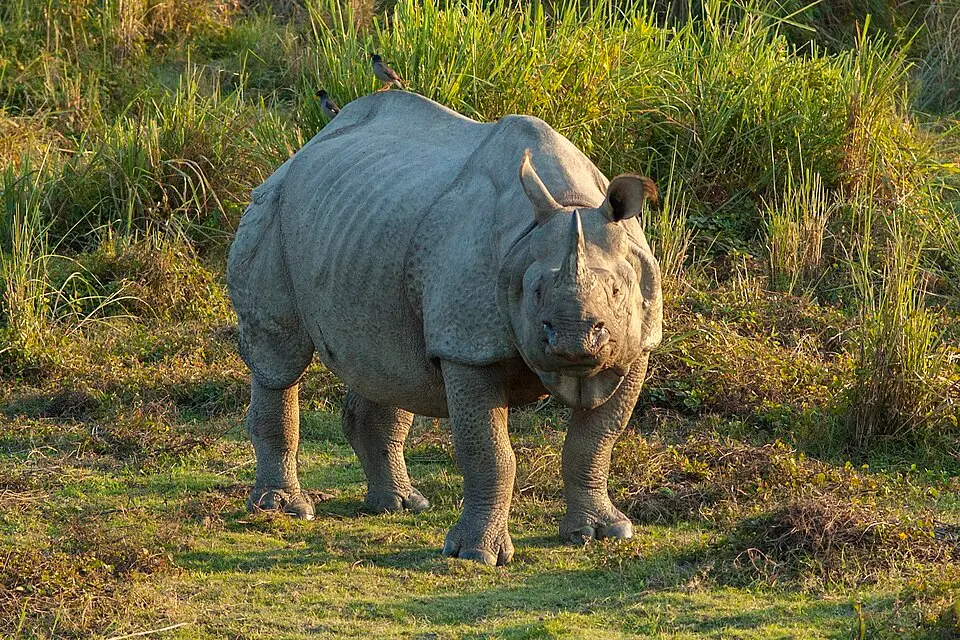
- Status block. Rhinoceros unicornis. IUCN: Vulnerable. Schedule I. CITES: Appendix I. Range in India: the floodplain grasslands of Assam (Kaziranga, Pobitora, Orang, Manas), West Bengal (Jaldapara, Gorumara) and Uttar Pradesh (Dudhwa, where rhinos were reintroduced in 1984). Main threats: poaching for horn, floods, and invasive plants that choke grassland. Programme: Indian Rhino Vision 2020 and the national strategy of 2019.
- Numbers. The rhino was close to extinction in the early twentieth century, when Kaziranga was first protected; the species now numbers about 4,000 across India and Nepal, most of them in Assam, and Kaziranga alone counted 2,613 in 2022. In 2021 Assam publicly burned 2,479 rhino horns from its stocks to send the message that horn has no value.

Other large mammals
- Wild water buffalo. Bubalus arnee. IUCN: Endangered. Schedule I. CITES: Appendix III. Range: Assam (Kaziranga, Manas) and central India (Udanti–Sitanadi and Indravati in Chhattisgarh, where it is the State animal). Main threats: interbreeding with domestic buffalo, diseases from cattle and loss of wet grassland.
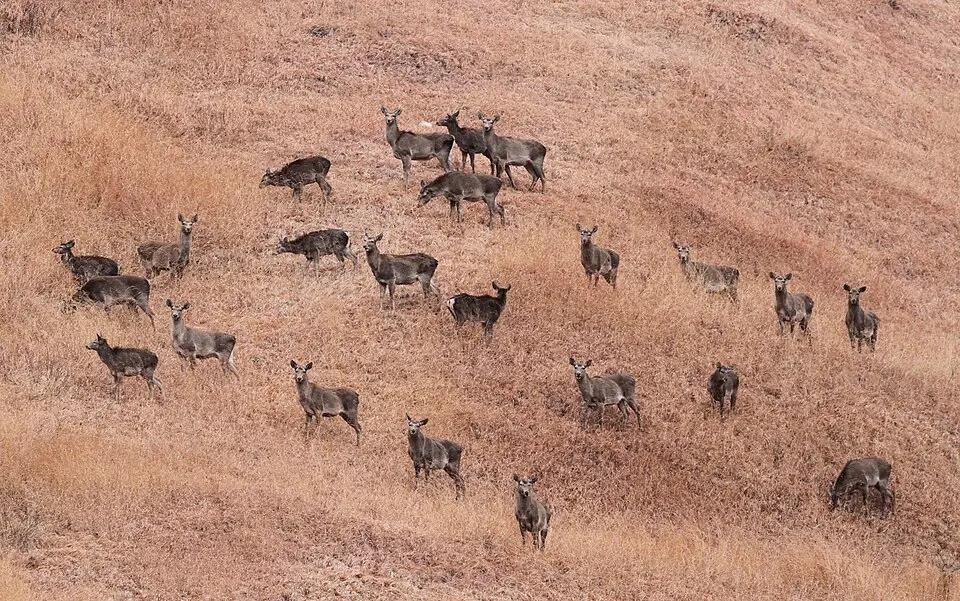
- Hangul. The Kashmir stag, a red deer, Cervus hanglu hanglu, listed as Cervus elaphus hanglu in CITES. Schedule I. CITES: Appendix I. Range: Dachigam National Park and nearby forests of the Kashmir valley, and it is the State animal of Jammu and Kashmir. The census counted 261 in 2021 and 289 in 2023. Main threats: few fawns surviving, a population with too few males, grazing by livestock, poaching and free ranging dogs.
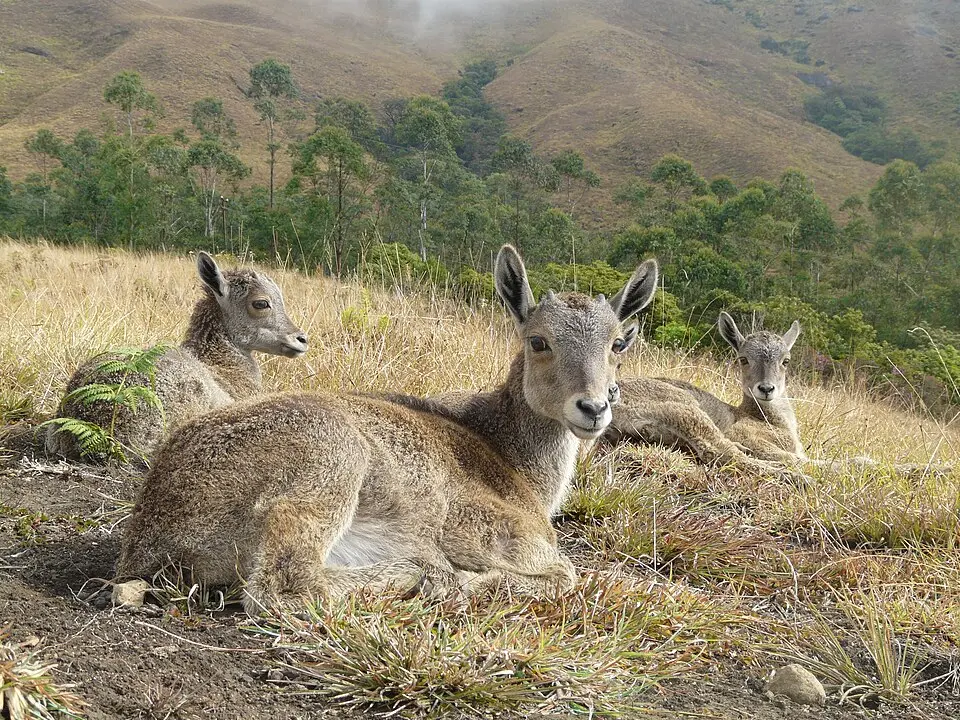
- Nilgiri tahr. Nilgiritragus hylocrius, a wild goat of the montane grasslands of the Western Ghats. IUCN: Endangered. Schedule I. Not listed in CITES. Range: Kerala and Tamil Nadu, with its largest population in Eravikulam National Park; it is the State animal of Tamil Nadu. Tamil Nadu's first synchronised survey counted 1,031 in the State in 2024, and the State runs Project Nilgiri Tahr. Main threats: loss and fragmentation of grassland, invasive trees such as wattle and pine, and fire.
- Others. The gaur, Bos gaurus (Vulnerable, Schedule I, CITES Appendix I), lives in the forests of the Western Ghats and central India; the sangai or brow antlered deer, Rucervus eldii eldii (Endangered as the species Eld's deer, Schedule I, CITES Appendix I), survives on the floating phumdis of Keibul Lamjao National Park on Loktak lake in Manipur; and the hard ground barasingha, Rucervus duvaucelii branderi (Vulnerable as a species, Schedule I, CITES Appendix I), was saved from near extinction in Kanha.


Issues and way forward
- Corridors without law. Most elephant corridors are not legally protected and are cut by roads, railways and mines; notifying key corridors as conservation reserves or eco sensitive zones, buying land where needed, and building underpasses and overpasses on linear projects, as the Wildlife Institute of India (WII) guidelines of 2016 advise, keep them open.
- Deaths on rails and wires. Trains and electric fences kill elephants every year; speed limits and early warning systems on known crossings, and joint patrols by power and forest departments against illegal fences, cut these deaths.
- Poaching pressure. Rhino horn is still sought, so intelligence led policing, armed protection and quick trials, as Assam has shown since 2021, keep poaching low.
- Invasive plants and floods. Mimosa and other invasive species spread through Kaziranga's grasslands while floods drown animals each year; grassland management, highlands for refuge and safe passage across the highway to the Karbi Anglong hills are needed.
- Tiny populations. The hangul and the wild buffalo survive in very small numbers in few places; conservation breeding, protection from domestic animals and, where possible, a second population reduce the risk.
- Captive elephants. Temples, owners and festivals keep elephants in poor conditions; the Captive Elephant (Transfer or Transport) Rules 2024 regulate their movement, but welfare inspection needs to be stronger.
Common confusions
- Elephant reserve and protected area. An elephant reserve is an administrative unit notified by a State under Project Elephant and may include forests, farms and villages, while a national park or sanctuary is a protected area under the Wildlife (Protection) Act.
- Corridor and elephant reserve. A corridor is a strip of habitat that links two populations, often outside any reserve, while an elephant reserve is a larger landscape that contains several protected areas.
- Indian and African rhinos. The Indian rhino has one horn and armour like folds of skin, while the white and black rhinos of Africa have two horns; the Javan and Sumatran rhinos, now extinct in India, are critically endangered.
- Wild and feral buffalo. The wild water buffalo is a distinct species, while feral buffaloes are domestic animals gone wild, and their interbreeding threatens the wild stock.
For the exam
- Keyword bank: ecosystem engineer, keystone species, megaherbivore, slow life history, minimum viable population, Project Elephant, elephant reserve, elephant corridor, national heritage animal, DNA based estimation, Indian Rhino Vision 2020, translocation, conservation breeding, Project Tiger and Elephant, linear infrastructure mitigation.
- Previous year questions: Practise the previous year questions on this topic →
- Use in an answer:
- Introduction with data: India's first DNA based elephant estimate of 2025 put the wild population at 22,446, the largest of any country for the Asian elephant, with 33 elephant reserves and 150 identified corridors.
- Introduction with a report: The Gajah report of 2010 called the elephant a national heritage animal and warned that without secure corridors India's elephant populations would break into isolated fragments.
- Conclusion: The recovery of the rhino in Assam shows what firm protection can do, but elephants need more than protection: they need land that stays connected.
- Conclusion: Large mammals are the test of whether conservation in India can work at the scale of landscapes rather than single parks.