Birds in danger and flyways
- Syllabus
- Conservation, environmental pollution and degradation, environmental impact assessment
- As of
- October 2026
- Great Indian Bustard
- Desert National Park
- power line collisions
- right against adverse effects of climate change
- Gyps vultures
- diclofenac
- Vulture Safe Zone
- great hornbill
- seed dispersal
- Central Asian Flyway
- Convention on Migratory Species
- stopover site
The first principle
A bird's risk of extinction depends on how long it takes to replace an adult. Large birds such as bustards, vultures and hornbills live long, mature late and raise one chick at a time, so even a small rise in adult deaths, from a power line or a poisoned carcass, can push a population into decline that breeding cannot repair. Migratory birds add a second problem: a species is only as safe as the weakest site on its route, which may lie in another country.
The core
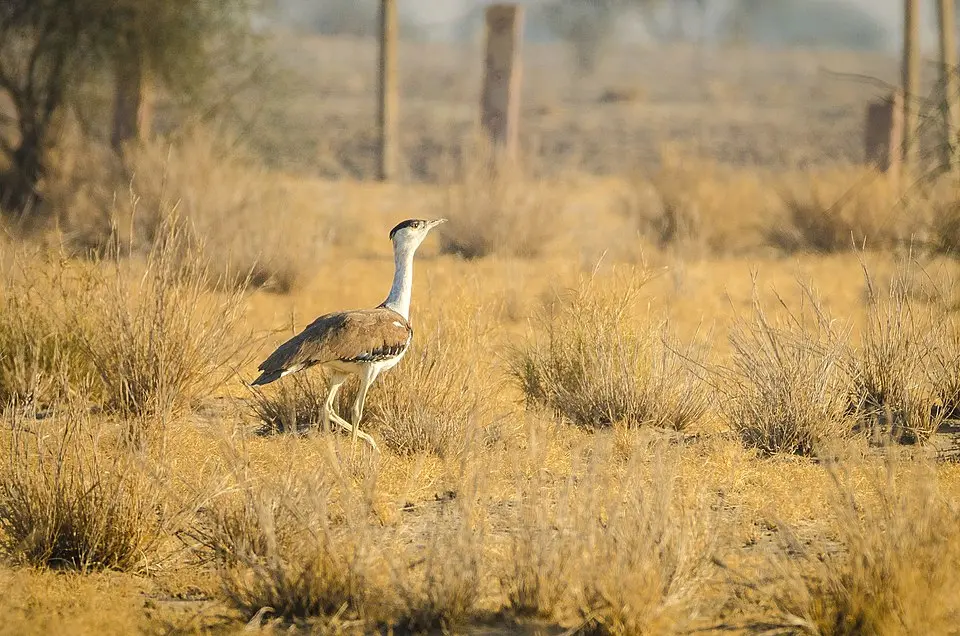
Great Indian Bustard (Ardeotis nigriceps)
The Great Indian Bustard (GIB) is one of the heaviest flying birds in the world, a bird of open grassland and scrub that is the state bird of Rajasthan. Its eyes look sideways, so it often misses a wire ahead in flight, and being heavy it cannot turn in time.
- Status: Critically Endangered on the Red List of the International Union for Conservation of Nature (IUCN); Schedule I of the Wildlife (Protection) Act 1972 (WPA); Appendix I of the Convention on International Trade in Endangered Species of Wild Fauna and Flora (CITES); and, since 2020, Appendix I of the Convention on the Conservation of Migratory Species of Wild Animals (CMS).
- Range in India: The Wildlife Institute of India (WII) put the wild population at about 150 birds, most of them in Jaisalmer in Rajasthan, in and around the Desert National Park, with a handful in Gujarat (Kutch) and a few in Maharashtra, Karnataka and Andhra Pradesh.
- Main threats: Collision with overhead power lines from the wind and solar parks of the Thar is the largest single cause of adult deaths, followed by the conversion of grassland to farms and plantations and predation of eggs and chicks by free ranging dogs.
- Programme: The programme for habitat improvement and conservation breeding of the GIB, sanctioned with Rs 33.85 crore over five years from the compensatory afforestation fund, runs breeding centres in Jaisalmer with the WII and the Rajasthan Forest Department. In October 2024 the first chick produced by artificial insemination hatched at the centre.

Vultures and diclofenac
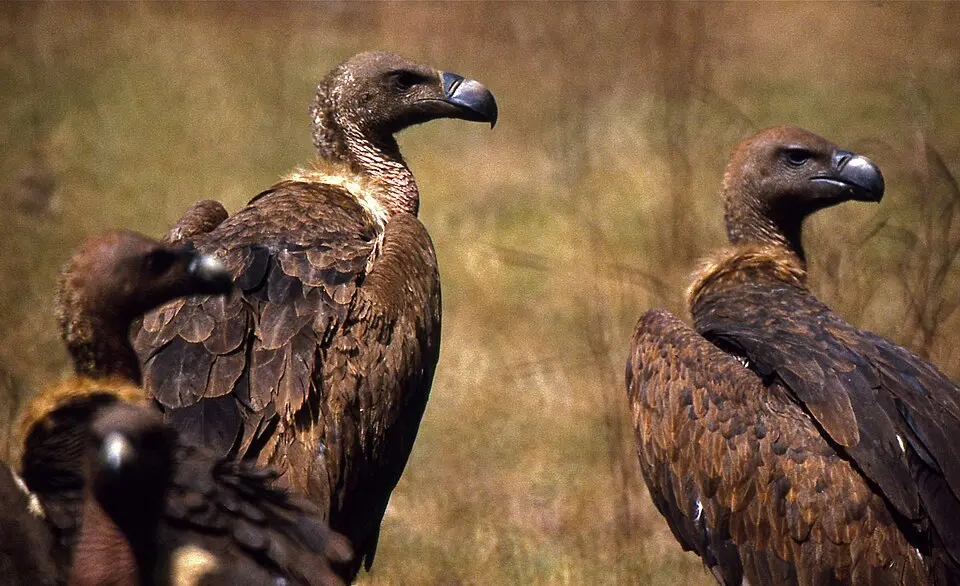
India's vultures are scavengers that clear carcasses, and the three resident Gyps species, the white rumped (Gyps bengalensis), the Indian or long billed (Gyps indicus) and the slender billed (Gyps tenuirostris), collapsed from the 1990s, falling by more than 95 per cent by the mid 2000s.
- Status: All three Gyps species and the red headed vulture (Sarcogyps calvus) are Critically Endangered, and the Egyptian vulture (Neophron percnopterus) is Endangered; all are in Schedule I of the WPA and in CITES Appendix II, which covers birds of prey not listed higher.
- Mechanism: Diclofenac, a non steroidal anti inflammatory drug (NSAID) given to sick cattle, stays in the carcass, and Gyps vultures, which clear it very slowly, die of kidney failure and visceral gout, a deposit of uric acid on the organs.
- Programme: Veterinary diclofenac was banned in 2006, and the Ministry of Health and Family Welfare banned aceclofenac and ketoprofen for animal use by a notification of 31 July 2023, since aceclofenac turns into diclofenac in the animal's body. Conservation breeding began at the Jatayu Conservation Breeding Centre at Pinjore in Haryana with the Bombay Natural History Society (BNHS), and the Action Plan for Vulture Conservation 2020–2025 of the Ministry of Environment, Forest and Climate Change (MoEFCC) extends breeding and Vulture Safe Zones, areas of about 100 km radius kept free of harmful drugs before birds are released.

Hornbills
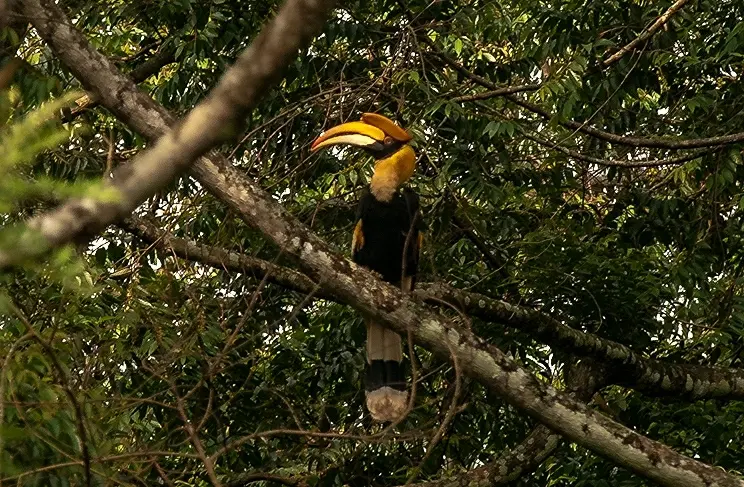
India has nine species of hornbill, found in the Western Ghats, the north east, the Eastern Ghats and the Andaman and Nicobar Islands. They swallow large fruits whole and drop the seeds far away, so they are called the farmers of the forest, and many large seeded trees depend on them.
- *Great hornbill (Buceros bicornis):* Vulnerable on the IUCN Red List, Schedule I of the WPA and CITES Appendix I; found in the Western Ghats, the Himalayan foothills and the north east, and the state bird of Kerala and Arunachal Pradesh.
- Breeding biology: The female seals herself inside a tree hollow, leaving a slit through which the male feeds her and the chick for months, so losing one male or one old tree ends a nesting attempt.
- Main threats and programme: Hunting for the casque and the felling of old trees with hollows are the main threats. The Hornbill Nest Adoption Programme at Pakke Tiger Reserve in Arunachal Pradesh pays local Nyishi people to guard nests, turning former hunters into protectors.

Migratory birds and the Central Asian Flyway
- A flyway is the whole set of breeding, stopover and wintering sites that a group of bird populations uses on its annual journey. The Central Asian Flyway (CAF) runs from the Arctic and Siberia across Central Asia to the Indian subcontinent and the Indian Ocean, covering about 30 countries, and most of India lies within it.
- Why birds migrate: Northern summers give long days and a flush of insects and plants for raising chicks, while winters there freeze the food supply, so birds move south to wetlands and grasslands that stay productive. A bird must refuel at stopovers, so the loss of one wetland can break the chain.
- Example: The Amur falcon (Falco amurensis), Least Concern on the IUCN Red List and in CITES Appendix II, stops in Nagaland in huge numbers each autumn on its way from East Asia to southern Africa, and its mass hunting at Doyang ended after community campaigns from 2012.
- Law: India has been a Party to the CMS since 1983 and hosted its 13th Conference of the Parties (COP) at Gandhinagar in February 2020, where the GIB, the Bengal florican and the Asian elephant were added to Appendix I. The MoEFCC's National Action Plan for Conservation of Migratory Species under the Central Asian Flyway (2018) covers site protection, research and cooperation.
Dimensions
- Ecological. Vultures dispose of carcasses, hornbills plant forests and bustards indicate healthy grassland, so each decline weakens a process, not just a species list.
- Public health. When vultures vanished, uneaten carcasses fed a rise in feral dogs, and studies have linked this to more dog bites and rabies, which shows that conservation and health are one problem.
- Energy transition. The best wind and solar land overlaps the last GIB habitat in the Thar, so the bustard case tests whether clean energy can be built without losing a species.
- Cultural. Hornbill casques and feathers have long been part of tribal headgear in the north east, so community values can hurt or, through nest adoption, help conservation.
- International. A migrant protected in India can be shot elsewhere on its route, so only flyway wide cooperation under the CMS protects it.
In practice
- M K Ranjitsinh v Union of India (April 2021 order). The Supreme Court ordered that low voltage lines in about 99,000 sq km of potential bustard habitat in Rajasthan and Gujarat be laid underground, and that a committee examine the feasibility of putting high voltage lines underground.
- M K Ranjitsinh v Union of India (21 March 2024). A bench led by Chief Justice D Y Chandrachud recalled the blanket restriction after the Centre argued that undergrounding high voltage lines was often not feasible and would slow renewable energy, which itself protects against climate change. It set up an expert committee to decide where lines must go underground within a priority area of about 13,663 sq km, and it held that people have a right to be free from the adverse effects of climate change under Articles 14 and 21.
- Drug control. The 2023 ban was issued under Section 26A of the Drugs and Cosmetics Act 1940, so a species may be saved by a health law rather than a wildlife law.
- Community guarding. The Pakke nest adoption scheme and the end of falcon hunting at Doyang show that paying or persuading local people works better than policing alone, and bird diverters, bright flappers hung on wires, are the remedy where lines cannot be buried.
Issues and way forward
- Grassland is not valued. Revenue records often classify grassland as wasteland, so it is given away for solar parks or planted with trees; recording grasslands as ecosystems and notifying priority bustard areas as conservation reserves would close this gap.
- Breeding without habitat. Captive birds have nowhere safe to go if lines and dogs remain, so release must follow the clearing of priority areas, as the 2024 expert committee is meant to decide.
- New drugs, old problem. Each banned NSAID can be replaced by another toxic one, so every new veterinary painkiller should be tested on vultures before sale, and meloxicam, which is safe for vultures, should be promoted.
- Weak data. Bustard and vulture counts are irregular, so a periodic national survey, like the tiger estimation, is needed.
- Flyway gaps. Stopover wetlands are drained or polluted, so the CAF action plan needs funding and joint monitoring.
Common confusions
- IUCN status and WPA schedule. IUCN measures how close a species is to extinction and has no legal force, while the WPA schedule decides the penalty in India; the Amur falcon is Least Concern but still protected by Indian law.
- CITES and CMS. CITES controls international trade in a species, while the CMS protects migratory animals and their routes; the GIB is in Appendix I of both.
- Diclofenac and meloxicam. Both are NSAIDs used on cattle, but only diclofenac is lethal to Gyps vultures, so meloxicam is the recommended substitute.
- The 2021 order and the 2024 judgment. The 2021 order imposed a wide undergrounding mandate, while the 2024 judgment withdrew the blanket rule and handed the decision to an expert committee for a smaller priority area.
For the exam
- Keyword bank: Great Indian Bustard, power line collision, bird diverter, right against adverse effects of climate change, Gyps vultures, diclofenac, aceclofenac and ketoprofen ban, Vulture Safe Zone, great hornbill, seed dispersal, Central Asian Flyway, stopover site, CMS Appendix I.
- Previous year questions: Practise the previous year questions on this topic →
- Use in an answer:
- Introduction with data: The Wildlife Institute of India estimated only about 150 Great Indian Bustards left in the wild, most of them in Jaisalmer, which makes the species one of the rarest birds in the world.
- Introduction with a judgement: In M K Ranjitsinh v Union of India (2024), the Supreme Court read a right to be free from the adverse effects of climate change into Articles 14 and 21 while deciding how to protect the Great Indian Bustard from power lines.
- Conclusion: India's threatened birds die outside protected areas, on power lines, in cattle carcasses and at distant stopovers, so their protection must be built into energy, veterinary and wetland policy.
- Conclusion: The vulture's recovery from diclofenac shows that a species can be brought back when the cause of death is removed at its source, and the same discipline is now needed for the bustard and the power line.